
Nearshore staffing has quietly made onshore placements look expensive — and the numbers back that up. If you've been quoting full-time US-based hires lately, you already know the sticker shock: $50,000–$90,000 in annual fully-loaded labor costs for a single administrative or coordinator role. That's before you factor in benefits, payroll taxes, turnover, and the 6–8 weeks it typically takes to fill a seat. This post breaks down exactly what onshore placements cost in 2026, where they still make sense, and why a growing number of small and mid-sized businesses are choosing nearshore virtual staff instead — without sacrificing quality, time zone alignment, or communication.
What Are Onshore Placements? A Plain-English Definition for 2026
An onshore placement is a staffing arrangement where the hired worker lives and works in the same country as the employer. For a US business, that means a US-based employee or contractor — someone subject to US labor law, working in a US time zone, and paid in US dollars. Onshore placements include both direct hires and placements made through domestic staffing agencies. The term is most commonly used in contrast to offshore (Philippines, India, Eastern Europe) or nearshore (Latin America, Canada, Mexico) models.
Onshore placements are the default for most businesses that haven't yet explored remote staffing. They're familiar, legally straightforward, and culturally seamless — but they carry the highest price tag of any staffing model by a wide margin. According to the U.S. Bureau of Labor Statistics (2024), total employer compensation costs for civilian workers averaged $46.14 per hour — meaning a full-time onshore employee costs roughly $7,600/month before any agency markup or benefits overhead.
That figure — $46/hour — is the floor, not the ceiling. Add a domestic staffing agency's placement fee (typically 15–25% of first-year salary) and you're looking at an effective cost well above $8,000/month for roles like property management coordinator, bookkeeper, or executive assistant. For context, a full three-way comparison of nearshore vs. offshore vs. onshore virtual assistants shows that nearshore VAs typically cost 60–70% less than their onshore equivalents while maintaining equivalent functional output.
How Onshore Placement Costs Stack Up Against Alternatives in 2026
Cost alone isn't the whole story — but it's where most business owners start. The table below compares onshore, nearshore (Latin America), and offshore (Philippines/India) staffing across the dimensions that matter most to US operators in 2026.
| Factor | Onshore (US-Based) | Nearshore (Latin America) | Offshore (Philippines / India) |
|---|---|---|---|
| Monthly All-In Cost | $5,000–$8,500+ | $2,500 flat | $800–$1,800 |
| Time Zone Alignment (US Hours) | ✅ Perfect | ✅ Full overlap | ⚠️ 6–13 hr gap |
| English Proficiency | ✅ Native | ✅ 8/10+ screened | ⚠️ Variable |
| Cultural Alignment with US Clients | ✅ Native | ✅ High (US media, business norms) | ⚠️ Moderate |
| Ramp / Placement Speed | 4–8 weeks | ~7 days | 1–3 weeks |
| No Long-Term Contract Option | Varies by agency | ✅ Month-to-month | Varies |
| AI Copilot / Software Pre-Training | Rare / Extra cost | ✅ Included (AppFolio, QuickBooks, etc.) | Rare |
| Free Replacement if Not a Fit | ❌ Usually not | ✅ Included | ⚠️ Sometimes |
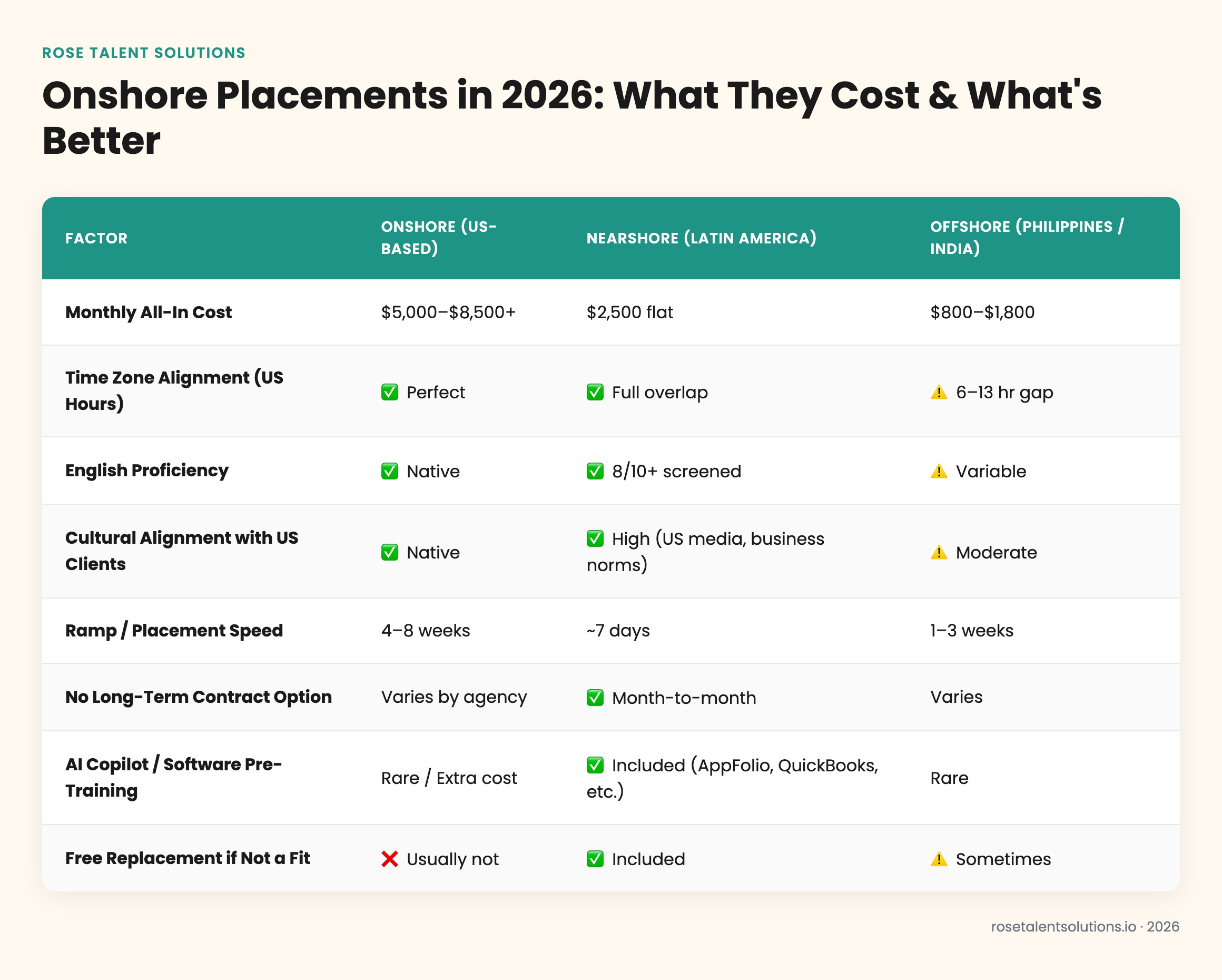
The nearshore column performs identically to onshore on every people-quality dimension — time zone, English, cultural fit — while costing roughly 65% less. The offshore column wins on price only, and surrenders time zone alignment and communication consistency in exchange.

Why Do Businesses Still Choose Onshore Placements in 2026?
Onshore placements aren't irrational — they're just often chosen by default rather than by design. There are genuine use cases where a physically co-located, US-based employee is the right call: roles that require in-person presence (warehouse, field service, clinical), positions involving highly regulated data access where vendor contracts prohibit offshore handling, or senior leadership roles where daily face-time and local market knowledge are core to the job.
Outside those specific situations, most administrative, coordinative, and back-office functions can be performed just as effectively by a nearshore virtual team member. According to Gallup's State of the Global Workplace report (2023), remote workers who have the tools and autonomy to do their jobs well score no lower on engagement or output than in-office counterparts — a finding that fundamentally undermines the assumption that physical proximity drives performance.
"The question is no longer whether remote work 'works' — it clearly does. The question is whether you're sourcing remote talent from the right labor markets for your cost structure." — Matt Mochary, Executive Coach and Author of The Great CEO Within (2023)
The real reason most small businesses default to onshore placements is familiarity, not superiority. They've always hired locally, their accountant is local, their HR vendor is local — so the staffing agency they call is local too. That habit is worth examining carefully when a nearshore alternative delivers the same outcome at less than half the price. For a deeper look at how the two models compare on output and workflow fit, see this breakdown of onshore vs. offshore virtual assistants and where each model actually wins.
How Nearshore VAs Close the Onshore Quality Gap in 2026
The most common objection to skipping onshore placements is quality. Business owners worry that a virtual team member based in Latin America won't understand their software, their clients, or their pace. In practice, three things close that gap almost entirely: time zone alignment, rigorous English screening, and role-specific AI copilots pre-trained on the tools your business already uses.
Rose Talent Solutions requires every placed team member to score 8/10 or higher on English proficiency screens — a bar that filters out the vast majority of applicants. Latin American team members work fully within US Eastern, Central, Mountain, or Pacific business hours — no shift differentials, no overnight handoffs. And every placement comes with a role-specific AI copilot trained on the software that role uses: AppFolio for property management coordinators, QuickBooks or Xero for bookkeeping and accounting roles, and so on. That pre-training cuts the typical ramp period dramatically.
The hidden cost of onshore placements isn't just the salary — it's the 6–8 weeks of vacancy while you recruit, the agency placement fee on top of that salary, and the full benefits load. Nearshore VAs eliminate all three friction points: placement in ~7 days, no placement fee layered on top, and a flat $2,500/month that includes recruiting, payroll, HR, and ongoing management.
According to SHRM's Talent Acquisition Benchmarking data (2024), the average cost-per-hire for a US company is $4,700, and the average time-to-fill is 44 days. That's nearly a month and a half of lost productivity before an onshore placement even starts — plus the placement cost stacked on top of salary. Nearshore staffing through a firm like Rose collapses that timeline to roughly one week, with the placement cost bundled into the flat monthly rate.
The productivity drain during that vacancy window is real. A Pew Research Center analysis of remote work trends (2022) found that workers who shifted to fully remote arrangements reported equivalent or higher productivity in information-processing and administrative roles — the same categories where nearshore VAs are most commonly placed. For a more detailed look at how a nearshore staffing agency structures these placements end-to-end — recruiting, vetting, payroll, and ongoing management — the linked post covers the full process.

How the Rose Placement Process Works — From Application to Day One
One of the sharpest practical differences between onshore placements and nearshore virtual staffing is the process itself. Traditional onshore hiring involves job boards, resume stacks, phone screens, reference checks, offer letters, background checks, and onboarding paperwork — each step adding days or weeks. Rose compresses that entire sequence into roughly seven business days.
Intake Call
You describe the role, the software your team uses, the hours, and any must-have experience. Rose matches against an active bench of pre-vetted Latin American candidates — no cold sourcing.
Candidate Match & Interview
Rose presents 1–3 matched candidates within 48–72 hours. You interview your top choice — same as you would with any hire, just faster and with the vetting already done.
AI Copilot Activation
Before day one, the team member's role-specific AI copilot is activated — pre-trained on your software stack so they arrive already fluent in your tools. Learn more about the AI copilot advantage and what it means for ramp time.
Day One, Live
Your new team member logs in at your business hours, joins your Slack or Teams, and starts executing. Rose handles payroll, HR, and compliance — you manage the work.
Ongoing Support + Free Replacement
If the placement isn't the right fit for any reason, Rose replaces them at no additional cost. Month-to-month terms, cancel with 30 days written notice — no long-term contract.
This process is a direct response to the friction points in traditional onshore placements. The time-to-fill drops from 44 days to roughly 7. The cost-per-hire drops from $4,700+ (before salary) to $0 additional — it's included in the $2,500/month flat. And the replacement risk, which in onshore hiring means restarting the entire process, is covered by the free replacement guarantee. Start your placement here when you're ready to move.
When Onshore Placements Still Make Sense (And When They Don't)
Intellectual honesty matters here. Onshore placements aren't wrong — they're just expensive and slow for roles that don't require physical presence. Below is a clear-eyed breakdown of where each model wins.
When Onshore Placements Win
- Role requires physical presence (field work, warehouse, clinical settings)
- Regulatory or contractual restrictions prohibit remote/international staff
- Senior executive role where local market knowledge is core to the job
- Company culture requires daily in-person collaboration
When Nearshore Virtual Staff Win
- Administrative, coordinative, or back-office functions (leasing, bookkeeping, scheduling)
- Roles that run entirely in software (AppFolio, Buildium, QuickBooks, HubSpot)
- Businesses that want full-time dedicated capacity without $7,000+/month cost
- Operators who need a placement in days, not weeks, with no long-term contract
According to McKinsey's research on automation and remote work potential (2023), roughly 70% of business tasks that can be performed remotely involve information processing, communication, and software operation — exactly the categories where a nearshore virtual assistant performs at parity with an onshore hire. That 70% figure represents the practical ceiling for onshore-to-nearshore substitution without any quality trade-off.
For businesses currently paying $6,000–$8,000/month for an onshore administrative placement, the math is straightforward: switching to a nearshore VA at $2,500/month saves $42,000–$66,000 per year, per role — with the same time zone, the same English fluency, and a free replacement guarantee if it doesn't work out. According to Deloitte's Global Human Capital Trends report (2024), organizations that restructure roles around remote-first talent models report an average 22% reduction in total workforce cost — a figure consistent with what businesses experience when shifting from onshore placements to nearshore virtual staffing at scale.