
Nearshore no-code virtual assistants have quietly become one of the most cost-effective technical hires available to small and mid-size businesses in 2026 — but most owners still default to posting a developer job on Upwork the moment automation comes up. That instinct is expensive. A full-stack developer commands between $80,000 and $150,000 per year in the US, according to the U.S. Bureau of Labor Statistics (2024), while a trained no-code VA solving the same workflow problem costs a fraction of that — without a single line of code touching your stack. Before you post that dev job, it's worth asking whether you actually need a developer at all.
What Is a No-Code Virtual Assistant — and What Can They Actually Build in 2026?
A no-code virtual assistant is a trained remote professional who builds, manages, and maintains automated business workflows using visual platforms — tools like Make.com, Zapier, Airtable, Notion, and Webflow — without writing traditional code. They are not junior admins who happen to use software. They are systems operators who understand data flow, trigger logic, conditional branching, and API connections well enough to build production-grade automations that replace repetitive manual work.
In 2026, the no-code market has matured dramatically. Gartner (2025) projects that by 2026, over 65% of application development activity will involve low-code or no-code tools. That means the gap between "what a developer can build" and "what a skilled no-code VA can build" has narrowed significantly for the workflow use cases that actually matter to most SMBs: lead routing, CRM updates, invoice generation, onboarding sequences, reporting dashboards, and cross-platform data sync. If your problem fits inside those categories, you probably don't need a developer. You need someone who knows the tools — and a good no-code VA can be hired and ramped in days, not months.

How No-Code VAs vs Full-Stack Developers Compare on Cost, Speed, and Scope in 2026
The honest answer to "which is better" is: it depends on what you're actually trying to build. A no-code VA is the right answer for roughly 80% of small business automation needs. A full-stack developer is the right answer when you need custom application logic, proprietary APIs with no existing connector, or infrastructure that sits outside the no-code toolchain. The problem is that most business owners can't tell which category their problem falls into — so they default to hiring the more expensive option.
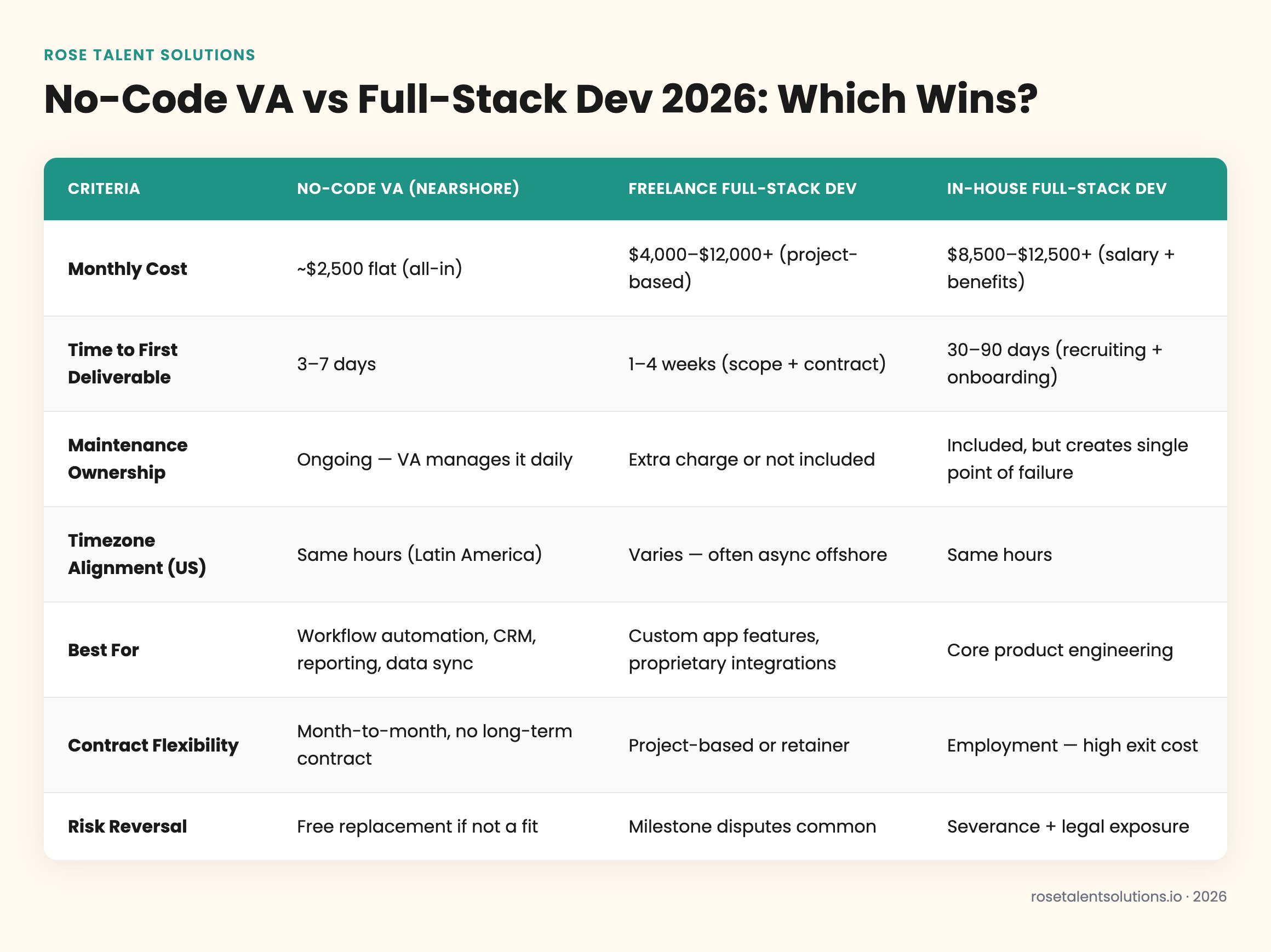
The comparison below cuts through the noise. It's based on real market rates, realistic ramp timelines, and the actual scope boundaries of both roles as they exist today — not how vendors market them.
| Criteria | No-Code VA (Nearshore) | Freelance Full-Stack Dev | In-House Full-Stack Dev |
|---|---|---|---|
| Monthly Cost | ~$2,500 flat (all-in) | $4,000–$12,000+ (project-based) | $8,500–$12,500+ (salary + benefits) |
| Time to First Deliverable | 3–7 days | 1–4 weeks (scope + contract) | 30–90 days (recruiting + onboarding) |
| Maintenance Ownership | Ongoing — VA manages it daily | Extra charge or not included | Included, but creates single point of failure |
| Timezone Alignment (US) | Same hours (Latin America) | Varies — often async offshore | Same hours |
| Best For | Workflow automation, CRM, reporting, data sync | Custom app features, proprietary integrations | Core product engineering |
| Contract Flexibility | Month-to-month, no long-term contract | Project-based or retainer | Employment — high exit cost |
| Risk Reversal | Free replacement if not a fit | Milestone disputes common | Severance + legal exposure |
"The no-code movement isn't just about tools — it's about who gets to build. Operations people, VAs, and analysts can now own systems that used to require a six-figure engineer. That's a fundamental shift in how small businesses scale." — Vlad Magdalin, CEO at Webflow (2024)
What Tasks Does a No-Code VA Handle That Used to Require a Developer?
This is the question that surprises most business owners when they first dig into it. The list of formerly-dev-required tasks that a trained no-code VA owns in 2026 is long — and it covers the majority of workflow problems that come up in operations, sales, and client service roles. If your team is spending hours on manual data entry, copy-pasting between tools, or waiting on a developer to "fix the Zap," a no-code VA fixes all of that without a single Jira ticket.
Common no-code VA deliverables include: multi-step Make.com automations connecting your CRM, email, and project management tools (a skilled VA who specializes in Make.com automation workflows can build complex branching logic in hours); Airtable bases with linked tables, forms, and automated notifications — the kind of work covered by a dedicated Airtable VA; Zapier multi-step zaps with filters, formatters, and conditional paths; Webflow CMS updates and basic page builds; and reporting dashboards that pull live data from multiple sources into a single view your team actually checks. Many no-code VAs also handle lightweight API integrations using no-code connectors, eliminating the need for a developer entirely on integrations between popular SaaS tools.
The question isn't "developer vs VA" — it's "does this problem require custom code or configured logic?" If your automation lives inside tools with existing connectors (Salesforce, HubSpot, QuickBooks, Slack, Google Workspace), a no-code VA almost certainly solves it faster and cheaper than a developer will.

How Rose Talent Delivers No-Code VAs That Are Production-Ready in 2026
Hiring a no-code VA from a random freelance platform is a gamble. You're vetting someone's self-reported skill set with no way to verify their Make.com build quality until you've already paid for a project that missed the mark. Rose Talent Solutions solves this at the source. Every no-code VA placed through Rose has been screened for both tool proficiency and English fluency — the published floor is 8/10 on English proficiency screens — and ships with a role-specific AI copilot trained on the exact platforms they'll use in your business.
That AI advantage matters practically. A VA supporting your operations in Rose's AI-augmented model doesn't just know the tool — they have an assistant that surfaces best practices, flags logic errors before they go live, and helps them document every workflow they build so you're not dependent on one person's memory. According to McKinsey Global Institute (2023), AI-augmented workers complete knowledge tasks 40% faster than non-augmented peers — a compounding advantage on every automation your VA touches.
Pricing is $2,500 per month flat. That's full-time (40 hours per week), all-in — recruiting, vetting, payroll, HR, and ongoing management are included. There's no long-term contract. If the team member isn't the right fit, Rose replaces them at no additional cost. Explore the full model at the Rose start page or review how the bookkeeping and accounting VA track applies the same model to financial workflows.
When You Actually Do Need a Full-Stack Developer Instead of a No-Code VA
Intellectual honesty matters here. A no-code VA is not the right answer for every technical problem — and overselling the category does everyone a disservice. There are real scenarios where a full-stack developer is the correct hire, and you should know what they look like before you make a decision.
You need a developer when: your automation requires a custom-built API with no existing connector in Make, Zapier, or n8n; you're building a user-facing product (an app, a customer portal, a proprietary SaaS tool); your data volume or query complexity exceeds what Airtable or Google Sheets can handle without performance degradation; or you need server-side logic, authentication flows, or database architecture that no-code platforms can't replicate. These are real engineering problems. Trying to solve them with a no-code VA is like trying to frame a house with a finish nail gun — the tool isn't wrong, it's just built for a different job. According to Statista (2024), the global low-code/no-code platform market is projected to reach $187 billion by 2030 — but that growth is built on the premise that no-code handles operational workflows, not core engineering.
No-Code VA: Best Fit
- Workflow automation between SaaS tools
- CRM setup, maintenance, and enrichment
- Reporting dashboards and data visualization
- Form builders, onboarding sequences, email triggers
- Ongoing system maintenance and iteration
- Documentation and SOP creation for tech stack
Full-Stack Dev: Best Fit
- Custom application or product development
- Proprietary API builds with no existing connector
- Database architecture and server-side logic
- High-volume data pipelines at scale
- Authentication, security, and compliance engineering
- Core infrastructure or DevOps work
How to Get Started With a No-Code VA Through Rose in 2026
The onboarding process at Rose is designed to get a production-ready no-code VA working inside your systems within a week of your first conversation. There's no lengthy discovery process, no weeks-long recruiting cycle on your end, and no guesswork about whether the person can actually do the work — Rose handles all of that before you ever meet the candidate.
Scope Your Workflow Needs
Rose's team works with you to map the specific tools, automations, and outputs you need — so the match is built on your actual stack, not a generic job description.
Meet Your Matched VA Candidate
Rose presents a pre-vetted candidate with verified tool proficiency and 8/10+ English fluency. You interview and approve before anyone starts.
Onboard With the AI Copilot
Your VA arrives with a role-specific AI copilot pre-configured for the platforms in your stack — cutting ramp time and surfacing best practices from day one.
Iterate and Scale
Because the engagement is month-to-month with no long-term contract, you can scale scope up or down as your automation needs evolve — and if the fit isn't right, Rose replaces the VA at no additional cost.
According to SHRM (2024), the average cost to replace a single employee in the US is six to nine months of that employee's salary. The replacement guarantee built into the Rose model eliminates that risk entirely for the VA layer of your team — making the $2,500 flat monthly rate an even cleaner comparison against the true cost of a developer hire. Explore the full property management VA track to see how the same nearshore model applies across operations roles, not just technical automation.