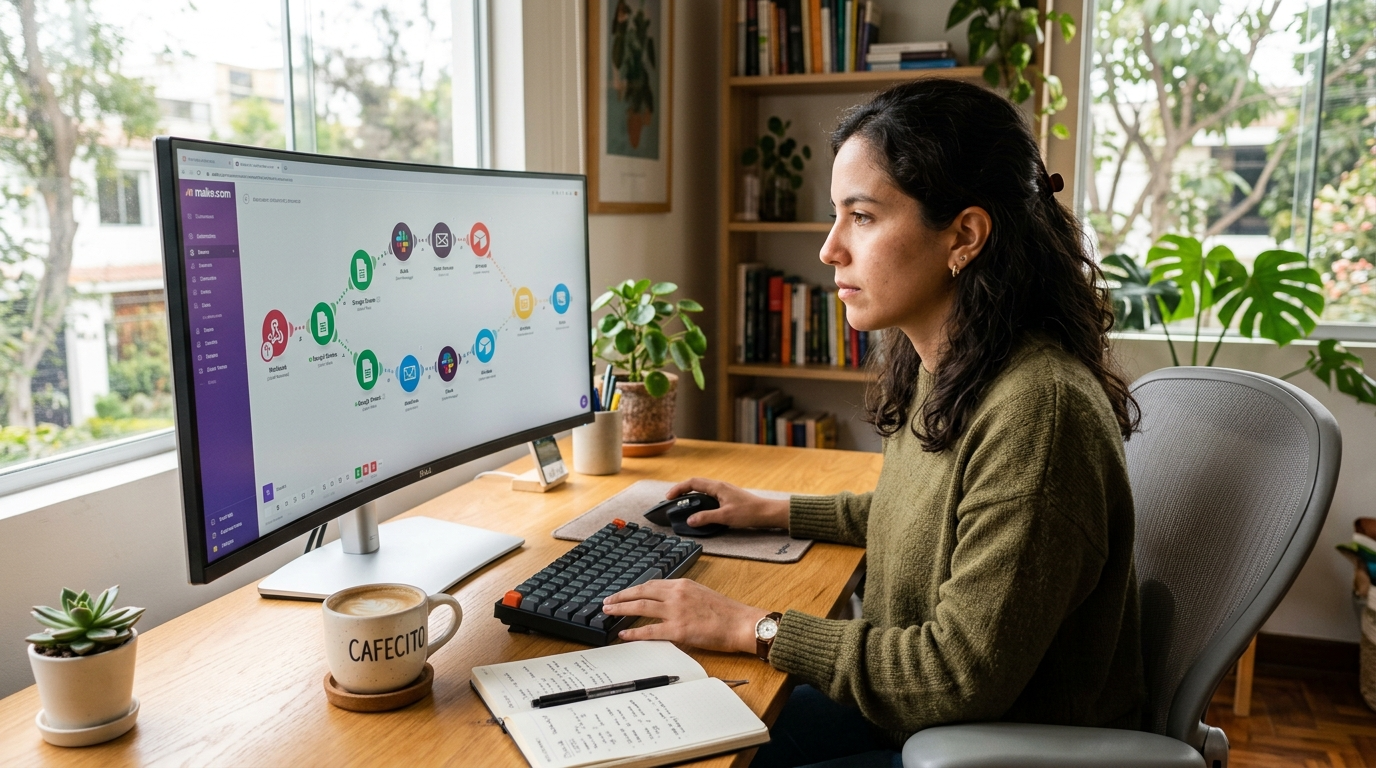
Nearshore virtual assistants who specialize in Make.com automation are one of the highest-leverage hires a small or mid-sized business can make in 2026. Instead of paying a full-stack developer $120,000 a year to wire together your CRMs, project management tools, and communication platforms, you hire a trained no-code operator — based in Latin America, working your time zone — for a flat $2,500 a month. They build the scenarios. They monitor them. They fix the broken nodes at 10 a.m. your time, not 2 a.m. theirs.
This guide explains exactly what a Make.com automation VA does, how to evaluate candidates, what the work actually looks like day-to-day, and why the nearshore model consistently outperforms both offshore and in-house options for this specific role.
What Is a Make.com Automation Virtual Assistant?
A Make.com automation virtual assistant is a remote operator who designs, builds, and maintains automated workflows inside Make.com — the visual no-code integration platform formerly known as Integromat. They connect apps like HubSpot, Slack, Google Sheets, Airtable, and QuickBooks using drag-and-drop scenario builders, routers, filters, and HTTP modules — no traditional coding required. Think of them as the person who permanently removes the manual steps your team keeps repeating.
The role sits at the intersection of operations and technology. A great Make.com VA doesn't just follow a tutorial — they interview your team to map the pain, design the logic, build and test the scenario, document it, and hand it back running. That last part (documentation and handoff) is what separates a professional automation VA from a freelancer who disappears after the Zap goes live.
Automation VAs are closely related to — but distinct from — general no-code builders. If you want someone who can also manage databases and relational views alongside your workflows, you may want to pair your Make.com VA with someone who handles Airtable virtual assistant services — the two tools work together constantly in modern ops stacks.
How Make.com Automation VAs Actually Work in 2026
The typical engagement starts with a workflow audit. Your VA spends the first few days documenting every manual handoff in your business — form submissions that get copy-pasted into a spreadsheet, lead notifications that go out manually, invoice data that has to be re-entered in a second system. That audit becomes the build queue.
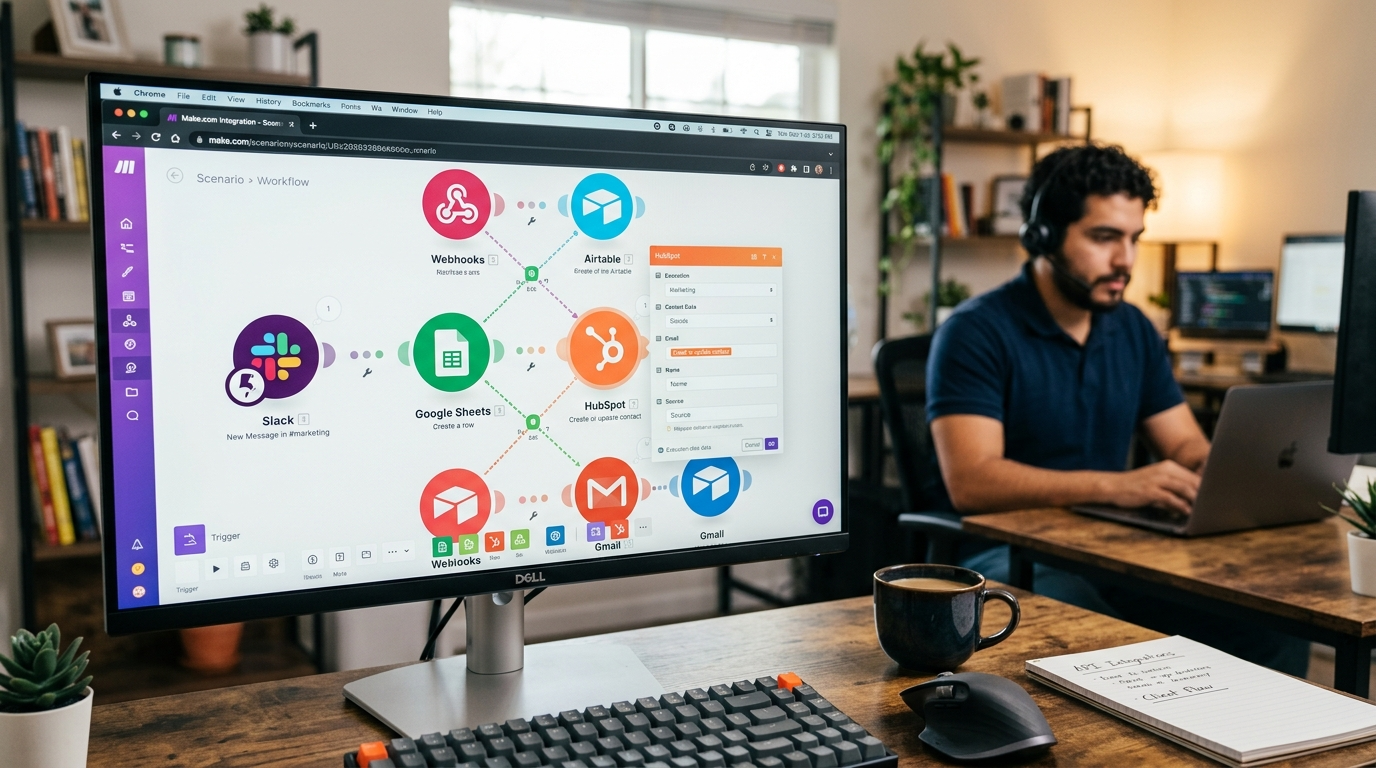
From there, the VA builds in sprints — one or two scenarios per week depending on complexity. They test with live data, handle edge cases (what happens when a field is blank? when an API returns a 429?), and set up error-handling routes so a broken node sends a Slack alert instead of silently failing. According to McKinsey & Company (2023), knowledge workers spend an average of 1.8 hours per day on tasks that could be automated — that's nearly a quarter of a full workweek your automation VA is handing back to your team every single week.
Every Rose automation VA also arrives with a role-specific AI copilot trained on Make.com's module library, error codes, and best practices — which means faster builds, fewer mistakes, and a VA who can diagnose a scenario failure in minutes instead of hours.
Nearshore vs. Offshore vs. Onshore: 2026 Comparison for Make.com VAs
Not all remote automation talent is equal — and the differences matter more for a Make.com VA than almost any other role because the work requires real-time collaboration. When a scenario breaks mid-day, you need someone who can respond right now, not someone who is asleep. According to Gallup's State of the Global Workplace report (2023), employees who work in misaligned time zones report significantly lower engagement and responsiveness scores — a measurable drag on any async-heavy remote role.
| Factor | Nearshore VA (Latin America) | Offshore VA (Philippines / India) | Onshore (US-Based) |
|---|---|---|---|
| Monthly cost | ~$2,500 flat (all-in) | $800–$1,500 (management extra) | $5,000–$8,000+ |
| Timezone overlap (US ET) | Full overlap — same hours | 6–12 hrs behind / ahead | Full overlap |
| English proficiency | 8/10+ screened | Varies widely | Native |
| Make.com ramp time | 3–5 days (AI copilot included) | 1–3 weeks | 1–2 weeks (depends on hire) |
| Recruiting + HR burden | Zero — fully managed | High (DIY platforms) | Very high (W-2 overhead) |
| Contract flexibility | Month-to-month, 30-day notice | Varies | High (at-will), but expensive |
The timezone issue is especially acute for Make.com work. Scenarios break. Webhooks time out. A new app update changes a module's field structure overnight. When that happens at 11 a.m. EST and your VA is 11 hours ahead, you either wait until tomorrow or you fix it yourself. Same-timezone support is not a perk for automation roles — it is a functional requirement.
Offshore cost savings also tend to erode once you factor in the management overhead. Platforms like Upwork add 20–30% on top of hourly rates for compliance, and you still handle vetting, onboarding, and performance management yourself. Rose's all-in $2,500 model covers recruiting, vetting, payroll, HR, and ongoing management — nothing extra. The Society for Human Resource Management (SHRM, 2024) puts the average cost-per-hire in the US at $4,700 and 42 days to fill a single role — Rose's flat model eliminates both figures entirely.
What Tasks Can a Make.com VA Handle for Your Business in 2026?
The short answer: any repeatable, multi-step process that moves data between apps. But here is a more concrete breakdown of what Rose automation VAs actually build most often:
- Lead routing: New form submission → qualify with conditional logic → assign to the right rep in your CRM → send a personalized Slack alert → log to a master Airtable tracker
- Invoice automation: Approved project in your PM tool → auto-generate draft invoice in QuickBooks → notify the client via email → update payment status when marked paid
- Onboarding flows: New client signs contract → trigger a Make.com scenario that creates a project folder, sends a welcome email sequence, adds them to your CRM, and posts to your internal Slack channel
- Report aggregation: Pull data from multiple ad platforms nightly → normalize it in Google Sheets → email a formatted summary to stakeholders every Monday morning
- Error monitoring: Watch for failed scenarios → parse the error → send a formatted alert with the failing module, the payload, and suggested fix to the ops lead
If your automation needs extend into direct API work — custom webhooks, OAuth flows, or connecting tools that don't have native Make.com modules — Rose also places VAs with API skills. Learn more about what that looks like in our guide to API integration virtual assistants and how they complement a Make.com operator on the same team.
"No-code tools like Make.com have fundamentally changed who can build automation — but someone still needs to own the logic, the error handling, and the documentation. That person is increasingly a trained operations VA, not a developer." — Wade Foster, CEO at Zapier (2024)
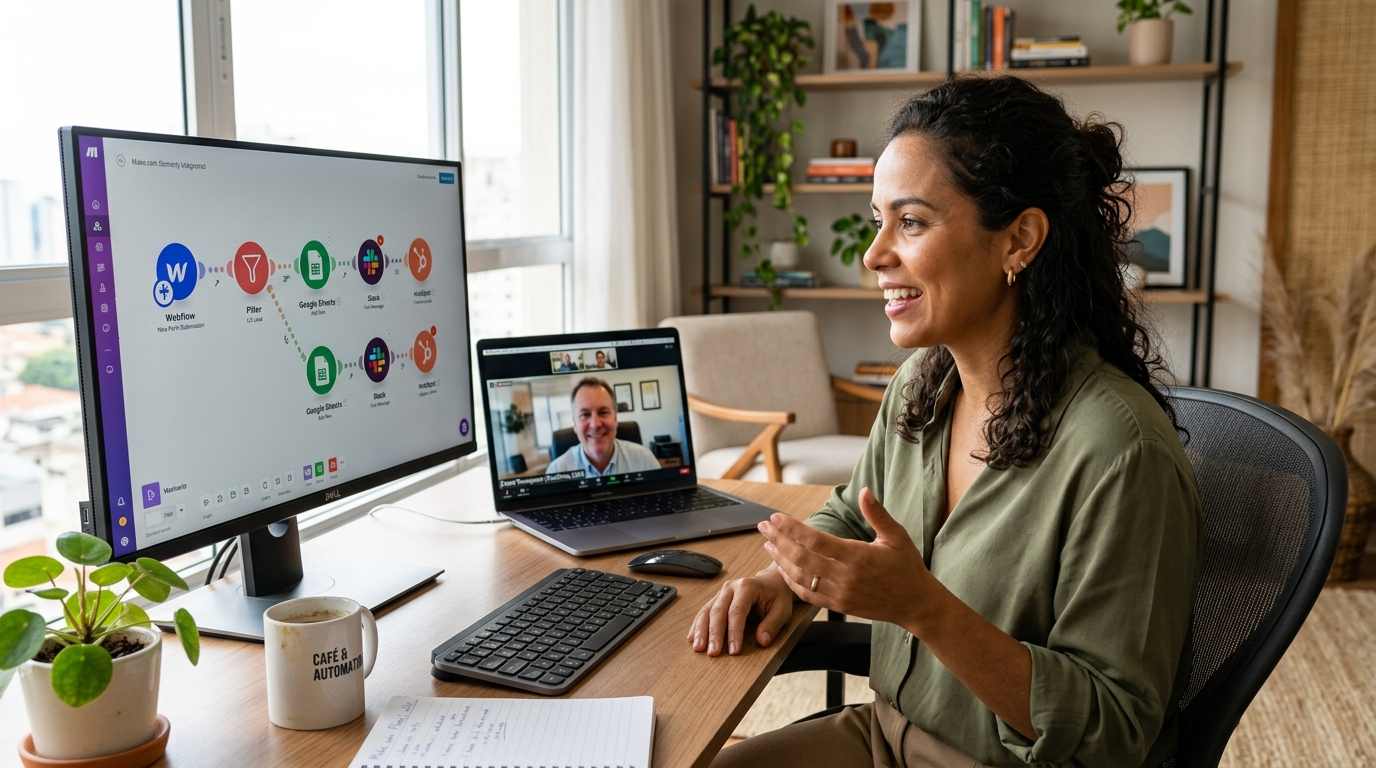
Make.com has over 1,500 app integrations as of 2026 — but the platform's power is gated by the operator's ability to think in conditional logic, handle API errors gracefully, and document scenarios so others can maintain them. Hiring a VA who has been trained and vetted specifically for this skill set compresses your time-to-value from months to days.
The no-code automation market itself is expanding fast. According to Gartner (2024), low-code and no-code technologies are among the fastest-growing segments in enterprise software, with adoption accelerating as businesses seek to reduce reliance on developer backlogs for routine operational work. A dedicated Make.com VA puts that capacity directly in your operations team — without the developer price tag.
For property management businesses specifically, workflow automation has become a core operational differentiator. Rose's property management VA services include automation-trained team members who build Make.com scenarios for maintenance request routing, lease renewal reminders, and tenant communication workflows — all running inside your existing property management software stack.
How Rose Places a Make.com Automation VA in Your Business
The process is designed to eliminate the friction that makes most VA engagements fail. You don't post a job, sift through applications, run your own skills tests, or negotiate hourly rates. Rose handles every layer.
Discovery Call
You walk Rose through your current stack, your biggest manual bottlenecks, and the tools your VA will work in. This takes 30–45 minutes and directly shapes the candidate profile.
Candidate Match
Rose sources from its pre-vetted Latin America talent pool — screened for Make.com scenario experience, English proficiency (8/10+ floor), and availability in your time zone. You typically see a shortlist within a few days.
Interview & Select
You interview the top candidate(s) — Rose facilitates. You make the call. No pressure, no sales tactics. If none feel right, Rose keeps searching at no additional cost.
Onboarding & AI Copilot Activation
Your VA starts, gets access to their role-specific AI copilot, and begins the workflow audit. Most clients have a live scenario in production within the first week.
Ongoing Management
Rose handles HR, payroll, and performance check-ins. You manage the work. If the fit ever isn't right, Rose replaces the team member at no additional cost — no long-term contract required.
The engagement runs month-to-month. Cancel with 30 days written notice. No long-term contract. The only commitment is the work itself — and if your VA isn't delivering, the replacement guarantee means you're not stuck paying for underperformance.
Is a Make.com VA Right for Your Business — Pros and Cons
This model isn't for every business. Here is an honest breakdown so you can self-select before starting the process.
Strong fit if you…
- Have 5+ repeatable manual processes consuming staff time every week
- Use SaaS tools (CRMs, PM platforms, accounting software) that have Make.com integrations
- Want a dedicated operator, not a freelancer who juggles 12 clients
- Value real-time collaboration during US business hours
- Need automation maintained and improved over time, not just built once
May not be the right fit if you…
- Have fewer than 3–4 clear automation candidates (you won't fully utilize 40 hrs/week on Make.com alone)
- Need custom software development, not no-code workflow automation
- Are not yet using SaaS tools with API or webhook support
- Want a single one-time scenario built (a freelancer may be more cost-effective for a single project)
If the no-code scope extends beyond Make.com into broader tooling — Zapier, n8n, custom scripts, or database management — consider reading our full breakdown on what it means to hire a no-code virtual assistant for a complete picture of what the role can cover.
For businesses with finance-heavy workflows — accounts payable automation, QuickBooks sync, or revenue reporting — Rose also places dedicated bookkeeping and accounting VAs who work alongside your Make.com operator to automate the financial data layer specifically. According to the U.S. Bureau of Labor Statistics (2024), the median annual wage for a US-based bookkeeping clerk is $47,440 — a fully managed nearshore equivalent through Rose runs $30,000 a year flat, all costs included.
The World Economic Forum's Future of Jobs Report (2023) identifies automation and AI as the top forces reshaping operational roles — and notes that businesses that invest in automation talent now will hold a compounding productivity advantage through the rest of the decade. A dedicated Make.com VA is one of the most direct ways a non-technical founder can act on that finding without building an engineering team.
The businesses that get the most from a Make.com automation VA are the ones that treat the role as an ongoing operations function — not a one-time project. Automation stacks grow. New tools get added. Existing scenarios need to adapt when an upstream app changes its data structure. A dedicated VA who knows your stack, your logic, and your edge cases is dramatically more valuable than a rotating cast of freelancers who each need to relearn the same context from scratch. If you are ready to explore what that looks like for your specific workflows, the Rose placement process starts here.