
What Is an Airtable Virtual Assistant — and Why Does It Matter in 2026?
Nearshore Airtable virtual assistant services connect your business with a dedicated, Latin America-based team member who builds, maintains, and automates your Airtable workspace — working your time zone, in fluent English, for a flat monthly rate. This is not a generic data-entry hire. An Airtable VA is a specialist who understands relational databases, linked records, views, automations, and API integrations well enough to run your operations stack without daily hand-holding.
Airtable has grown from a spreadsheet alternative into a genuine operations platform. As of 2024, Business of Apps estimated Airtable's user base at over 450,000 organizations globally — with heavy adoption among real estate, marketing, and professional services firms. That adoption surge created a staffing problem: your team knows Airtable exists, but nobody has the bandwidth to become the in-house expert who keeps the bases clean, the automations running, and the views useful.
That's where a dedicated Airtable VA pays for itself fast. When someone owns your database — not just touches it occasionally — accuracy goes up, automation debt goes down, and you get your mornings back.
How Nearshore Airtable VAs Outperform Offshore Alternatives in 2026
The offshore VA market is crowded, and the pitch is always the same: lower hourly rates, large talent pools, fast hiring. What that pitch skips is the timezone math. A VA based in the Philippines or India operates on a 10-to-14-hour offset from US Eastern time. When your Airtable automation breaks at 2pm on a Tuesday and your VA is asleep, you're the one debugging it. That gap compounds on every Slack message, every revision loop, every urgent data pull.
Nearshore VAs based in Latin America — Colombia, Mexico, Costa Rica, Argentina — work 9am–6pm EST or CST by default. When your operations manager flags a broken Airtable view at noon, the fix is in before your next meeting. That real-time collaboration loop is not a soft benefit; it's the reason onboarding timelines compress and error rates drop.
According to Gallup's State of the Global Workplace report (2023), employees who work in aligned time zones with their managers report 23% higher engagement scores — a proxy for how well remote team members actually perform when communication is synchronous rather than asynchronous and delayed.

Nearshore vs. Offshore vs. Onshore: 2026 Airtable VA Comparison
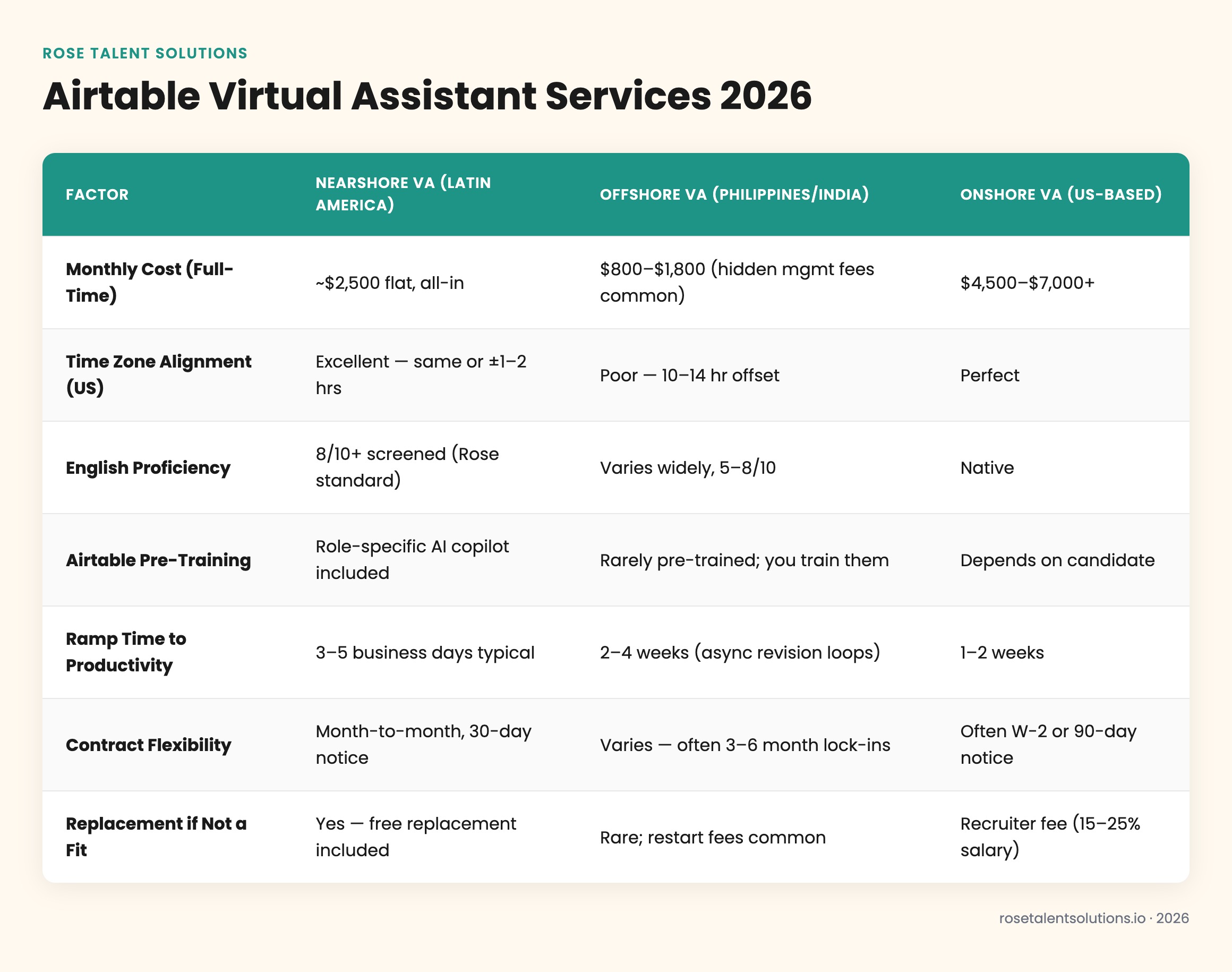
Before you commit to any staffing model, you need to see the tradeoffs clearly. The table below compares the three main options businesses consider when hiring Airtable virtual assistant support. The numbers reflect 2025–2026 market rates and typical performance benchmarks for Airtable-specific roles.
| Factor | Nearshore VA (Latin America) | Offshore VA (Philippines/India) | Onshore VA (US-based) |
|---|---|---|---|
| Monthly Cost (Full-Time) | ~$2,500 flat, all-in | $800–$1,800 (hidden mgmt fees common) | $4,500–$7,000+ |
| Time Zone Alignment (US) | Excellent — same or ±1–2 hrs | Poor — 10–14 hr offset | Perfect |
| English Proficiency | 8/10+ screened (Rose standard) | Varies widely, 5–8/10 | Native |
| Airtable Pre-Training | Role-specific AI copilot included | Rarely pre-trained; you train them | Depends on candidate |
| Ramp Time to Productivity | 3–5 business days typical | 2–4 weeks (async revision loops) | 1–2 weeks |
| Contract Flexibility | Month-to-month, 30-day notice | Varies — often 3–6 month lock-ins | Often W-2 or 90-day notice |
| Replacement if Not a Fit | Yes — free replacement included | Rare; restart fees common | Recruiter fee (15–25% salary) |
"The number-one mistake I see ops leaders make is optimizing for the hourly rate instead of the collaboration rate. A VA who costs half as much but adds four hours of lag to every revision loop will cost you more in decision delay than you saved on the invoice." — Liam Martin, Co-founder at Time Doctor & Running Remote Conference (2024)
What Does an Airtable Virtual Assistant Actually Do Day-to-Day?
This is where a lot of buyers get vague answers from staffing agencies. A real Airtable VA has a concrete daily scope. Here's what that looks like in practice when the hire is matched correctly.
An Airtable VA manages your base architecture — building and restructuring tables, defining field types, linking records across bases, and enforcing naming conventions so your data doesn't become a landfill by Q3. They run your automations, including Airtable's native automation builder, Zapier or Make.com integration, and webhook triggers that fire when a record hits a specific status. They produce views and reports on demand — gallery views for your team, grid exports for your accountant, calendar views for your project managers — without you having to explain what a grouped view is every time.
The real ROI of an Airtable VA is not just the hours saved building bases — it's the elimination of "Airtable debt." Every business that self-manages Airtable accumulates broken formulas, duplicate records, and stale automations. A dedicated VA prevents that debt from compounding, which is worth more than any single deliverable.
Beyond core Airtable work, many Rose Talent team members are trained on the specific software stack their client uses — QuickBooks, Notion, Slack, HubSpot, or industry-specific tools like AppFolio and Buildium for property management clients. Each VA ships with a role-specific AI copilot trained on their assigned software, which cuts onboarding time and reduces the back-and-forth that slows most remote hires. According to McKinsey's 2023 report on generative AI's economic potential, AI-augmented knowledge workers complete routine data tasks 30–40% faster than peers working without AI assistance — a direct productivity multiplier when your VA is already inside Airtable for 40 hours a week.

How Rose Talent's Airtable VA Matching Process Works in 2026
Most staffing agencies send you a resume and call it a match. Rose's process is built differently — the sourcing, vetting, and placement happen before you see a single candidate, so you're not interviewing 12 people to find one who can actually build a formula field.
Intake & Scope Definition
You tell Rose what your Airtable environment looks like — number of bases, automation complexity, integrations in use, and the adjacent tools your VA will touch. This takes 30 minutes and shapes the entire search.
Sourcing & Technical Vetting
Rose screens candidates on English proficiency (8/10+ minimum), Airtable-specific skill assessments, and role-specific software familiarity. Candidates who can't demonstrate live Airtable competency don't reach you.
AI Copilot Configuration
Before your VA starts, Rose configures a role-specific AI copilot trained on Airtable and your other tools — so ramp time is measured in days, not weeks.
Placement & Onboarding
Your VA starts within approximately seven days of intake. Rose handles payroll, HR compliance, and ongoing management — you manage the work, Rose manages the employment relationship.
Ongoing Support & Replacement Guarantee
If the team member isn't the right fit for any reason, Rose replaces them at no additional cost. No restart fees, no recruiter bills, no gap in coverage.
The all-in pricing model matters here. At $2,500/month for a full-time, 40-hour-per-week team member, you're not paying a separate recruiting fee, a separate payroll fee, or an HR management retainer. Those costs are baked in. For context, the U.S. Bureau of Labor Statistics (2024) pegs the median annual wage for US-based administrative and operations support staff at over $44,000 — before benefits, payroll taxes, or recruiting costs, which typically add another 25–30% on top. A nearshore Airtable VA through Rose runs roughly one-quarter of that fully-loaded cost, with zero long-term contract.
If you support a bookkeeping or accounting function, your Airtable VA can also integrate directly with QuickBooks workflows — pulling invoice data into Airtable for project tracking, reconciling vendor records, or building budget dashboards that your accountant reviews weekly. The combination of Airtable fluency and financial tool familiarity is where the real operational leverage lives.
Is an Airtable Virtual Assistant Right for Your Business in 2026?
Not every business is ready for a dedicated Airtable VA — and a good agency will tell you that. If you have fewer than two Airtable bases and use it mostly as a prettier spreadsheet, you're not at the volume where a full-time hire makes sense. But if any of the following are true, you're past the threshold.
Strong Fit: Hire an Airtable VA If You...
- Run 3+ Airtable bases with active automations
- Have team members duplicating data entry between tools
- Spend 5+ hours per week maintaining or fixing Airtable records
- Use Airtable as a CRM, project tracker, or operations hub
- Need Airtable integrated with Zapier, Make, or an API endpoint
- Want a consistent owner for your data — not a rotation of generalists
Not Yet Ready: Hold Off If You...
- Only use one simple Airtable base with under 500 records
- Have no existing automation setup and no near-term plans
- Haven't defined your workflows well enough to delegate them
- Are still deciding whether Airtable is the right tool at all
According to Statista's 2024 low-code/no-code market analysis, the global no-code platform market is projected to exceed $65 billion by 2027, with Airtable among the top five most-adopted platforms in professional services. The businesses hiring Airtable VAs now are building a compound advantage — cleaner data, faster automations, and a team member who gets better at your specific stack every month. Ready to scope your Airtable VA role? Start here.