
Nearshore staffing — what practitioners increasingly call nearsourcing — is reshaping how US, Canadian, and UK businesses hire remote talent in 2026. Instead of recruiting in the Philippines or India (12–13 hours offset from New York), nearsourcing taps Latin America: same time zones, fluent English, university-educated professionals, and monthly costs that come in at a fraction of domestic salaries. If you've heard the term but aren't sure how it differs from plain outsourcing, this guide breaks down everything you need to know — including the numbers that make the business case undeniable.
What Is Nearsourcing? A Plain-Language Definition for 2026
Nearsourcing refers to the practice of contracting or hiring remote workers from countries geographically close to your home market. For US-based businesses, that means Latin America: Mexico, Colombia, Argentina, Costa Rica, Brazil, and their neighbors. The "near" in nearsourcing has two meanings — physical proximity (similar time zones) and cultural proximity (shared business norms, calendar holidays, and communication styles).
Nearsourcing sits in a distinct middle lane. It is not domestic hiring — you're not paying $60,000–$90,000 US salary. It is not traditional offshoring — you're not sending work to a team that operates while you sleep. It combines the cost savings of outsourcing with the real-time collaboration of a domestic employee. According to SHRM (2024), communication friction is the top driver of outsourcing dissatisfaction — and nearsourcing directly eliminates the biggest source of that friction: the time-zone gap.
This matters for any business where speed of response is a competitive advantage — think property management, bookkeeping, customer support, or sales coordination. Every hour your VA is offline while a tenant waits for an answer is an hour your competitor can use. For a deeper look at how nearsourcing stacks up against every alternative, see this complete comparison of nearshore vs. offshore vs. onshore virtual assistants.
How Nearsourcing Differs From Offshoring and Onshore Hiring in 2026
The three staffing models — nearsourcing, offshoring, and onshore hiring — are often lumped together as "remote work," but they produce dramatically different outcomes. The table below shows the honest comparison across the dimensions that operators actually care about.

| Factor | Nearsourcing (Latin America) | Offshoring (Philippines / India) | Onshore (US-Based) |
|---|---|---|---|
| Time Zone Overlap | Full overlap with US hours | 0–4 hrs overlap; often graveyard shift | Full overlap |
| English Proficiency | High (Rose screens 8/10+ minimum) | Varies (6–8/10 average) | Native |
| Monthly Cost (Full-Time) | ~$2,500 flat all-in | $800–$1,800 (hidden fees common) | $4,500–$7,500+ |
| Cultural Alignment | High — shared US business norms | Moderate — some calendar/culture gaps | Full |
| Recruiting Lead Time | ~7 days to first placement | 2–4 weeks typical | 4–8 weeks typical |
| Software Training | AI copilot included (AppFolio, QuickBooks, etc.) | Buyer typically pays for training | Buyer typically pays for training |
| Contract Flexibility | Month-to-month, 30-day notice | Varies — often 3–6 month minimums | Employment law applies |
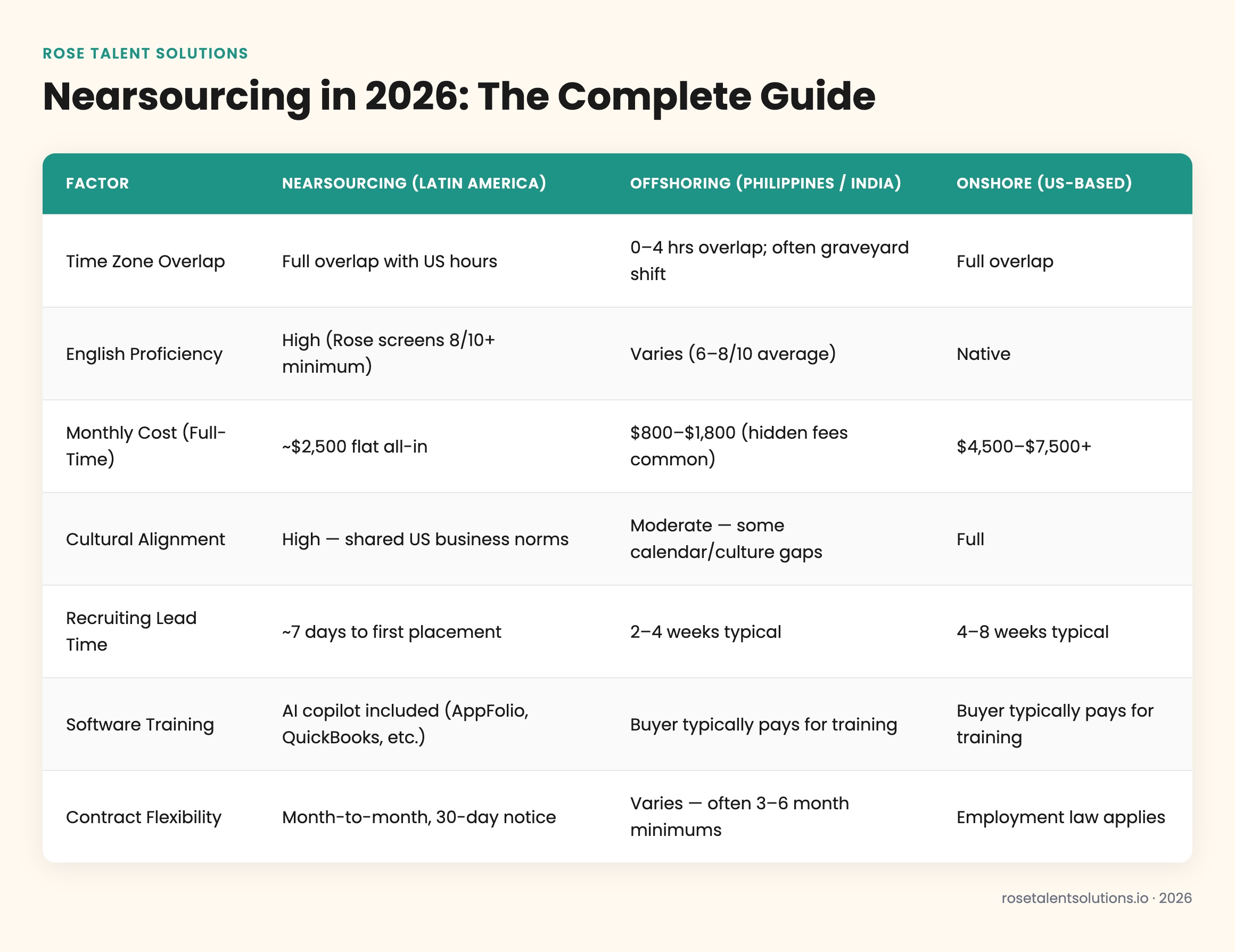
The cost gap between nearsourcing and onshore hiring is substantial. The U.S. Bureau of Labor Statistics (2024) puts the median annual wage for administrative support roles at over $43,000 — that's before benefits, payroll taxes, and recruiting costs. A full-time nearshore VA through Rose runs $2,500/month flat, all-in. That's $30,000 a year versus $55,000–$70,000 loaded cost for a domestic hire doing equivalent work.
Why Latin America Is the 2026 Nearsourcing Hub for US Businesses
Not all "nearshore" is equal. Eastern Europe is nearshore for German companies. Southeast Asia is nearshore for Australian firms. For US businesses specifically, Latin America checks every box that makes nearsourcing work in practice — not just on paper.
Time zone alignment is the non-negotiable foundation. Colombia, Mexico, Peru, and Argentina all fall between UTC−3 and UTC−6 — the same band as US Eastern through Pacific time. Your VA in Bogotá starts their day when your New York office does. They're reachable by Slack, phone, or video all day. No batching emails overnight. No waiting until 6am for a response to a question you sent at 5pm.
Beyond time zones, Latin America has seen a surge in university-educated bilingual professionals. According to the British Council's English Effect Report, English proficiency in Latin America has risen sharply over the past decade, with Colombia and Argentina posting some of the highest gains in the region. Rose's own screening sets an 8/10 minimum on English proficiency — a bar that filters out the majority of applicants and ensures the team members who reach clients can handle client-facing communication without a second thought.
For a broader look at the staffing ecosystem, this overview of virtual assistant companies in Latin America explains what to look for when evaluating providers in the region.
How Nearsourcing Actually Works: From Inquiry to Day One in 2026
One of the most common questions operators ask is: "How long until someone's actually working?" The answer with a proper nearsourcing model is faster than most people expect. Rose's process, for example, moves from intake call to active team member in roughly a week. Here's what that looks like in practice:
Role Scoping Call
You describe the role, software stack, and working style in a 30-minute call. Rose matches against an active pool of pre-vetted Latin American candidates — no cold sourcing required.
Candidate Shortlist
Within 2–3 business days, you receive a curated shortlist of candidates who have already cleared English proficiency screens, skills assessments, and background checks.
Interview & Selection
You interview your top choice (or top two) and make the call. Rose handles offer logistics, payroll setup, and HR paperwork — none of that lands on your desk.
AI Copilot Activation
Your team member arrives with a role-specific AI copilot trained on the software they'll use — AppFolio, Buildium, QuickBooks, or whatever your stack includes — so ramp time is days, not weeks.
Ongoing Management
Rose handles HR, payroll, compliance, and performance check-ins. You manage the work. If the fit isn't right, Rose replaces the team member at no additional cost.
That last point is worth underlining. The replacement guarantee — not a free trial, not a discounted first month, but a genuine no-additional-cost replacement if the fit doesn't work — is the risk reversal that makes nearsourcing a low-stakes decision for businesses trying it for the first time. Learn more about how Rose structures this on the getting started page.
What Roles Fit Nearsourcing Best in 2026?
Nearsourcing works for any role where real-time communication, software fluency, and professional judgment matter — which is most knowledge-work roles. The highest-volume use cases in 2026 cluster around a few verticals.

Property management is the single biggest use case. Maintenance coordination, tenant communication, lease renewal processing, and vendor follow-ups are all tasks that require real-time responsiveness during business hours — exactly what a nearshore VA delivers. According to Buildium's 2024 Property Management Industry Report, 52% of property managers say staffing constraints are their top operational challenge. Nearsourcing solves that without the overhead of a W-2 hire. Rose's property management VA services page covers the role profiles in detail.
Bookkeeping and accounting support is the second-largest category. Reconciliations, accounts payable, financial report prep, and QuickBooks maintenance all transfer cleanly to a nearshore VA — especially when that VA arrives with AI-assisted workflows baked in. See how Rose structures bookkeeping and accounting VA support for small businesses and property operators.
Executive assistance, customer support, and marketing coordination round out the top roles. Any function that has historically required a domestic hire because of the "we need someone available during business hours" constraint is now a clean nearsourcing candidate.
The hidden cost of offshore staffing isn't the hourly rate — it's the compounding delay from a 10–12 hour time-zone gap. Every email, every approval, every client question that waits overnight costs you speed, and speed costs you revenue. Nearsourcing eliminates that delay at a price point that still beats domestic hiring by 50–60%.
Nearsourcing vs. Offshoring: The 2026 Honest Pros and Cons
Offshoring has a genuine cost advantage at the raw labor rate level — a VA in the Philippines or India may bill at $800–$1,400/month before agency fees. But that rate comparison is misleading if you don't account for what you're actually buying. Nearsourcing costs more per hour and delivers more per hour — the question is whether the productivity gap justifies the price gap. For most US business owners, it does.
"Outsourcing decisions that focus purely on labor arbitrage without factoring in coordination costs and time-zone friction consistently underperform. Proximity — cultural and geographic — is a measurable productivity variable, not a soft preference." — Atul Vashistha, Founder & CEO at Neo Group (2023)
Nearsourcing Pros
- Full US business-hours overlap — no overnight batching
- High English fluency, culturally aligned communication
- Faster ramp time with AI copilot tools
- Month-to-month terms, no long-term contract
- Single flat rate covers recruiting, HR, and payroll
Nearsourcing Cons
- Higher rate than raw offshore labor
- Smaller candidate pool than Philippines/India for some niche technical roles
- Best providers (like Rose) require minimum 40 hrs/week commitment — not ideal for 10-hour-a-week tasks
The right frame isn't "which is cheaper?" — it's "which produces better outcomes per dollar spent?" A McKinsey analysis of remote workforce productivity found that collaboration-intensive tasks drop 25–35% in quality when teams operate across large time-zone gaps, according to McKinsey Global Institute (2021). If your VA's work touches clients or requires daily back-and-forth with your team, that 25–35% quality drag is a real cost — it just doesn't show up on your invoice.
For operators who've already gone down the offshore path and are evaluating a switch, this comparison of onshore vs. offshore virtual assistant models provides the framework for calculating true total cost. And if you want to understand the full Latin American staffing landscape before committing, this guide to working with a Latin America staffing agency walks through what to look for in a provider.
How Rose's AI Advantage Makes Nearsourcing Even Faster in 2026
The traditional knock on any remote staffing model — nearshore or otherwise — is ramp time. It takes weeks to get someone up to speed on your software, your processes, your clients. Rose's answer is the AI copilot system, which ships with every team member, pre-trained on the specific software they'll use in your business.
If you run AppFolio, your VA arrives knowing AppFolio. If you run Buildium, QuickBooks, or Yardi, the copilot is configured for that stack. This isn't a chatbot bolted on as an afterthought — it's a structured AI layer that surfaces the right workflow, the right template, and the right next step for the tasks your VA handles daily. The result is a ramp time measured in days, not months. According to Gallup's State of the Global Workplace Report (2023), onboarding friction is one of the top three predictors of early-tenure turnover — reducing it with AI-assisted tools directly improves retention and output quality from week one.
Every Rose team member ships with a role-specific AI copilot — this is a differentiator that no raw freelance hire and few staffing agencies match. It compresses the learning curve that historically made outsourcing feel risky, and it keeps your VA performing at a high level even as your business evolves.