
Nearshore technology staffing is one of the fastest-growing hiring strategies for US businesses in 2026 — and for good reason. Instead of posting a $120,000 full-time domestic role or gambling on an offshore team eight time zones away, you hire a skilled, English-fluent tech professional based in Latin America who works your hours, uses your tools, and integrates into your team like a local hire. The cost difference is dramatic, but the quality gap most people expect simply isn't there anymore.
This guide breaks down exactly how nearshore technology staffing works, what it actually costs, how it compares to offshore and onshore alternatives, and how to evaluate whether it's the right move for your business in 2026.
What Is Nearshore Technology Staffing — and Why Does It Matter in 2026?
Nearshore technology staffing is the practice of hiring full-time or part-time technical professionals from countries geographically and culturally close to your own — in the US context, that means Latin America. These team members work your standard business hours (EST, CST, PST), communicate in fluent English, and operate within a 0–3 hour timezone offset from most US cities. The "near" in nearshore refers to proximity: physical, cultural, and temporal.
This is fundamentally different from offshore staffing, which typically places workers in regions 8–12 hours removed from US time zones — creating async-only collaboration that slows technically demanding work. If you want to understand the full spectrum of options, this detailed comparison of nearshore vs offshore vs onshore virtual assistants walks through every meaningful difference.
The demand surge in 2026 is partly structural. US tech unemployment sits near historic lows, driving domestic salaries to levels that price out small and mid-sized businesses. At the same time, Latin America's developer and technical talent pool has expanded significantly, with university enrollment in STEM fields growing by double digits in countries like Colombia, Mexico, and Argentina over the past five years, according to the U.S. Bureau of Labor Statistics (2025), which regularly benchmarks demand against domestic supply shortfalls.
How Nearshore Technology Staffing Costs Compare to Onshore and Offshore in 2026
Cost is usually the first question — and the answer is more nuanced than a simple hourly rate comparison. The real number you need is the fully-loaded cost: salary, payroll taxes, benefits, recruiting fees, onboarding time, and management overhead. When you factor all of that in, the three staffing models look very different.
At Rose Talent Solutions, nearshore technology staffing is priced at a flat $2,500 per month. That's fully all-in: recruiting, vetting, payroll, HR compliance, and ongoing management are all included. There are no hidden add-ons, and the arrangement runs month-to-month with no long-term contract — cancel with 30 days written notice. If a placement isn't the right fit, we replace them at no additional cost.

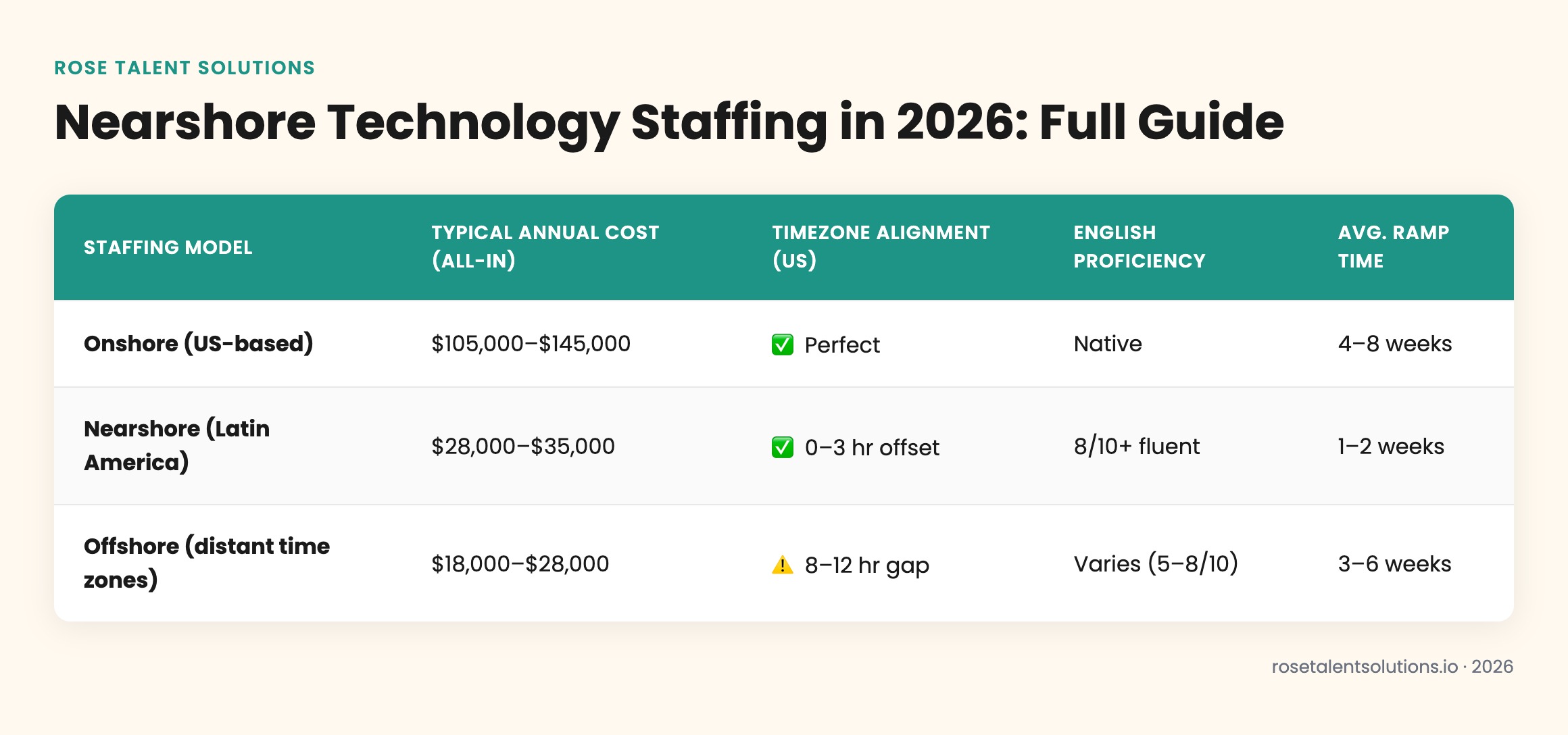
According to SHRM's hiring cost benchmarks (2024), the average cost-per-hire for a technical role in the United States exceeds $4,700 — before the first paycheck clears. Add a median annual salary of $85,000–$110,000 for a mid-level developer, plus 25–30% in benefits and payroll taxes, and a domestic technical hire runs $105,000–$145,000 per year fully loaded. Nearshore staffing at $30,000/year all-in represents a 65–75% cost reduction without sacrificing time-zone alignment or communication quality.
| Staffing Model | Typical Annual Cost (All-In) | Timezone Alignment (US) | English Proficiency | Avg. Ramp Time |
|---|---|---|---|---|
| Onshore (US-based) | $105,000–$145,000 | ✅ Perfect | Native | 4–8 weeks |
| Nearshore (Latin America) | $28,000–$35,000 | ✅ 0–3 hr offset | 8/10+ fluent | 1–2 weeks |
| Offshore (distant time zones) | $18,000–$28,000 | ⚠️ 8–12 hr gap | Varies (5–8/10) | 3–6 weeks |
How the Latin America Tech Talent Pipeline Actually Works in 2026
One of the biggest misconceptions about nearshore technology staffing is that Latin American talent is a recent phenomenon. It isn't. Countries like Colombia, Mexico, Argentina, and Brazil have been producing technically strong engineers and IT professionals for decades. What changed is infrastructure: high-speed internet penetration, remote-work tooling maturity, and the normalization of distributed teams post-2020 created the conditions for this talent to serve US companies seamlessly.
According to McKinsey Digital's research on global technology talent (2024), Latin America is now among the top three emerging regions for software engineering outsourcing, driven by a combination of STEM graduation rates, English-language education investment, and cultural alignment with North American business practices. That last factor — cultural alignment — is consistently undervalued by buyers who focus purely on cost.
"Cultural proximity matters more than most hiring managers realize. When your nearshore team member grew up watching the same American media, celebrating similar holidays, and operating in a business culture shaped by the same Western frameworks, collaboration friction drops significantly." — Andres Franzetti, Co-founder at BairesDev (2023)
If you're exploring which virtual assistant companies operating in Latin America are worth considering for technical roles, the differentiators to look for are English proficiency screening standards, role-specific vetting processes, and whether the agency handles HR and compliance or passes that burden back to you.
The hidden cost of distant-timezone tech staffing isn't the hourly rate — it's the 8–12 hour gap that turns a 10-minute clarification into a 24-hour delay. On a two-week sprint, that compounds fast. Nearshore Latin America eliminates this problem entirely because your team member is online when you are.
What Roles Fit Nearshore Technology Staffing in 2026?
Nearshore technology staffing works across a broader range of roles than most buyers initially expect. The obvious candidates are software developers (frontend, backend, full-stack), QA engineers, and DevOps specialists. But the model extends well into technical support, IT project management, data analysis, CRM administration, and systems coordination roles that sit at the intersection of technology and operations.

At Rose, every team member ships with a role-specific AI copilot trained on the software stack they'll be working in — whether that's QuickBooks, Salesforce, HubSpot, AppFolio, or a custom internal tool. This isn't a chatbot layer slapped on top; it's systematic tool-specific training that meaningfully shortens the ramp period. According to Gallup's workplace research (2024), employees who receive role-specific onboarding support are 2.5× more likely to reach full productivity within their first month — a finding that applies directly to technical staffing placements.
For businesses that also need financial operations support alongside technical roles, Rose's bookkeeping and accounting virtual staff operate on the same model — flat rate, fully managed, Latin America-based, working your hours.
How Rose's Nearshore Staffing Process Works — From Brief to Day One
One of the practical objections to nearshore technology staffing is the placement process itself: how long does it take, who vets the candidates, and what happens if the match doesn't work out? Here's exactly how it works at Rose.
Role Brief (Day 1)
You submit a role brief through the get started page — describing the tools, responsibilities, and working style you need. This takes about 15 minutes and replaces a full job description.
Candidate Sourcing and Vetting (Days 1–5)
Rose's recruiting team sources from its Latin America talent network, screens for English proficiency (minimum 8/10), and conducts role-specific technical assessments. You don't touch a candidate until they've cleared every filter.
Your Interview (Days 5–7)
You meet the shortlisted candidate — typically one strong match, not a stack of resumes to sort through. The goal is one right hire, not ten options that waste your time.
Placement and AI Copilot Onboarding (Days 7–10)
Your team member starts, receives their role-specific AI copilot setup, and begins integrating into your tools and workflows. Rose handles all payroll and HR from this point forward.
Ongoing Management (Month 1+)
Rose manages HR, performance check-ins, and compliance. If at any point the placement isn't right, we replace them at no additional cost — that's the sole risk reversal and it's meaningful.
The same structured model applies whether you're staffing a technical role or a broader operations function. Rose's property management virtual assistant practice uses identical vetting standards — same English proficiency floor, same AI copilot deployment, same flat-rate pricing.
Nearshore vs Offshore for Technical Roles: What the 2026 Data Shows
The offshore-vs-nearshore debate for technical staffing has largely settled in favor of nearshore for US-market businesses — not because distant-timezone talent is inferior, but because the operational overhead of a large timezone gap makes it structurally inefficient for roles that require real-time collaboration. If you want a deeper breakdown of how these models compare across every dimension, this onshore vs offshore virtual assistant analysis covers the tradeoffs in detail.
For technical roles specifically, the timezone issue is most acute in agile environments. Daily standups, sprint planning, bug triage, and stakeholder demos all assume participants are online at the same time. According to Statista's global remote work research (2024), teams operating across a timezone gap greater than 5 hours report 34% lower collaboration satisfaction scores than co-located or near-timezone teams. Nearshore Latin America staffing eliminates this drag entirely.
For businesses evaluating nearshore staffing agencies specifically, this guide to choosing a nearshore staffing agency outlines the questions to ask before signing with any provider — pricing transparency, replacement policies, HR handling, and English screening methodology.
Nearshore Tech Staffing (Latin America): Pros
- 0–3 hour timezone offset — real-time collaboration with US teams
- English fluency at 8/10+ — no communication overhead
- Cultural alignment with North American business norms
- 65–75% cost savings vs domestic hiring
- All-in flat rate covers recruiting, HR, payroll, management
- Month-to-month terms — no long-term contract
Distant-Timezone Offshore Tech Staffing: Cons
- 8–12 hour timezone gap turns same-day issues into next-day delays
- Async-only collaboration slows sprint velocity
- Variable English proficiency across providers
- Cultural distance can create miscommunication on requirements
- Many providers pass HR/compliance burden back to the buyer
The cost gap between nearshore and offshore has also narrowed. According to Deloitte's Global Outsourcing Survey (2024), the average hourly rate differential between Latin American and Southeast Asian technical talent has compressed to less than 20% — while the productivity benefits of timezone alignment remain fully intact with nearshore. Put differently: you're giving up very little on cost and gaining enormously on collaboration quality.