
What Is Nearshore Technical Recruiting — and Why California Businesses Care in 2026?
Nearshore technical recruiting is the practice of sourcing, vetting, and placing skilled professionals from geographically close, lower-cost countries — for US businesses, that almost always means Latin America. Unlike offshore hiring from the Philippines or India, nearshore staff work in time zones that overlap fully with California business hours, hold English proficiency scores that meet or exceed 8/10 on standardized screens, and operate within cultural frameworks familiar to North American companies. If you've ever lost a morning of productivity chasing a reply from an overseas team member who was asleep when you sent the message, nearshore is the direct solution to that problem.
California's labor market makes this conversation especially urgent. The state's median software developer salary sits well above the national average, and non-technical roles like technical recruiters, project coordinators, and operations specialists carry fully-loaded costs — salary, benefits, payroll taxes, office overhead — that routinely push past $80,000–$100,000 per year for a single mid-level hire. For startups, SMBs, and even mid-market companies trying to stay lean, that math is increasingly hard to justify when nearshore alternatives exist. The real question in 2026 isn't whether nearshore technical recruiting works — it's whether your competitors are already using it while you're still posting on LinkedIn.
According to SHRM's Human Capital Benchmarking data (2023), the average cost-per-hire in the US exceeds $4,700 across industries — and climbs significantly higher for technical and specialized roles. That's before you account for the 42-day average time-to-fill, the ramp period, or the replacement cost if the hire doesn't work out in the first 90 days. Nearshore recruiting compresses all three of those numbers simultaneously.
If you want a deeper breakdown of how nearshore stacks up against every alternative, the complete nearshore vs offshore vs onshore comparison on the Rose blog walks through each model with specific cost and performance data.

How Nearshore Technical Recruiting in California Compares to Offshore and Onshore in 2026
Most California businesses evaluating this decision are comparing three models: hiring locally (onshore), hiring from the Philippines or India (offshore), or hiring from Latin America (nearshore). Each has real trade-offs. The table below gives you an honest side-by-side so you can make an informed call for your specific situation.
| Criteria | Onshore (California) | Offshore (Philippines / India) | Nearshore (Latin America) |
|---|---|---|---|
| Monthly cost (full-time) | $6,000–$12,000+ | $800–$1,800 | $2,500 flat (all-in) |
| Time zone overlap with PST | Full overlap | 0–3 hours (mostly async) | Full overlap (same or ±1–2 hrs) |
| English proficiency | Native | Variable (6–8/10 avg) | 8/10+ screened minimum |
| Cultural alignment with US | High | Moderate | High (US media, education, business norms) |
| Recruiting + HR overhead | Full burden on employer | Variable; often DIY | Included in flat rate |
| Replacement if not a fit | Full rehire cost | Full rehire cost | Free replacement included |
| Typical time to first placement | 30–60 days | 14–30 days | ~7 days |
| Contract commitment | At-will (but costly to exit) | Variable | Month-to-month, 30-day notice |
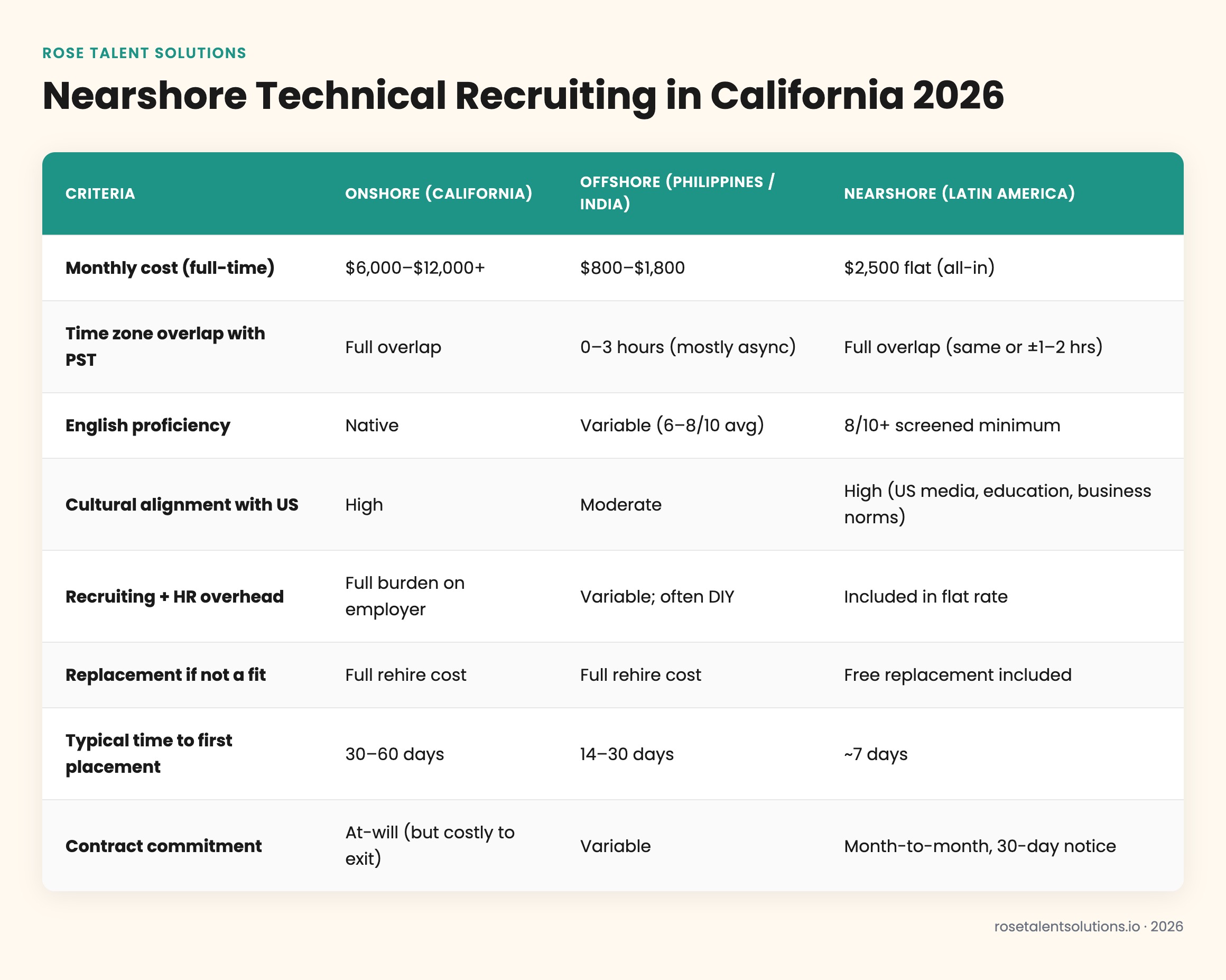
The offshore price point looks attractive on paper, but the hidden cost is throughput. Every question that requires a back-and-forth adds a full business day of lag when your team is 12 time zones away. For technical recruiting specifically — where speed-to-screen and speed-to-offer are competitive advantages — that lag is a direct threat to your pipeline. The full onshore vs offshore breakdown digs into exactly where that cost shows up in real workflows.
Remote work adoption has also accelerated candidate expectations. According to Pew Research Center's analysis of remote work trends (2023), a majority of workers who can do their jobs remotely say they want to continue doing so — and the same preference applies to the high-quality Latin American professionals driving the nearshore talent pool. The supply of motivated, experienced nearshore candidates is growing precisely because remote work is now their default.
How California's Labor Market Makes Nearshore Recruiting More Valuable in 2026
California isn't just expensive — it's structurally expensive. AB 5 classification rules, high workers' comp rates, mandatory sick leave, and some of the highest employer payroll tax burdens in the country mean that every W-2 hire carries a multiplier well above base salary. The fully-loaded cost of a California-based technical recruiter earning $75,000 in base pay can easily reach $95,000–$110,000 when you add benefits, taxes, and overhead.
California's labor market for tech-adjacent roles remains highly competitive heading into 2026. According to the U.S. Bureau of Labor Statistics — California regional data (2024), tech-adjacent occupations in California continue to show above-average wage growth, compressing margins for companies that rely on headcount-heavy models. Nearshore technical recruiting gives California businesses a way to add capacity without adding California payroll.
It's also worth understanding the supply side. Latin America has produced a rapidly growing pool of English-fluent, technically literate professionals over the last decade — driven by US-curriculum bootcamps, bilingual universities, and the explosion of remote work infrastructure. If you want context on where these professionals are coming from and what they typically earn, the Rose post on virtual assistant companies in Latin America covers the regional landscape in detail.
"The talent pool in Latin America for technical and operations roles has matured significantly. We're seeing candidates with 5–8 years of US-market-facing experience who are choosing remote roles over local employment because the economics work better for them too." — Agustina Ruiz, Head of Talent Acquisition at Toptal Latin America (2024)

What Roles Can Nearshore Technical Recruiting in California Actually Fill in 2026?
The phrase "technical recruiting" covers a wide range of functions, and nearshore delivery works across nearly all of them. The most common roles California businesses are filling through nearshore models in 2026 include: technical sourcers (Boolean search, LinkedIn Recruiter, GitHub profile outreach), recruiting coordinators (scheduling, ATS management, candidate communications), HR operations specialists (offer letters, onboarding workflows, compliance tracking), and full-cycle technical recruiters managing requisitions end-to-end.
The roles most suited to nearshore technical recruiting are ones where real-time communication matters more than physical presence. If the job can be done over Slack, Zoom, LinkedIn, and your ATS — and most recruiting coordination can — nearshore delivery is a direct substitute for an onshore hire at a fraction of the cost.
Rose team members also arrive with role-specific AI copilots trained on the tools your team already uses — whether that's Greenhouse, Lever, Workday, or a custom ATS stack. This AI advantage means new team members aren't starting from scratch on your workflows; they're already familiar with the software layer before day one. According to McKinsey's State of Organizations report (2023), companies that combine human talent with AI-assisted workflows see productivity gains of 20–30% over teams using either alone. Nearshore plus an AI copilot is that combination, already packaged.
The productivity case is also backed by engagement research. Gallup's State of the Global Workplace report (2023) found that remote workers who have clear role definition and real-time manager access consistently outperform co-located workers in time-to-task metrics. Nearshore team members — operating in your time zone with daily communication — hit that benchmark by default.
Beyond technical recruiting specifically, many California businesses extend their nearshore team into adjacent functions. Rose supports property management operations and bookkeeping and accounting functions through the same model — which means companies that start with a recruiting coordinator often expand into a broader nearshore operations team over time.
If you're evaluating what a nearshore team member should actually earn in their home market — and what that means for your all-in cost — the Rose post on average salaries for Latin America virtual assistants gives you transparent benchmark data to work from.
How Rose Talent Solutions Makes Nearshore Technical Recruiting Simple for California Teams in 2026
Most California businesses don't have time to build a nearshore recruiting process from scratch. Sourcing candidates in Latin America, running language and skills assessments, handling cross-border payroll, and managing ongoing HR compliance are each full-time problems on their own. Rose Talent Solutions handles every layer of that stack so you never have to.
Intake & Role Scoping
You tell Rose what the role needs to accomplish — the ATS platforms, the volume of reqs, the communication style. Rose translates that into a candidate brief against a vetted Latin America talent pool.
Vetting & Matching
Every candidate clears Rose's English proficiency screen (8/10+ minimum), a skills assessment for your specific tools, and a cultural alignment interview before you see their profile. You don't interview people who don't qualify.
Placement in ~7 Days
Most placements land within a week of intake. Your new team member joins your Slack, logs into your ATS, and starts contributing to your pipeline — not completing onboarding paperwork.
Ongoing Management & Support
Rose handles payroll, HR, and performance oversight. If the team member isn't the right fit, Rose replaces them at no additional cost — no re-recruiting fee, no lost deposit.
Month-to-Month Flexibility
There's no long-term contract. Cancel with 30 days written notice if your needs change. Rose's model is designed around your business cycle, not a rigid multi-year commitment.
The pricing is flat at $2,500/month — full-time, 40 hours per week, with recruiting, vetting, payroll, HR, and ongoing management all included. There are no hidden fees, no per-placement charges, and no surprise invoices when you need a replacement. According to Gallup's research on employee turnover costs (2019, updated benchmarks 2023), replacing an employee costs 50–200% of their annual salary. Rose's free replacement guarantee removes that risk entirely from your nearshore headcount.
Workforce flexibility has become a board-level priority since 2020. Deloitte's Global Human Capital Trends report (2023) found that 63% of executives rated workforce adaptability — the ability to scale teams up or down quickly — as a top-three strategic priority. Month-to-month nearshore staffing is the direct operational answer to that priority.
Why Nearshore Technical Recruiting Works for California
- Full PST/PT business hours overlap — real-time collaboration, no async lag
- English proficiency screened to 8/10+ minimum — communication is not a guessing game
- Latin America cultural alignment with US business norms — less ramp friction
- $2,500/month all-in vs $95,000+ fully-loaded California salary
- Month-to-month terms — scales with your hiring cycle, not locked in
- AI copilot included — team member arrives trained on your ATS stack
When to Think Carefully Before Hiring Nearshore
- Roles requiring on-site presence (e.g., in-person interview coordination at a California office) need a hybrid plan
- Highly regulated functions (e.g., licensed HR compliance work) may require local counsel in addition
- If your internal team isn't remote-ready, nearshore onboarding takes longer than expected
If you're ready to stop overpaying for California-market recruiting capacity and want to see how nearshore technical recruiting fits your specific workflows, getting started with Rose takes less than 10 minutes — and your first placement can be active within a week.
The companies winning the 2026 California talent race aren't the ones with the biggest recruiting budgets. They're the ones who figured out how to move faster, communicate in real time, and keep fixed costs low while competitors are still debating the hire. Nearshore technical recruiting is how you do all three at once.