
Nearshore tech recruitment is quietly reshaping how California businesses hire in 2026. Instead of competing in one of the world's most expensive talent markets — or accepting the timezone headaches of offshore teams in Asia — hundreds of California companies are now building technical support functions with Latin American professionals who work the same hours, speak fluent English, and cost a fraction of a Bay Area salary. This guide breaks down exactly how nearshore tech recruitment works, what it costs, and whether it's the right move for your business this year.
What Is Nearshore Tech Recruitment — and Why Does It Matter in 2026?
Nearshore tech recruitment is the practice of hiring technical talent from countries geographically and culturally close to your own — for US businesses, that means Latin America. Unlike offshore recruitment (which typically points to India or the Philippines), nearshore hiring keeps your team within 0–3 hours of your timezone. That matters enormously for real-time collaboration, daily standups, and any role that needs to respond to customers or internal teams without a 12-hour lag.
California's tech labor market makes nearshore staffing especially attractive. The state's median software developer wage hit $145,000 per year, according to the U.S. Bureau of Labor Statistics (2024). When you layer on benefits, payroll taxes, and recruiting fees, a single mid-level technical hire can easily cost $180,000–$200,000 fully loaded. Nearshore professionals performing comparable technical support, coordination, and operations roles can be onboarded for a fraction of that — all-in, with no recruiting overhead on your side.
If you want a deeper breakdown of how nearshore compares structurally to other staffing models, Rose's complete nearshore vs. offshore vs. onshore comparison covers every dimension in detail.
How California Companies Are Using Nearshore Tech Talent in 2026
Nearshore staffing in the tech context doesn't always mean replacing engineers. Most California businesses using nearshore recruitment are filling technical support, operations, and coordination roles that sit around their core engineering teams. Think: technical account coordinators, software-trained virtual operations staff, QA support, IT help desk, CRM administration, and data entry with tools like Salesforce, HubSpot, QuickBooks, or industry-specific platforms.
These are roles where real-time availability matters — someone needs to answer a support ticket at 10am Pacific, not batch-process it overnight. That's where Latin America has a structural advantage over traditional offshore markets. A team member in Bogotá, Mexico City, or Buenos Aires is working the same morning you are.
The size of the global business process outsourcing market signals just how mainstream this shift has become. The BPO market was valued at $280.6 billion in 2023 and is projected to grow at a CAGR of 9.4% through 2030, according to Grand View Research (2024). Latin America is capturing a growing share of that growth specifically because of timezone alignment with North America.

How Nearshore Compares to Offshore and Onshore Tech Recruitment in 2026
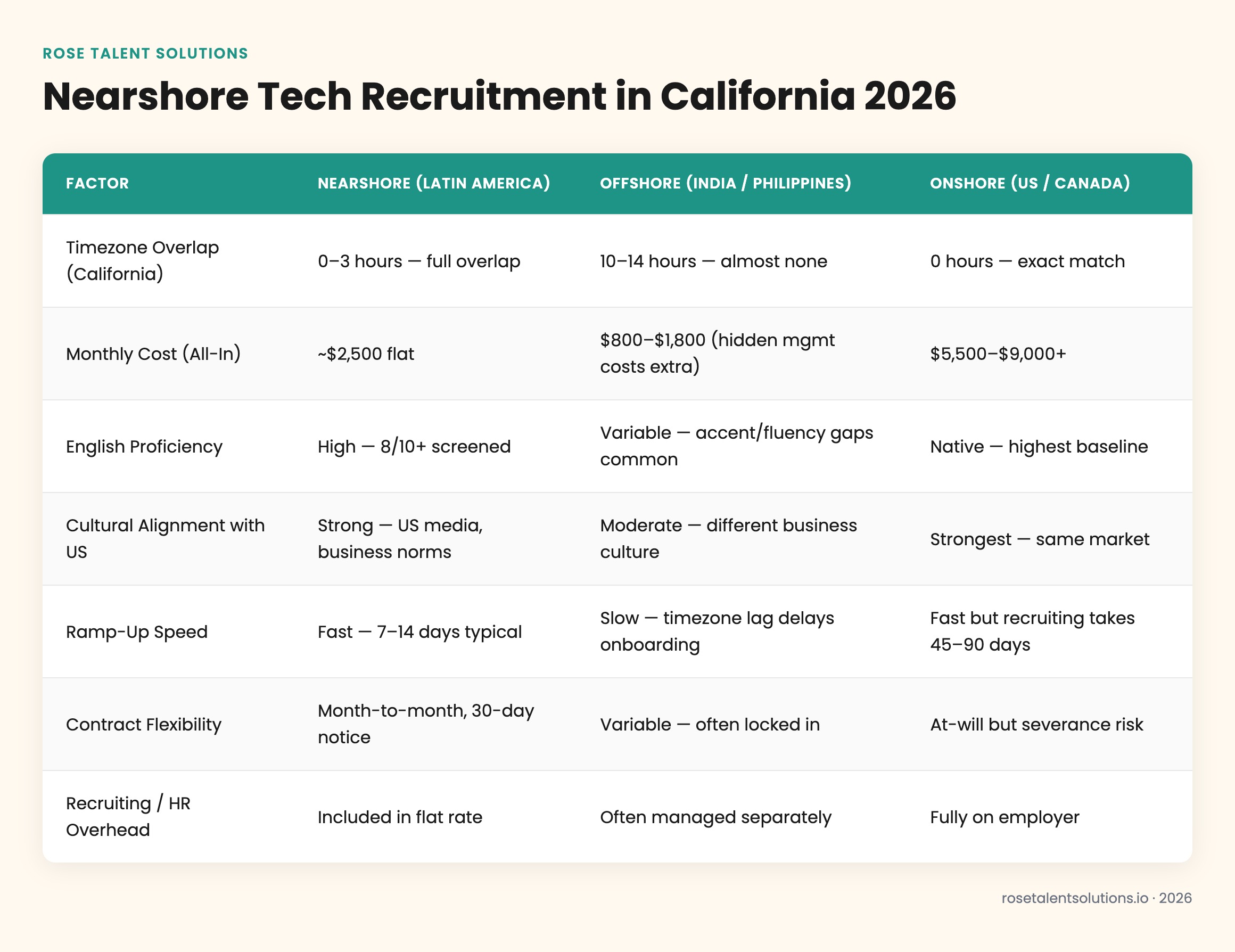
The three-way comparison between nearshore, offshore, and onshore hiring is where most California business owners get clarity. Each model has a real place — but the tradeoffs are significant. Understanding them upfront saves you from an expensive mismatch six months down the road.
For a deeper look at the salary dynamics on the Latin America side of this equation, the breakdown of average Latin America virtual assistant salaries explains why the $2,500/month all-in model works economically for both sides.
| Factor | Nearshore (Latin America) | Offshore (India / Philippines) | Onshore (US / Canada) |
|---|---|---|---|
| Timezone Overlap (California) | 0–3 hours — full overlap | 10–14 hours — almost none | 0 hours — exact match |
| Monthly Cost (All-In) | ~$2,500 flat | $800–$1,800 (hidden mgmt costs extra) | $5,500–$9,000+ |
| English Proficiency | High — 8/10+ screened | Variable — accent/fluency gaps common | Native — highest baseline |
| Cultural Alignment with US | Strong — US media, business norms | Moderate — different business culture | Strongest — same market |
| Ramp-Up Speed | Fast — 7–14 days typical | Slow — timezone lag delays onboarding | Fast but recruiting takes 45–90 days |
| Contract Flexibility | Month-to-month, 30-day notice | Variable — often locked in | At-will but severance risk |
| Recruiting / HR Overhead | Included in flat rate | Often managed separately | Fully on employer |
What Does Nearshore Tech Recruitment Actually Cost in California in 2026?
Let's get specific about numbers — because "cheaper than local" doesn't mean much without context. The fully loaded cost of a mid-level technical operations hire in California (salary + benefits + payroll taxes + recruiting fee) typically lands between $85,000 and $130,000 per year depending on role seniority. That's before you account for the 45–90 days of recruiter time it takes to fill the seat.
A nearshore tech operations team member through Rose Talent Solutions is $2,500/month flat — $30,000 per year. That price is all-in: recruiting, vetting, payroll processing, HR administration, and ongoing management are included. There's no separate agency fee stacked on top, and no long-term contract locking you in. You operate month-to-month with 30 days written notice to cancel.
The savings aren't just in base compensation. According to SHRM (2023), the average cost-per-hire in the United States is $4,683 — and that's before any salary is paid. With nearshore staffing, that recruiting cost is absorbed into the flat monthly rate. You don't pay a recruiter and then pay a salary. You pay one number and get a vetted, placed, and managed team member.
The real cost comparison isn't $2,500/month nearshore vs. a $25/hour offshore freelancer. It's $30,000/year all-in vs. $120,000+/year fully loaded onshore — plus the 90 days you lose while the onshore seat sits open.
Rose's AI copilot advantage adds another layer of leverage. Every team member placed through Rose ships with a role-specific AI assistant trained on the software stack they'll actually use — Salesforce, HubSpot, QuickBooks, or whatever platform your business runs on. That means shorter ramp time and fewer "how do I do X?" delays in the first weeks.

How the Rose Nearshore Recruitment Process Works — Step by Step
One of the most common questions California business owners ask is: "How fast can you actually place someone?" The answer depends on role complexity, but most placements happen within 7–14 days of intake. Here's what the process looks like end-to-end.
Intake & Role Definition
You tell Rose the role, the software stack, the hours, and the personality fit. A 30-minute call is usually enough to capture everything needed.
Candidate Vetting
Rose screens for English proficiency (8/10+ bar), technical skill, and cultural fit. You receive a shortlist of 2–3 matched candidates — you don't review 40 resumes.
Your Interview
You meet the shortlisted candidates on video. Most clients select in one round. If nobody clicks, Rose re-runs the search at no additional cost.
Onboarding & AI Copilot Setup
Rose handles payroll, HR paperwork, and activates the team member's role-specific AI copilot before day one. Your job is to run a system walkthrough — nothing else.
Ongoing Management
Rose stays in the background handling HR issues, performance check-ins, and compliance. If the placement isn't a fit at any point, Rose replaces them at no additional cost.
That replacement guarantee is the core risk reversal. There's no free trial, and there's no hedging — if the team member doesn't work out, you get a replacement. That's it. You're not locked in, and you're not eating a bad hire.
Why Latin America Specifically — and Not Other Nearshore Regions?
The term "nearshore" gets applied loosely, so it's worth being precise. For California businesses, Latin America is the only nearshore region that checks every box simultaneously: timezone alignment, English fluency, strong university-educated talent pipelines, and cultural familiarity with US business norms. Eastern Europe is technically "nearshore" for Western Europe — not for California at 9 hours' difference.
Latin America's tech talent pool has grown dramatically. According to the Inter-American Development Bank (2023), Latin America produces over 1.1 million STEM graduates per year — a pipeline that's expanded significantly with remote-work infrastructure investments post-2020. Countries like Colombia, Mexico, Argentina, and Brazil now have mature freelancer and staffing ecosystems specifically oriented toward the US market.
For context on which companies are leading this space and what to look for when vetting a nearshore provider, Rose's overview of virtual assistant companies operating in Latin America is a useful reference before you compare vendors.
English proficiency is another area where Latin America's trajectory is measurable. EF's English Proficiency Index (2023) ranked several Latin American countries — including Argentina and Costa Rica — in the "High Proficiency" tier globally, with improvement trends outpacing most Southeast Asian markets year-over-year.
Why Nearshore Latin America Works for California
- 0–3 hour timezone difference — real-time collaboration without scheduling acrobatics
- Strong English proficiency with US-accent familiarity
- University-educated talent pipeline growing at scale
- Cultural alignment: US TV, media, and business norms are mainstream
- No long-term contract — cancel with 30 days written notice
- All-in flat pricing — no hidden recruiting or HR fees
What to Watch For
- Quality varies significantly by provider — vetting standards matter
- Not every role is a fit — highly specialized engineering roles may still need onshore
- Requires clear onboarding documentation on your side — garbage in, garbage out
How to Evaluate Whether Nearshore Tech Recruitment Is Right for Your California Business
Nearshore tech recruitment works best for roles that require real-time responsiveness, consistent software usage, and clear process documentation — but don't require physical presence or US licensure. If you're a California SaaS company, property tech firm, fintech operation, or any business with recurring technical operations work, you almost certainly have roles that fit this profile.
The clearest signal that nearshore is the right move: you have a role that's been open for more than 60 days, or you're currently doing the work yourself because you can't justify a $100K+ local hire for it. Those situations are exactly what nearshore staffing was designed to solve.
If you're still mapping out whether a virtual staffing model fits your operations at all, comparing the full tradeoffs between onshore and offshore virtual staffing is a useful first step before committing to any model.
Businesses that use nearshore staffing for technical operations roles — CRM coordination, data management, technical customer support, bookkeeping with tools like QuickBooks — can explore Rose's bookkeeping and accounting virtual staff or the broader start page to scope a role in under 30 minutes.
"The companies winning on talent right now aren't the ones paying the most — they're the ones building smarter access to global pools while their competitors are still posting on LinkedIn and waiting." — Matt Mochary, CEO Coach and Author of The Great CEO Within (2023)
The bottom line for 2026: California's tech talent market is not getting cheaper or faster. Nearshore recruitment through a managed provider like Rose gives you a vetted, software-trained, English-fluent team member working your hours — for $2,500/month flat, with no long-term contract and a free replacement guarantee if the fit isn't right. That's a different category of decision than it was even three years ago.