
What Are Nearshore Talent Solutions in 2026?
Nearshore talent solutions are staffing arrangements where a business hires full-time remote workers from geographically close countries — typically Latin America for US and Canadian companies — rather than from distant regions like Southeast Asia or South Asia. The word "nearshore" is doing real work here: it signals shared or overlapping time zones, cultural familiarity with North American business norms, and English fluency that doesn't require a 6 AM call just to sync on a task. If you've been researching ways to grow your team without ballooning payroll, nearshore staffing is likely the most practical answer you haven't fully explored yet.
The model gained serious traction between 2022 and 2024 as remote infrastructure matured across Latin America. By 2026, it's no longer a niche experiment — it's a mainstream hiring strategy for property management companies, e-commerce operators, accounting firms, and professional services businesses across the US. According to SHRM's Global Talent Trends research (2024), nearly 60% of US employers now say geographic flexibility is a top-three priority when building support teams — a number that has climbed every year since 2020.
A nearshore VA (virtual assistant) is a full-time remote team member based in a Latin American country — Mexico, Colombia, Argentina, Costa Rica, or similar — who works your business hours, communicates fluently in English, and operates inside your existing software stack. At Rose Talent Solutions, every team member clears an 8/10 or higher English proficiency screen before they ever reach a client interview. That bar matters more than most hiring managers realize until they've dealt with the alternative. For a deeper breakdown of how the model stacks up against other options, see our complete nearshore vs. offshore vs. onshore virtual assistant comparison.
How Nearshore Talent Solutions Solve the 2026 Hiring Crunch
US businesses are facing a persistent labor squeeze. The Bureau of Labor Statistics Job Openings and Labor Turnover Survey (2024) consistently shows millions of unfilled positions in administrative, operational, and customer-facing roles — categories where nearshore VAs excel. At the same time, fully loaded onshore salaries for these roles have climbed well past $50,000 annually when you factor in benefits, payroll taxes, and recruiting overhead.
The nearshore model compresses that cost dramatically without the timezone penalty you absorb with traditional offshore hiring. Time zone alignment is the single biggest operational difference between nearshore and offshore staffing — and most buyers underestimate it until they're three weeks into working with someone who batches all responses overnight. Latin American team members working US hours can answer a leasing inquiry at 10 AM, join a Thursday all-hands on Zoom, and flag an urgent bookkeeping discrepancy before the bank closes — all in the same workday as your in-house team.
Rose's flat-rate structure — $2,500/month, covering recruiting, vetting, payroll, HR, and ongoing management — removes the guesswork from budgeting. You're not negotiating hourly rates or absorbing surprise employer taxes. The all-in pricing is intentional: when operators know exactly what a team member costs, they make smarter decisions about how many to hire and which roles to fill first. If you're evaluating virtual assistant companies in Latin America, pricing transparency is one of the first filters worth applying.

How Nearshore Compares to Offshore and Onshore Staffing in 2026
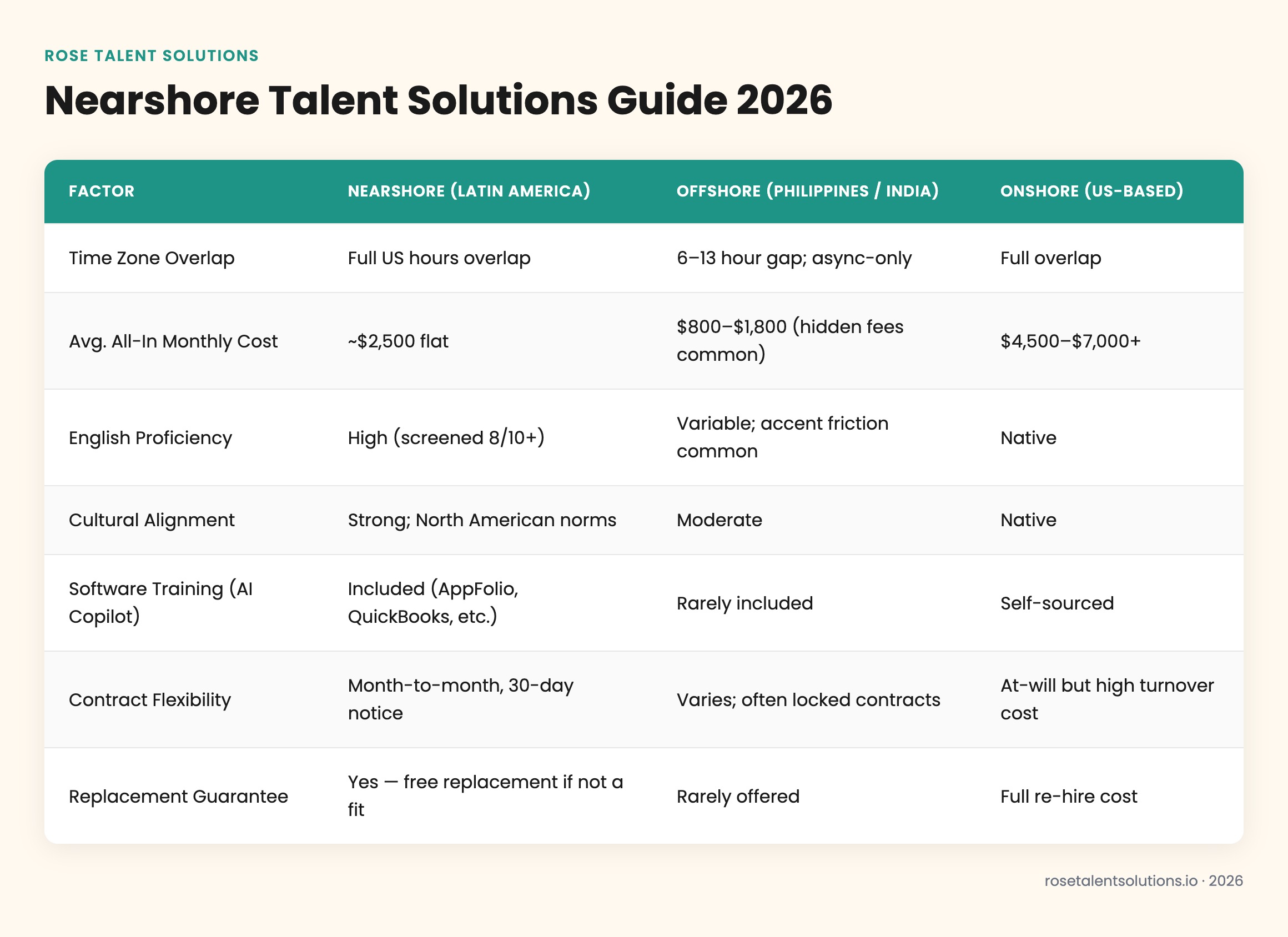
The three staffing options most US businesses consider — nearshore, offshore, and onshore — differ across several dimensions that compound over time. Price is the most visible variable, but it's rarely the most important one after the first 90 days. Response latency, communication overhead, and cultural fit tend to dominate the conversation once a team is actually running.
| Factor | Nearshore (Latin America) | Offshore (Philippines / India) | Onshore (US-based) |
|---|---|---|---|
| Time Zone Overlap | Full US hours overlap | 6–13 hour gap; async-only | Full overlap |
| Avg. All-In Monthly Cost | ~$2,500 flat | $800–$1,800 (hidden fees common) | $4,500–$7,000+ |
| English Proficiency | High (screened 8/10+) | Variable; accent friction common | Native |
| Cultural Alignment | Strong; North American norms | Moderate | Native |
| Software Training (AI Copilot) | Included (AppFolio, QuickBooks, etc.) | Rarely included | Self-sourced |
| Contract Flexibility | Month-to-month, 30-day notice | Varies; often locked contracts | At-will but high turnover cost |
| Replacement Guarantee | Yes — free replacement if not a fit | Rarely offered | Full re-hire cost |
"Remote work has permanently shifted how businesses think about talent geography. The question is no longer 'can this be done remotely?' — it's 'what time zone do I need this person in?'" — Johnny C. Taylor Jr., President & CEO at SHRM (2024)
The offshore model's lower sticker price is real. But the total cost of a 10-hour timezone gap — delayed tenant responses, missed vendor calls, async-only collaboration on urgent issues — erodes that savings quickly. For a detailed side-by-side of working styles, our post on onshore vs. offshore virtual assistants walks through the operational tradeoffs in depth.
What Roles Do Nearshore Talent Solutions Cover in 2026?
The range of roles that work well in the nearshore model has expanded significantly as Latin American professionals have gained exposure to US software ecosystems. In 2026, the strongest use cases cluster around four categories: property management operations, bookkeeping and accounting support, customer-facing coordination, and executive/administrative assistance.
Property management is one of the highest-demand verticals for nearshore staffing. A trained property management virtual assistant handles leasing inquiries, maintenance coordination, tenant communications, rent roll updates, and inspection scheduling — all tasks that require real-time responsiveness and familiarity with platforms like AppFolio and Buildium. According to Buildium's State of the Property Management Industry Report (2024), 58% of property management companies cite staffing and operations as their top growth constraint — a gap nearshore VAs are increasingly filling.
On the finance side, a nearshore bookkeeping and accounting VA trained on QuickBooks or Xero can handle accounts payable, bank reconciliations, monthly close support, and financial reporting — tasks that previously required a part-time CPA or a costly domestic bookkeeper. Every Rose team member ships with a role-specific AI copilot trained on the software relevant to their function, which means your AppFolio coordinator isn't learning the platform from scratch on your dime.

The AI copilot advantage is not a marketing claim — it's a structural ramp-time difference. A VA who already knows AppFolio's work order module before day one doesn't cost you two weeks of onboarding. That's billable time you recover immediately at $2,500/month flat.
According to McKinsey's research on generative AI and workforce productivity (2023), AI-augmented workers in administrative and operational roles demonstrate 20–40% higher throughput on task-completion benchmarks compared to unaugmented peers doing the same work. That gap widens when the AI is role-specific rather than general-purpose — which is exactly what Rose's copilot model delivers. Learn more about how that works on the AI advantage page.
How the Rose Nearshore Hiring Process Works in 2026
One of the biggest objections operators raise about nearshore staffing is complexity: "How long does this actually take?" The answer, done right, is fast. Here's the sequence Rose runs for every placement:
Role Discovery Call
Rose's team maps your specific workflows, software stack, and communication preferences — not a generic job description, but a role blueprint built around your actual operations.
Candidate Vetting & Shortlist
Candidates are screened on English proficiency (8/10+ floor), software familiarity, and role-specific competencies. You receive a curated shortlist — typically within days, not weeks.
Client Interview & Selection
You interview your top candidates and choose the right fit. No staffing agency pressure — you make the final call.
Onboarding & AI Copilot Activation
Your team member's role-specific AI copilot is activated before their first day. Rose handles payroll, HR paperwork, and ongoing management from day one.
Ongoing Support & Free Replacement Guarantee
If the team member isn't the right fit at any point, Rose replaces them at no additional cost. Month-to-month terms mean you can cancel with 30 days written notice — no long-term contract required.
This process is designed to get you to a working team member in roughly one week — not one quarter. The Latin American talent pool Rose draws from is deep, particularly in countries with strong tech and business-services education infrastructure. For more context on what makes this region work so well for US businesses, the Latin America staffing agency guide covers the regional dynamics in detail.
Is Nearshore Staffing Right for Your Business in 2026?
Nearshore talent solutions work best for businesses that need real-time operational support — not just overnight task processing. If your team handles tenant calls, client inquiries, vendor coordination, or time-sensitive financial work during the business day, the timezone alignment of a Latin American team member is not a "nice to have." It's the difference between the model working and not working.
Nearshore Is a Strong Fit If You…
- Need real-time response during US business hours
- Use specific software (AppFolio, Buildium, QuickBooks, Xero)
- Want predictable, all-in monthly pricing with no hidden fees
- Prefer month-to-month flexibility over long-term contracts
- Value cultural alignment and minimal communication friction
- Want a free replacement guarantee rather than a re-hiring process
Nearshore May Not Be Ideal If You…
- Need purely overnight/overnight-shift coverage (offshore may fit better)
- Require a US-licensed professional (CPA, attorney, licensed PM)
- Want to manage payroll and HR entirely in-house
- Need highly niche technical skills not yet common in Latin American markets
According to Gallup's State of the Global Workplace report (2024), employees who work in time zones closely aligned with their managers report 23% higher engagement scores than those operating in asynchronous-only arrangements. That engagement difference translates directly to output quality and retention — two things that matter a great deal when you're paying a flat monthly rate and expecting consistent performance. If you're ready to explore placing your first nearshore team member, the fastest path forward is the get started page — the intake form takes under five minutes.
The question for most operators in 2026 isn't whether nearshore staffing works — the evidence is clear that it does. The real question is which roles to fill first, and how quickly you can get the right person in seat before your competitors do.