
Nearshore talent acquisition is quietly reshaping how US, Canadian, and UK businesses staff their operations — and 2026 is the year it goes mainstream. Unlike offshore outsourcing, which ships work to teams 10–12 time zones away, nearshore hiring pulls top-tier professionals from Latin America, keeping them inside your working day, your communication style, and your culture. If you've ever lost hours chasing a contractor who went dark overnight, you already understand the problem nearshore solves.
This guide breaks down exactly what nearshore talent acquisition is, how it differs from every other staffing model, what you should pay, and how to evaluate providers — without the buzzword fog.
According to SHRM (2024), 72% of small business owners cite talent acquisition as their single biggest operational hurdle. Nearshore staffing is increasingly the answer — not because it's cheap, but because it delivers full-time, dedicated professionals at a cost structure domestic hiring simply cannot match.
What Is Nearshore Talent Acquisition in 2026?
Nearshore talent acquisition is the practice of hiring full-time or part-time workers from geographically close countries that share similar time zones with the hiring business. For US and Canadian companies, that means Latin America — countries like Colombia, Mexico, Argentina, Costa Rica, and Brazil. Workers operate during standard US business hours, communicate in fluent English, and integrate directly into your existing tools and workflows.
This is meaningfully different from offshore outsourcing (think Philippines or India), where time zone gaps of 8–13 hours force asynchronous collaboration and slow every decision cycle. It's also different from domestic (onshore) hiring, where fully-loaded employee costs regularly exceed $70,000 per year for roles that don't require physical presence. If you want the full breakdown, Rose's complete comparison of nearshore vs. offshore vs. onshore virtual assistants walks through every tradeoff in detail.
The Latin America talent pool is large, educated, and growing fast. According to the Inter-American Development Bank (2023), university enrollment across Latin America has more than doubled over the past two decades, producing a surge of degree-holding professionals in accounting, administration, marketing, and technology — exactly the roles US businesses struggle to fill affordably at home.

How Nearshore Compares to Offshore and Onshore Hiring in 2026
Before you decide on any staffing model, you need a clear apples-to-apples comparison. The table below covers the seven factors that actually matter when you're making a hiring decision — not the ones that look good in a sales deck.
| Factor | Nearshore (Latin America) | Offshore (Philippines / India) | Onshore (US-based) |
|---|---|---|---|
| Time Zone Overlap | Full US business hours | 8–13 hour gap; mostly async | Full overlap |
| English Proficiency | High (Rose screens 8/10+) | Varies; accent barriers common | Native |
| Monthly Cost (Full-Time) | ~$2,500 all-in | $800–$1,500 (plus mgmt overhead) | $4,500–$7,000+ fully loaded |
| Cultural Alignment | Strong (US media, business norms) | Moderate | Native |
| Recruiter / HR Overhead | Included in flat rate | Usually DIY or extra fee | Significant (ATS, benefits, taxes) |
| Replacement if Not a Fit | Free replacement (Rose policy) | Rarely included | Full rehire cost (~$4,000+) |
| Contract Terms | Month-to-month, 30-day notice | Varies (often annual) | At-will but high severance risk |
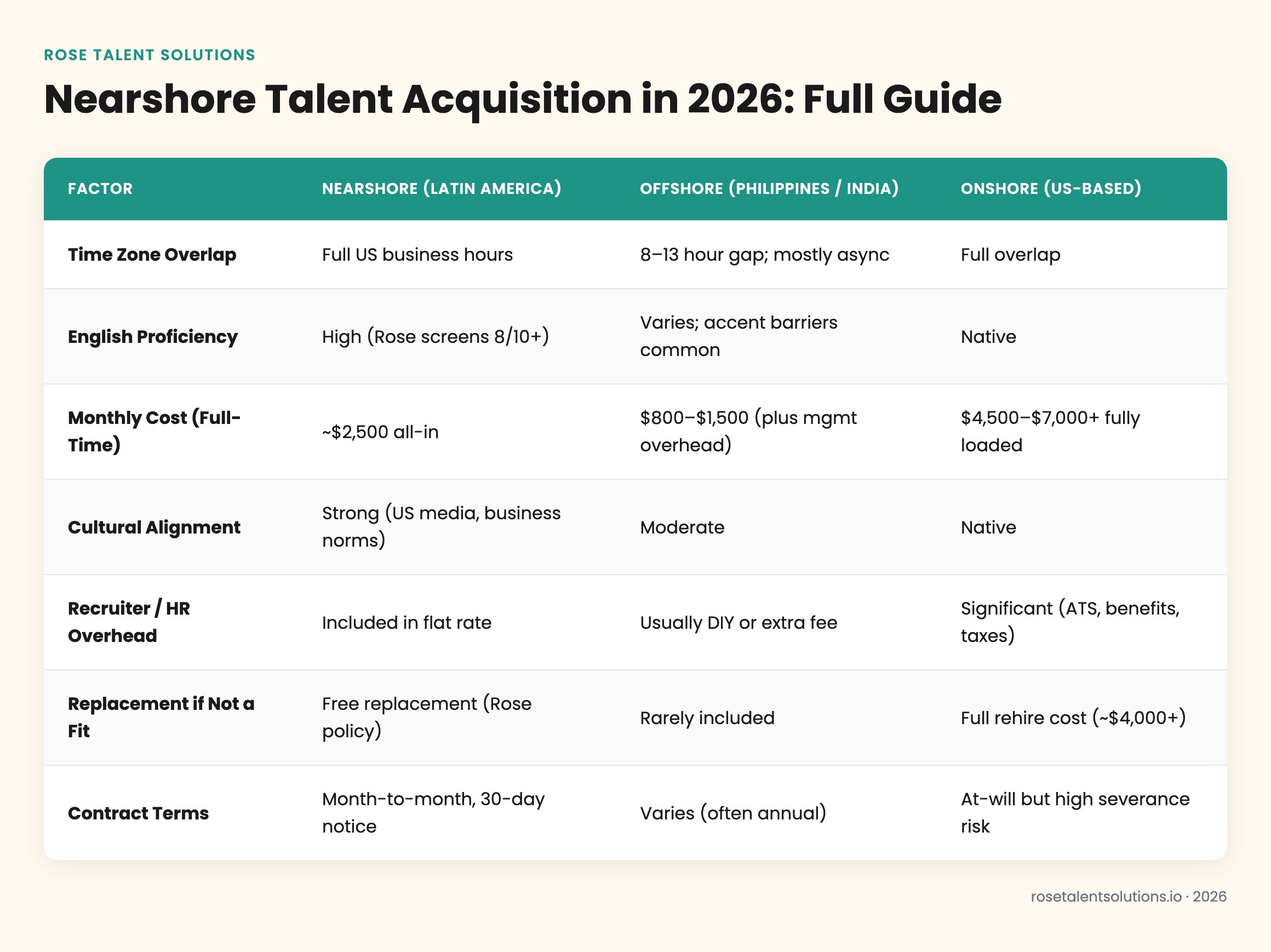
The offshore price advantage looks compelling on a spreadsheet until you factor in management friction, rework from timezone gaps, and the hidden cost of slow communication. For a deeper look at why the cost comparison isn't as simple as hourly rates, see Rose's analysis of onshore vs. offshore virtual assistant tradeoffs — it quantifies the soft costs most business owners ignore.
How the 2026 Nearshore Talent Acquisition Process Actually Works
Most business owners assume hiring a nearshore professional is complicated — that it involves setting up a foreign entity, navigating labor law in another country, or managing payroll across borders. With a managed nearshore staffing partner, none of that falls on you. Here's exactly how the process works at Rose Talent Solutions:
Role Discovery Call
You describe the role, the software your team uses, and the hours you need covered. Rose maps that to a specific candidate profile — not a generic VA, but someone with demonstrated experience in your stack.
Vetting and Matching
Rose screens candidates on English proficiency (minimum 8/10), technical skills, and culture fit. You review a shortlist — typically within a week — and select your hire.
AI Copilot Onboarding
Every Rose team member ships with a role-specific AI copilot pre-trained on their software — whether that's AppFolio, Buildium, QuickBooks, or another tool your business runs on. This cuts ramp time dramatically. Learn more on the AI advantage page.
Active Management and HR
Rose handles payroll, HR, compliance, and ongoing performance oversight. You manage the work; Rose manages the employment relationship.
Free Replacement if Needed
If the team member isn't the right fit for any reason, Rose replaces them at no additional cost. There's no long-term contract and no penalty for a change.
This model is particularly powerful for property management companies, which need staff who can operate inside specialized platforms on a live, real-time basis. Rose's property management virtual assistant service places coordinators already trained on AppFolio, Buildium, and Yardi — reducing onboarding drag from months to days.
"The real competitive advantage in 2026 isn't automation alone — it's pairing skilled nearshore professionals with purpose-built AI tools so they operate at a level that was previously only possible with a much larger in-house team." — Matthew Whitaker, CEO at Evernest (2024)
What Does Nearshore Talent Acquisition Cost in 2026?
Pricing in the nearshore VA market ranges from roughly $1,200 to $4,000 per month for full-time support, depending on the provider model and what's included. The lower end typically means a freelance marketplace where you're doing your own recruiting, vetting, payroll, and HR — which sounds cheap until you price your own time. The higher end includes fully managed services where all of that is handled for you.
According to SHRM's Human Capital Benchmarking Report, the average cost to replace a single US employee is $4,129 — and that figure doesn't include the productivity loss during the vacancy window. Nearshore staffing with a free-replacement guarantee structurally eliminates that risk.
The broader labor market context reinforces the urgency. The U.S. Bureau of Labor Statistics Job Openings and Labor Turnover Survey (2024) consistently shows more than 8 million open positions in the US economy — a supply gap that domestic hiring alone cannot close. Nearshore talent acquisition has emerged as a structurally sound answer to that gap for roles that don't require physical presence.
Rose Talent Solutions charges a flat $2,500 per month. That's all-in: recruiting, vetting, payroll processing, HR management, and the AI copilot onboarding layer. There are no add-on fees, no long-term contract, and you can cancel with 30 days written notice. For roles like bookkeeping or accounts payable — where accuracy directly affects cash flow — the Rose bookkeeping and accounting virtual assistant service provides QuickBooks-trained professionals at that same flat rate.
Curious how Latin America salary benchmarks translate into what a nearshore provider can sustainably charge? Rose's breakdown of average Latin America virtual assistant salaries explains the economics in plain terms — and why the $2,500 flat rate is structured the way it is.

The hidden cost of offshore staffing isn't the hourly rate — it's the 8–13 hour timezone gap that forces every decision, approval, and question into a 24-hour delay cycle. For US businesses handling tenant calls, client inquiries, or live transactions, that lag is operationally unacceptable. Nearshore eliminates it entirely.
How to Evaluate a Nearshore Talent Acquisition Partner in 2026
Not all nearshore staffing providers are built the same. Some are freelance marketplaces dressed up as agencies. Others are traditional outsourcing firms that rebranded after the nearshore trend picked up steam. Here's what to evaluate before you sign anything:
Green Flags
- Transparent, flat-rate pricing with no hidden add-ons
- English proficiency screening with a published minimum score
- Free replacement guarantee in writing — not just a verbal promise
- Month-to-month terms with a clear cancellation policy (30-day written notice is standard)
- Software-specific vetting — candidates tested on your actual tools, not just "admin experience"
- Active HR and payroll management included — you shouldn't be touching foreign compliance
Red Flags
- Offshore candidates presented as "nearshore" (Latin America geography matters — verify)
- Annual contracts with steep exit fees
- No published English proficiency standard
- Pricing that looks suspiciously low (under $1,000/mo for "full-time") — someone is cutting corners on vetting or worker compensation
- No replacement policy — you're on your own if the placement doesn't work out
The Latin American nearshore market has grown significantly enough that there are now dozens of providers. For context on what a legitimate provider landscape looks like, Rose's roundup of virtual assistant companies in Latin America covers the major players and what differentiates them.
According to Gallup's State of the Global Workplace report (2023), employees who feel actively managed and supported show 23% higher productivity than those left to self-manage — a finding that applies equally to nearshore professionals. This is why ongoing HR and management support, not just initial placement, is the differentiating service layer.
The managed staffing model is also gaining traction across the broader industry. According to McKinsey's Future of Work research (2024), businesses that use managed talent solutions — rather than transactional freelance platforms — report meaningfully higher retention and output consistency from their remote teams. Nearshore managed staffing sits squarely in that growth lane.
If you're ready to hire, the fastest path is a direct conversation about your specific role. Rose's intake process starts at rosetalentsolutions.io/start — no lengthy forms, no automated funnel, just a quick call to scope your role and start the match process.