
Nearshore talent has moved from a niche workaround to the default hiring strategy for growth-minded US businesses in 2026. Where distant offshore staffing once dominated the conversation around cost savings, operators are now waking up to a hard truth: a $10/hr VA located 10 or more time zones away costs you more in coordination friction, delayed communication, and rework than the hourly savings ever recover. The nearshore model — sourcing professionals from Latin America who work your exact US business hours — flips that equation entirely. You get comparable cost efficiency, real-time collaboration, and professionals who share cultural context with your US-based clients and customers.
This guide breaks down exactly what nearshore talent is, why it outperforms the alternatives in 2026, how to evaluate providers, and what your first hire should actually look like — with hard numbers attached to every claim.
What Is Nearshore Talent? A Working Definition for 2026
Nearshore talent refers to skilled remote professionals hired from countries geographically and culturally close to the employer's home market. For US and Canadian businesses, that means Latin America — countries like Colombia, Mexico, Argentina, Costa Rica, and Brazil. The defining feature isn't just proximity on a map — it's time zone alignment. A nearshore team member in Medellín works 9am–5pm EST, answers your Slack message before lunch, and attends your Tuesday standup without anyone setting an alarm at 3am.
Nearshore talent is distinct from distant offshore staffing models and from onshore talent (US-based contractors or employees). The nearshore model sits at the intersection of cost efficiency and operational compatibility — and in 2026, that intersection is exactly where fast-moving companies are staffing. If you want to dig deeper into how these three models stack up side-by-side, this complete comparison of nearshore vs offshore vs onshore virtual assistants walks through every tradeoff in detail.
According to SHRM's HR research division (2024), time zone friction is now the single most-cited complaint about distant offshore staffing relationships — more than accent or language issues, and more than price. That single data point explains a lot of what's driving the nearshore surge you're seeing in 2026.
How Nearshore Talent Compares to Offshore and Onshore in 2026
Not all remote talent is equal. The staffing model you choose shapes your team's productivity, your client experience, and your own stress level every single day. Here's how the three models compare across the dimensions that actually matter to operators:
| Factor | Nearshore (Latin America) | Distant Offshore Staffing | Onshore (US-based) |
|---|---|---|---|
| Time Zone Overlap | Full overlap (EST/CST/PST) | 0–4 hrs overlap; overnight batching common | Full overlap |
| Typical Monthly Cost (Full-Time) | $2,000–$3,500 all-in | $1,200–$2,000 all-in | $5,000–$9,000+ |
| English Proficiency | High (8/10+ screened) | Variable (6–8/10 average) | Native |
| Cultural Alignment with US Clients | Strong (US media, consumer culture) | Moderate | Full |
| Ramp-Up Speed (Days to Productivity) | 5–10 days with software training | 10–21 days average | 3–7 days |
| Availability for Real-Time Calls | Yes — during US business hours | No — often requires late-night scheduling | Yes |
| Typical Contract Structure | Month-to-month, no long-term contract | Varies; often 3–6 month minimums | At-will or 12-month common |
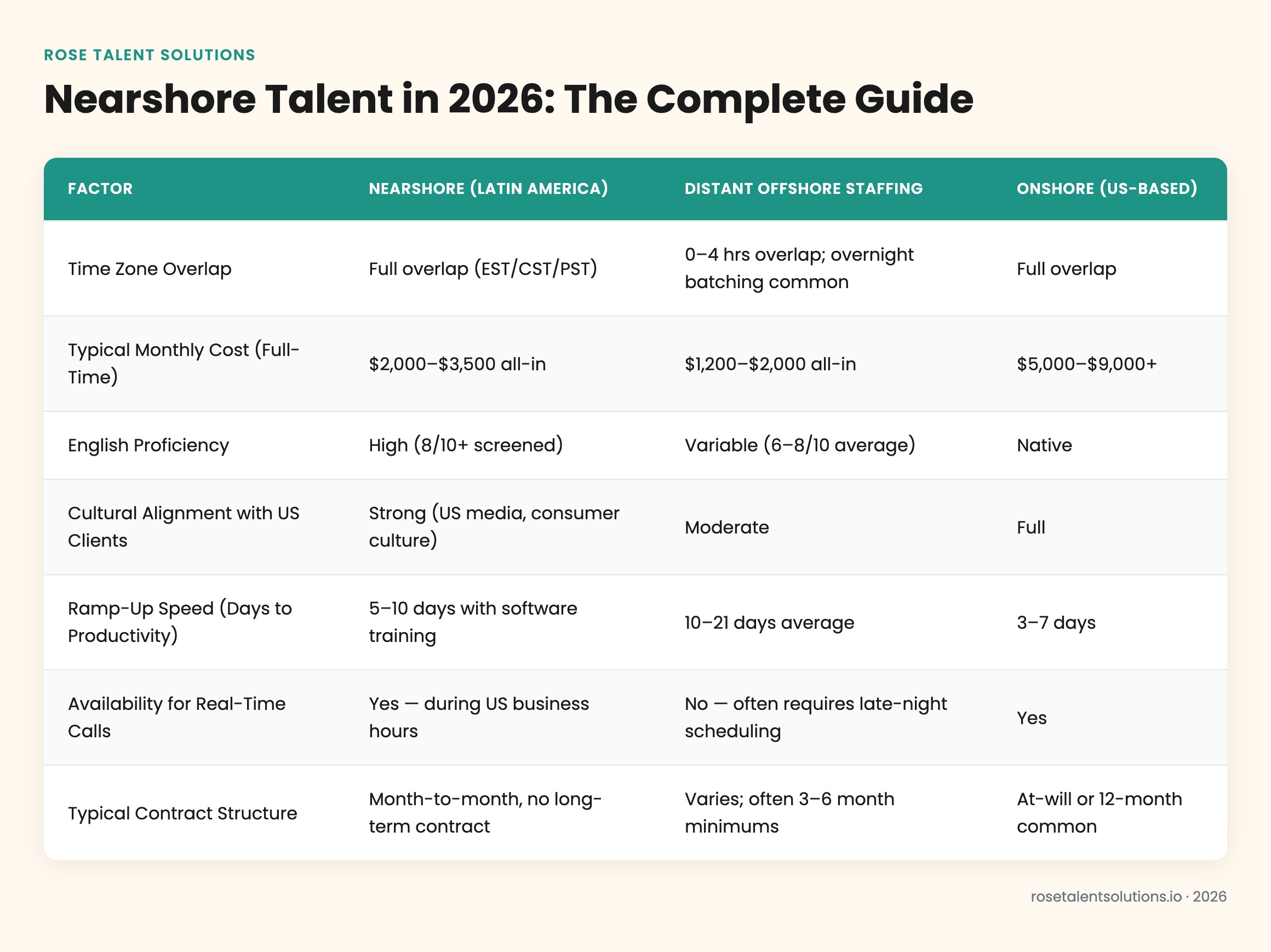
The takeaway from that table is consistent with what operators report in the field: nearshore talent gives you 80–90% of the onshore experience at 40–60% of the cost, while distant staffing options trade real-time collaboration for a slightly lower sticker price — a trade most businesses regret within 60 days.
"The companies winning right now are the ones treating Latin American talent as a strategic advantage, not a cost-cutting tactic. The professionals coming out of Bogotá, Mexico City, and Buenos Aires are every bit as skilled as their US counterparts — and far more accessible than anything you'll find in a distant time zone." — Matías Recchia, Co-Founder & CEO at IguanaFix (2023)

Why the 2026 Labor Market Is Pushing Operators Toward Nearshore Hiring
The US labor market in 2026 is not the same as it was in 2019. Wages for administrative and operational roles have climbed steadily — the US Bureau of Labor Statistics Occupational Employment data (2024) shows median annual wages for administrative support roles now exceed $47,000, putting a full-time in-house coordinator well above $55,000 once you factor in benefits, payroll taxes, and overhead. For a small operator running a lean team, that's a budget-breaking hire for a role that may only need 30–40 hours per week of attention.
At the same time, the talent pool in Latin America has expanded dramatically. University enrollment and bilingual professional development programs in Colombia, Mexico, and Argentina have produced a generation of workers fluent in English, trained on US-standard business software, and actively seeking roles with US employers. McKinsey's People & Organizational Performance research (2023) estimates that Latin America's skilled remote workforce will grow by 35% between 2023 and 2027 — driven largely by demand from North American businesses.
The result is a hiring window that won't stay open forever. The supply of high-quality nearshore talent is growing, but so is demand. Operators who build nearshore teams now are locking in better candidates at current pricing before the market tightens further. You can explore what this looks like for specific roles through Rose's breakdown of how a Latin America staffing agency actually sources and vets candidates — the process is more rigorous than most operators expect.
The hidden cost of distant staffing arrangements isn't the hourly rate — it's the 6–12 hour timezone gap that triples how long every back-and-forth issue takes to resolve. A tenant maintenance request that should take one phone call becomes a three-day email chain when your support team is asleep during US business hours.
According to Gallup's State of the Global Workplace report (2023), managers spend an average of 4.7 hours per week on coordination friction caused by asynchronous remote teams — time that compounds into lost revenue and operator burnout over a full year. Nearshore staffing eliminates that category of friction almost entirely, because your team is present and responsive during the same hours you are.
What Roles Are Best Suited for Nearshore Talent in 2026?
Nearshore talent performs strongest in roles that require real-time responsiveness, judgment calls, and ongoing communication — not just task execution. The following categories see the highest ROI when filled with nearshore professionals:
- Property management support: Tenant communication, maintenance coordination, lease renewals, and AppFolio or Buildium data entry. These roles need someone available during tenant-facing business hours. Learn more about Rose's property management virtual assistants and the specific tasks they handle.
- Bookkeeping and accounting: AP/AR, bank reconciliation, QuickBooks management, and month-end close support. Rose's bookkeeping and accounting virtual assistants are trained on the specific software your finance stack runs on.
- Executive and administrative support: Calendar management, inbox triage, CRM updates, research, and internal reporting.
- Customer success and client-facing coordination: Roles that require live phone or video availability during US business hours.
- Marketing operations: Social scheduling, content coordination, ad trafficking, and analytics reporting.
The common thread across all of these: they require a human who is present, responsive, and able to exercise judgment in real time. That's the nearshore value proposition — and it's why distant staffing arrangements consistently underperform in these categories despite a lower headline cost. For a detailed breakdown of how the onshore-versus-distant-offshore decision plays out specifically for VA roles, this analysis of onshore vs offshore virtual assistants lays out the trade-offs without sugarcoating either side.
How Rose Talent Solutions Delivers Nearshore Talent in 2026
Rose Talent Solutions places nearshore professionals from Latin America with US, Canadian, and UK businesses at a flat rate of $2,500 per month. That price includes recruiting, vetting, payroll, HR administration, and ongoing management — no hidden fees, no per-task billing, no long-term contract. If a placement isn't a fit, Rose replaces them at no additional cost.
Every team member also ships with a role-specific AI copilot trained on the software they'll actually use — AppFolio, Buildium, QuickBooks, and other platforms common in property management and professional services. That means your hire isn't learning your software from scratch on your dime. They arrive with working knowledge of your stack embedded into their workflow from day one.
The hiring process is structured to move fast without cutting corners on quality. Rose screens every candidate against a minimum 8/10 English proficiency bar, role-specific technical assessments, and a cultural fit evaluation before any candidate is presented to a client. The average time from kickoff call to first day on the job is seven days.
Kickoff Call
Rose learns your role requirements, software stack, and team culture in a 30-minute call. No RFP, no procurement cycle.
Candidate Matching
Rose surfaces 2–3 pre-vetted candidates from Latin America who meet your technical and communication requirements. You interview and select.
AI Copilot Setup
Your hire's role-specific AI copilot is configured to your software environment before their first day — AppFolio, QuickBooks, or whatever your stack requires.
Day One
Your nearshore team member is present, online, and productive during your US business hours from the start — no two-week onboarding ramp needed.
Ongoing Management
Rose handles HR, payroll, and performance management. You get the output — without the management overhead of a traditional hire.
Ready to place your first nearshore hire? Start the process at Rose Talent Solutions — the kickoff call takes 30 minutes and most clients have a candidate in front of them within 72 hours.
2026 Nearshore Talent: Pros, Cons, and Who It's Right For
Nearshore staffing isn't the right answer for every role or every business. Here's an honest look at where it excels and where it has limits — because the best staffing decision is an informed one.
Pros
- Full US time zone alignment — real-time collaboration, no overnight batching
- Significantly lower cost than equivalent US-based hires (40–60% savings typical)
- High English proficiency — Rose screens to 8/10+ minimum
- Strong cultural alignment with US clients and business norms
- Faster ramp-up with AI copilots pre-trained on your software stack
- Month-to-month terms — no long-term contract commitment
- Free replacement if the placement isn't a fit
Cons
- Not ideal for roles requiring physical US presence (on-site property inspections, in-person client meetings)
- Slightly higher cost than the most distant offshore markets at the headline rate
- Requires clear async documentation for tasks outside core business hours
- Best results come when the hiring company has defined SOPs — less suited to highly ambiguous, unstructured roles
The businesses that get the most from nearshore talent tend to share a few traits: they have defined processes, they use cloud-based software their VA can access remotely, and they value responsiveness over the lowest possible hourly rate. If that describes your operation, nearshore is almost certainly the right model. According to Statista's outsourcing industry data (2024), businesses that prioritize time zone alignment in staffing decisions report 31% higher satisfaction with remote team performance than those who prioritize cost alone. To see how other companies in Latin America are building these teams, this overview of virtual assistant companies in Latin America gives helpful context on the competitive landscape and what separates quality providers from commodity brokers.
The nearshore model wins when you define "cost" correctly — not as the monthly invoice, but as the total operational cost including coordination time, rework, and the opportunity cost of a timezone gap that slows down every tenant interaction, client deliverable, and internal decision.