
Nearshore staffing for specific developer roles is one of the fastest-growing hiring strategies for US companies in 2026 — and for good reason. Instead of posting a job on LinkedIn and competing with every funded startup in your city, you tap a pool of vetted, English-fluent software developers based in Latin America who work your exact business hours. No 10-hour lag, no cultural guesswork, no six-figure salary negotiation. Just a skilled developer at your desk by 9am Monday morning.
This guide breaks down exactly how role-specific nearshore developer staffing works, what separates a great placement from an expensive mistake, and how to evaluate your options with clear numbers — not sales promises.
What Is Nearshore Staffing for Specific Developer Roles?
Nearshore staffing refers to hiring skilled professionals from countries geographically and culturally close to your home market — in the US context, that means Latin America: Colombia, Mexico, Argentina, Brazil, Costa Rica, and similar markets. Unlike offshore models that route work through the Philippines or India, nearshore developers sit in the same or adjacent time zones as your US team, meaning real-time collaboration is the norm rather than the exception.
Role-specific nearshore staffing takes that concept further. Rather than placing a general-purpose contractor, a true role-specific agency screens and trains candidates for the exact stack, tools, and workflows your team uses — whether that's a React front-end developer, a Django back-end engineer, a DevOps specialist, or a QA automation tester. The candidate arrives already familiar with your category of software, not spending their first month learning the basics on your dime.
The developer talent gap is real and documented. According to the U.S. Bureau of Labor Statistics (2024), software developer employment is projected to grow 25% through 2032 — roughly four times faster than the average occupation. Supply simply isn't keeping pace with demand, which is why companies that crack the nearshore model gain a meaningful competitive advantage in shipping product.
How Does Role-Specific Nearshore Developer Staffing Work in 2026?
The mechanics are straightforward once you understand them. A nearshore staffing agency — acting as your recruiting, HR, and management layer — sources candidates from its Latin American network, runs them through technical and English proficiency screens, and places a matched developer with your team on a dedicated full-time basis. You manage the work; the agency handles payroll, compliance, HR paperwork, and ongoing performance support.
At Rose Talent Solutions, the model is a flat $2,500/month for a full-time (40 hours/week) nearshore developer. That rate includes recruiting, vetting, payroll, HR administration, and ongoing management support. There's no long-term contract — you can cancel with 30 days written notice. And every Rose developer ships with a role-specific AI copilot trained on the tools relevant to their stack, so ramp time is materially shorter than a cold hire.

The onboarding process is designed to get your developer productive fast. Here's how a typical Rose placement unfolds:
Role Scoping Call
You describe the stack, the deliverables, and the team culture. Rose maps those requirements to its candidate network and sets matching criteria before a single résumé is reviewed.
Curated Shortlist
Rose surfaces 2-3 pre-vetted candidates who've passed technical screening and English proficiency scoring (8/10 minimum). You interview and choose — or ask for another round.
Day-One Readiness
Your developer arrives with their role-specific AI copilot already configured. Rose handles all onboarding paperwork, equipment coordination, and compliance so you focus on the sprint, not the setup.
Ongoing Management Support
Rose stays in the loop. If something's off, you flag it and Rose resolves it — up to and including a free replacement if the team member isn't a fit.
Nearshore vs. Offshore vs. Onshore Developers: 2026 Comparison
The three staffing models are not interchangeable. Each has a different cost profile, collaboration dynamic, and risk surface. The table below makes the differences concrete so you can match the model to your actual workflow needs — not marketing copy.
| Factor | Nearshore (Latin America) | Offshore (India / Philippines) | Onshore (US-based) |
|---|---|---|---|
| Monthly cost (full-time) | ~$2,500 (managed, all-in) | $1,200–$2,000 (managed) or $800–$1,500 (freelance) | $7,000–$12,000+ (salary + benefits) |
| Time zone overlap with US East | Full overlap (0–3 hrs difference) | Minimal (8–13 hrs difference) | Full overlap |
| English proficiency | High (Rose: 8/10+ screened) | Variable; accent and idiom gaps common | Native |
| Cultural alignment with US teams | Strong — shared media, business norms | Moderate — differences in communication style | Native |
| Ramp time to productivity | Fast (AI copilot + role-specific vetting) | Moderate to slow (timezone and tool gaps) | Slow (hiring cycle 4–10 weeks) |
| Contract flexibility | No long-term contract (30-day notice) | Varies — often 3–12 month minimums | At-will but severance norms apply |
| Replacement guarantee | Yes — free replacement if not a fit | Rare; usually a new placement fee | You bear all re-hiring costs |
If your developers need to pair-program, jump on a Slack huddle at 2pm, or push a hotfix before the business day ends — time zone alignment isn't a nice-to-have, it's a hard requirement. Offshore teams in Asia work while your US team sleeps, which means every blocker waits overnight. Nearshore developers in Latin America are at their desks when you are. That single factor changes how your sprints actually run. For a deeper look at how these models stack up across every dimension, this breakdown of onshore vs. offshore staffing dynamics is worth 10 minutes of your time.
How Much Does Nearshore Developer Staffing Actually Cost in 2026?
Cost is where most businesses get confused because they're comparing apples to invoices. A $15/hour offshore freelancer sounds cheap until you factor in the project management overhead, re-work cycles caused by timezone miscommunications, and the 3-6 week ramp before they're actually useful to your team.
"Latin American developers represent one of the most underutilized talent pools for US software companies. The combination of technical depth, time zone alignment, and improving English proficiency creates a genuine arbitrage opportunity that closed for most in 2024-2025." — Ariel Camus, CEO at Microverse (2024)
The true cost of a developer hire includes recruiting (typically 15-25% of first-year salary for a US-based recruiter), benefits (add 20-30% on top of base salary), payroll taxes, equipment, and HR time. According to SHRM's cost-per-hire research (2023), the average cost to hire a single US employee is $4,700 — before their first day of salary. Nearshore managed staffing collapses that overhead into a single flat line item.
Remote work has also permanently altered what developers expect from employers. According to Pew Research Center's analysis of remote workforce trends (2023), 46% of workers who can do their jobs remotely are now doing so all or most of the time — normalizing the idea of full-time remote developers who never set foot in a US office. Latin American nearshore developers slot seamlessly into that expectation while adding real cost savings.
The $2,500/month Rose rate isn't just cheaper than a US hire — it's cheaper than the recruiting cost alone of a mid-level US developer. You're getting a vetted, working team member for less than the HR paperwork costs to onboard a domestic employee.
Curious what Latin American developers and virtual professionals actually earn in the local market? This salary breakdown for Latin American virtual professionals gives you real market context so you understand why the economics work — and why quality candidates take these roles seriously.
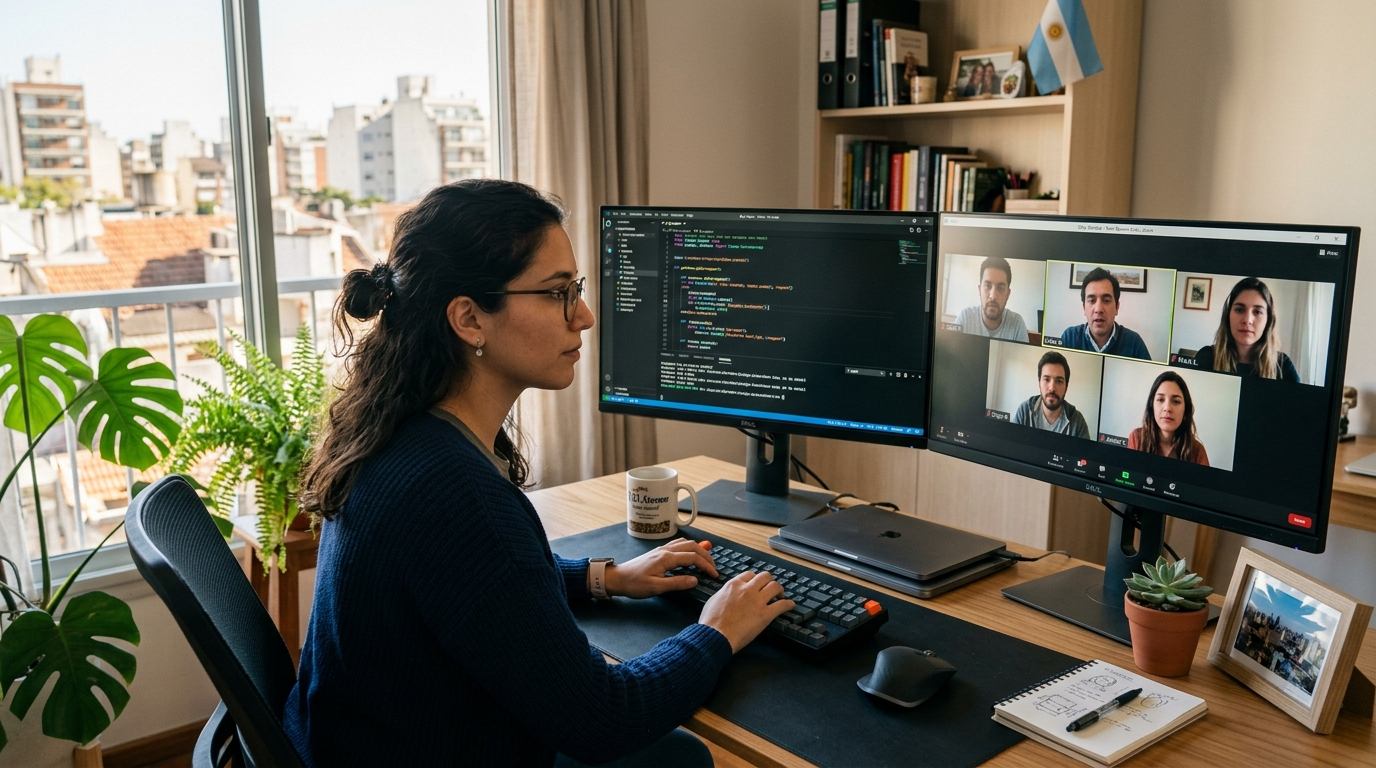
What Developer Roles Are Best Suited for Nearshore Staffing in 2026?
Not every role is equal in the nearshore model. The best fits are roles where clear deliverables can be scoped, where tooling is standardized, and where real-time collaboration with your core team adds value. Based on what's working for US companies in 2026, these developer roles are consistently strong nearshore placements:
- Front-end developers (React, Vue, Angular) — visual feedback loops work best with same-timezone standup
- Back-end engineers (Node.js, Python/Django, Ruby on Rails, Java Spring) — clear API contracts make deliverables auditable
- Full-stack developers — the most requested nearshore role; LATAM talent density here is high
- QA / test automation engineers — repeatable, documentation-heavy work with low timezone friction
- DevOps and cloud engineers (AWS, GCP, Azure) — incident response requires real-time coverage your US team actually needs
- Mobile developers (iOS/Swift, Android/Kotlin, React Native) — sprint-based delivery suits the managed model well
- Data engineers and analysts (Python, dbt, SQL, Spark) — high demand, strong LATAM supply especially in Argentina and Brazil
According to McKinsey's analysis of global software talent demand (2023), software development and data engineering are among the highest-demand skill categories globally through 2030, with Latin America identified as a key growth region for English-proficient technical talent. The supply is there — the question is whether your sourcing process can reach it efficiently.
Gallup's ongoing workforce research reinforces why dedicated full-time engagement matters more than headcount. According to Gallup's State of the Global Workplace report (2023), employees who feel their role expectations are clearly defined are 2.5x more likely to be engaged — a finding that applies directly to nearshore developers who benefit from explicit deliverable scoping and dedicated management oversight. The managed nearshore model is structurally built to deliver that clarity.
How to Evaluate a Nearshore Staffing Agency for Developer Roles in 2026
The quality gap between nearshore staffing agencies is enormous. Some are little more than resume forwarding services. Others — like Rose — function as an embedded HR and management layer. Before you sign anything, here's the framework for separating them:
Signs of a Quality Nearshore Agency
- Published English proficiency standards with a minimum score (Rose's bar: 8/10+)
- Role-specific technical vetting — not just a general aptitude test
- Free replacement guarantee if the placement isn't a fit
- No long-term contract — you can cancel with 30 days written notice
- Transparent flat-rate pricing with nothing hidden in the fine print
- AI copilot or tooling onboarding built into the placement
Red Flags to Walk Away From
- Vague "vetted talent" claims with no published screening criteria
- Hourly billing that incentivizes slow delivery
- Minimum 6-12 month contracts with no exit ramp
- No replacement guarantee — you bear all re-hiring risk
- Offshore talent rebranded as "nearshore" (check where team members are actually based)
- No dedicated point of contact after placement
One fast diagnostic: ask the agency where, specifically, their developers are based — city and country. A legitimate nearshore agency answers immediately. Agencies that hedge or say "various Latin American locations" without specifics are often routing offshore talent through a LATAM-named brand. Location transparency is non-negotiable when you're paying a nearshore premium for timezone and cultural alignment.
For a structured guide to what separates a genuine nearshore staffing agency from a glorified job board, this breakdown of what a nearshore staffing agency actually does covers the vetting, management, and compliance layers most companies don't think to ask about until something goes wrong.
Ready to scope a specific developer role? Start your search with Rose and get a curated shortlist in days, not weeks.