
Nearshore staffing is reshaping how France-connected businesses scale their operations in 2026. Whether you run a property management firm with US assets, a transatlantic e-commerce brand, or a bilingual service business straddling North America and Europe, a nearshore virtual assistant agency gives you full-time talent — without the overhead of local hiring, the timezone chaos of offshore teams, or the commitment of a long-term contract. This guide explains exactly how it works, what it costs, and how to choose the right partner.
What Is a Nearshore Staffing Agency — and Why Does It Matter in 2026?
A nearshore staffing agency recruits, vets, and manages remote workers from countries geographically and culturally close to your primary market. For businesses operating in or connected to North America, that means talent from Latin America — Mexico, Colombia, Argentina, Costa Rica, and similar markets. These team members work US business hours, communicate in fluent English, and integrate into your tools and workflows the same way an in-house employee would.
This is fundamentally different from offshore staffing, which typically draws from the Philippines or India — regions 10 to 14 hours ahead of US time zones. The timezone gap alone is enough to make real-time collaboration nearly impossible. Nearshore VAs, by contrast, are online when your clients are calling, your tickets are coming in, and your decisions need to be made.
If you want the full breakdown of how these models stack up, Rose's deep-dive on nearshore vs offshore vs onshore virtual assistants walks through every dimension — cost, communication, ramp time, and retention.
According to the U.S. Bureau of Labor Statistics (2024), the median annual wage for a full-time administrative assistant in the United States is approximately $44,080 — not counting benefits, payroll taxes, or recruiting fees. At $2,500/month, a full-time nearshore VA costs $30,000/year all-in, including recruiting, HR, payroll, and ongoing management. That gap is real money.
How France-Connected Businesses Are Using Nearshore VAs in 2026
France-based businesses — and European companies with North American operations — face a specific staffing challenge: they need English-fluent staff who work US hours, understand American business culture, and can operate tools like QuickBooks, AppFolio, Buildium, Salesforce, or HubSpot without a three-month learning curve. Offshore teams in Asia rarely check all those boxes. Local hires in France or the US are expensive and slow to place.
Nearshore VAs from Latin America fill that gap precisely. They're available during US Eastern, Central, and Pacific hours. English proficiency at Rose is screened to an 8/10 minimum — candidates who don't clear that bar don't reach your inbox. And because Latin American business culture overlaps heavily with North American norms, the integration friction is low.

Common use cases include property management coordination for US real estate portfolios managed by French-domiciled owners, bookkeeping and accounting support using QuickBooks or Xero, customer service and leasing administration, and executive assistance for founders who split their time between continents.
According to SHRM's Talent Acquisition Benchmarking report (2024), the average time-to-fill for an administrative or support role in the US is 36 days — and that's before onboarding. Rose's seven-day placement window isn't a marketing claim; it's a function of having a pre-vetted talent pipeline already built.
Nearshore vs Offshore vs Onshore: 2026 Comparison for France-Connected Businesses
Before committing to any staffing model, it helps to see the tradeoffs laid out plainly. The table below compares the three main options across the dimensions that matter most to businesses with transatlantic or North American operations.
| Dimension | Nearshore (Latin America) | Offshore (Philippines / India) | Onshore (US / France) |
|---|---|---|---|
| Monthly cost (full-time) | ~$2,500 all-in | $1,200–$2,000 (management extra) | $4,000–$6,500+ |
| Timezone alignment (US hours) | ✅ Full overlap | ❌ 10–14 hr gap | ✅ Full overlap |
| English proficiency | High (8/10+ screened) | Variable (6–8/10 typical) | Native |
| Cultural alignment (US business) | Strong | Moderate | Strong |
| Ramp time (tool-trained) | 3–7 days with AI copilot | 2–4 weeks | 1–3 weeks |
| Recruiting / HR included | ✅ Yes (Rose model) | Often billed separately | Rarely included |
| Replacement if not a fit | ✅ Free replacement | Varies by agency | Costly re-hire |
| Long-term contract required | No long-term contract | Often 3–6 month minimums | Employment law varies |
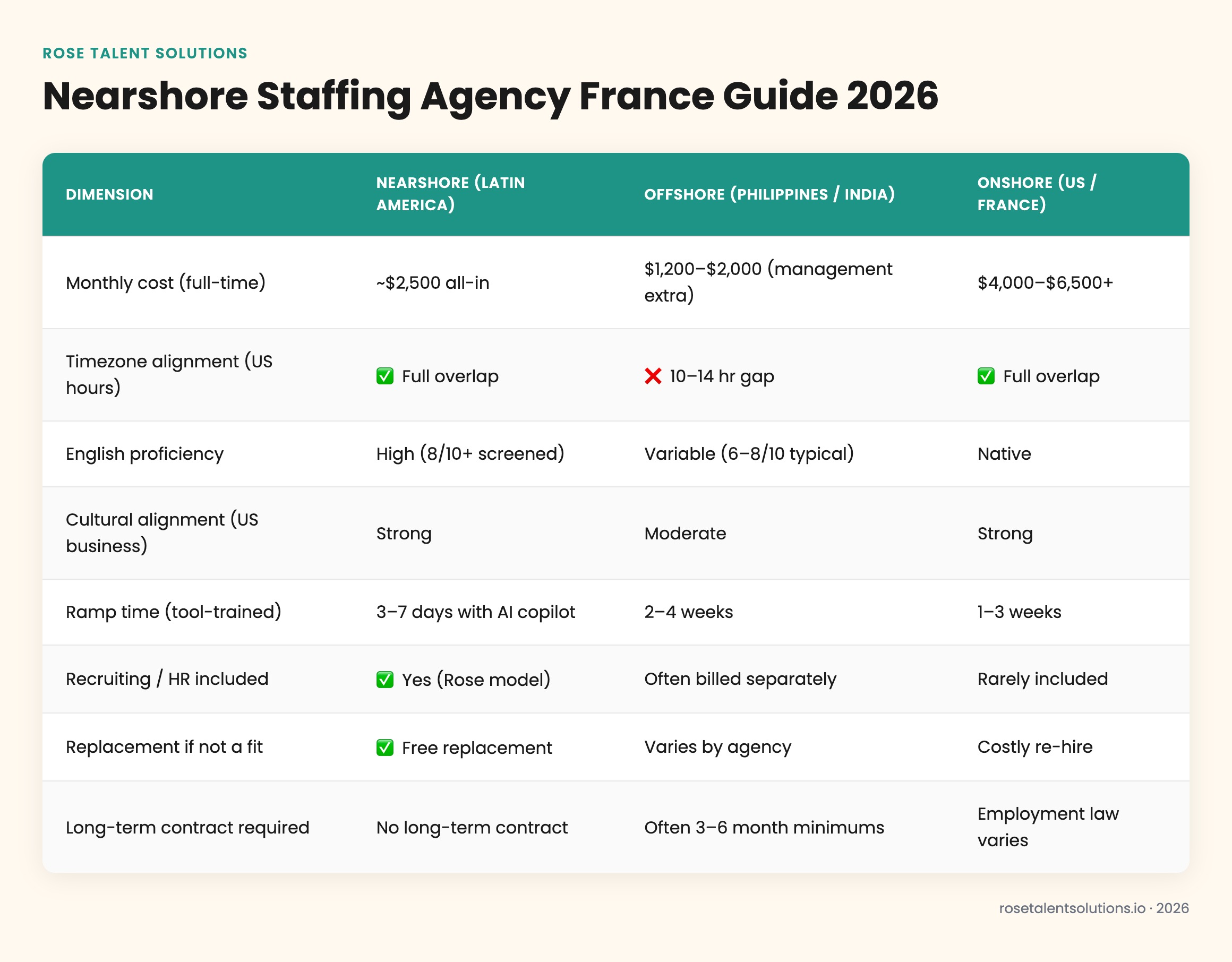
The offshore model often looks cheaper on paper. But as the table shows, the sticker price rarely includes recruiting fees, HR overhead, or the cost of the hours lost to asynchronous back-and-forth. If you want a longer read on how the numbers actually compare, Rose's post on onshore vs offshore virtual assistant tradeoffs breaks it down with real cost scenarios.
How Rose's AI Advantage Makes Nearshore VAs Ramp Faster in 2026
One of the most common objections to hiring a remote VA — nearshore or otherwise — is the ramp time. "How long before they're actually useful?" The honest answer with a generic hire is four to six weeks. With a Rose team member, it's closer to three to seven days. The reason is the AI copilot built into every placement.
Every Rose team member arrives pre-trained on a role-specific AI assistant tuned to the software they'll use: AppFolio, Buildium, QuickBooks, HubSpot, Asana, and others. That means your new hire isn't spending Week 1 Googling how to run a vendor report in Buildium — they already know. The AI copilot handles workflow prompts, document templates, and common task sequences so the human can focus on judgment calls, client communication, and relationship management.
The hidden cost of offshore VAs isn't the hourly rate — it's the 6–12 hour timezone gap that batches every real-time decision into a 24-hour delay cycle. Nearshore coordinators answer tickets, update records, and communicate with clients while you're still in your morning meeting.
According to Gallup's State of the Global Workplace Report (2024), disengaged or misaligned remote workers cost businesses an average of 18% of their annual salary in lost productivity. Pre-trained, role-matched VAs reduce that drag significantly — the alignment happens before Day 1, not during a costly trial-and-error period on your dime.

For France-based property owners managing US real estate portfolios, this matters enormously. Your AppFolio coordinator needs to understand US lease law conventions, maintenance ticket workflows, and tenant communication norms — not just how to log into the platform. Rose's role-specific training covers that context, not just the software mechanics. Learn more about what's possible on the property management VA page.
"AI-augmented staffing is not about replacing human judgment — it's about removing the friction that keeps smart people from doing their best work on Day 1." — Gartner HR Research Team, Future of Work Insights (2024)
How to Choose the Right Nearshore Staffing Agency: 2026 Checklist
Not all nearshore staffing agencies operate the same way. Some are marketplaces where you browse profiles and manage everything yourself. Others, like Rose, function as a full managed staffing partner — recruiting, vetting, matching, onboarding, payroll, HR, and ongoing performance management are all included in the flat rate. Knowing which model you need before you start shopping will save you weeks of wasted conversations.
Rose's overview of virtual assistant companies operating in Latin America is a useful reference if you want to compare agency types before committing. The managed model costs more than a freelance marketplace but returns that cost in time saved on HR, compliance, and replacement logistics.
Managed Nearshore Agency (Rose Model)
- Recruiting, vetting, payroll, HR all included
- Replacement at no additional cost if not a fit
- AI copilot pre-trained on your software stack
- Dedicated account management, not self-serve
- No long-term contract — cancel with 30 days notice
Freelance VA Marketplace
- You recruit, vet, and manage independently
- No built-in replacement guarantee
- Tool training is your responsibility
- No HR or payroll infrastructure
- Cheaper upfront, more expensive in management time
According to McKinsey's State of Organizations report (2023), companies that outsource HR and talent functions to managed partners report 23% faster time-to-productivity for new hires compared to self-managed remote hiring. That's not a small edge — it's the difference between a VA who's contributing in Week 1 and one who's still getting access credentials in Week 3.
Submit Your Role Brief
Tell Rose what software your team uses, what hours you need covered, and what tasks are highest priority. This takes about 10 minutes via the intake form.
Receive Matched Candidates
Rose's sourcing team presents 2–3 pre-vetted candidates within days — already screened on English proficiency, tool familiarity, and role fit. No resume sifting on your end.
Interview and Select
You interview your top choice (or choices) and confirm the match. Rose handles offer logistics, onboarding paperwork, and payroll setup behind the scenes.
Your VA Starts — With AI Copilot Active
Your team member begins Day 1 with a role-specific AI copilot already configured. Most clients report meaningful productivity by end of Week 1.
Ongoing Support from Rose
If anything isn't working — performance, fit, scope shift — Rose handles it. If the placement isn't right, you get a free replacement at no additional cost.
For a broader look at what makes a nearshore staffing agency worth partnering with long-term, Rose's dedicated guide on how nearshore staffing agencies work covers vetting standards, pricing models, and red flags to watch for when evaluating vendors.
If you're ready to move, the fastest path is the get started page — it takes under 10 minutes to submit your role brief and begin the matching process. The flat rate is $2,500/month, all-in, with no long-term contract and a free replacement guarantee if the placement isn't right for your team.