
What Is Nearshore Staff Augmentation LATAM in 2026?
Nearshore staff augmentation is the practice of adding full-time or part-time skilled workers from a geographically close region — in this case, Latin America — directly into your existing team. Unlike traditional outsourcing, the nearshore model puts a dedicated person inside your workflows, your tools, and your Slack channels, working the same hours as your US or Canadian team. They are not a vendor. They are a team member who happens to be based in Medellín, Mexico City, Buenos Aires, or Bogotá.
The "LATAM" designation matters because it separates this model from the offshore alternatives in the Philippines or India. Latin American talent operates in timezones that overlap perfectly with US business hours — no 6- to 12-hour lag, no overnight batch processing of requests, no morning pile of unanswered messages. That overlap is the core value proposition, and it shows up in productivity from day one.
According to SHRM's Talent Acquisition research (2024), the average cost-per-hire for a skilled professional in the United States now exceeds $4,700, before salary. Nearshore augmentation sidesteps that entirely with a flat monthly rate that bundles recruiting, vetting, payroll, HR, and ongoing management.
How Nearshore LATAM Compares to Offshore and Onshore in 2026
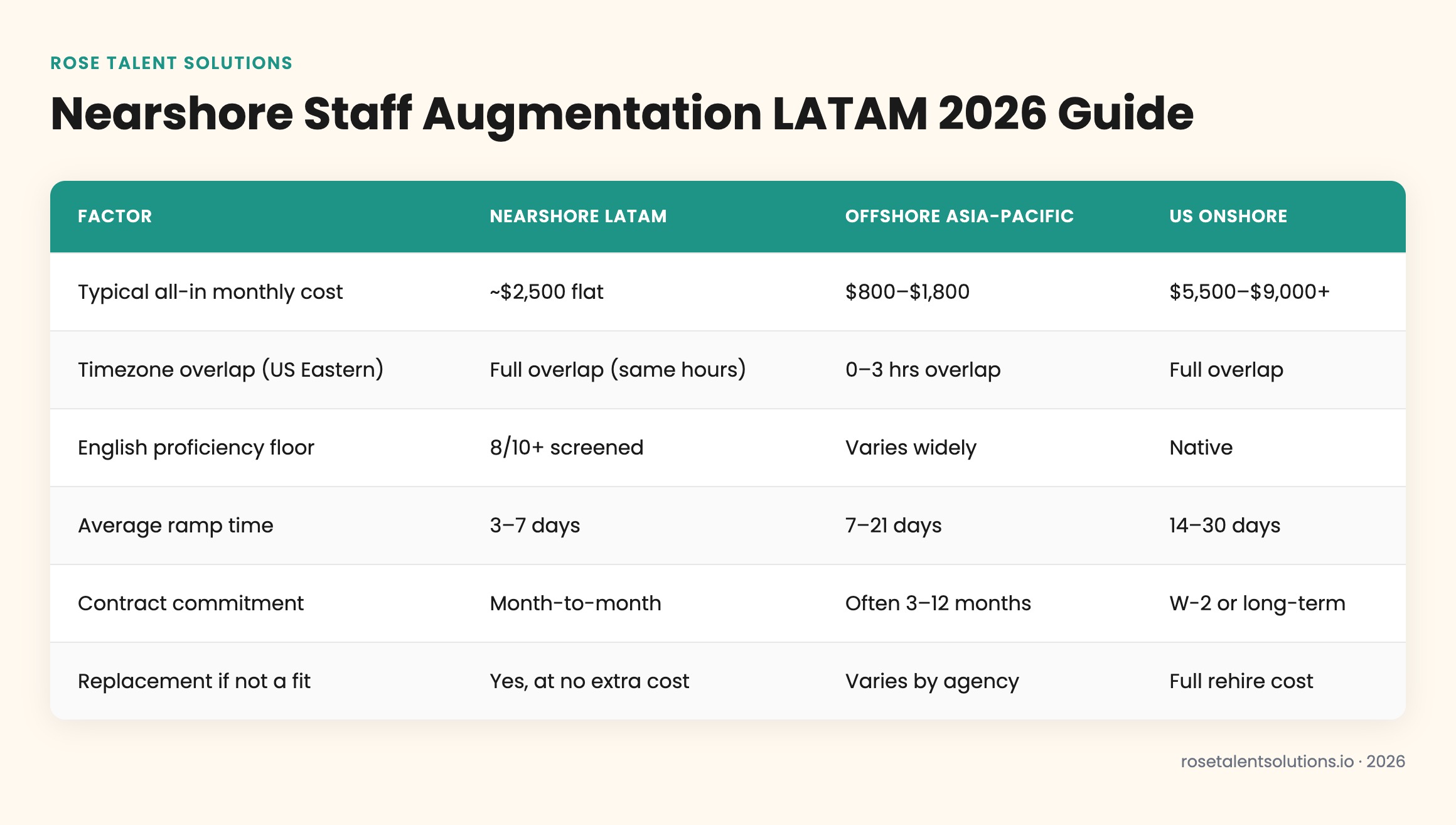
When US business owners evaluate staff augmentation, they typically face three buckets: hire onshore (expensive, slow), go offshore to Asia-Pacific (cheap, but misaligned hours and variable English quality), or go nearshore to Latin America (the middle path that is increasingly winning). The comparison is not abstract — it shows up in measurable outcomes like ticket resolution time, manager overhead, and ramp speed.
The table below is a practical breakdown based on industry benchmarks. Rose Talent Solutions operates exclusively in the nearshore LATAM column.
| Factor | Nearshore LATAM | Offshore Asia-Pacific | US Onshore |
|---|---|---|---|
| Typical all-in monthly cost | ~$2,500 flat | $800–$1,800 | $5,500–$9,000+ |
| Timezone overlap (US Eastern) | Full overlap (same hours) | 0–3 hrs overlap | Full overlap |
| English proficiency floor | 8/10+ screened | Varies widely | Native |
| Average ramp time | 3–7 days | 7–21 days | 14–30 days |
| Contract commitment | Month-to-month | Often 3–12 months | W-2 or long-term |
| Replacement if not a fit | Yes, at no extra cost | Varies by agency | Full rehire cost |
Why 2026 Is the Inflection Point for LATAM Staff Augmentation
Several converging forces are making 2026 the clearest moment yet to evaluate nearshore LATAM augmentation. First, US labor costs keep climbing. According to the Bureau of Labor Statistics Employment Cost Index (2024), civilian worker compensation rose 4.2% year-over-year — compounding on top of the 2022 and 2023 spikes. For small and mid-size businesses, that math breaks the headcount model they relied on through the 2010s.
Second, the talent pool in Latin America has matured dramatically. Universities in Colombia, Mexico, Argentina, and Chile are producing large annual cohorts of business administration, tech, and accounting graduates — many of whom have learned English specifically to work with North American companies. The supply has caught up with demand in a way it had not five years ago.
Third — and this is specific to 2026 — AI tooling has become a differentiator within the nearshore model itself. The best nearshore staffing firms now equip every placed team member with a role-specific AI copilot trained on the software they will actually use: AppFolio, Buildium, QuickBooks, HubSpot, Yardi. That means a new hire does not need three weeks to become productive. They arrive day one with an AI assistant that knows the platform's workflows better than most experienced hires. You can read more about how Rose structures this on the AI advantage page.

What Roles Does Nearshore LATAM Staff Augmentation Cover in 2026?
The common misconception is that nearshore augmentation is only for software development. That was true in 2015. By 2026, the roles that US businesses are filling via LATAM nearshore span nearly every operational function. Here is what the demand actually looks like across Rose's placements.
Technical roles remain the highest volume. If you need to hire a nearshore full-stack developer, Latin America has deep benches of engineers fluent in React, Node, Python, and cloud infrastructure at a fraction of US market rates. For product-focused companies specifically building mobile products, the LATAM talent pool for nearshore iOS and Android mobile developers has grown substantially, with strong cohorts coming out of Buenos Aires, São Paulo, and Bogotá.
Operations and administrative roles — property management coordinators, executive assistants, customer support specialists, data entry and CRM management — make up a large and growing share of nearshore placements. These roles benefit as much from the timezone alignment as developers do, because they require real-time responsiveness to tenants, clients, or customers. See how Rose structures property management staffing specifically for US operators.
Finance and accounting roles are the fastest-growing segment. According to McKinsey's Future of Work research (2021, updated 2024), finance and accounting functions are among the roles most amenable to remote distributed models because the output is quantifiable and tool-based. Bookkeepers, AR/AP specialists, and QuickBooks-trained accountants from Latin America are filling gaps that US CPA firms cannot staff affordably. Explore Rose's bookkeeping and accounting staffing for a deeper look at that vertical.
"The idea that you need to be in the same building to do great accounting work was always a cultural assumption, not a practical one. Cloud-based tools dissolved that constraint years ago." — Gene Marks, Columnist and Small Business Owner Advocate at The Guardian / The Washington Post (2023)
The hidden cost of offshore staffing is not the hourly rate — it is the 6-to-12-hour timezone gap that turns every simple back-and-forth into a 24-hour delay. Timezone alignment is the single most underrated factor when evaluating nearshore vs offshore augmentation, and it compounds across every task your team handles daily.
How the Nearshore LATAM Hiring Process Actually Works in 2026
One of the most common questions from business owners evaluating nearshore augmentation is: how fast can this actually happen? The answer, with a structured agency model, is faster than most people expect. The process from first conversation to a team member in your Slack workspace takes about one week in most cases.
Role scoping call
You describe what you need — specific tools, hours, responsibilities. A good agency should ask you about software stack, communication style, and the specific outcomes you need, not just a job title.
Candidate matching
The agency matches you from a pre-vetted bench of screened candidates — not a job board search. English proficiency, software experience, and timezone availability are already confirmed before you see a profile.
Interview and selection
You interview your top match (or two). You make the call. The agency does not force a candidate on you.
Onboarding and AI setup
Your new team member is onboarded with their role-specific AI copilot pre-configured. They join your tools, receive access, and are productive typically within the first three business days.
Ongoing management
Payroll, HR compliance, and performance support are handled by the agency. You manage the work; they manage everything else. If the fit is not right, replacement is included at no additional cost.
The no-long-term-contract, month-to-month structure means you are not locked into a 12-month commitment while you figure out whether the model works for your business. That structural flexibility is a meaningful risk reduction for operators who have been burned by long-term staffing agreements before. Ready to scope a role? The intake process starts here.

How Nearshore LATAM Stacks Up Against Marketplaces Like Toptal and Turing in 2026
Talent marketplaces like Toptal and Turing are a different category from agency-managed nearshore augmentation, and the distinction matters. Marketplaces give you access to a directory of pre-screened freelancers — but sourcing, payroll management, HR, and performance oversight are your responsibility once you make a hire. For operators who want to run a lean internal team, that overhead adds up quickly.
The managed nearshore model bundles all of that into the flat monthly rate. You do not need an in-house HR person to process payroll for your LATAM team member. You do not need to build an onboarding process from scratch. The agency carries the operational weight so you can focus on the work output. If you are evaluating whether a marketplace or a managed model is the right fit, the Rose blog goes deep on the tradeoffs in the nearshore developer vs Toptal comparison and the nearshore developer vs Turing breakdown — both worth reading before you commit to either path.
According to Gallup's State of the Global Workplace report (2023), manager time spent on administrative and compliance tasks reduces team productivity by an estimated 20% in distributed team environments. The managed nearshore model is designed specifically to absorb that overhead — so your managers spend their time on output, not on paperwork.
Pros and Cons of Nearshore LATAM Staff Augmentation in 2026
No model is perfect for every business. Here is an honest assessment of where nearshore LATAM augmentation wins, and where you should go in with realistic expectations.
Pros
- Full US-hours timezone overlap — real-time collaboration with zero lag
- English-fluent talent screened to a minimum 8/10 proficiency floor
- All-in flat rate ($2,500/month) covers recruiting, HR, payroll, and ongoing management
- Month-to-month terms — no long-term contract required
- Role-specific AI copilot included — faster ramp, higher day-one productivity
- Free replacement if the team member is not a fit
- Deep bench across technical, operations, and finance roles
Cons
- Not the cheapest option — offshore Asia-Pacific rates can be lower for pure cost plays
- Requires some internal onboarding investment (tool access, process documentation)
- Best results come from managers who treat LATAM team members as real team members, not task queues
- Not ideal for roles requiring in-person US presence
The tradeoff is straightforward: if your primary filter is the absolute lowest possible monthly cost and timezone alignment does not matter to your workflow, offshore may win on price. But for the overwhelming majority of US business operations — where real-time responsiveness, clear communication, and tool proficiency determine output quality — nearshore LATAM delivers a better return on that $2,500 than a cheaper offshore alternative at $1,000 that requires double the management overhead and produces half the throughput.
According to Deloitte's Global Human Capital Trends research (2023), 71% of organizations that adopted a hybrid nearshore model reported improved team collaboration scores compared to fully offshore arrangements — driven primarily by timezone overlap and communication clarity.