
What Is Nearshore Recruitment — and Why Does It Matter in 2026?
Nearshore recruitment is the practice of hiring full-time remote employees from countries that share — or closely overlap — your time zone and cultural context. For US and Canadian businesses, that means sourcing talent from Latin America: Colombia, Mexico, Argentina, Costa Rica, and similar markets. Unlike generic offshore outsourcing, nearshore staff work live alongside your domestic team, join Slack threads in real time, and pick up the phone during your business hours — not yours plus eight.
The distinction matters because the main failure mode of offshore hiring isn't skill — it's latency. When a tenant maintenance request lands at 3 p.m. Eastern and your VA is asleep in Manila, the response doesn't go out until the next morning. That 14-hour gap compounds across every workflow in your business. Nearshore recruitment eliminates that gap entirely.
In 2026, the model has matured significantly. Latin American universities are producing more English-fluent graduates than at any point in history, and regional salaries — while competitive for local workers — remain well below US market rates. That combination of quality, availability, and cost is why the nearshore model is accelerating past offshore for North American businesses that care about responsiveness and collaboration.
If you want a deeper look at how nearshore stacks up against every alternative, the complete nearshore vs. offshore vs. onshore virtual assistant comparison walks through every variable — cost, control, ramp time, and risk — in detail.

How Nearshore Recruitment Works in 2026: The End-to-End Process
Nearshore recruitment is not a job board. It is a managed staffing process that spans sourcing, vetting, matching, onboarding, and ongoing support — typically run by a specialized agency on your behalf. Here is how a well-run process looks from intake to day one.
Role Definition
You describe the role — tasks, tools, hours, communication style. A good agency asks detailed questions here; a bad one skips straight to candidate delivery. The intake call is where fit actually gets determined.
Sourcing & Screening
The agency sources from its existing talent network in Latin America, screens for English proficiency (Rose's published floor is 8/10+), verifies software experience, and runs background checks before you see a single résumé.
Client Interview
You interview two to three shortlisted candidates. You make the hire decision — the agency doesn't place someone without your approval. This step typically takes two to five business days.
Onboarding & AI Copilot Setup
The placed team member receives role-specific AI copilot training calibrated to the software you use — AppFolio, QuickBooks, Buildium, or other tools. This accelerates ramp time materially in the first two weeks.
Ongoing HR & Payroll
The agency handles payroll, compliance, benefits administration, and performance check-ins. You manage the work; they manage the employment relationship. One flat invoice per month.
According to SHRM's Talent Acquisition research (2024), the average US employer spends 42 days and $4,700 to fill a single open role domestically — before factoring in training costs or lost productivity during vacancy. A nearshore recruitment process through a specialized agency typically compresses that to under two weeks from intake to day one, with no job board fees, no ATS licensing, and no benefits enrollment overhead.
Nearshore vs. Offshore vs. Onshore: 2026 Comparison
The staffing market uses these three terms interchangeably in casual conversation, but they describe fundamentally different hiring models with different cost profiles, collaboration patterns, and risk levels. The table below cuts through the noise.
| Factor | Nearshore (Latin America) | Offshore (Philippines / India) | Onshore (US-based) |
|---|---|---|---|
| Time zone overlap | Full US business hours (ET/CT/PT) | 0–2 hours overlap; primarily async | Full overlap |
| English proficiency | High (8/10+ screened) | Variable; accent gap common in calls | Native |
| Typical all-in monthly cost | ~$2,500 flat (agency-managed) | $800–$1,500 (often unmanaged) | $5,000–$8,000+ (salary + benefits) |
| Cultural alignment | Strong (US media, business norms) | Moderate | Strongest |
| Legal / payroll complexity | Managed by agency | Managed by agency or DIY contractor risk | Full US employment law applies |
| Typical ramp time | 1–2 weeks with AI copilot | 3–5 weeks (timezone-delayed feedback loops) | 2–4 weeks |
| Replacement if not a fit | Included at no extra cost (Rose) | Varies by agency; often fee-based | Full re-hire process |
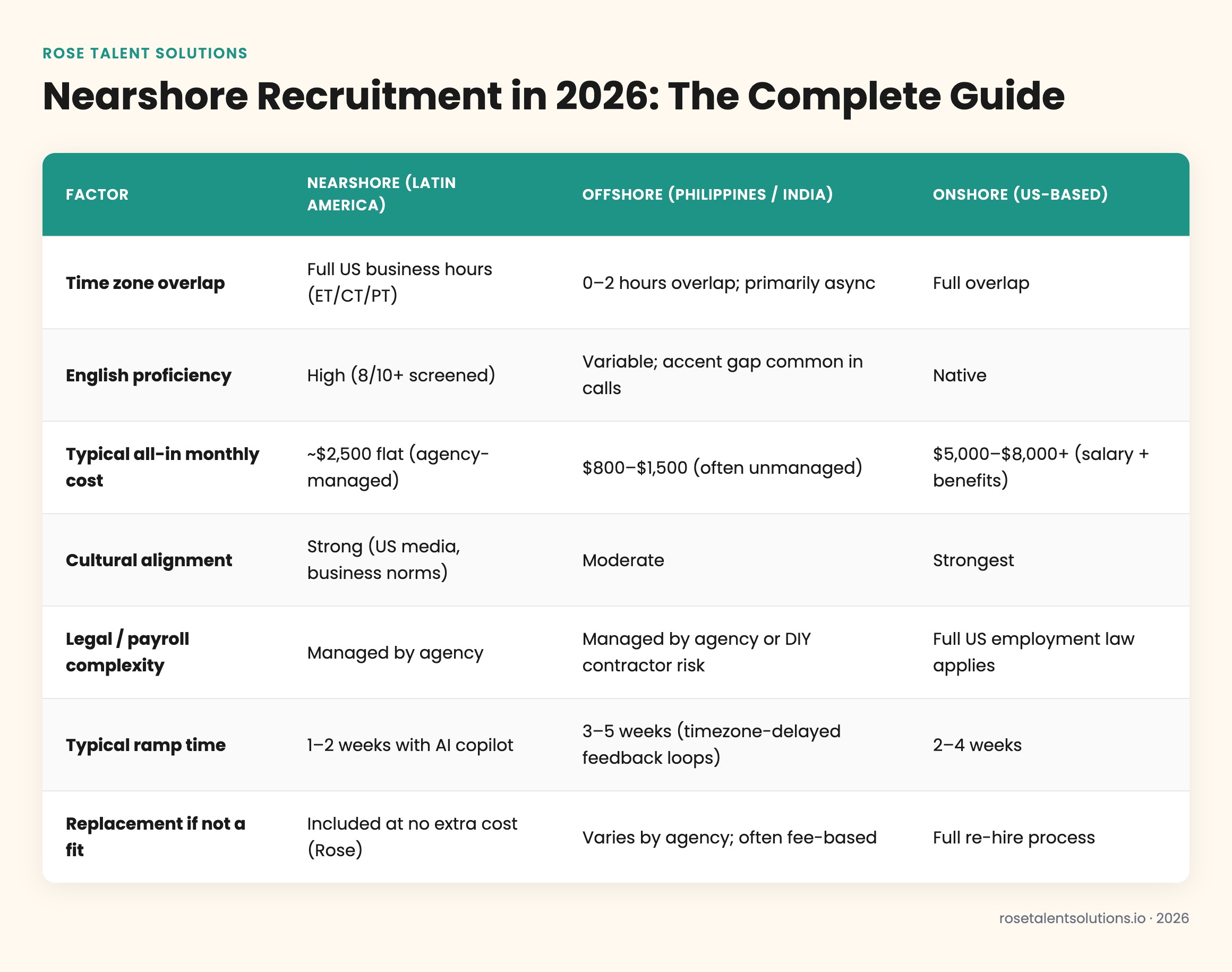
Table: Nearshore vs. offshore vs. onshore staffing compared across seven key factors for US businesses in 2026.
"The companies winning at remote work in 2026 aren't choosing between cost and quality — they're choosing geography more deliberately. Latin America has closed the skills gap while maintaining a meaningful cost advantage over domestic hiring." — Agustín Fontes, Co-Founder at Deel Latin America Operations (2024)
How the AI Advantage Changes Nearshore Recruitment in 2026
One of the most underreported shifts in nearshore recruitment over the past 18 months is the role of AI augmentation at the individual team-member level. Historically, the biggest knock on any remote hire — nearshore or otherwise — was ramp time. It took weeks for a new VA to learn your software, your SOPs, and your communication preferences. That lag is now dramatically shorter.
At Rose, every placed team member ships with a role-specific AI copilot trained on the software stack they'll actually use — whether that's AppFolio for property management workflows, QuickBooks for bookkeeping and accounts payable, or Buildium for lease tracking and maintenance coordination. The copilot surfaces contextual guidance, draft responses, and task checklists within the tool — so your new team member isn't searching a generic help center on day three.
According to McKinsey's research on generative AI economic potential (2023), AI-assisted workers complete knowledge tasks 30–40% faster than unassisted peers performing identical work. In a nearshore staffing context, that delta shows up immediately in first-week output — tenant emails answered, invoices processed, leasing inquiries routed — before a traditional onboarding curriculum would even be finished.

The hidden cost of offshore hiring isn't the rate — it's the compounding async tax. Every ticket, question, or approval that requires a back-and-forth adds 24 hours minimum when your VA is in a non-overlapping time zone. Multiply that across 50 weekly interactions and you've added the equivalent of a part-time employee's worth of wasted calendar time per month.
What Roles Benefit Most from Nearshore Recruitment in 2026?
Nearshore recruitment works across a wide range of business functions, but it delivers the highest return in roles where real-time responsiveness, tool fluency, and professional communication are non-negotiable. The following categories consistently generate the best outcomes for US and Canadian businesses using the nearshore model.
- Property management coordination — tenant communication, maintenance dispatch, lease renewals, and AppFolio or Buildium data entry. Time zone alignment is critical here; a tenant's 2 p.m. call cannot wait until tomorrow morning.
- Bookkeeping and accounts payable — QuickBooks reconciliation, invoice processing, vendor payment tracking, and month-end close support. These roles benefit from a dedicated 40-hour-per-week cadence rather than fractional contractor hours.
- Executive and administrative support — calendar management, travel booking, inbox triage, CRM updates, and research tasks. A nearshore EA who works 9–5 in your time zone is functionally indistinguishable from an in-office hire for most tasks.
- Customer service and leasing — inbound inquiry response, showing scheduling, application processing, and follow-up sequences. Response speed directly correlates with conversion rate; offshore teams cannot compete here.
- Marketing operations — social posting, listing management, email campaign execution, and basic graphic production using Canva or similar tools.
According to the U.S. Bureau of Labor Statistics Occupational Outlook Handbook (2024), median annual wages for US-based administrative support roles now exceed $47,000 — putting the all-in employer cost (salary plus benefits, taxes, and overhead) closer to $62,000–$70,000 per year. A nearshore equivalent through Rose runs $30,000 annually, all-in, with recruiting, HR, payroll, and replacement coverage included.
If you are exploring which type of agency to work with, the breakdown of what a nearshore staffing agency actually does — versus a freelance marketplace or a traditional temp firm — is worth reading before you make a vendor decision. And if you want to understand the broader landscape of providers in the region, the guide to virtual assistant companies in Latin America covers the key players and what differentiates them.
Why Nearshore Recruitment Works
- Full time zone alignment — your team works while you work
- Live collaboration: Slack, calls, video standups in real time
- English fluency screened before placement (8/10+ floor)
- Flat, predictable monthly rate — no hourly billing surprises
- Strong cultural fit with US business norms and communication styles
- Free replacement if the team member isn't a fit
Where to Set Realistic Expectations
- Not suitable for roles requiring a US physical presence
- Internet reliability varies by country — top agencies pre-screen for this
- Onboarding still requires 1–2 weeks of your time upfront
- Not the lowest possible rate (that's unmanaged offshore) — but TCO is lower
How to Choose a Nearshore Recruitment Partner in 2026
Not all nearshore recruitment agencies are the same. The market has three distinct tiers: managed full-service agencies, semi-managed marketplaces, and pure freelance platforms that use "nearshore" as a marketing label. Choosing the wrong tier for your needs is the most common and most expensive mistake buyers make.
A full-service managed agency handles recruiting, vetting, payroll, compliance, HR, and ongoing performance management. You pay a flat monthly fee and manage the work — they manage everything else. This is the model Rose operates on: $2,500 per month, full-time (40 hours per week), month-to-month with no long-term contract required, and a free replacement at no additional cost if the fit isn't right.
A semi-managed marketplace pre-vets a pool of candidates but offloads payroll and HR to you. Your cost per hire looks lower until you factor in contractor misclassification risk, which the IRS explicitly flags for US businesses that engage foreign workers in ongoing, directed roles without a proper employment structure.
Pure freelance platforms — Upwork, Fiverr, and equivalents — are fine for one-off projects. They are not a substitute for a dedicated, full-time team member. The hourly economics look attractive until you account for turnover, availability uncertainty, and the absence of any HR infrastructure.
When evaluating a managed nearshore recruitment partner, ask five questions: What is your English proficiency screening methodology? What is your average time-to-placement? What happens if the placement doesn't work out? Do you handle payroll and compliance in the VA's home country? And what ongoing support do you provide after the first 90 days? A credible agency has specific, quantified answers to all five.
If you are comparing this model against purely onshore alternatives, the onshore vs. offshore virtual assistant breakdown provides a useful framework for thinking through the trade-offs before you commit.
According to Gallup's State of the Global Workplace report (2024), 51% of currently employed workers globally are actively watching for or seeking new job opportunities — which means the talent pool for nearshore recruitment is deeper and more competitive than it has been at any previous point. The supply side is not the constraint in 2026; finding a recruitment partner with the infrastructure to vet and manage that supply is.
Ready to see how the process works in practice? The fastest path is to start a conversation with the Rose team — the intake process takes under 20 minutes and most clients receive shortlisted candidates within five to seven business days.