
Nearshore recruiting has quietly become the most practical hiring model for US businesses that need full-time, dedicated talent without the overhead of a domestic hire or the timezone headaches of traditional offshore outsourcing. The model is simple: you source professionals from Latin America, they work your hours, they speak fluent English, and you pay a flat, predictable rate. No recruiting fees, no payroll complexity, no surprise costs. For business owners who've tried both domestic hiring and overseas outsourcing, nearshore tends to be the answer they wish they'd found first.
This guide covers exactly how nearshore recruiting works in 2026 — what it costs, how to vet candidates, how it compares to alternatives, and what the most common pitfalls are. Whether you're a property manager, a bookkeeper, or a growth-stage startup, the framework is the same.
What Is Nearshore Recruiting — and How Does It Work in 2026?
Nearshore recruiting is the process of identifying, vetting, and placing workers from geographically close countries — for US employers, that almost always means Latin America: Mexico, Colombia, Argentina, Costa Rica, and similar markets. The defining characteristic that separates nearshore from offshore is timezone alignment. A nearshore hire works your business hours in real time. An offshore hire in the Philippines or India is often working while you sleep, which creates communication lags that compound into operational drag over time.
The term "nearshore" is borrowed from software development, where teams quickly learned that a developer in Bogotá is far easier to collaborate with than one in Bangalore — not because of skill differences, but because of proximity, shared calendar, and cultural overlap with North American business norms. That logic now applies to virtual assistants, bookkeepers, property management coordinators, customer support reps, and dozens of other roles. If you want a deeper breakdown of how these models differ, the nearshore vs. offshore vs. onshore virtual assistant comparison is worth reading before you decide on a model.
In practical terms, nearshore recruiting in 2026 typically involves a staffing agency that handles sourcing, English proficiency screening, skills testing, and ongoing HR management — so the US employer receives a fully vetted team member who's ready to work without having to navigate foreign employment law themselves.

How Nearshore Recruiting Compares to Offshore and Onshore Hiring in 2026
The staffing market in 2026 presents three distinct models for business owners who need professional support: hire domestically (onshore), hire from a distant low-cost country (offshore), or hire from a nearby country in a compatible timezone (nearshore). Each model has a legitimate use case, but they are not interchangeable — and choosing the wrong one creates problems that are expensive to unwind. According to SHRM's Talent Acquisition research (2024), the average cost to replace an employee is six to nine months of that employee's salary — a figure that makes the upfront decision far more consequential than most hiring managers realize.
| Factor | Nearshore (Latin America) | Offshore (Philippines / India) | Onshore (US-based) |
|---|---|---|---|
| Timezone alignment | ✅ Full US hours overlap | ❌ 6–14 hour gap | ✅ Perfect |
| English fluency | ✅ High (8/10+ screens) | ⚠️ Variable | ✅ Native |
| Monthly cost (full-time) | ~$2,500 all-in | ~$1,200–$1,800 | $4,500–$7,500+ |
| Cultural alignment | ✅ Strong North American overlap | ⚠️ Moderate | ✅ Native |
| Ramp-up speed | Fast (1–2 weeks typical) | Slower due to async lag | Moderate (onboarding overhead) |
| Employer admin burden | Low (agency handles HR) | Low–Medium | High (payroll, benefits, compliance) |
| Risk reversal | Free replacement if not a fit | Varies by agency | Severance costs apply |
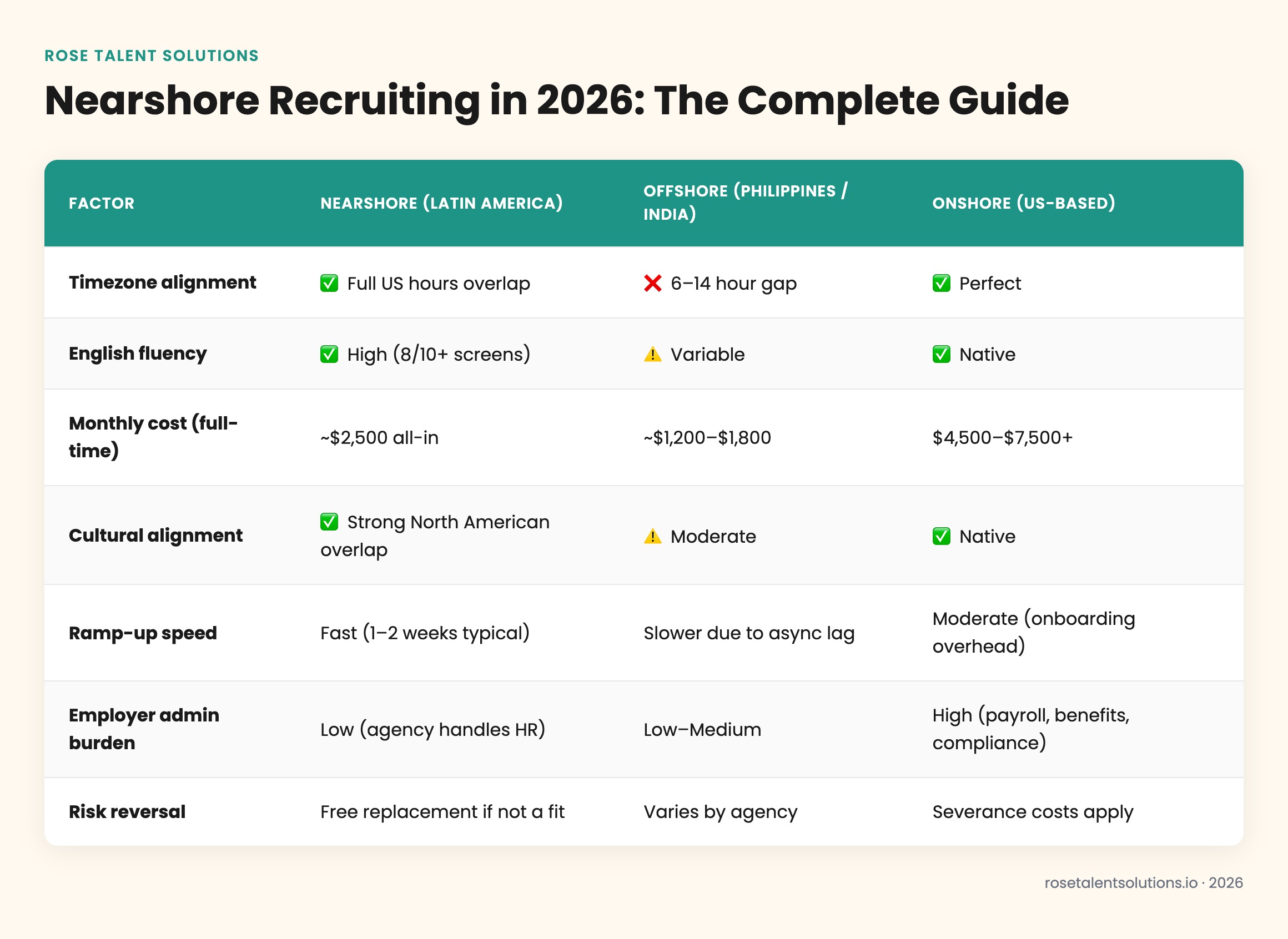
The cost delta between nearshore and onshore is significant. The Bureau of Labor Statistics Employer Costs for Employee Compensation report (2024) shows that US employers pay an average of $43.11 per hour in total compensation for civilian workers — benefits included. A full-time nearshore hire through a flat-rate agency comes in at roughly $15.63 per hour all-in, with no benefits administration, no payroll tax complexity, and no recruiting overhead on your end. For a more detailed look at how the models stack up financially, this onshore vs. offshore virtual assistant breakdown covers the math from multiple angles.
How to Evaluate a Nearshore Recruiting Agency in 2026
Not all nearshore staffing agencies operate the same way. The quality variation is wide — ranging from credible, process-driven firms to essentially resume brokers who hand you a candidate and disappear. Before you sign with any agency, there are six specific things worth verifying.
English proficiency standards. Ask the agency what their minimum English score is and how it's measured. Rose's published floor is 8/10 on structured proficiency screens. Any agency that can't give you a specific number is worth treating with skepticism. Vetting depth. Ask whether they conduct skills testing specific to the software your business runs — AppFolio, QuickBooks, Buildium, or whatever your stack includes. A coordinator who's never touched your property management platform will take weeks longer to become productive than one who was screened on it before placement.
"The single biggest mistake companies make when hiring remote talent is treating language fluency and cultural fit as secondary to task skills. In reality, communication gaps are what kill remote working relationships — not competence gaps." — Liam Martin, Co-founder at Time Doctor (2023)
What's included in the monthly rate. Some agencies quote a low placement fee and then charge separately for HR management, payroll processing, or replacement candidates. A genuinely all-in rate covers recruiting, vetting, onboarding support, payroll, and HR. Replacement policy. If the placement isn't a fit, what happens? At Rose, the answer is straightforward: we replace at no additional cost. Contract terms. Month-to-month with 30 days written notice is the standard you should expect. Any agency asking for a 12-month commitment upfront is offloading their retention risk onto you. Candidate location. Confirm team members are actually in Latin America and working your business hours. If you want to explore which Latin American countries produce the strongest virtual assistant talent pools, this guide to virtual assistant companies in Latin America covers the regional landscape in detail.

The hidden cost of nearshore recruiting isn't the monthly rate — it's the cost of choosing the wrong agency. An agency that skips software-specific vetting, has no replacement policy, and locks you into a long-term contract can easily cost you two to three months of lost productivity before you realize the placement was wrong.
What Roles Work Best for Nearshore Recruiting in 2026?
Nearshore recruiting works across a wide range of functions, but some roles benefit more than others from the timezone alignment and cultural overlap that define the model. The highest-ROI placements tend to be in roles where real-time responsiveness is a core job requirement — anything where a 12-hour callback delay would create a customer service failure or an operational bottleneck.
According to McKinsey's Future of Work research (2021, with projections through 2026), up to 25% of work in advanced economies could shift to remote formats without any loss in output quality — with customer interaction, data management, and administrative coordination roles leading the transition. That finding maps almost perfectly to where nearshore VAs are being deployed most successfully in 2026.
Remote work adoption has accelerated this trend considerably. Pew Research Center's survey on how Americans view their jobs (2023) found that 35% of workers with jobs that can be done remotely are working from home all or most of the time — a structural shift that has normalized distributed teams and lowered the psychological barrier to hiring across borders for most US employers.
For property management teams, nearshore coordinators handle leasing inquiries, maintenance ticket routing, tenant communication, and AppFolio or Buildium data entry — all in real time during business hours. For firms that need financial support, nearshore bookkeeping and accounting VAs trained on QuickBooks or Xero are among the most requested placements, because the work requires both precision and daily availability. Customer support, executive assistance, marketing coordination, and inside sales are also high-fit categories. Roles that require physical presence, licensed professional judgment (law, medicine), or highly classified data access are the primary exceptions.
One underappreciated advantage in 2026 specifically: every Rose team member ships with a role-specific AI copilot trained on the software relevant to their position. A leasing coordinator gets an AI layer tuned to AppFolio workflows. A bookkeeper gets one tuned to QuickBooks. This isn't a generic ChatGPT integration — it's a purpose-built productivity layer that compresses ramp-up time and reduces error rates from day one.
How the Nearshore Recruiting Process Works Step by Step
Understanding the actual mechanics of a nearshore placement helps you set realistic expectations and prepare your team for a new hire. The process at a structured agency is more systematic than most business owners expect — it's not a job board search.
Role Discovery Call
The agency consults with you to define the role scope, required software skills, communication style, and business hours. This shapes the entire candidate search — generic job descriptions produce generic candidates.
Sourcing and Initial Screening
Candidates are sourced from the agency's Latin American talent network and screened against your role requirements — including English proficiency scoring, software-specific assessments, and background verification.
Client Interview Round
You meet the top two or three candidates via video call. You make the final selection — you're never handed a placement without input. Most clients hire on the first or second interview round.
Onboarding and Integration
The agency handles employment paperwork, payroll setup, and initial onboarding support. Your new team member starts on a defined date — typically within seven days of the role discovery call for common roles.
Ongoing HR and Management Support
The agency manages payroll, compliance, and HR issues on an ongoing basis. If the placement isn't working, the replacement process activates at no additional cost to you.
The total timeline from initial call to a working team member is typically seven to fourteen days for standard roles. Specialized or senior-level placements may take slightly longer depending on candidate availability and assessment depth. This is dramatically faster than domestic recruiting — the average US job opening takes 44 days to fill, according to NFIB Small Business Economic Trends (2024). Meanwhile, Gallup's State of the Global Workplace report (2024) finds that employee engagement drops sharply when onboarding drags past 30 days — a risk nearshore placements sidestep by design. You can explore what to expect from a structured nearshore agency relationship in this overview of how a nearshore staffing agency operates differently from a traditional recruiter. When you're ready to move forward, the fastest path is to start the placement process directly.
Pros of Nearshore Recruiting
- Full US-hours timezone alignment — no overnight message queues
- Significantly lower cost than domestic hires (typically 50–65% savings)
- Faster placement than traditional domestic recruiting
- Agency handles payroll, HR, and compliance complexity
- Cultural alignment with North American business norms
- Free replacement if the placement isn't a fit
Cons to Plan Around
- Requires clear onboarding documentation — remote hires can't shadow in person
- Some highly specialized technical roles have shallower candidate pools
- Quality varies significantly between agencies — vetting the agency matters
- Roles requiring physical presence or US licensure are not a fit
The bottom line on nearshore recruiting in 2026 is straightforward: for US businesses that need full-time, dedicated professional talent at a predictable cost, the nearshore model outperforms both offshore (on communication quality and responsiveness) and onshore (on cost and speed to hire) for a wide range of roles. The key is choosing an agency with documented vetting standards, a clear replacement policy, and a flat all-in rate — so the only variable you're managing is how well you onboard your new team member.