
Nearshore React Native development is reshaping how US and Canadian companies build mobile apps in 2026. Instead of wrestling with a 10-hour timezone gap or paying $150–$200/hour for a US contractor, more product teams are turning to Latin America — same time zones, fluent English, and engineering talent that can jump on a Slack huddle at 10am your time. This guide breaks down exactly how nearshore React Native hiring works, what it costs, and how to avoid the most common mistakes.
What Is Nearshore React Native Development?
Nearshore React Native development means hiring mobile engineers based in Latin American countries — Mexico, Colombia, Argentina, Brazil, Costa Rica — to build cross-platform iOS and Android apps using Meta's React Native framework. The defining characteristic is geographic and timezone proximity: nearshore teams operate within 0–3 hours of US Eastern Time, which means real-time standups, same-day code reviews, and no overnight lag on pull request feedback.
React Native itself was released by Meta in 2015 and has become one of the dominant frameworks for companies that want a single JavaScript codebase to power both iOS and Android apps. According to Stack Overflow's 2024 Developer Survey, React Native is used by roughly 9% of all professional developers globally — making it one of the most in-demand mobile skill sets you can hire for. Nearshore engineers who specialize in it are concentrated heavily in Latin America's fast-growing tech hubs.
If you've been researching where to staff remote tech roles, the nearshore vs. offshore vs. onshore comparison on Rose's blog breaks down the structural tradeoffs across all three models — worth reading before you commit to a sourcing strategy.
How 2026 Market Conditions Make Nearshore React Native the Smart Hire
The US mobile development talent market is expensive and tight. According to the U.S. Bureau of Labor Statistics (2024), the median annual wage for software developers in the United States is $132,270 — and React Native specialists in major metros routinely command $140,000–$180,000 fully loaded. That's before equity, benefits, and the recruiter fee.
Latin America, by contrast, has produced a massive cohort of React Native engineers over the last five years. Brazil alone has over 500,000 active software developers, according to IDC (2023). Countries like Colombia and Argentina have government-backed STEM programs specifically designed to grow exportable tech talent. The result: a deep pool of mid-to-senior React Native engineers based entirely within the Latin American region — a fraction of US equivalent cost — who work the same hours you do.

The timezone alignment point is not a minor convenience — it compounds across every sprint. When your product manager can message a developer at 2pm and get a same-afternoon response, you're shipping features faster. When you're relying on a team operating 8–10 hours away, that same exchange takes 24 hours minimum. Multiply that by every PR, every bug triage, every design question, and the productivity gap becomes substantial. For a deeper look at how this plays out structurally, see Rose's breakdown of onshore vs. offshore collaboration dynamics.
Nearshore vs. Offshore vs. Onshore React Native: 2026 Comparison
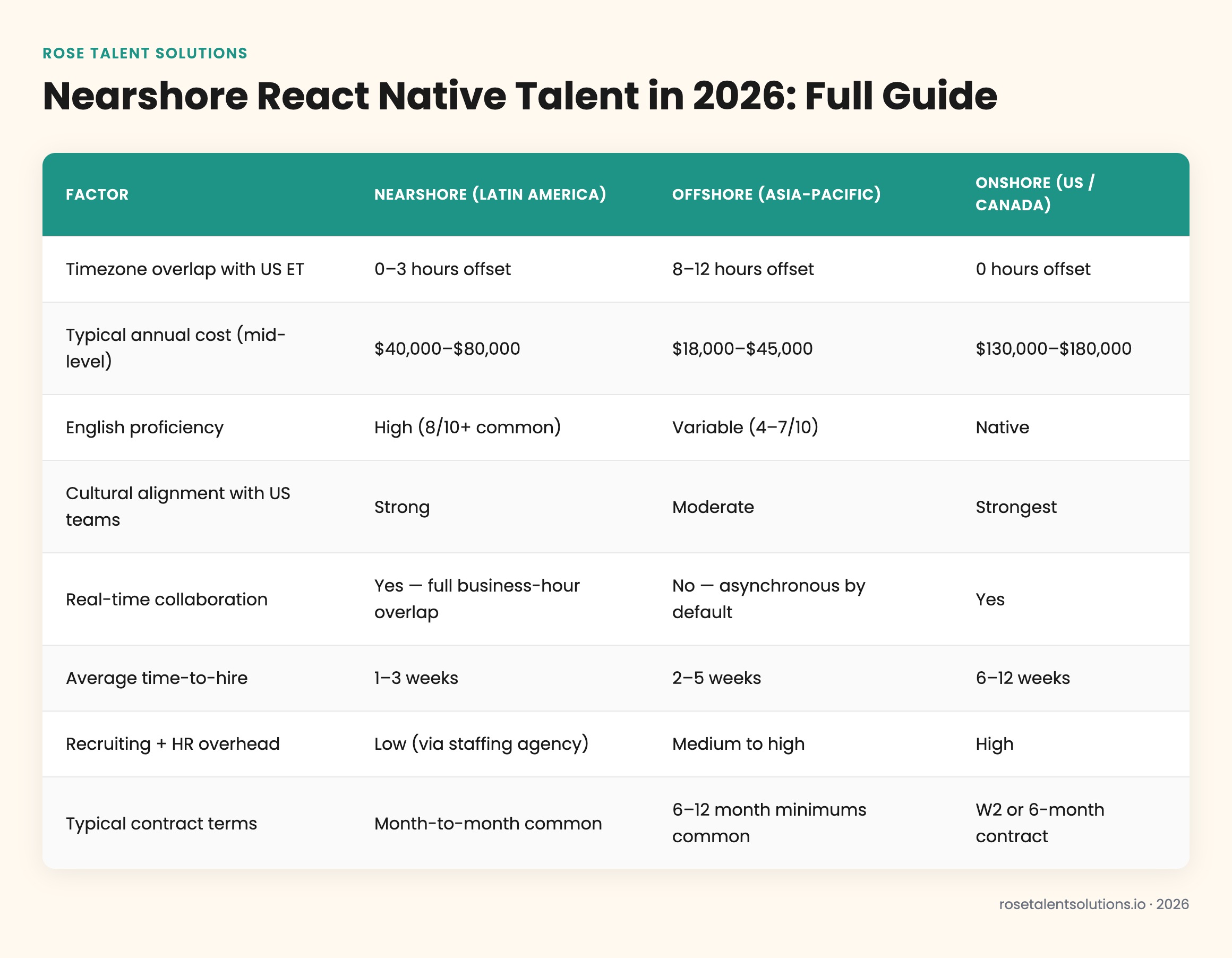
The table below compares the three primary sourcing models for React Native talent on the dimensions that matter most to a US product team in 2026. Costs reflect fully loaded averages (salary/fees + recruiting + HR) for a mid-level engineer. Note that "offshore" in this context refers to Asia-Pacific regions — Rose exclusively sources talent from Latin America.
| Factor | Nearshore (Latin America) | Offshore (Asia-Pacific) | Onshore (US / Canada) |
|---|---|---|---|
| Timezone overlap with US ET | 0–3 hours offset | 8–12 hours offset | 0 hours offset |
| Typical annual cost (mid-level) | $40,000–$80,000 | $18,000–$45,000 | $130,000–$180,000 |
| English proficiency | High (8/10+ common) | Variable (4–7/10) | Native |
| Cultural alignment with US teams | Strong | Moderate | Strongest |
| Real-time collaboration | Yes — full business-hour overlap | No — asynchronous by default | Yes |
| Average time-to-hire | 1–3 weeks | 2–5 weeks | 6–12 weeks |
| Recruiting + HR overhead | Low (via staffing agency) | Medium to high | High |
| Typical contract terms | Month-to-month common | 6–12 month minimums common | W2 or 6-month contract |
What React Native Skills Should You Screen for in 2026?
Not every developer who lists "React Native" on a resume can actually ship production-quality mobile apps. The skill set has expanded significantly over the last two years. A strong nearshore React Native engineer in 2026 should demonstrate proficiency in the Expo ecosystem or bare React Native CLI, TypeScript (not just JavaScript), state management libraries like Redux Toolkit or Zustand, REST and GraphQL API integration, and — increasingly — React Native's New Architecture (Fabric renderer and JSI). If a candidate can't speak to the New Architecture migration, they're likely working from tutorials, not production codebases.
"The React Native New Architecture is not optional for teams starting greenfield projects in 2024 and beyond — Fabric and JSI are the foundation everything else is being built on." — Nicola Corti, React Native Core Contributor at Meta (2024)
Beyond the technical checklist, screen for CI/CD experience (Bitrise, Fastlane, GitHub Actions), App Store and Google Play submission history, and — critically — the ability to communicate technical tradeoffs in plain English to non-technical stakeholders. That last skill is where candidates with large timezone gaps struggle most, and where Latin American engineers — who are accustomed to working directly with American clients during US business hours — consistently stand out. According to SHRM's State of the Workplace Report (2024), communication skills are the number-one factor managers cite when evaluating remote technical hires.
The hidden cost of remote React Native teams with large timezone gaps isn't the hourly rate — it's the 8–12 hour offset that turns every architecture question, every blocked PR, and every deployment issue into a 24-hour delay. Over a 6-month sprint cycle, that compounds into weeks of lost velocity.

How Rose Talent Solutions Places Nearshore React Native Staff in 2026
Rose Talent Solutions is a nearshore staffing agency for US, Canadian, and UK businesses that need dedicated full-time virtual staff sourced exclusively from Latin America. For technical roles like React Native development, the model works differently from a typical freelance platform: you're not hiring a contractor for a one-off project — you're placing a dedicated full-time team member (40 hours/week) who works exclusively for your company, embedded in your Slack, your sprints, your standups.
The $2,500/month flat rate covers recruiting, vetting, payroll, HR, and ongoing management. If the team member isn't a fit, Rose replaces them at no additional cost. Terms are month-to-month with no long-term contract — 30 days written notice to cancel. Every placed team member also ships with a role-specific AI copilot trained on their primary tools. For a React Native developer, that means AI assistance tuned to their IDE, testing suite, and documentation workflow — not a generic chatbot. Learn more about how that works on Rose's AI advantage page.
Latin America's virtual assistant and technical staffing ecosystem has matured significantly. If you want context on who the major players are, Rose's guide to virtual assistant companies operating in Latin America maps the landscape. And if you're curious about what the fully loaded salary cost looks like before agency fees, the average salary data for Latin American virtual staff gives you a grounded baseline.
How to Onboard a Nearshore React Native Developer: Step-by-Step
Onboarding a nearshore technical hire well is the difference between a developer who ships in week two and one who's still waiting for repo access in week three. Here's the process that high-performing teams use to get Latin American React Native developers productive fast.
Pre-boarding access provisioning
Before day one, grant GitHub/GitLab access, add them to your Slack workspace, and send credentials for your project management tool (Jira, Linear, or similar). A developer who can't push code on day one is a waste of a day.
Architecture walkthrough (Day 1)
Schedule a 90-minute async-friendly walkthrough video of your codebase structure, state management approach, and any known technical debt. Record it so they can rewatch. This single step cuts ramp time by roughly half.
First ticket — small, real, and shippable (Days 2–5)
Assign a real but low-stakes ticket from your backlog — a UI bug fix, a minor feature flag, a test coverage gap. The goal is a merged PR by end of week one. Nothing builds confidence and team trust faster than shipping something real early.
Weekly 1:1 cadence (Ongoing)
Set a standing 30-minute weekly 1:1 with the developer — not just sprint ceremonies. Use it to surface blockers, calibrate expectations, and course-correct early. Nearshore teams thrive with structured check-ins, especially in the first 60 days.
Nearshore React Native: Pros and Cons for US Teams in 2026
No hiring model is perfect. Here's an honest assessment of what nearshore React Native development delivers and where the limitations are.
Pros
- Full US business-hour overlap — real-time standups, same-day PR reviews
- 40–60% cost savings vs. US-based contractors
- Strong English communication (8/10+ proficiency common in top candidates)
- Cultural alignment with US product and business norms
- Month-to-month terms with no long-term contract risk
- Faster time-to-hire than US recruiting (1–3 weeks vs. 6–12 weeks)
- Free replacement if the placement isn't a fit
Cons
- Smaller total talent pool than some larger global tech regions
- Senior architects and niche specialists (e.g., React Native + ML) are harder to find
- Public holiday calendars differ by country — requires upfront planning
- Currency fluctuations can affect direct-hire salary expectations over time
The cons are real but manageable. The talent pool constraint is the most significant — if you need a React Native engineer with five-plus years of production experience AND deep native module bridging expertise AND Kotlin/Swift knowledge, Latin America has those people, but you'll wait longer to find them. For most product teams building standard cross-platform consumer or B2B apps, the nearshore talent pool is more than sufficient. If you're evaluating the broader cost structure, Rose's intake process starts with a role scoping call to confirm fit before any commitment.
According to McKinsey Digital (2023), companies that use nearshore talent models report 30% faster product iteration cycles compared to fully remote teams with large timezone gaps — primarily due to the real-time collaboration advantage. That velocity compounding is the strongest argument for nearshore over cheaper alternatives when you're building software, not just maintaining it.