
Nearshore React development has quietly become the default hiring strategy for US and Canadian product teams that need senior-level frontend talent without the sticker shock of domestic salaries or the scheduling chaos of offshore engagements. Instead of posting a $160,000 job requisition on LinkedIn — or handing a sprint to a team twelve time zones away — you hire a React engineer based in Mexico City, Medellín, or Buenos Aires who logs on at 9 a.m. your time, speaks fluent English, and ships production code before your afternoon standup. This guide breaks down exactly how the model works in 2026, what it costs, and how to choose a partner that won't waste six months of your runway.
What Is Nearshore React Development in 2026?
Nearshore React development refers to engaging React.js engineers or development teams located in geographically proximate countries — typically Latin America for US-based companies — who operate within the same or adjacent time zones. The distinction matters: nearshore is not generic outsourcing. It is a staffing model built around real-time collaboration, cultural alignment, and sustainable cost reduction.
A nearshore React developer is not a freelancer you found on Upwork and hope shows up to the call. They are a vetted, full-time professional who works exclusively for your product during contracted hours, uses your toolchain (GitHub, Jira, Figma, Storybook), and participates in your sprint ceremonies live — not asynchronously. If you want to understand how this fits into the broader outsourcing landscape, the complete nearshore vs. offshore vs. onshore comparison is a useful starting point for framing the tradeoffs.
React.js is currently the most widely used JavaScript framework in the world, powering everything from SaaS dashboards to e-commerce storefronts. According to Stack Overflow's 2024 Developer Survey, React was the most commonly used web framework for the third consecutive year, used by 39.5% of professional developers globally. The demand for React talent has outpaced domestic supply in the US for years, and that gap is widening — making the nearshore model not just attractive but increasingly necessary for teams that need to ship.
How Nearshore Compares to Offshore and Onshore React Teams in 2026
Most engineering leaders who've tried offshore development come back with the same story: the hourly rate looks incredible on paper, and the first two weeks feel promising. Then the timezone friction compounds. Code review turnaround stretches to 24 hours. A single clarifying question costs you a full day. By month three, the "cheap" team has become the most expensive line on your project timeline.
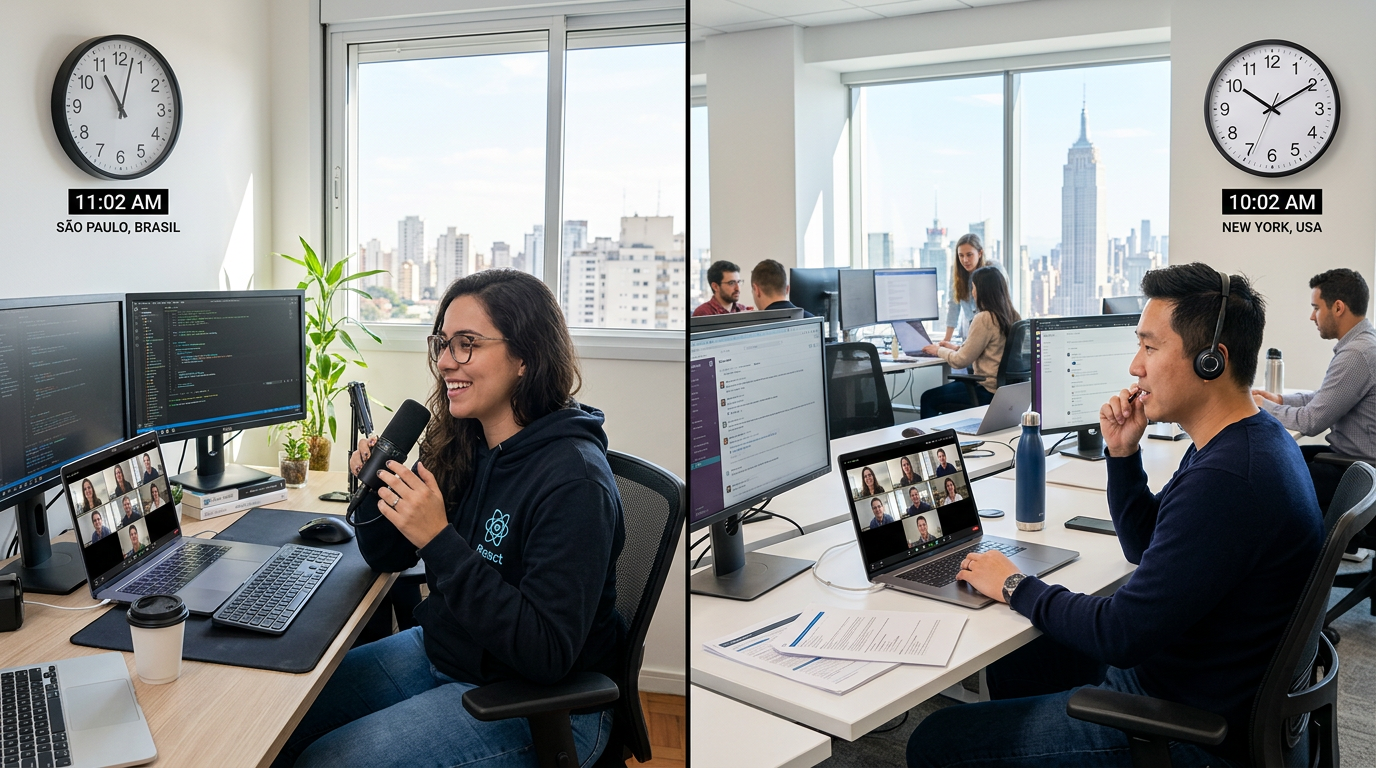
Time-zone overlap is the variable most hiring managers underweight when evaluating development models. A 10–12 hour gap between your team and an offshore developer means you share, at best, 2 hours of working overlap per day — if anyone stays late. A nearshore React developer in Colombia or Argentina shares 5–8 hours of real-time overlap with a US East Coast team, and full overlap with US Central and Mountain time zones.
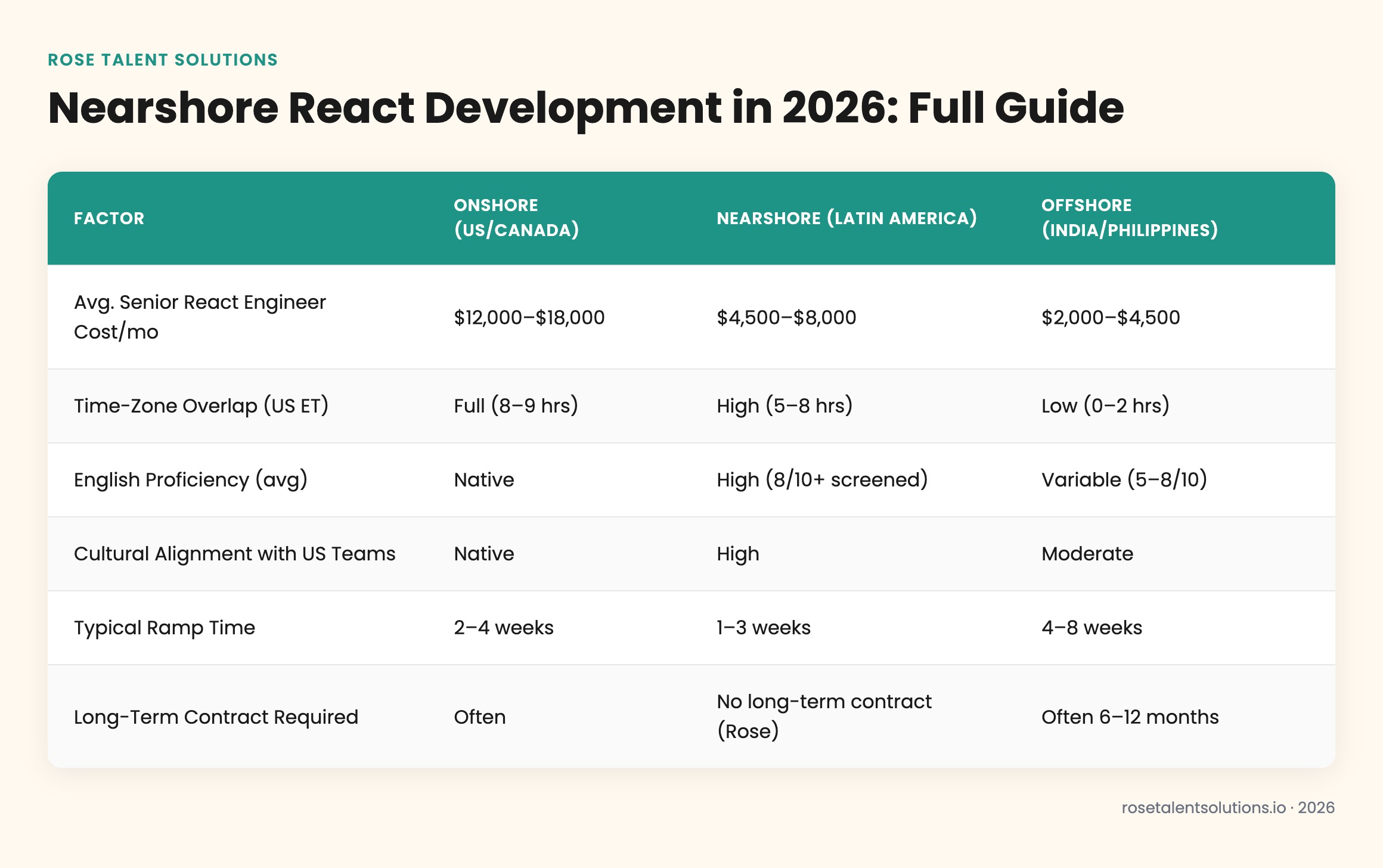
| Factor | Onshore (US/Canada) | Nearshore (Latin America) | Offshore (India/Philippines) |
|---|---|---|---|
| Avg. Senior React Engineer Cost/mo | $12,000–$18,000 | $4,500–$8,000 | $2,000–$4,500 |
| Time-Zone Overlap (US ET) | Full (8–9 hrs) | High (5–8 hrs) | Low (0–2 hrs) |
| English Proficiency (avg) | Native | High (8/10+ screened) | Variable (5–8/10) |
| Cultural Alignment with US Teams | Native | High | Moderate |
| Typical Ramp Time | 2–4 weeks | 1–3 weeks | 4–8 weeks |
| Long-Term Contract Required | Often | No long-term contract (Rose) | Often 6–12 months |
"The best-performing distributed engineering teams we benchmark share one trait: they have at least four hours of real-time daily overlap between their core and extended team members. That's essentially impossible with pure offshore, and it's the core structural advantage of the nearshore model." — Ariel Camus, CEO at Microverse (2024)
What Does Nearshore React Development Actually Cost in 2026?
The honest answer is: significantly less than US hiring, and more than pure offshore — and the premium over offshore is money well spent. A senior React engineer in Latin America typically earns between $4,500 and $8,000 per month all-in when hired through a managed nearshore staffing model. Compare that to the US Bureau of Labor Statistics median software developer salary of $132,270 annually (2024) — roughly $11,000 per month before benefits, payroll taxes, equipment, and PTO costs are added.
When you factor in employer taxes, health insurance, 401(k) match, and the loaded cost of a US hire, the all-in annual cost of a domestic senior React developer commonly reaches $180,000–$220,000. A nearshore equivalent through a managed staffing model like Rose Talent Solutions lands at a flat $2,500 per month for a full-time team member — that's recruiting, vetting, payroll, HR, and ongoing management included, with no long-term contract required. If you're curious how Latin American compensation benchmarks work, this breakdown of Latin American virtual assistant salary averages gives useful context on the regional wage market.
What you don't get at the low end of the cost range is quality control. The $2,000/month offshore developer on a platform marketplace comes with no vetting guarantee, no replacement policy, and no HR infrastructure behind them. The managed nearshore model costs more than a raw marketplace hire, and it should — you're buying a screened candidate, a managed relationship, and a free replacement if the team member isn't a fit. According to McKinsey's Global Tech Trends report, companies that use structured talent vetting processes experience 35% lower first-year attrition than those relying on unscreened marketplace hires — a gap that compounds painfully on sprint-driven development teams.
How to Evaluate a Nearshore React Development Partner in 2026
Choosing a nearshore partner is not the same as posting a job on a freelance platform. You're selecting a firm that will represent your engineering brand to candidates, manage compliance across international employment law, and serve as your HR layer for an indefinite engagement. The criteria that matter are different from a typical vendor evaluation.

The most common mistake US engineering leaders make when evaluating nearshore partners is focusing entirely on the hourly rate and ignoring the vetting process. Ask every partner: "Walk me through your technical screening for React developers step by step." If they can't answer in specific detail — live coding environment, component architecture challenge, TypeScript fluency test — keep looking.
According to SHRM's research on hiring costs, a bad technical hire costs an average of $17,000 in direct replacement expenses alone — not counting the 3–6 months of lost productivity and delayed sprint velocity. That number is why the replacement guarantee matters: if the team member isn't a fit, a quality nearshore partner replaces them at no additional cost. That's the risk reversal that separates a professional staffing model from a marketplace gamble.
Rose Talent Solutions screens every React candidate for English proficiency at 8/10 or above, requires a live technical assessment, and pairs each team member with a role-specific AI copilot trained on the tools they'll use in your stack. That AI layer — trained on frameworks like Next.js, testing libraries, CI/CD tooling, and your specific tech requirements — is one reason Rose placements ramp faster than typical managed staffing. You're not waiting for someone to rediscover your documentation on week three.
For a broader look at how to evaluate staffing partners in this space, this guide to choosing a nearshore staffing agency covers the red flags and green flags to look for in 2026.
How the Nearshore React Hiring Process Works in 2026 — Step by Step
The mechanics of getting a nearshore React developer on your team are faster than most engineering managers expect. A quality managed partner can place a vetted candidate within one week of intake. Here's how the process runs end to end.
Intake & Role Definition
You fill out a role brief: React version, state management preference (Redux, Zustand, React Query), TypeScript requirement, test coverage expectations, and sprint cadence. The more specific, the better the match.
Candidate Vetting
The staffing partner screens from their Latin American talent network — English proficiency test, live React coding challenge, architecture discussion, and cultural fit screen. You receive a shortlist of 2–3 pre-vetted candidates.
Your Interview
You meet the shortlisted candidates directly, run your own technical or culture interview, and select your hire. You retain full decision-making authority — the partner does not place someone without your approval.
Onboarding & AI Copilot Activation
The developer joins your Slack, gets access to your GitHub org, and their AI copilot is configured to your stack. Most Rose placements are committing reviewed code within the first sprint week.
Ongoing HR & Management
The staffing partner handles payroll, compliance, and HR in the developer's country. You manage the work; they manage the employment relationship. Cancel with 30 days written notice — no long-term contract.
This model is meaningfully different from a staff augmentation firm that sends you a resume and bills you hourly. The managed model includes the full employment infrastructure, which is particularly important when engaging talent across multiple Latin American jurisdictions where labor law varies significantly. According to Gallup's State of the Global Workplace report, engaged employees — those with clear role expectations and management support — are 23% more productive than disengaged workers. The managed staffing structure is engineered to produce that engagement from day one.
Latin America's developer talent pipeline has grown substantially in the past five years. According to the Inter-American Development Bank's Digital Economy research, Latin America added over 1.2 million new technology professionals between 2020 and 2024, with React and JavaScript skills ranking among the most commonly certified competencies in the region's top coding bootcamp ecosystems. That talent depth is what makes the nearshore model scalable — you're not drawing from a thin pool.
Nearshore React Development: Pros, Cons, and Who It's Right For in 2026
The nearshore model is not the right answer for every company. It works exceptionally well for growth-stage US SaaS companies, digital agencies managing multiple product streams, and enterprises looking to scale their React capacity without headcount approvals for domestic FTEs. It works less well for organizations that have strong preferences for in-person collaboration or that operate in regulated industries with strict data residency requirements.
Pros of Nearshore React Development
- 40–60% cost savings vs. US senior React salaries
- Full US business-hours overlap (5–8 hrs/day)
- English fluency screened before placement
- No long-term contract — cancel with 30 days notice
- Free replacement if the developer isn't a fit
- Faster ramp than offshore — cultural alignment reduces onboarding friction
- Latin American talent pool is growing rapidly in React/TypeScript depth
Cons to Consider
- Higher cost than raw offshore marketplace hiring
- Less suitable for companies requiring on-site presence
- Partner quality varies widely — vetting the partner is as important as vetting the developer
- Some data residency regulations may complicate cross-border engagements
If your team already uses remote-first tooling — async standups in Loom, tickets in Linear or Jira, PR reviews in GitHub — the nearshore model slots in with almost no workflow change. The developer shows up in your tools, speaks your language (literally and figuratively), and operates inside your sprint rhythm. That's the real value proposition, and it's why the model has grown faster than traditional offshore over the past three years. A Pew Research Center study on remote work and digital collaboration found that teams with standardized digital tooling reported 31% fewer communication breakdowns than those operating without shared workflow platforms — a finding that maps directly to why nearshore developers, who adopt your toolchain on day one, integrate faster than offshore alternatives.
For companies that want a full comparison before committing to a nearshore partner, this deep-dive on onshore vs. offshore hiring tradeoffs applies directly to technical roles and is worth reading alongside this guide. And when you're ready to move forward, getting started with Rose takes about ten minutes — you'll have a shortlist of vetted React candidates within the week.
The bottom line: nearshore React development in 2026 is not a compromise between quality and cost. It is a structural upgrade for most US product teams — better timezone alignment than offshore, meaningfully lower cost than domestic, and a managed employment model that removes the HR and compliance complexity you'd otherwise inherit. The companies winning on React velocity right now are not the ones with the biggest US hiring budgets. They're the ones that figured out the nearshore arbitrage before their competitors did.