
What Are Nearshore Python Development Services?
Nearshore Python development services place skilled Python engineers and technical staff based in Latin America on your team — working your business hours, communicating in fluent English, and operating at a fraction of domestic US hiring costs. The "nearshore" label is specific: it means the talent is geographically and culturally proximate to North America, not routed through a 10-hour timezone gap in Southeast Asia or South Asia. If you've ever hired an offshore developer only to discover your feedback loop runs on a 24-hour delay, you already understand why the distinction matters.
Python is one of the most in-demand programming languages in the world. According to Stack Overflow's 2024 Developer Survey, Python has held the top spot as the most-used programming language among professional developers for the third consecutive year, cited by over 51% of respondents. That ubiquity means US businesses are competing for Python talent in one of the tightest labor markets in tech.
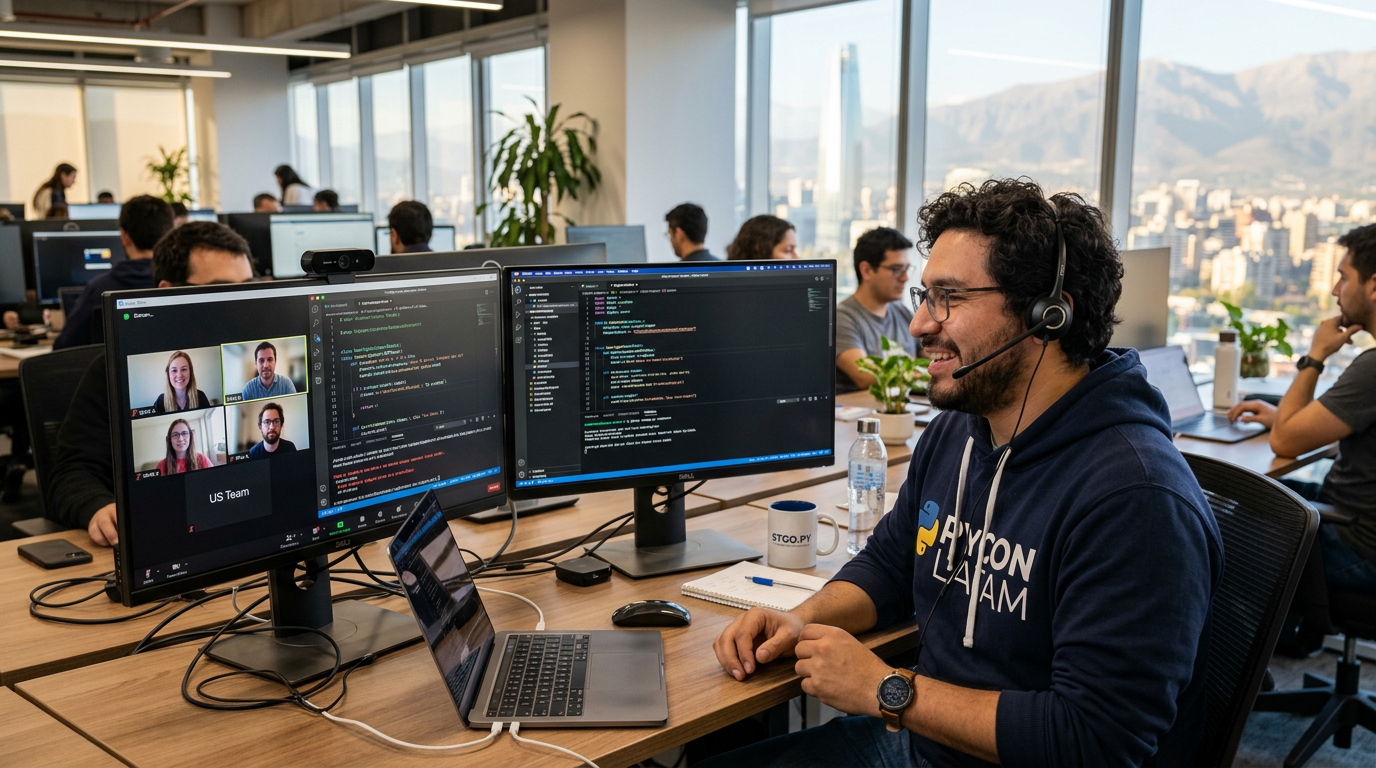
Nearshore staffing solves that squeeze without sacrificing collaboration quality. A developer in Bogotá, Buenos Aires, or Mexico City works in the same EST–PST window you do. Stand-ups happen live. Code reviews don't pile up overnight. Bugs get triaged in real time.
How Nearshore Python Developers Compare to Offshore and Onshore in 2026
The three hiring models — onshore, nearshore, and offshore — are not interchangeable. Each involves a different tradeoff between cost, collaboration speed, and risk. Understanding exactly where they diverge helps you match the model to what your team actually needs.
Onshore US Python developers command median salaries that make full-time hiring prohibitive for most growth-stage businesses. According to the US Bureau of Labor Statistics (2024), the median annual wage for software developers is $132,270 — which, with benefits, payroll taxes, and recruiting overhead, regularly pushes total employment cost above $170,000 per year. That number alone rules out a dedicated Python hire for most small and mid-sized businesses.
Offshore vendors (India, Philippines, Eastern Europe) advertise lower hourly rates but introduce timezone misalignment that compounds daily. When a US product manager needs a quick Python data pipeline fix at 2pm on a Tuesday, a developer working GMT+5:30 is already offline. For teams running agile sprints with daily standups and async PRs, that gap is not a minor inconvenience — it structurally slows your velocity. You can read a detailed breakdown of how these models compare on cost and availability in our complete nearshore vs. offshore vs. onshore comparison.
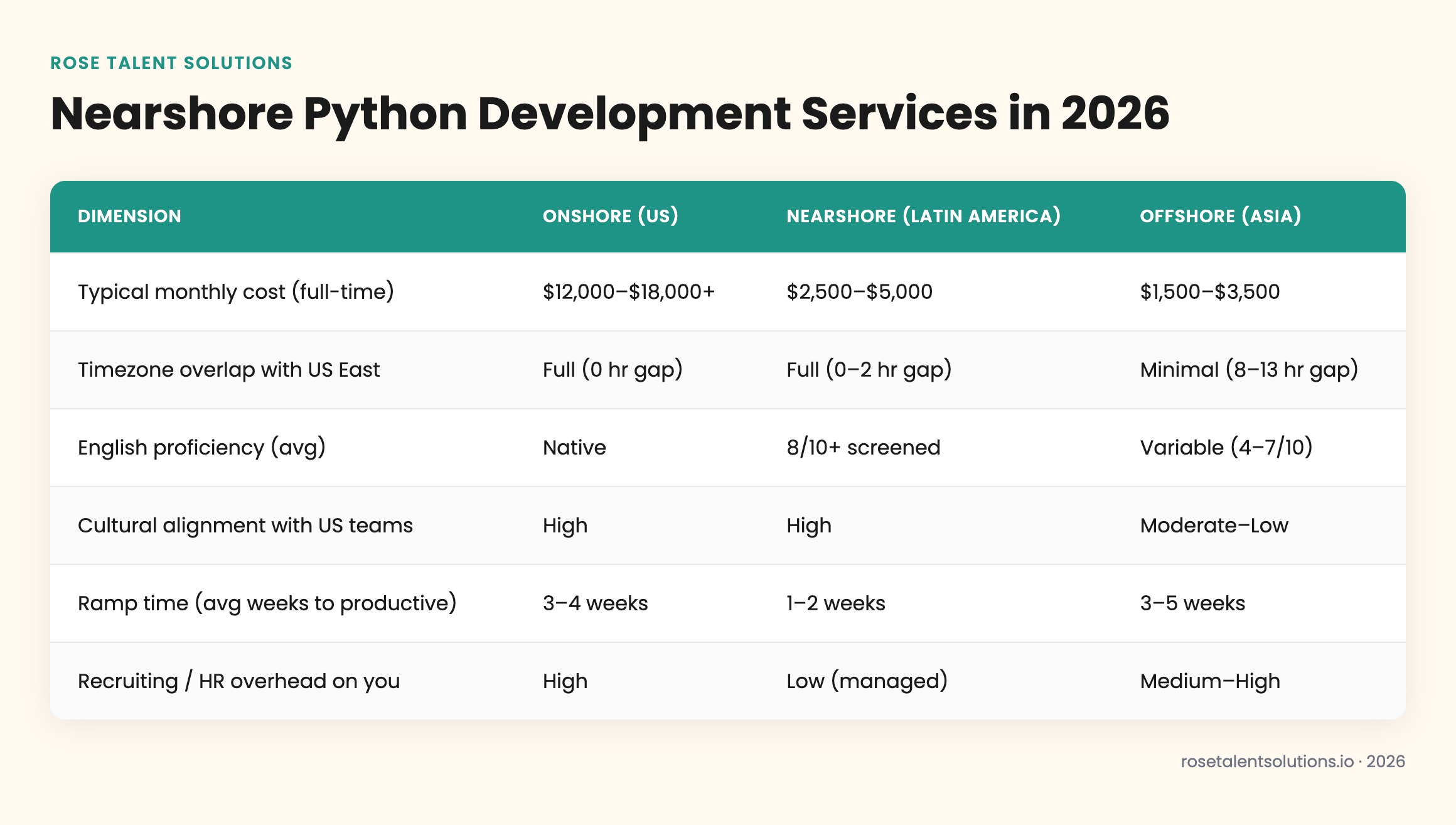
Nearshore Latin American developers land in the middle — cost structures closer to offshore rates, collaboration quality closer to onshore. The table below summarizes the key dimensions:
| Dimension | Onshore (US) | Nearshore (Latin America) | Offshore (Asia) |
|---|---|---|---|
| Typical monthly cost (full-time) | $12,000–$18,000+ | $2,500–$5,000 | $1,500–$3,500 |
| Timezone overlap with US East | Full (0 hr gap) | Full (0–2 hr gap) | Minimal (8–13 hr gap) |
| English proficiency (avg) | Native | 8/10+ screened | Variable (4–7/10) |
| Cultural alignment with US teams | High | High | Moderate–Low |
| Ramp time (avg weeks to productive) | 3–4 weeks | 1–2 weeks | 3–5 weeks |
| Recruiting / HR overhead on you | High | Low (managed) | Medium–High |
Why Latin America Became the Top Source for Nearshore Python Talent in 2026
Latin America's tech workforce has grown dramatically over the past decade. According to the Inter-American Development Bank (IDB), Latin America and the Caribbean produced over 500,000 new technology graduates annually as of their most recent regional workforce analysis. Countries like Brazil, Colombia, Mexico, and Argentina have invested heavily in STEM education pipelines, and Python is consistently among the most-taught languages at the university level across the region.
Beyond raw talent volume, Latin America's developers have been shaped by proximity to US tech culture. Many have worked on US-facing products, taken US-curriculum online certifications (AWS, Google, Meta), and built careers that include direct collaboration with North American product teams. The result is a talent pool that doesn't just know Python syntax — it knows how to work inside a US-style engineering culture, which is a different and equally important skill.
English fluency is a screened-for requirement, not an assumption. At Rose Talent Solutions, every candidate clears an 8/10+ English proficiency bar before they reach your desk. That matters specifically for Python roles where technical documentation, PR comments, and stakeholder communication all happen in English. If you want to understand how Latin American staffing compares more broadly to other sourcing strategies, our post on what a Latin America staffing agency actually does breaks down the vetting and placement process end to end.
"Latin America has quietly become one of the strongest nearshore software development regions in the world — the combination of time zone alignment, improving English proficiency, and competitive cost structures is very hard to replicate elsewhere." — Ariel Camus, CEO at Microverse (2023)
How Rose Talent Solutions Delivers Nearshore Python Staff in 2026
Rose Talent Solutions is a nearshore virtual staffing agency that places full-time, dedicated team members from Latin America with US, Canadian, and UK businesses. For Python-specific roles, the process is straightforward and fast.
Role scoping call
You tell us exactly what you need — Python data engineer, backend developer, automation specialist, or technical VA who runs Python-based workflows. We document the tech stack, working hours, and communication preferences.
Vetting and matching
Rose screens candidates on Python proficiency, English fluency (8/10+ floor), and culture fit for your team. You receive a shortlist of pre-vetted candidates, typically within days — not weeks.
AI copilot activation
Every team member ships with a role-specific AI copilot trained on their primary tools — whether that's data pipeline tooling, cloud environments, or specific frameworks you use in your stack.
Ongoing HR and management
Rose handles payroll, HR compliance, and performance oversight. You manage the work. We manage the employment relationship — keeping your overhead low and your team stable.
Free replacement if not a fit
If the team member doesn't work out for any reason, we replace them at no additional cost. No awkward termination conversations, no rehiring fees, no downtime penalty.
Pricing is $2,500 per month, flat — full-time (40 hours per week), all-in. That includes recruiting, vetting, payroll, HR, and ongoing management. There is no long-term contract; you can cancel with 30 days' written notice. For context on how that price point benchmarks against the broader market, our breakdown of Latin America virtual assistant and technical staff costs gives a detailed look at what the market rate looks like across role types and seniority levels.
What Python Roles Work Best with the Nearshore Model?
Not every Python role is a natural fit for a nearshore staffing model — but most are. The model works best for roles where real-time communication with a US team is important, where the work is defined enough to be managed remotely, and where the cost savings materially change what's possible for your business. According to SHRM's workforce benchmarking research (2024), the average cost-per-hire for a software developer in the US now exceeds $28,000 when accounting for recruiter fees, interview time, and onboarding — a figure that makes even a few months of nearshore engagement financially compelling.

The Python roles that map most cleanly onto the nearshore model include:
- Data pipeline engineers — building and maintaining ETL workflows in Python (Pandas, PySpark, Airflow), typically integrated with cloud data warehouses like Snowflake or BigQuery.
- Backend API developers — FastAPI, Django REST Framework, Flask — building the server-side logic that powers web products and internal tools.
- Automation and scripting specialists — Python-based RPA, browser automation (Playwright, Selenium), and workflow automation that eliminates repetitive operational tasks.
- Data analysts with Python proficiency — analysts who work in Jupyter notebooks, use Pandas and Matplotlib, and produce insights that feed business decisions in real time.
- Technical operations staff — team members who use Python as a tool inside operations roles: parsing CSVs, writing internal scripts, connecting APIs via requests or boto3.
For businesses that also need operational support alongside technical development — think a property management company that needs both a Python-powered data workflow and day-to-day administrative coordination — Rose's property management staffing and bookkeeping and accounting specialists can complement your technical hires within the same managed model.
The hidden cost of a timezone-misaligned offshore Python developer isn't the hourly rate — it's the 8–13 hour feedback gap that turns a 20-minute code review into a 48-hour blocker. Nearshore developers in Latin America eliminate that gap entirely by working live, concurrent US business hours.
Nearshore vs. Offshore Python Development: Pros and Cons in 2026
The honest framing is that offshore vendors are cheaper on paper and nearshore vendors are cheaper in practice — once you account for collaboration overhead, ramp time, and the hidden management cost of asynchronous communication. A McKinsey Digital analysis on tech workforce trends (2023) found that engineering team productivity losses from timezone-driven async cycles are frequently underestimated by 40–60% by hiring managers who focus only on loaded labor cost. That gap is where nearshore wins in the total cost of ownership calculation.
If you're still weighing whether to go nearshore or stay with an offshore vendor you've used before, the breakdown in our post on onshore vs. offshore team tradeoffs walks through the decision framework in detail — including the scenarios where offshore still makes sense (and when it doesn't).
Nearshore Python (Latin America)
- Full US timezone overlap — live standups, real-time code reviews
- High English proficiency — screened, not assumed
- Strong cultural alignment with US product and engineering culture
- All-in managed model — no payroll, HR, or compliance overhead on you
- Free replacement if not a fit — zero rehiring cost risk
- Ramp time typically 1–2 weeks vs. 3–5 weeks offshore
Offshore Python (Asia)
- 8–13 hour timezone gap — async-only collaboration for most of the day
- English proficiency highly variable and rarely pre-screened to a floor
- Cultural and communication friction compounds over time on complex projects
- Cheaper headline rate, but higher hidden management overhead
- Longer ramp time due to onboarding communication inefficiencies
- Often requires a US-based tech lead to bridge the gap — adding cost
Python projects that involve iterative development cycles — agile sprints, daily PRs, stakeholder demos — are where the nearshore model's real-time advantage is most acute. Every hour of timezone overlap you recover is an hour of compounding engineering velocity restored to your team.