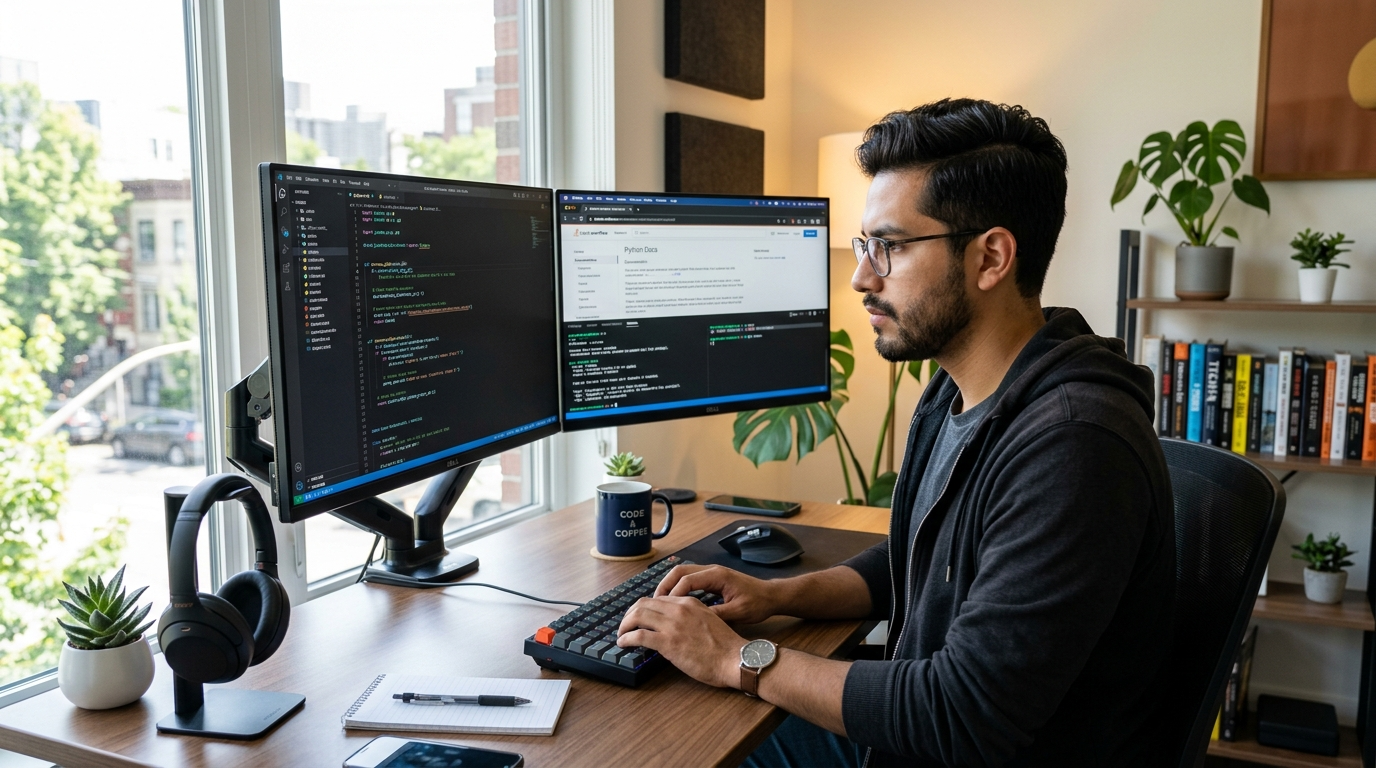
Nearshore Python developers — based in Latin America, working your hours, fluent in English — have become one of the most practical hiring decisions a US or Canadian business can make in 2026. The market for Python talent has never been more competitive domestically, and the cost gap between a US-based developer and a vetted Latin American one is significant enough that most operators can't justify ignoring it. This guide walks you through what nearshore Python development actually means, how to evaluate candidates, what you should pay, and how to avoid the mistakes that turn a great idea into a headache.
What Is a Nearshore Python Developer?
A nearshore Python developer is a software professional based in a geographically proximate country — in the context of US businesses, that means Latin America (Mexico, Colombia, Argentina, Brazil, and similar markets) — who builds, maintains, or automates systems using the Python programming language. Unlike offshore developers in the Philippines or India, nearshore hires operate in overlapping or identical time zones to the US, which means your 10am standup doesn't require anyone to set a 2am alarm.
Python is the second most used programming language in the world, according to Stack Overflow's 2024 Developer Survey (2024), with over 51% of professional developers using it regularly. That penetration spans data engineering, automation, backend APIs, machine learning, and web development — which is why demand for Python-fluent hires has outpaced supply in North American markets for three consecutive years.
When you hire a nearshore Python developer through a staffing partner like Rose Talent Solutions, you're not just getting someone who can write clean code. You're getting a vetted professional who has been screened for English proficiency (Rose's published floor is 8/10+), technical skill, and culture fit — with the payroll, HR, and management overhead handled for you. That's a fundamentally different product than posting a job on a freelance marketplace.
How Nearshore Python Developers Compare to Offshore and Onshore in 2026
The "cheaper overseas developer" instinct often leads businesses to offshore markets first. But cheap-per-hour doesn't mean cheap-overall. A 6–9 hour timezone gap means every code review, bug report, or sprint planning session either happens asynchronously — adding 24-hour delays per cycle — or requires your team to work outside normal hours. For most US businesses running two-week sprints, that lag compounds fast.

| Dimension | Nearshore (Latin America) | Offshore (India / Philippines) | Onshore (US / Canada) |
|---|---|---|---|
| Monthly Cost (Full-Time) | ~$2,500–$5,000 | ~$1,200–$3,000 | ~$8,000–$14,000+ |
| Timezone Overlap with US | Full (0–2 hrs difference) | Minimal (6–9 hrs behind/ahead) | Full |
| English Proficiency | High (8/10+ screened) | Variable (4–7/10 typical) | Native |
| Time to First Placement | ~7 days | 2–4 weeks | 4–12 weeks |
| Cultural Alignment with US | High | Moderate | Native |
| Long-Term Contract Required | No (month-to-month) | Often yes (3–12 month minimums) | Typically yes (employment law) |
The table above makes the value proposition clear: nearshore developers sit in a sweet spot that offshore can't match on collaboration and onshore can't match on cost. If you're already considering alternatives to domestic hiring, you may also want to read how nearshore developers compare to Toptal on total cost and flexibility — the differences are sharper than most people expect.
What Python Skills Should You Actually Screen For in 2026?
Python is a broad language. "Python developer" can mean a data scientist building ML pipelines, a backend engineer building Django REST APIs, or a DevOps engineer writing automation scripts. Before you post a role or engage a staffing partner, be specific about which Python ecosystem your business actually needs.
The most in-demand Python specializations for US businesses right now include:
- Backend API development — FastAPI, Django, Flask. Critical for SaaS products and internal tooling.
- Data engineering and ETL — Pandas, SQLAlchemy, Airflow. Needed by any business doing meaningful analytics.
- Automation and scripting — Selenium, Beautiful Soup, Celery. High ROI for businesses with repetitive manual workflows.
- Machine learning / AI integration — PyTorch, scikit-learn, LangChain. Growing fast as businesses build AI-adjacent features.
- Cloud infrastructure scripting — Boto3 (AWS), GCP SDK. Often paired with DevOps roles.
Latin American developer ecosystems have matured significantly in these specializations. Countries like Argentina and Colombia produce thousands of computer science graduates annually — Argentina alone had over 120,000 tech professionals in its export sector as of 2023, according to CESSI, Argentina's Chamber of Software and IT Services Companies (2023). That talent pool is deep, and a significant portion of it is Python-fluent.
The regional growth in tech talent is also reflected in remote work adoption trends. According to SHRM's State of the Workplace 2024 report (2024), 72% of HR leaders say access to global talent has become a top workforce strategy — a shift that directly benefits US businesses able to tap Latin America's growing developer pool without the friction of traditional offshore hiring.
"Latin America's tech talent density is no longer a secret — what's changed is the infrastructure to find, vet, and retain that talent reliably for US businesses." — Ariel Quiñones, Co-founder & CEO at Platzi (2024)
When evaluating candidates, a live technical screen matters more than a resume. Ask for a take-home problem in their stated specialty, then do a 30-minute walkthrough. You're testing reasoning under pressure, not just syntax recall — and that's where English fluency matters too. A developer who can't explain their architectural tradeoffs clearly will cost you hours of back-and-forth per sprint.
How Rose Talent Solutions Sources and Vets Nearshore Python Developers in 2026
Rose Talent Solutions operates a structured sourcing and vetting pipeline specifically designed for US businesses hiring technical roles from Latin America. The process isn't a resume marketplace — it's a managed staffing model where Rose handles recruiting, skills screening, English proficiency testing, payroll, HR compliance, and ongoing performance management. You get a vetted developer. Rose handles everything behind the scenes.
The hidden cost of DIY offshore hiring isn't the hourly rate — it's the recruiting time, compliance risk, and management overhead that adds 30–40% to your true cost of employment when you source and manage the hire yourself. According to SHRM's Human Capital Benchmarking Report (2023), the average cost-per-hire in the US across all industries is $4,700 — and that's before the first paycheck clears.
One differentiator worth noting: every Rose team member ships with a role-specific AI copilot trained on the tools relevant to their work. For Python developers, that means AI assistance calibrated to the frameworks and workflows your specific project uses — which compresses ramp time meaningfully in the first 30 days.
Python isn't always a standalone hire, either. Many businesses that come to Rose for a Python developer also need adjacent technical capacity. If your product has a mobile component, the same vetting rigor applies to nearshore iOS and Android mobile developers — Rose sources both. And if you need someone who can straddle backend Python and frontend JavaScript, check whether a nearshore full-stack developer might cover more ground for the same monthly investment.
Discovery Call
You tell Rose exactly what you're building, what Python stack you use, and what a successful hire looks like in 90 days. This scopes the search before a single resume is pulled.
Candidate Sourcing & Technical Screen
Rose's recruiting team identifies candidates from its Latin America network, runs a live technical screen in Python, and scores English proficiency against the 8/10+ floor.
You Interview Finalists
You meet 2–3 pre-screened candidates. You're not filtering through a stack of résumés — you're making a final call between vetted options.
Placement & Onboarding
Your developer starts within days of your decision. Rose handles payroll, HR, and compliance so you can focus on sprint planning, not paperwork.
Ongoing Management & Replacement Guarantee
If the placement isn't a fit, Rose replaces the team member at no additional cost. Month-to-month terms mean no long-term contract locks you in.
What Does It Actually Cost to Hire a Nearshore Python Developer in 2026?
Through Rose Talent Solutions, the all-in rate for a full-time nearshore Python developer is $2,500/month — flat, no hidden fees, and inclusive of recruiting, vetting, payroll, HR, and ongoing management. That's 40 hours per week of dedicated technical capacity for a number that's a fraction of what a US-based mid-level Python developer costs.

For context: the median annual salary for a software developer in the United States was $132,270 in 2023, according to the U.S. Bureau of Labor Statistics (2024). That's roughly $11,000/month before benefits, payroll taxes, and recruiting costs. At $2,500/month flat, the nearshore model represents a cost reduction of roughly 77% — significant enough to fund two additional hires for the same budget.
The terms are month-to-month. You can cancel with 30 days written notice — there's no long-term contract. If the developer isn't the right fit, Rose replaces them at no additional cost. That's the risk reversal — not a promotional trial, but a structural guarantee baked into how Rose operates.
Cost comparisons matter, but so does what you're comparing. Freelancer marketplaces offer lower hourly rates on paper but zero vetting infrastructure, no HR compliance, and no management support. McKinsey research on distributed workforce models found that businesses using managed staffing partners reduce total talent acquisition cost by up to 25% versus self-managed remote hiring, according to McKinsey & Company's talent competition analysis (2023). You're not just buying developer hours — you're buying a managed technical employee without the employment overhead. The same logic applies whether you're hiring for Python, React, or Android development through a nearshore staffing model.
How to Set Your Nearshore Python Developer Up for Success in 2026
The most common reason nearshore developer placements underperform isn't skill — it's onboarding. US businesses that treat their nearshore hire like a freelance contractor rather than a team member consistently get contractor-level output. The businesses that treat them like an embedded team member — included in standups, given real sprint ownership, looped into product decisions — get dramatically different results.
What Works
- Daily standups with your nearshore developer included — timezone overlap makes this possible
- Clear sprint tickets with defined acceptance criteria before the sprint starts
- Access to the same tools as your onshore team (GitHub, Jira, Slack, Notion)
- Dedicated Slack channel for async Q&A between syncs
- 30/60/90 day milestone check-ins with Rose's account team
What Fails
- Treating the hire as a task-taker with no product context
- Sending work only via email with 24-hour response expectations
- No documented codebase, no README, no onboarding runbook
- Skipping the intro call between the developer and existing team leads
- Measuring output in hours logged rather than sprint velocity
Remote-first companies are measurably better at this. According to Gallup's State of the Global Workplace Report (2024), engaged remote employees show 23% higher profitability outcomes than disengaged ones — and engagement is driven overwhelmingly by clarity of expectations and quality of manager communication, not physical proximity. Your nearshore Python developer performs at the level your onboarding and communication systems permit.
The data on remote developer productivity is also instructive. A widely cited Stanford study by Nicholas Bloom (2023) found that remote workers show a 13% performance increase compared to in-office counterparts when given clear task structures and communication rhythms — exactly the conditions a well-onboarded nearshore developer thrives under. Structure your onboarding around clarity, and the productivity gains follow.
If your business is still early in the remote technical hiring journey, consider starting with a clearly scoped project — a specific API integration, an automation script, a data pipeline — before moving to open-ended development work. Scoped projects give you a measurable outcome for the first 30 days, which builds trust in both directions. You can always expand scope once the collaboration rhythm is established. To get started, visit Rose's intake page and describe what you're building — the team will scope the right technical profile from there.