
Nearshore mobile app development has quietly become the default hiring strategy for US product teams that need real engineers at non-US prices — and in 2026, the Latin America talent pool is deeper than it has ever been. Whether you're building a consumer-facing iOS app, an internal business tool, or a property management platform integration, the core question is the same: do you hire locally, go offshore to Southeast Asia, or go nearshore to Colombia, Mexico, or Argentina? This post breaks down exactly how nearshore development works, what it costs, and how to staff a capable mobile team without locking into a long-term contract.
What Is Nearshore Mobile App Development in 2026?
Nearshore mobile app development is the practice of contracting software engineers or development teams located in geographically close countries — typically within 1–3 time zones of your headquarters. For US and Canadian companies, "nearshore" almost always means Latin America: Mexico, Colombia, Argentina, Brazil, Costa Rica, and Peru are the most active hubs. The critical distinction from offshore outsourcing (India, Philippines, Eastern Europe) is timezone overlap. Nearshore teams work your business hours, answer Slack messages in real time, and join your standups live — no async delays, no overnight handoffs.
Nearshore is not the same as a freelance marketplace or a body-shop agency. A true nearshore engagement means the developer or team is fully embedded in your sprint cycle, communicates in fluent English, and is managed against your product roadmap — not against a scope-of-work document delivered in batches. For a deeper look at how nearshore compares to other staffing models, see our complete nearshore vs offshore vs onshore comparison, which covers the full tradeoff matrix across cost, communication, and control.
Latin America produces over 600,000 software engineering graduates per year, according to the Inter-American Development Bank (IDB) (2023). That pipeline has been growing at roughly 8% annually, meaning the talent supply in 2026 is materially larger than it was even two years ago. English proficiency in tech hubs like Bogotá, Medellín, Buenos Aires, and Mexico City routinely meets or exceeds the B2/C1 threshold that US engineering managers expect from a direct report.
How Nearshore vs Offshore vs Onshore Mobile Development Compares in 2026
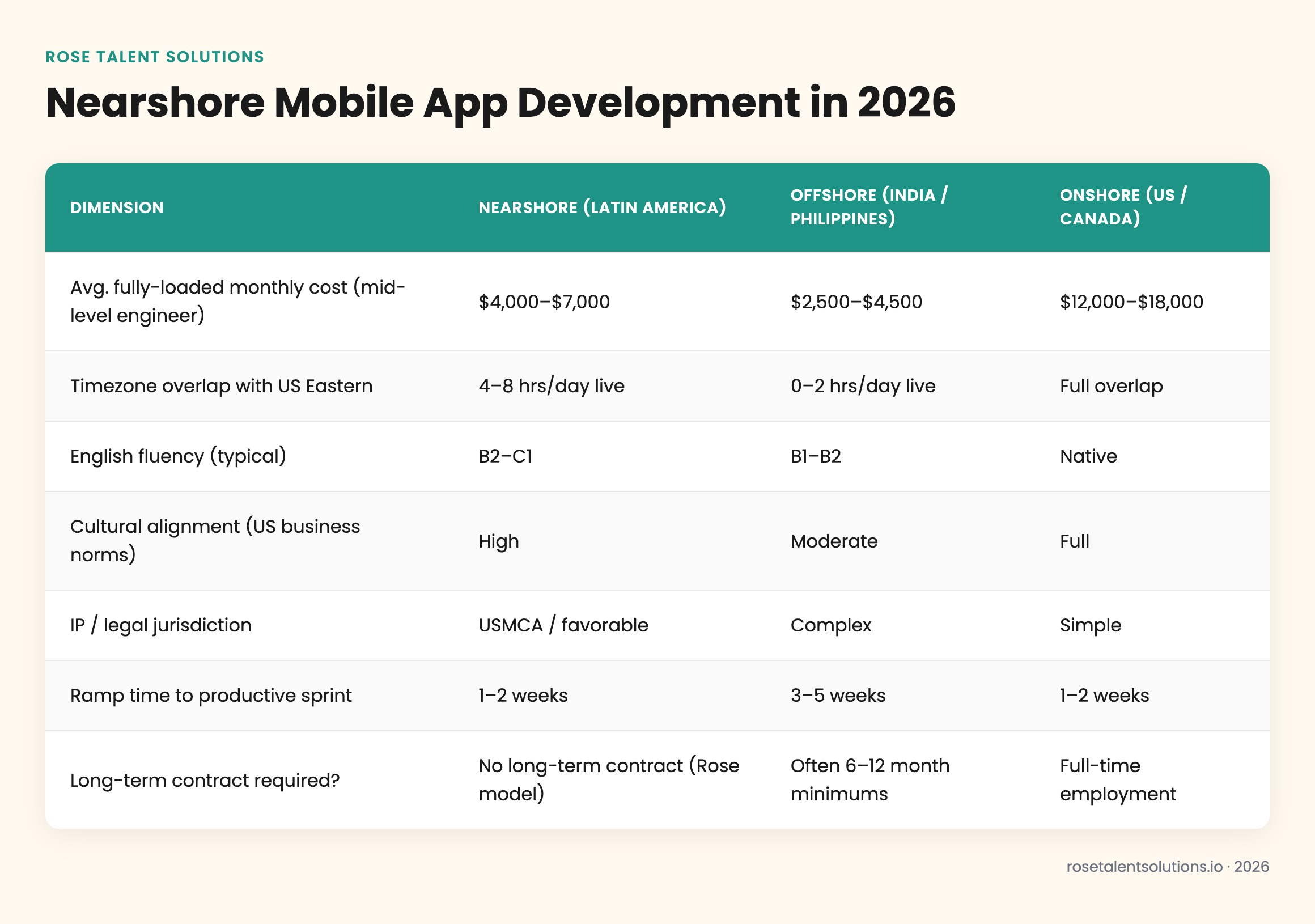
The three-way comparison matters because each model has a genuinely different risk profile. Onshore US development is low-risk on communication but high-cost — senior iOS and Android engineers in the US commanded median salaries of $155,000–$175,000 in 2025, according to the US Bureau of Labor Statistics (2025). Offshore teams in India or the Philippines cut that cost dramatically but introduce a 9–13 hour timezone gap that compounds every day your team is in active development. Nearshore sits cleanly in the middle: 40–60% cost savings with near-zero timezone friction.
| Dimension | Nearshore (Latin America) | Offshore (India / Philippines) | Onshore (US / Canada) |
|---|---|---|---|
| Avg. fully-loaded monthly cost (mid-level engineer) | $4,000–$7,000 | $2,500–$4,500 | $12,000–$18,000 |
| Timezone overlap with US Eastern | 4–8 hrs/day live | 0–2 hrs/day live | Full overlap |
| English fluency (typical) | B2–C1 | B1–B2 | Native |
| Cultural alignment (US business norms) | High | Moderate | Full |
| IP / legal jurisdiction | USMCA / favorable | Complex | Simple |
| Ramp time to productive sprint | 1–2 weeks | 3–5 weeks | 1–2 weeks |
| Long-term contract required? | No long-term contract (Rose model) | Often 6–12 month minimums | Full-time employment |
The legal dimension is also worth flagging. Mexico is a USMCA signatory, which gives US companies a more predictable IP enforcement framework than contracts signed under Indian or Philippine law. That matters when your mobile app involves proprietary algorithms, health data, or financial transaction logic. If you want the full breakdown of how onshore and offshore models compare on these dimensions, our post on onshore vs offshore virtual assistant staffing covers the legal, payroll, and control tradeoffs in plain language.
How Rose Talent Solutions Staffs Nearshore Mobile App Teams in 2026
Rose Talent Solutions operates as a nearshore staffing agency specifically for US, Canadian, and UK businesses. The model is straightforward: $2,500 per month, flat, for one full-time (40 hours per week) nearshore team member. That price is all-in — recruiting, vetting, payroll, HR compliance, and ongoing management are all included. There are no hidden platform fees, no per-seat software charges, and no long-term contract. If the team member isn't a fit, Rose replaces them at no additional cost.
The AI copilot layer is what separates Rose from a generic staffing agency. Every team member is trained on the specific software stack relevant to their role before they start — for mobile app support roles, that means tools like Jira, Confluence, Figma, Slack workflows, TestFlight, and Firebase. The AI advantage Rose builds into each placement means the team member arrives knowing your toolchain, not learning it on your dime.
For context on what Latin America-based talent actually earns and why the $2,500 flat rate makes economic sense for both sides, see our detailed breakdown of average Latin America virtual assistant salaries — the same wage market that applies to nearshore technical support and coordination roles.
Discovery Call
Rose's team maps your role requirements — tech stack, working hours, seniority level, and communication expectations — in a 30-minute call. No generic intake form.
Candidate Matching
Rose surfaces 2–3 pre-vetted candidates from its Latin America network within 3–5 business days. All have passed English proficiency screens at 8/10 or above and role-specific technical assessments.
AI Copilot Onboarding
Before day one, the selected team member completes a role-specific AI copilot training module built around your software stack — Jira, Figma, Firebase, or whatever tools your team uses.
Live in Your Sprint
The team member joins your Slack, attends standups, and starts contributing to active work within the first week. Rose handles all payroll and HR from that point forward.
Ongoing Management
Rose monitors performance and availability. If something isn't working, the replacement guarantee activates — no additional cost, no restart fee.
What Roles Can a Nearshore Mobile App Team Actually Cover in 2026?
The most common misconception about nearshore staffing for mobile development is that it only covers low-skill task work. That undersells the Latin America market significantly. In 2026, the roles you can realistically hire nearshore — at the $2,500–$7,000/month range — include QA engineers, junior-to-mid iOS and Android developers, mobile UI/UX designers, technical project managers, product coordinators, app store optimization specialists, and customer support engineers who understand your codebase. The senior architect layer typically stays onshore or in-house; everything below it is a nearshore candidate.

According to McKinsey's Tech Trends report (2024), QA automation and mobile testing are among the fastest-growing outsourced functions for US tech companies. The reasoning is straightforward: QA is high-volume, process-driven, and benefits enormously from timezone overlap — a QA engineer who can retest a bug fix the same afternoon it's deployed is worth three offshore testers working the next morning's queue.
The biggest leverage point for most mobile teams is the product coordinator or technical project manager role — someone who runs your Jira board, manages sprint ceremonies, writes tickets from stakeholder feedback, and keeps the offshore or nearshore developers unblocked. That role, nearshored at $2,500/month, typically replaces a $80,000–$95,000/year US hire. Rose's placement process is specifically built to match that profile.
The hidden cost of offshore mobile development isn't the hourly rate — it's the 9–13 hour timezone gap that means every bug reported at 3pm ET doesn't get looked at until 4am, and doesn't get fixed until the following afternoon. That compounding delay across a 6-month build adds weeks to your launch date.
How to Evaluate a Nearshore Mobile App Development Partner in 2026
Not all nearshore arrangements are equal. Some agencies pitch "nearshore" but place candidates in time zones that still produce a 5–7 hour lag. Others call themselves nearshore while quietly sourcing from Eastern Europe or the Philippines. The due diligence checklist for evaluating a legitimate nearshore mobile development partner comes down to six questions:
- Where exactly are the candidates located? Ask for city-level disclosure, not just "Latin America." Bogotá, Mexico City, Buenos Aires, Lima, and San José all work. "LatAm region" without specifics is a flag.
- What is the English proficiency bar, and how is it tested? Rose's published floor is 8/10 on structured proficiency screens. Ask any agency for their equivalent standard.
- Is the contract month-to-month? Legitimate nearshore agencies in 2026 do not require 6- or 12-month minimums. Insist on no long-term contract terms.
- Who handles payroll, compliance, and HR? If the agency passes those to you, you are effectively running a foreign contractor relationship with all the legal exposure that entails.
- What is the replacement policy? The standard you want is a free replacement if the team member isn't a fit — no restart fee, no gap in coverage.
- How do they handle tool onboarding? A team member who doesn't know your mobile stack on day one costs you 2–3 weeks of ramp time.
According to SHRM's research on employee turnover costs (2024), replacing a mid-level technical employee costs between 50% and 200% of their annual salary when you account for recruiting, onboarding, and productivity loss. A nearshore partner with a genuine replacement guarantee eliminates the majority of that risk from your cost model.
Pros of Nearshore Mobile Development
- Real-time timezone overlap — standups, reviews, and hotfixes happen live
- 40–60% cost reduction vs US onshore rates
- High English fluency in major Latin America tech hubs
- Strong and growing STEM talent pipeline (600,000+ graduates/year)
- USMCA legal framework for IP protection (Mexico)
- Cultural alignment with US business communication norms
- No long-term contract required with the right partner
Cons to Plan Around
- Senior architect-level talent remains thinner than onshore market
- Some agencies mislabel offshore placements as nearshore — verify locations
- Infrastructure quality varies by city — confirm reliable connectivity
- Slightly higher cost floor than deep-offshore models
The nearshore mobile app development market in 2026 is mature enough that you should not have to compromise on any of the "pros" above. The talent is there, the tooling for remote collaboration is excellent, and the agency layer — when you choose the right one — absorbs the compliance and HR complexity entirely. The property management staffing page shows how Rose applies this exact model to a different vertical, but the underlying placement mechanics are identical for mobile app teams.
"Latin America has reached an inflection point in software talent — the combination of strong universities, US cultural proximity, and near-perfect timezone alignment for American companies makes it the obvious first call for any team looking to scale engineering capacity in 2026." — Monika Herrero, VP of Engineering Partnerships at Globant (2024)
If you want to benchmark what you should be paying before you talk to any agency, Statista's IT outsourcing market data (2024) shows the global market crossed $617 billion — and the fastest-growing segment is nearshore engagement in the Americas, driven precisely by the timezone and communication advantages outlined above. Use that as context when evaluating proposals: if an agency is quoting nearshore rates but requiring offshore-style contract terms, the economics don't add up.