
What Is a Nearshore Medical Call Center in 2026?
Nearshore medical call centers place English-fluent agents in Latin America to handle inbound and outbound patient communications for US, Canadian, and UK healthcare businesses — live, during your office hours, not overnight from the other side of the world. "Nearshore" is the operative word: these agents sit in the same or adjacent time zones as your patients, so there is no lag, no overnight voicemail pileup, and no accent barrier frustrating a patient who just needs to reschedule an appointment.
A nearshore medical call center agent typically handles appointment scheduling, insurance pre-verification, patient intake, prescription refill requests, post-visit follow-up calls, and general front-desk overflow. The role is fundamentally identical to an in-office medical receptionist — the difference is the agent works remotely from Bogotá, Mexico City, or Buenos Aires instead of a cubicle down the hall from the exam rooms.
For a precise definition: a nearshore virtual medical receptionist is a full-time, dedicated remote staff member based in Latin America who handles patient-facing communications on behalf of a US healthcare provider, operating on US business hours with English fluency and awareness of HIPAA-sensitive data handling protocols.
The US healthcare staffing shortage is real and worsening. According to the U.S. Bureau of Labor Statistics (2024), demand for medical secretaries and administrative assistants is projected to grow 7% through 2032 — faster than average — while domestic wages for the role climb past $42,000 annually. That math is squeezing small and mid-size practices hard. Nearshore staffing is how forward-thinking operators are closing the gap without sacrificing quality.
Patient experience scores are increasingly tied to front-desk responsiveness. KFF Health Care Debt Survey (2023) found that administrative friction — including unanswered calls and slow callback times — is one of the top three reasons patients delay or abandon care. A dedicated nearshore agent eliminates that friction point entirely.

How Nearshore Compares to Offshore and Onshore Medical Staffing in 2026
The staffing model you choose for your medical front office has downstream consequences on patient satisfaction scores, no-show rates, and your own sanity. Most practice owners consider three options: hire domestically (onshore), outsource to a Philippines or India-based call center (offshore), or hire a nearshore agent from Latin America. Each model has a distinct cost and quality profile — and the differences are larger than most people expect before they've tried all three.
If you want the full breakdown across every dimension, this complete nearshore vs. offshore vs. onshore comparison covers the tradeoffs in detail. The short version for medical practices: timezone alignment and real-time responsiveness are the variables that matter most for patient-facing roles, and nearshore wins both.
| Factor | Nearshore (Latin America) | Offshore (Philippines / India) | Onshore (US-based) |
|---|---|---|---|
| Monthly cost (full-time) | ~$2,500 flat | $1,000–$1,800 | $4,000–$6,500+ |
| Timezone overlap with US hours | Full (same or ±1–2 hrs) | Minimal (10–14 hr gap) | Full |
| English fluency floor | 8/10+ screened | Variable (6–8/10) | Native |
| HIPAA-aware training | Yes (role-specific) | Varies by vendor | Yes (typically) |
| AI copilot for medical software | Yes (included) | Rarely included | Rarely included |
| Ramp time to productivity | 3–7 days | 7–21 days | 7–14 days |
| Long-term contract required | No long-term contract | Often 6–12 months | Employment law applies |
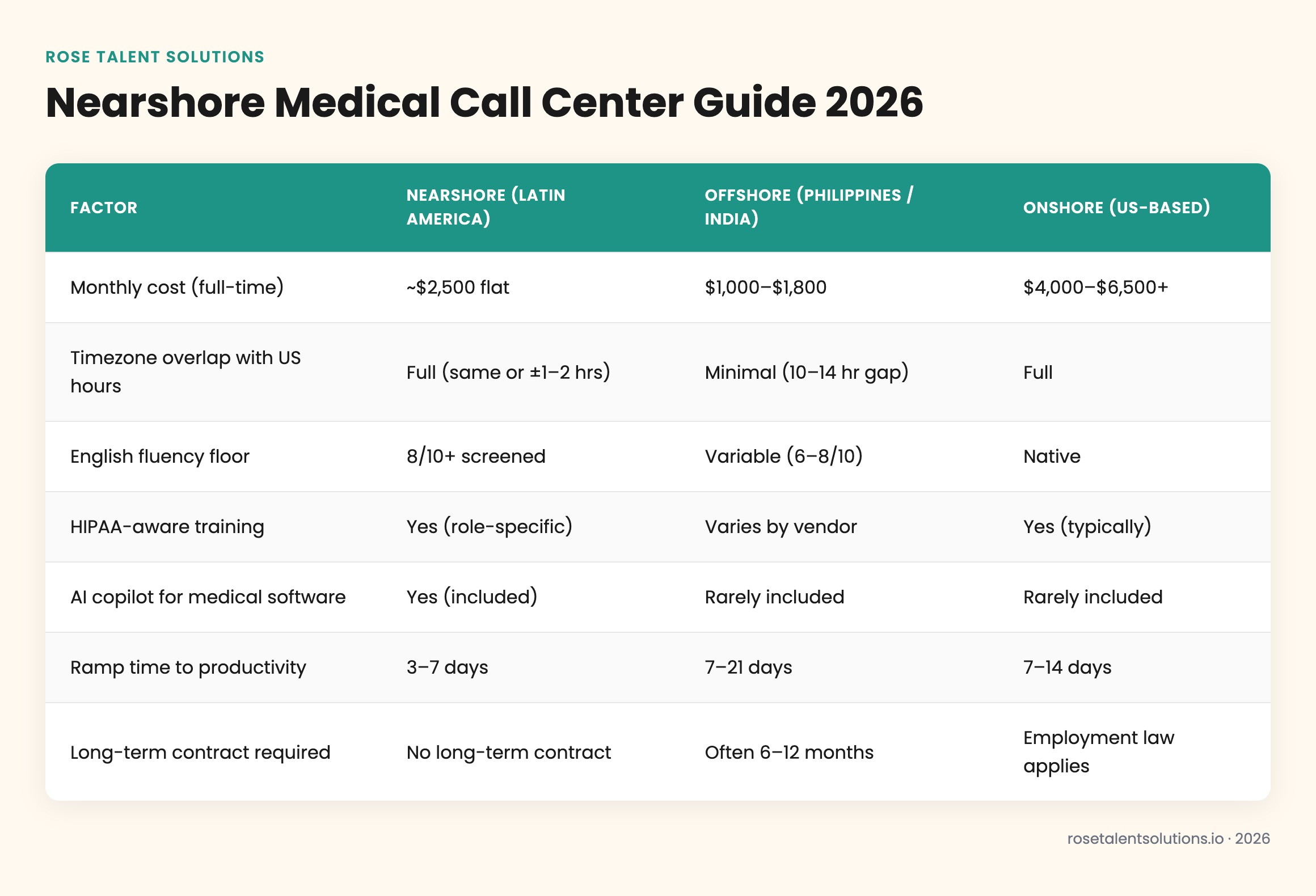
The offshore cost advantage evaporates quickly when you factor in the operational drag of asynchronous communication. A patient who calls at 10am and gets a callback 14 hours later — or worse, a voicemail loop — is a patient who books with your competitor. The onshore vs. offshore staffing tradeoff comes down to whether you're optimizing for sticker price or total operational cost, and for medical practices, the hidden costs of offshore are steep.
What Tasks Does a Nearshore Medical Call Center Agent Handle?
The scope of what a nearshore medical receptionist or call center agent can handle is broader than most practice managers initially assume. These are not entry-level chat-bot replacements — they are trained, full-time professionals who own specific workflows end to end. The best nearshore vendors pair each agent with a role-specific AI copilot trained on the software your practice already uses, so they're productive from day one.
Common task categories for a nearshore medical call center agent include:
- Inbound patient scheduling — appointment booking, rescheduling, and cancellations across your EHR or scheduling platform
- Insurance verification — pre-visit eligibility checks and benefits confirmation to reduce claim denials
- Patient intake calls — collecting demographics, chief complaint, and medical history prior to the appointment
- Prescription refill routing — triaging refill requests and routing to the appropriate clinical staff
- Post-visit follow-up — satisfaction check-ins, lab result notifications (non-clinical), and return visit reminders
- Billing support calls — answering patient questions about statements, payment plans, and balances
- After-hours voicemail management — processing overnight voicemails first thing in the morning so no message sits unanswered past 9am
Practices that improve front-desk response time see measurable downstream gains. According to Gallup's research on engagement and operational performance (2023), organizations that dedicate focused staff to single-function roles — rather than splitting attention across five jobs — consistently outperform those that don't on customer satisfaction metrics. Medical front desks are no exception: a dedicated nearshore call center agent running your scheduling queue full-time is one of the highest-ROI administrative hires a practice can make in 2026.
The real competitive advantage isn't just cost savings — it's the consistency of having one person who knows your protocols, your providers' schedules, and your patient population deeply, showing up 40 hours a week without the turnover churn that plagues domestic medical receptionist roles.
The hidden cost of an understaffed medical front desk isn't just missed calls — it's the downstream revenue loss from no-shows that weren't caught, appointments that weren't rebooked, and patients who silently switched practices. A nearshore call center agent running your scheduling queue full-time eliminates that leak without adding domestic payroll overhead.
How a Nearshore Medical Call Center Agent Gets Up and Running in 2026
One of the most common objections practice managers raise is onboarding complexity — "How do I train someone remote on our systems?" The answer is that the onboarding process for a well-placed nearshore agent is simpler than hiring a domestic W-2 employee, because a good nearshore staffing partner handles recruiting, vetting, and initial training before the agent ever touches your queue.
Here is how the process typically works with a full-service nearshore staffing provider:
Intake & role scoping
You describe your call volume, software stack (EHR, scheduling platform, phone system), and the specific tasks you need covered. The staffing partner uses this to write a precise candidate profile — not a generic "receptionist" req.
Recruiting & vetting
Candidates are screened on English proficiency (8/10+ floor), medical terminology familiarity, software experience, and HIPAA awareness. You receive 2–3 finalist profiles, not a stack of 50 résumés.
Interview & selection
You interview finalists directly via video call. You choose the person — the staffing partner doesn't make that call for you. Most practices select within one round.
AI copilot setup & software training
The agent receives a role-specific AI copilot configured for your software — whether that's Kareo, Athenahealth, or a custom scheduling tool — so they ramp in days, not weeks.
Go live & ongoing management
The staffing partner handles payroll, HR, and ongoing performance management. You manage the work; they manage the employment relationship. If the agent isn't a fit, they are replaced at no additional cost.
The full-service model — where recruiting, payroll, HR, and management are bundled into a flat monthly rate — is what separates a true nearshore staffing partner from a freelancer marketplace. You're not managing a contractor; you're plugging a fully supported team member into your practice. To understand how this compares to sourcing from freelance platforms, this overview of virtual assistant companies in Latin America breaks down the vendor landscape clearly.
How Much Does a Nearshore Medical Call Center Cost in 2026?
Pricing transparency is rare in the staffing industry, so here it is plainly: a full-service nearshore medical call center agent from Rose Talent Solutions costs $2,500 per month, flat. That is a full-time, 40-hour-per-week dedicated agent. Recruiting, vetting, payroll processing, HR administration, and ongoing management are all included in that number. There are no setup fees, no per-call charges, and no long-term contract — month-to-month terms with 30 days written notice to cancel.
For context on what that buys you: the average fully-loaded cost of a domestic medical receptionist (salary, benefits, payroll taxes, PTO, recruiting) runs $55,000–$75,000 per year, according to SHRM's total cost-of-employee framework (2024). That is $4,583–$6,250 per month before you account for turnover costs, which SHRM separately estimates at 50–200% of annual salary for administrative roles. At $2,500/month, a nearshore agent delivers the same front-office coverage at roughly 40–55 cents on the dollar.
The wage economics on the Latin America side are equally worth understanding. World Bank income data for Colombia, Mexico, and Argentina (2023) shows that professional wages in these markets are 60–75% lower than US equivalents for the same role complexity — not because the talent is inferior, but because purchasing power parity creates a structural cost difference that nearshore staffing passes directly to US clients. Curious about the specifics? This breakdown of Latin America virtual assistant salary ranges explains the wage economics without sugarcoating anything.
If the agent placed with your practice isn't a fit for any reason, they are replaced at no additional cost. That replacement guarantee is the risk reversal — there is no financial exposure if the first match doesn't click.
Nearshore Medical Call Center: Pros, Cons, and Who It's Right For in 2026
No staffing model is perfect for every practice. Here is an honest look at where nearshore medical call center staffing excels — and where it has real limitations worth knowing before you commit.
Pros
- Real-time patient communication — agents work your hours, not theirs
- Cost is 40–55% of equivalent domestic staffing
- No long-term contract — cancel with 30 days written notice
- Full-time dedicated agent (not shared across 10 other clients)
- AI copilot included, configured for your specific software
- Recruiting, payroll, HR, and management bundled in flat rate
- Free replacement if the agent isn't a fit
Cons
- Not suited for clinical tasks — this is administrative and communication work only
- Requires you to have clear SOPs or be willing to document them
- Agent works remotely — in-person tasks (physical filing, front desk check-in kiosk) aren't applicable
- HIPAA compliance requires your practice to onboard the agent on your BAA and security protocols
The practices that get the most from a nearshore medical call center setup share a few traits: they have consistent inbound call volume (10+ calls per day), they're currently losing appointments to voicemail or slow callback times, and they have at least a basic set of scheduling SOPs they can hand over. If that describes your practice, the ROI case is straightforward.
According to McKinsey's research on healthcare administration automation (2023), practices that dedicate focused administrative staff to patient communication workflows — rather than splitting those responsibilities across clinical staff — recover an average of 4–6 hours of physician time per week. That time translates directly to additional patient visits or reduced physician burnout. Freeing your clinical team from front-desk overflow is the secondary ROI of a nearshore call center agent that most practices underestimate until they've lived it.
For practices that also need support on the financial side — billing oversight, accounts receivable tracking, or expense reconciliation — pairing a medical call center agent with a nearshore bookkeeping and accounting specialist is a natural expansion that many practices make in their second or third month.
"The biggest misconception about remote healthcare staffing is that it requires complex technology. In practice, if you have a phone system with call forwarding and a browser-based EHR, you already have everything a nearshore agent needs to be fully operational."
— Ravi Coutinho, VP of Operations at Kareo (now Tebra), Healthcare Technology Summit (2023)
If you're ready to scope a role for your practice, the fastest path is to start the intake process here — it takes under five minutes and gives the team enough information to send you matched candidate profiles within days, not weeks.