
Nearshore Java developers from Latin America have become the default choice for US engineering teams that need real-time collaboration, English fluency, and senior-level skill — without the six-figure domestic salary that comes with a local hire. In 2026, the nearshore model isn't a workaround anymore; it's a deliberate staffing strategy used by growth-stage startups and enterprise tech teams alike. This guide breaks down how nearshore Java hiring actually works, what it costs, and how to evaluate whether Latin America is the right fit for your team.
What Are Nearshore Java Developers — and Why Does It Matter in 2026?
A nearshore Java developer is a software engineer based in a geographically close country — for US companies, that means Latin America — who works within 0–3 hours of your time zone. The "nearshore" label distinguishes this arrangement from offshore hiring, where time zone gaps of 8–13 hours create async-only collaboration. Nearshore engineers attend your stand-ups live, respond to Slack messages in real time, and ship pull requests that your US team can review the same afternoon.
Java specifically remains one of the most in-demand backend languages on the planet. According to the Stack Overflow Developer Survey 2024, Java ranks among the top five most-used programming languages globally for the eighth consecutive year, with particularly strong demand in enterprise fintech, healthcare systems, and SaaS backend infrastructure. Latin American universities — particularly in Brazil, Argentina, Colombia, and Mexico — graduate tens of thousands of Java-proficient engineers annually, creating a deep and growing talent pool that US companies are increasingly tapping.
If you want a deeper dive into how the nearshore model compares structurally to other staffing arrangements, this complete nearshore vs. offshore vs. onshore comparison breaks down the trade-offs across cost, control, and communication quality.

How Nearshore Java Talent in Latin America Compares to Offshore and Onshore in 2026
The table below cuts through the noise and gives you an honest, apples-to-apples comparison of the three major hiring models for Java developers. These figures reflect 2026 market rates and are drawn from published industry benchmarks — not agency marketing copy.
| Factor | Nearshore (Latin America) | Offshore (Eastern Europe / Asia) | Onshore (US / Canada) |
|---|---|---|---|
| Time Zone Overlap with US | Full overlap (0–3 hrs difference) | Minimal (8–13 hrs difference) | Full overlap |
| English Fluency | High (B2–C1 common) | Moderate (accent variance, async preferred) | Native |
| Typical Fully-Loaded Monthly Cost (Mid-Level) | $3,500–$6,000 | $2,000–$4,500 | $10,000–$16,000+ |
| Cultural Alignment | Strong (US media, business norms) | Moderate | Highest |
| Ramp-Up Speed | Fast (sync collaboration) | Slower (async cycles add days) | Fast |
| Legal / Compliance Complexity | Low–Moderate (contractor or EOR) | Low–Moderate | High (benefits, payroll taxes) |
| Senior Java Talent Availability | High and growing | Very high volume | High but expensive |
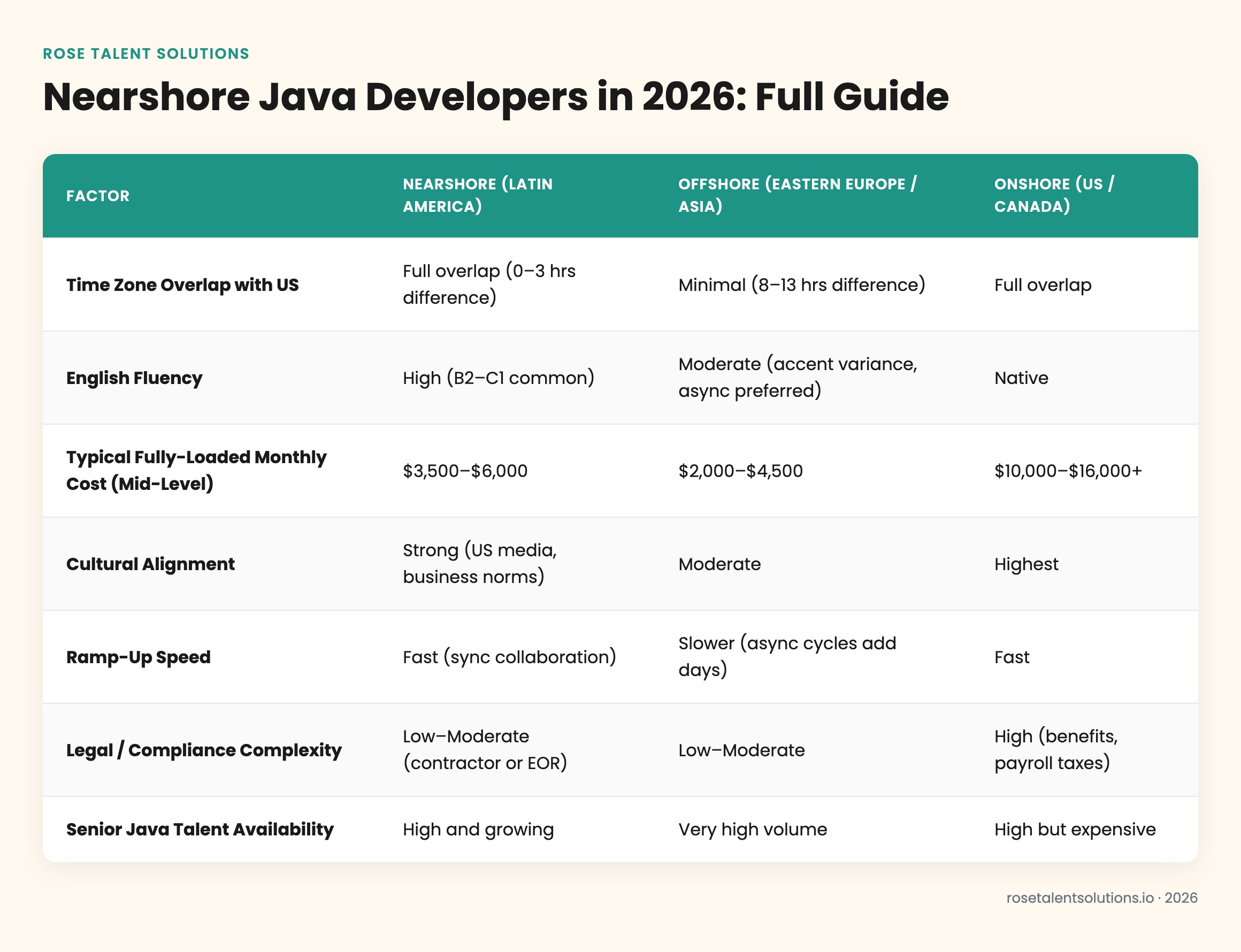
The cost gap between nearshore and onshore is significant, but the more important comparison is nearshore versus offshore. On paper, offshore looks cheaper. In practice, the async lag — where a single code review round-trip takes 24 hours instead of 2 — compounds across every sprint. Teams that switch from offshore to nearshore Java developers consistently report faster release cycles within the first quarter.
"The time zone problem is underrated. When your offshore developer's morning is your midnight, you're not collaborating — you're leaving notes for each other. That's not a team, that's a relay race." — Ariel Camus, CEO at Microverse (2023)
How Much Do Nearshore Java Developers Cost in 2026?
Cost is almost always the first question, and the answer depends heavily on seniority, country, and how you structure the engagement. According to Levels.fyi's Latin America compensation data (2024), mid-level Java engineers in Colombia and Mexico earn between $28,000 and $55,000 USD annually in total compensation — roughly 40–60% of what a comparable US hire would cost when you include benefits, payroll taxes, and equity.
When you work through a nearshore staffing agency rather than hiring directly, you're paying a bundled monthly rate that typically covers recruiting, vetting, payroll administration, HR support, and management overhead. Rose Talent Solutions prices full-time nearshore staff — based exclusively in Latin America — at a flat $2,500/month, all-in, no hidden fees, month-to-month with no long-term contract. That covers 40 hours per week of dedicated work plus recruiting and ongoing management. For context on what Latin American professionals earn across different roles, this breakdown of Latin American salary benchmarks gives useful baseline data that applies across knowledge-work roles, including technical ones.
The U.S. Bureau of Labor Statistics (2024) puts the median annual wage for US-based software developers at $132,270 — meaning even a fully-loaded nearshore mid-level Java engagement runs at roughly one-third to one-half of domestic cost, before you account for recruiting fees, benefits, and employer payroll taxes on the US side.
The true cost of a nearshore Java developer isn't just the monthly rate — it's the rate plus your internal management time. A well-run nearshore agency handles recruiting, vetting, HR, and payroll, so your engineering manager spends time on code reviews, not on contractor paperwork. That management overhead saving alone often justifies the agency fee over a direct hire arrangement.
What Skills Should You Vet for When Hiring Nearshore Java Developers in 2026?
Java is a broad ecosystem. A developer who's strong in Android mobile Java may have little overlap with someone who lives in Spring Boot microservices or Apache Kafka stream processing. Before you post a role or brief a nearshore agency, get specific about your stack. According to the JetBrains Developer Ecosystem Report 2023, the most in-demand Java sub-skills in enterprise environments are Spring/Spring Boot (used by 62% of Java developers), Hibernate/JPA, Docker/Kubernetes deployment, REST API design, and SQL/NoSQL database management.
Beyond technical skills, vet for these four practical factors when hiring nearshore:
- English communication at B2 or higher. Not just written — spoken, because your developer will be in stand-ups and client calls. Rose's published English proficiency floor is 8/10+ on structured screening, which roughly corresponds to CEFR B2–C1.
- Async documentation habits. Even in a nearshore model with strong time zone overlap, good engineers write clear commit messages, update tickets, and document decisions. This matters more in distributed teams.
- Familiarity with your CI/CD toolchain. GitHub Actions, Jenkins, GitLab CI — confirm your candidate has shipped code through a real pipeline, not just on a local machine.
- Portfolio of shipped production code. GitHub profiles with real commit history and deployed projects are more valuable than certifications alone.
According to Gallup's research on workforce engagement (2023), clearly defined role expectations and consistent manager feedback are the two strongest predictors of technical employee retention — a finding that applies directly to nearshore engagements, where ambiguous briefs are the most common reason a placement underperforms.

How Does the Nearshore Java Developer Hiring Process Actually Work in 2026?
Whether you go through a nearshore staffing agency or hire directly via platforms like LinkedIn or Toptal, the process follows a consistent pattern. Here's what a well-run agency engagement looks like end to end:
Role Scoping Call
You brief the agency on your Java stack, seniority level, team size, and expected deliverables. The more specific you are — "Spring Boot 3, REST APIs, PostgreSQL, GitHub Actions pipeline" — the faster and more accurately the agency matches you.
Candidate Sourcing and Vetting
The agency screens applicants on technical skills, English fluency, and cultural fit. At Rose, every candidate is based in Latin America and clears a structured English proficiency screen at 8/10+ before your name ever appears on a brief.
Your Interview Round
You meet the top 1–3 shortlisted candidates. This is where you run your own technical screen — a live coding exercise, a take-home problem, or a system design conversation, whichever fits your process.
Placement and Onboarding
Once you select a candidate, the agency handles contracting, payroll setup, and HR administration. Your developer starts within days, not weeks. Rose's average time to first placement is 7 days from role brief to start date.
Ongoing Management and Replacement Guarantee
If the placement isn't the right fit within the engagement, a quality agency replaces them at no additional cost. There's no long-term contract holding you in — and no penalty for requesting a replacement.
The replacement guarantee is the practical risk reversal that makes the agency model rational for engineering hires. Direct hiring carries the full cost of a bad hire — recruiter fees, onboarding time, and weeks of lost productivity. With a managed nearshore engagement, you absorb none of that downside.
Nearshore vs. Offshore Java Developers: Honest Pros and Cons in 2026
The nearshore-vs-offshore debate comes down to a single trade-off: cost savings versus collaboration speed. Offshore is marginally cheaper at the rate level. Nearshore is dramatically faster in practice. Here's an honest breakdown:
Nearshore Java Developers — Pros
- Full real-time overlap with US business hours (EST to PST)
- Higher English fluency on average, especially spoken communication
- Faster sprint cycles — code reviews and standups happen same-day
- Strong cultural alignment with US business norms and work styles
- Easier travel for occasional on-site visits (same hemisphere, similar flights)
- Growing senior talent pool in Colombia, Mexico, Argentina, and Brazil
Offshore Java Developers — Trade-offs to Know
- Slightly lower rate floor in some offshore markets
- Very large talent volume — easier to fill niche specializations at scale
- Established vendor ecosystems with decades of enterprise outsourcing infrastructure
- 8–13 hour time zone gap creates async delays that slow release cycles
- Communication friction adds hidden overhead to every cross-team interaction
- Cultural misalignment can create friction in fast-moving agile environments
According to a SHRM Talent Acquisition research report, the average cost of a mis-hire in a technical role is 50–200% of the annual salary for that position. Time zone friction that slows feedback loops is one of the most common predictors of offshore developer mis-hires — not because the engineers aren't skilled, but because the collaboration model doesn't fit how fast-moving US teams operate.
If you're evaluating the broader model — not just Java developers, but whether nearshore staffing in general fits your business — the onshore vs. offshore staffing comparison covers the decision framework in detail across multiple role types.
How Rose Talent Solutions Places Nearshore Technical Staff in 2026
Rose Talent Solutions is a nearshore staffing agency focused exclusively on Latin America — matching US and Canadian businesses with full-time, English-fluent professionals who work US business hours. Every team member Rose places is based in Latin America, never routed through offshore markets in Asia or Eastern Europe. While Rose's roots are in property management virtual staffing and bookkeeping and accounting roles, the staffing model applies equally to technical and operations roles across industries.
Every Rose placement ships with a role-specific AI copilot trained on the candidate's core software stack — which for technical roles means productivity tooling tuned to your actual development environment, not generic prompts. The pricing is straightforward: $2,500/month flat, full-time 40 hours per week, all-in. Recruiting, vetting, payroll, HR, and management are included. There's no long-term contract — month-to-month with 30 days written notice. If a placement isn't the right fit, Rose replaces them at no additional cost.
To see what the process looks like from brief to placement, visit the getting started page — it walks through how roles are scoped, how candidates are vetted, and what the first 30 days look like.
The $2,500/month flat rate is all-inclusive — there are no add-on fees for recruiting cycles, HR administration, or replacement placements. What you see is what you pay, every month.