
Nearshore IT talent is reshaping how US, Canadian, and UK businesses build their technology teams in 2026. Instead of struggling with an 8-hour timezone gap to a distant continent, or paying $85/hour for a local contractor, companies are hiring software-trained professionals from Latin America who log on at 9 AM Eastern — the same time you do. The result is faster iteration, cleaner communication, and a staffing cost that doesn't require a CFO sign-off every month.
This guide explains exactly what nearshore IT talent is, how it compares to every alternative, and what a realistic engagement looks like — including pricing, ramp time, and the AI tools that come bundled with every role.
What Is Nearshore IT Talent? A Working Definition for 2026
Nearshore IT talent refers to technology professionals — developers, data analysts, system administrators, IT support specialists, and software-trained virtual staff — who are based in countries geographically and culturally close to their client's home market. For US businesses, that means Latin America: countries like Colombia, Mexico, Argentina, Brazil, Costa Rica, and Peru. Nearshore workers operate in overlapping or identical time zones to their US clients, speak fluent English, and understand North American business culture.
The term is often confused with "offshore," which typically refers to talent sourced from regions with 8–13 hour timezone gaps from US Eastern Time. The timezone difference alone is the defining distinction, and it compounds into real productivity loss every single day. If you want a deeper breakdown of how the models differ, Rose's post on nearshore vs offshore vs onshore virtual assistants walks through every dimension of the comparison.
In an IT context specifically, nearshore talent covers roles where real-time collaboration matters: debugging a production issue at 2 PM your time, joining a sprint standup at 10 AM, or responding to a client ticket before end of business. These workflows break down completely when your developer is 11 hours ahead and asleep during your workday.
According to Statista's IT Outsourcing Market Forecast (2024), Latin America's IT outsourcing revenues are on a consistent upward trajectory as US companies prioritize time-zone-compatible teams over purely lowest-cost options. The nearshore model has moved from a niche workaround to a mainstream staffing strategy.
How Nearshore IT Talent Compares to Offshore and Onshore in 2026
The three staffing models are not equally suited to every situation. Onshore is the gold standard for collaboration but costs 3–5× more. Offshore — talent sourced from regions like Southeast Asia or South Asia — is the cheapest on paper but introduces hidden costs through timezone friction, revision cycles, and communication overhead. Nearshore sits in the middle, drawing exclusively from Latin America, and for most US businesses running technology operations, it's the optimal balance.
| Factor | Nearshore (Latin America) | Offshore (Outside Americas) | Onshore (US/Canada) |
|---|---|---|---|
| Timezone overlap with US East | Full overlap (same or ±1–2 hrs) | Minimal (8–13 hrs ahead) | Perfect |
| Avg. monthly cost (full-time) | $2,000–$3,500 | $1,200–$2,500 | $7,000–$12,000+ |
| English proficiency | High (8/10+ screened) | Variable (4–7/10 avg.) | Native |
| Cultural alignment with US | Strong | Moderate | Native |
| Avg. ramp-to-productivity time | 3–7 days | 2–4 weeks | 1–2 weeks |
| Contract flexibility | Month-to-month available | Varies (often 6–12 mo) | W2/1099, varied |
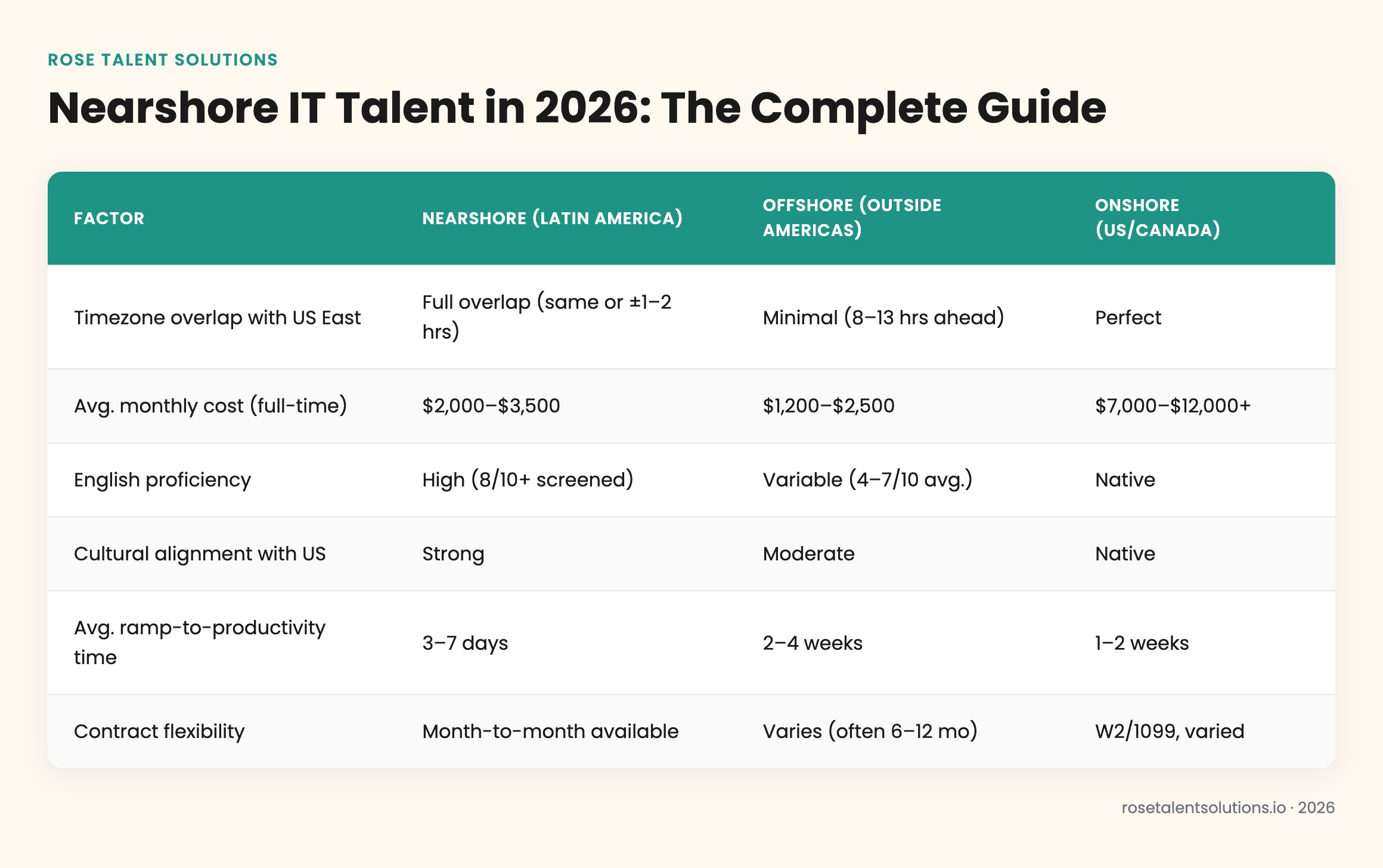
The cost difference between nearshore and onshore is not marginal. The U.S. Bureau of Labor Statistics (2024) reports median annual wages for software developers at $132,270 — roughly $11,000/month before benefits, payroll tax, or equipment. A nearshore equivalent at $2,500–$3,500/month represents a 65–75% cost reduction while maintaining real-time collaboration.

Why US Businesses Are Choosing Latin America for IT Roles in 2026
Latin America's technology talent pool has expanded dramatically over the last decade. Countries like Colombia, Argentina, and Mexico have invested heavily in STEM education, and their graduates are increasingly fluent in the same software stacks US companies run: AWS, Azure, React, Python, Jira, Salesforce, QuickBooks, and more. The region's universities produced over 500,000 engineering and technology graduates in 2023, according to the Inter-American Development Bank (2023).
Beyond technical skill, there's a cultural alignment factor that matters enormously for client-facing IT roles. Latin American professionals are accustomed to US communication norms — direct feedback, structured meetings, deadline-driven work — in a way that significantly reduces the management overhead that far-offshore teams often create. This is a key reason why companies exploring Latin America staffing agencies specifically for technical roles are growing in number year over year.
"The acceleration in Latin American tech talent quality over the last five years has been remarkable. We're seeing graduates from Bogotá and Buenos Aires competing at the same level as top US engineering schools for backend and cloud roles." — Guillermo Bravo, Senior Partner at Kearney Latin America Practice (2024)
English proficiency is a non-negotiable baseline for IT roles. Miscommunication in a technical context — a misunderstood API spec, a misread ticket — creates bugs, delays, and rework. Rose Talent Solutions screens every team member at 8/10 or higher on English proficiency before placement. That standard is higher than most staffing platforms operating outside the region even measure.
The hidden cost of far-offshore IT talent isn't the hourly rate — it's the 6–8 hour timezone gap that turns a 10-minute Slack clarification into a 24-hour delay, repeated across every sprint, every ticket, every deployment cycle.
What Roles Can You Fill with Nearshore IT Talent?
The range of IT roles suitable for nearshore staffing is broader than most business owners expect. The most common placements at Rose fall into four categories: software-trained virtual staff (specialists in platforms like QuickBooks, AppFolio, Buildium, or Salesforce), junior-to-mid software developers, IT support and helpdesk, and data entry and operations analysts. Each of these functions well in a nearshore model because the work requires real-time responsiveness, not just asynchronous task completion.
For businesses managing complex operational software, the AI copilot advantage is especially relevant. Every team member placed through Rose ships with a role-specific AI copilot trained on their primary platform — whether that's AppFolio for property management, QuickBooks for accounting workflows, or a custom business stack. You can explore how that works in detail on Rose's AI advantage page. This isn't a chatbot bolted on — it's platform-specific training that compresses ramp time significantly.
According to SHRM's Talent Acquisition research (2024), the average cost to hire a full-time IT employee in the US exceeds $4,700 in direct recruiting costs alone — before the first paycheck. Nearshore staffing through a managed agency like Rose includes recruiting, vetting, onboarding, payroll, HR, and ongoing management in the flat monthly rate. There are no hidden fees, no recruiter commissions, and no long-term contract.

How the Rose Nearshore IT Talent Process Works in 2026
Getting started with nearshore IT talent through Rose is a defined process — not a "submit a form and wait" experience. Here's what the engagement looks like from first contact to your team member's first day:
Intake & Role Definition
Rose's team works with you to define the role scope, required software proficiencies, working hours, and communication expectations. This call takes 30–45 minutes and prevents 90% of placement mismatches.
Candidate Sourcing & Vetting
Rose recruits from its Latin America talent network, screens for English proficiency (8/10+ floor), technical skills, and cultural fit. You receive a shortlist of pre-vetted candidates, not a resume dump.
Interview & Selection
You interview your top candidates and make the final call. Rose manages the offer, onboarding paperwork, payroll setup, and equipment checklist on the backend.
AI Copilot Activation
Your team member's role-specific AI copilot is activated and configured for your tech stack before day one. Most clients see meaningful output by the end of the first week.
Ongoing Management & HR
Rose handles payroll, HR issues, performance monitoring, and compliance. If the team member isn't a fit, Rose replaces them at no additional cost — no paperwork, no recruiting fee, no delay.
The flat rate is $2,500/month. That's all-in: recruiting, vetting, payroll, HR, ongoing management, and the AI copilot. Month-to-month terms with 30 days written notice. No long-term contract. If you're evaluating the cost side of this model in more detail, Rose's breakdown of Latin America virtual assistant costs gives transparent benchmarks across role types and experience levels.
Nearshore IT Talent vs Offshore: The Real Trade-Offs in 2026
It's worth being direct about where far-offshore staffing still wins and where nearshore consistently outperforms. If your IT workflow is 100% asynchronous — batch data processing, overnight rendering, documentation — distant offshore can be cost-effective. But the moment your workflow requires a human in the loop during your business day, that model's cost advantage evaporates entirely.
Nearshore IT Talent: Pros
- Full timezone overlap with US/Canada business hours
- High English proficiency — reduces miscommunication and rework
- Strong cultural alignment with North American work norms
- Faster ramp-to-productivity (3–7 days vs 2–4 weeks offshore)
- Month-to-month flexibility — no long-term contract
- AI copilots included at no extra cost
Nearshore IT Talent: Trade-Offs
- Slightly higher monthly cost than deep offshore alternatives outside the Americas
- Smaller total talent pool than some other regions for hyper-niche specializations
- Not suited for 24/7 "follow the sun" coverage without additional team members
For roles like IT support, software administration, data operations, and virtual staffing — which represent the majority of small and mid-size business IT needs — the nearshore model wins on every dimension that actually affects output quality. For a head-to-head comparison of how these models play out in practice, Rose's post on onshore vs offshore virtual assistants covers the decision framework in detail.
According to McKinsey's Future of Work research (2021, updated 2023), companies that prioritize timezone-compatible remote teams report 34% fewer project delays than those managing cross-continental timezone gaps. That productivity delta compounds across a 12-month engagement into a material difference in delivered work.
If you're ready to explore what a nearshore IT team member could do in your business, the fastest next step is Rose's intake form — it takes under five minutes and results in a same-day callback from the team.