
Nearshore hiring solutions have quietly become the most practical staffing lever available to small and mid-sized businesses in 2026. While offshore outsourcing to the Philippines or India dominated the last decade, a growing number of US operators are pivoting to Latin America — same time zones, high English fluency, and a talent pool that keeps getting deeper. This guide breaks down exactly how nearshore hiring works, what it costs, where it beats the alternatives, and how to get started without overcomplicating it.
What Are Nearshore Hiring Solutions — and How Do They Work in 2026?
A nearshore hiring solution is a staffing model where a business in one country hires remote workers from a geographically close region — in the US context, that means Latin America. The core advantage is timezone alignment: a virtual assistant (VA) based in Colombia, Mexico, or Argentina works your 9-to-5, answers calls in real time, and joins your team standup without anyone setting an alarm at 3am.
Unlike traditional staffing agencies that hand you a resume and disappear, modern nearshore solutions handle the entire employment relationship. Recruiting, vetting, payroll, HR compliance, and ongoing performance management are all included. You get a dedicated team member; the agency handles the back office. For a deeper look at how Latin American staffing agencies structure these engagements, this overview of the Latin America staffing agency model is worth five minutes of your time.
The timezone problem is not minor. When a tenant calls about a water leak at 10am Eastern, you need someone who can respond at 10am Eastern — not someone who will see the ticket 14 hours later. Nearshore staff work US business hours as a baseline, not as a scheduling exception, according to SHRM's workforce research division (2024).
How Nearshore Compares to Offshore and Onshore Hiring in 2026
Before committing to any staffing model, it helps to see the tradeoffs clearly. The table below compares nearshore, offshore, and onshore virtual assistants across the six dimensions that matter most to US business owners. If you want the full narrative breakdown, this complete nearshore vs offshore vs onshore comparison goes deeper on each category.
| Dimension | Nearshore (Latin America) | Offshore (Philippines / India) | Onshore (US-based) |
|---|---|---|---|
| Typical monthly cost (full-time) | ~$2,500 flat | $1,200–$1,800 | $4,500–$7,000+ |
| Timezone overlap with US East | Full overlap (0–2 hr diff) | Minimal (10–13 hr diff) | Full overlap |
| English proficiency (average) | High (8/10+ screened) | Moderate to high | Native |
| Average ramp time | 5–10 business days | 14–21 business days | 21–30 business days |
| Contract flexibility | Month-to-month | Varies (often 3–6 mo min) | Often W-2 employee |
| AI copilot / software pre-training | Included (AppFolio, Buildium, QB, etc.) | Rarely included | Rarely included |
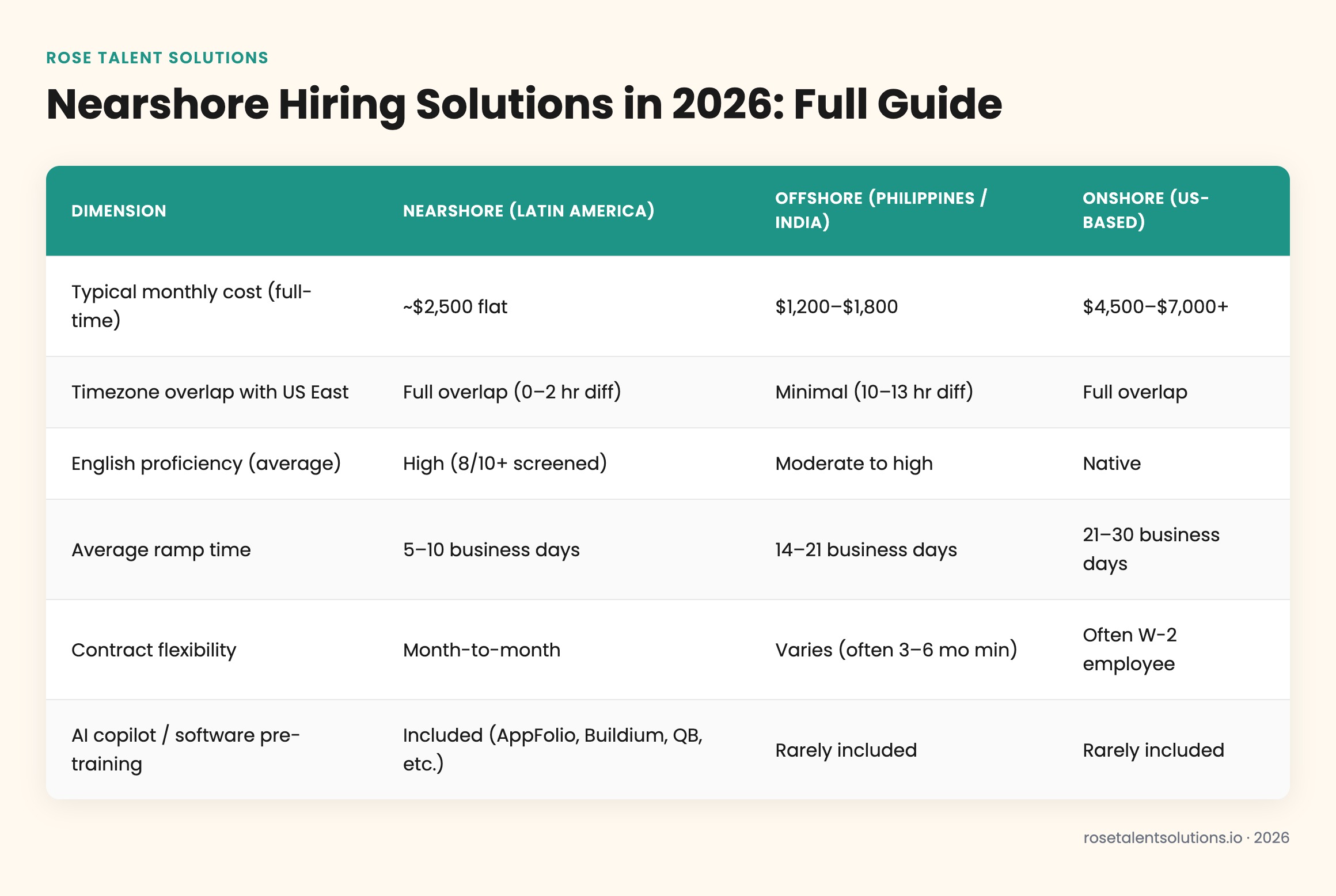
The cost difference between nearshore and onshore is substantial. Bureau of Labor Statistics Occupational Employment data (2024) shows the median US administrative assistant earns over $44,000 annually — before benefits, payroll taxes, or office overhead. A full-time nearshore VA at $2,500/month runs $30,000/year, all-in, with no additional HR burden on your team.

How the AI Advantage Makes 2026 Nearshore Hires Different
The single biggest shift in nearshore hiring between 2023 and 2026 is the addition of role-specific AI copilots. Every team member placed through Rose ships pre-trained on the software stack relevant to their role — AppFolio or Buildium for property management coordinators, QuickBooks Online for bookkeeping assistants, HubSpot for marketing VAs. This is not a generic ChatGPT integration. It is a purpose-built AI layer that knows your platform's workflows before the VA logs in on day one.
This matters because onboarding time is where most staffing engagements fail. A new hire who doesn't know the software costs you two to four weeks of hand-holding before they're independently productive. Buildium's property management industry research (2024) consistently finds that software proficiency — not task knowledge — is the primary bottleneck in VA onboarding. Pre-trained AI copilots cut through that bottleneck directly. Learn more about how this works at Rose's AI advantage page.
"AI-assisted virtual roles will become the standard hiring unit for small property management companies by 2026 — the question isn't whether to use AI-augmented staff, it's which provider trains them well enough to trust." — Narayan Bharadwaj, VP of Product at Buildium (2024 PM Industry Summit)
An AI copilot is only as good as the training underneath it. A VA who ships with a role-specific copilot trained on AppFolio workflows will outperform a generic VA with a generic AI tool every single time — because the copilot knows what a lease renewal workflow looks like in your actual software, not just in the abstract.
The AI advantage compounds over time. As a nearshore team member uses their copilot daily, the system surfaces better suggestions, flags workflow gaps, and helps the VA handle edge cases that would previously require escalation to you. For roles in bookkeeping and accounting, this means fewer month-end reconciliation errors and faster catch rates on coding mismatches — without you reviewing every transaction.
How to Evaluate Nearshore Hiring Solutions: 5 Questions to Ask Any Provider
Not all nearshore staffing agencies operate the same way. The market has matured enough that you can filter providers quickly by asking five direct questions before you book a discovery call.
Where exactly are your team members based?
Legitimate nearshore providers name specific countries: Colombia, Mexico, Argentina, Costa Rica, Peru. If the answer is vague ("Latin America and beyond"), keep digging — some agencies blend offshore talent into nearshore packages without disclosing it.
What does "all-in pricing" actually include?
Ask whether recruiting, vetting, payroll processing, HR management, and performance oversight are covered in the monthly rate — or whether those are line-item add-ons. The Rose flat rate of $2,500/month covers all of the above with no hidden fees.
What is your English proficiency standard?
Ask for the specific screening score and the assessment tool used. Rose's published floor is 8/10 on English proficiency screens. Any provider that can't give you a number is likely not testing consistently.
What happens if the placement isn't a fit?
The right answer is a free replacement at no additional cost. Be cautious of providers who charge a re-matching fee or require a new contract term for a replacement placement.
What are your contract terms?
Month-to-month with 30 days written notice is the standard you should expect. Walk away from any provider requiring a 6-month or annual commitment upfront — that structure protects the agency, not you.

How Nearshore Hiring Solutions Cut Costs Without Cutting Quality in 2026
The cost narrative around nearshore hiring is frequently misunderstood. This is not a race to the bottom on price — it is a geographic arbitrage that lets you access well-educated, fully bilingual professionals at a rate that reflects local living costs in Latin America, not US metropolitan salaries.
According to Pew Research Center's global income data (2023), a household income equivalent to $30,000–$35,000 USD per year places a worker in the upper-middle income tier in Colombia or Mexico. That means the wage is genuinely good for the team member — not exploitative — while remaining significantly below the US median for equivalent work. This is why nearshore retention rates tend to be higher than what you'd see in pure offshore markets. For a full breakdown of what these numbers look like by country, this analysis of Latin America virtual assistant costs walks through the country-by-country comparison.
Quality is a function of vetting, not geography. A poorly vetted domestic hire will underperform a well-vetted nearshore professional every time. The agencies that get this right invest heavily in multi-stage screening: skills assessments, English proficiency scoring, background checks, role-specific software testing, and reference verification — before a candidate ever reaches your desk.
According to Gallup's State of the Global Workplace report (2024), employees who feel their skills are well-matched to their role are 2.6× more likely to report high engagement. Nearshore staffing agencies that pre-screen for specific software skills and role fit are, in effect, doing the engagement work before the hire starts.
Nearshore Hiring: Strengths
- Full US-hours timezone alignment (0–2 hour difference)
- High English fluency — screened to 8/10+ minimum
- Significantly lower cost than onshore US staff
- Month-to-month terms — no long-term contract required
- All-in pricing covers HR, payroll, and ongoing management
- AI copilots included, pre-trained on role-specific software
Where to Set Expectations
- Not the cheapest option — offshore rates are lower
- Time-to-placement averages 5–10 days, not same-day
- Cultural nuances vary by country — good agencies account for this in matching
- Requires clear onboarding documentation from your side to ramp fastest
Who Should Use Nearshore Hiring Solutions — and Who Should Not
Nearshore solutions are the right fit for US, Canadian, and UK businesses that need a full-time dedicated team member — not a freelancer pool or a task-by-task contractor. If you need someone integrated into your operations, attending your team meetings, managing your software systems, and representing your brand on calls with clients or tenants, nearshore is built for that model.
The model works especially well for property management companies that need leasing coordinators, maintenance dispatchers, or resident communication specialists. It works equally well for accounting firms, real estate brokerages, e-commerce operators, and professional services businesses that have repeatable back-office workflows but can't justify a full US salary for each function.
Nearshore is not the right fit if you need occasional, project-based help — a freelance platform is more appropriate for that use case. It is also not the right fit if your work involves classified information or regulatory environments that restrict cross-border data handling. For the vast majority of small to mid-sized US businesses, neither of those exceptions applies. If you're ready to move forward, getting started with Rose takes less than 10 minutes to initiate a conversation about your specific role needs.
The question most operators ask too late is not "should I try nearshore hiring?" — it is "why did I wait this long?" The timezone alignment, the English fluency, the flat pricing, and the month-to-month flexibility collectively remove the objections that made offshore feel risky and onshore feel unaffordable. If you've been on the fence, the data in 2026 has largely settled the debate. For those still weighing the onshore option specifically, this side-by-side look at onshore vs offshore virtual assistants gives the full picture before you decide.