
Nearshore hiring is one of the fastest-growing workforce strategies in North America right now — and for good reason. Instead of posting a $60,000-a-year domestic role or rolling the dice on a distant offshore contractor in a radically different time zone, businesses are hiring full-time, English-fluent professionals from Latin America who work your exact business hours. The cost savings are real. The quality is real. And in 2026, the infrastructure to make it work reliably is more mature than ever.
This guide covers everything you need to know: what nearshore hiring actually means, how it compares to other staffing models, what roles it suits best, and how to evaluate a nearshore partner without getting burned. Whether you run a property management company, an accounting firm, or a growing e-commerce brand, the same fundamentals apply.
What Is Nearshore Hiring? A 2026 Definition
Nearshore hiring refers to the practice of staffing employees or contractors from countries geographically close to your own — typically within 1-3 time zones. For US and Canadian businesses, that means Latin America: Mexico, Colombia, Argentina, Brazil, Costa Rica, and several other markets with strong talent pools and growing English proficiency rates. The defining feature is proximity — not just geographic, but temporal. Your nearshore team member logs on when you do, answers messages when you do, and closes out their day when you do.
This is fundamentally different from offshore hiring, which typically refers to staffing from regions like South Asia or Southeast Asia — often 9-13 hours removed from US business hours. If you want a deeper breakdown of how these models differ across cost, culture fit, and communication quality, this complete three-way comparison of nearshore, offshore, and onshore virtual assistants lays it out in detail.
Nearshore hiring is not a new concept — multinational corporations have used it for decades. What has changed is accessibility. Platforms and staffing agencies now make it possible for a 20-unit property management company or a 4-person accounting firm to access the same talent pipeline that Fortune 500 operations departments used to monopolize.
How Nearshore Hiring Compares to Offshore and Onshore in 2026
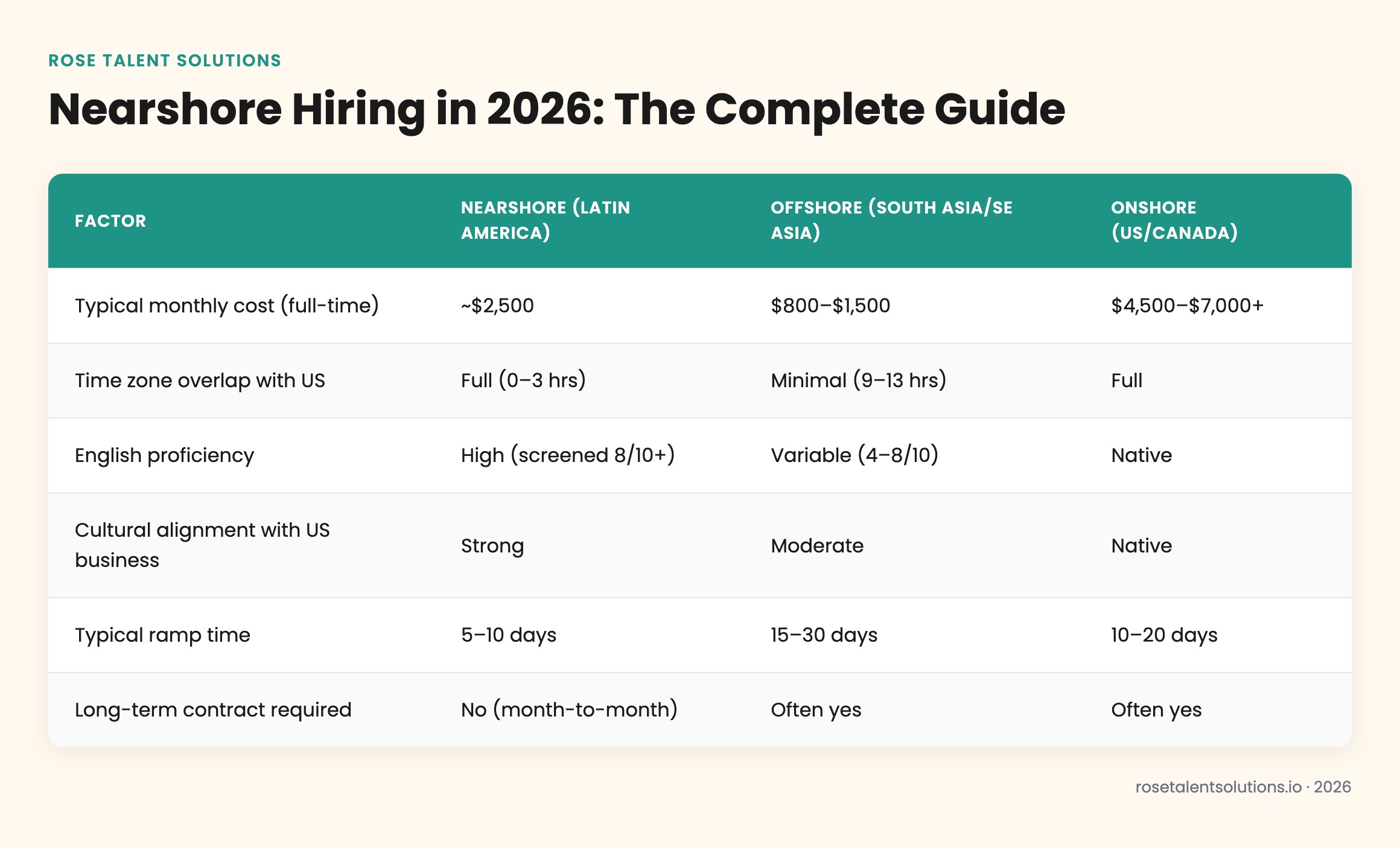
The staffing market in 2026 gives you three broad options: hire domestically (onshore), hire from a distant low-cost country (offshore), or hire from Latin America (nearshore). Each model has real trade-offs, and the right choice depends on what you actually need from the role.
The biggest misconception is that offshore and nearshore are interchangeable because both save money compared to domestic hiring. They are not. Time zone alignment is the variable that changes everything downstream — from how fast a tenant inquiry gets answered to how efficiently a bookkeeping question gets resolved during a live call with your client.
According to SHRM (2024), cross-time-zone communication delays are among the top three productivity killers for distributed teams. That finding maps directly onto what property managers and business operators report: offshore VAs often batch their responses overnight, creating a 12-24 hour lag on issues that needed a same-day answer.
| Factor | Nearshore (Latin America) | Offshore (South Asia/SE Asia) | Onshore (US/Canada) |
|---|---|---|---|
| Typical monthly cost (full-time) | ~$2,500 | $800–$1,500 | $4,500–$7,000+ |
| Time zone overlap with US | Full (0–3 hrs) | Minimal (9–13 hrs) | Full |
| English proficiency | High (screened 8/10+) | Variable (4–8/10) | Native |
| Cultural alignment with US business | Strong | Moderate | Native |
| Typical ramp time | 5–10 days | 15–30 days | 10–20 days |
| Long-term contract required | No (month-to-month) | Often yes | Often yes |
What Roles Fit Nearshore Hiring Best in 2026?
Not every role is a good nearshore fit. The sweet spot is any function that requires consistent, real-time availability during US business hours, benefits from software-specific training, and doesn't require a physical presence. That covers a wide swath of back-office and client-facing operations.
For property management companies, the highest-ROI nearshore roles are leasing coordinators, maintenance dispatch coordinators, tenant communications specialists, and AppFolio or Buildium administrators. These roles are high-volume, repetitive enough to systematize, but nuanced enough that you need someone who can make judgment calls — not just process tickets.
For finance-forward businesses, nearshore bookkeeping and accounting support has become one of the fastest-growing use cases. A nearshore bookkeeper who is trained on QuickBooks Online or Xero can handle accounts payable, bank reconciliations, and month-end close support at a fraction of the cost of a domestic hire. According to the U.S. Bureau of Labor Statistics (2024), the median annual wage for a US-based bookkeeping clerk is $47,440 — that's nearly double what a full-year nearshore equivalent costs through Rose.

How Nearshore Hiring Actually Works: The 2026 Process
One reason businesses hesitate on nearshore hiring is that they picture a complicated international HR arrangement — visas, foreign payroll, compliance headaches. When you work with a managed nearshore staffing agency, none of that lands on your plate. The agency handles recruiting, vetting, payroll, HR, and ongoing performance management. You get a team member; they handle the infrastructure.
Here's how the process works at Rose Talent Solutions specifically:
Discovery Call
You describe the role, the software your team uses, and the hours you need covered. Rose matches the role profile to candidates already in the pipeline — no cold sourcing required.
Candidate Matching
Rose surfaces 1-3 pre-vetted candidates who meet your role requirements. Each has been screened for English proficiency (8/10+ floor), relevant software experience, and background checks.
AI Copilot Onboarding
Your new team member arrives with a role-specific AI copilot trained on their software stack — AppFolio, Buildium, QuickBooks, or whatever your operation runs on. Learn more about the AI advantage built into every placement.
First Week Live
Your team member starts working your hours, integrated into your communication tools and workflows. Rose monitors early performance and checks in to make sure the fit is right.
Ongoing Management
Rose handles payroll, HR, and performance accountability. If the team member ever isn't the right fit, Rose replaces them at no additional cost — that's the core risk reversal built into the flat $2,500/month rate.
That last point is worth emphasizing. The reason the month-to-month, no long-term contract model works is that the replacement guarantee removes the biggest fear operators have: being stuck with the wrong person. You're not locked in, and if the match isn't right, the solution is a replacement — not a renegotiation.
Why Nearshore Hiring Outperforms Offshore for Real-Time Roles
The practical gap between nearshore and offshore shows up in workflows that require judgment calls during business hours. A leasing inquiry that comes in at 10am EST needs an answer by noon — not at 2am the following morning when an offshore coordinator's workday begins. The same applies to maintenance escalations, vendor callbacks, client-facing accounting questions, and any task that sits in a queue waiting for human approval.
Time zone alignment isn't a soft perk — it's an operational multiplier. Every hour of delay in a client-facing role has a downstream cost: a prospect who signs elsewhere, a tenant who escalates a complaint, a payment that misses a deadline. According to Gallup (2024), teams with real-time communication alignment report 21% higher productivity than distributed teams operating across significant time differences.
"Distributed work only succeeds when communication latency is managed deliberately. Time zone gaps beyond three hours create compounding coordination costs that most organizations underestimate until they're already embedded in the workflow." — Tsedal Neeley, Professor of Business Administration at Harvard Business School, author of Remote Work Revolution (2021)
This is also why understanding the full landscape of available virtual assistant companies operating in Latin America matters before you commit to a provider. Not every nearshore agency runs the same vetting process, enforces the same English proficiency floor, or includes HR and payroll management in its flat fee. The structure of the engagement matters as much as the location of the talent.
The hidden cost of offshore hiring isn't the lower hourly rate — it's the downstream operational drag created by a 9-13 hour time zone gap. Every back-and-forth that takes 20 minutes with a nearshore coordinator can take 24 hours with an offshore equivalent. At scale, that lag compounds into missed revenue and tenant churn.

How to Evaluate a Nearshore Staffing Partner in 2026
Choosing the right nearshore partner is the decision that determines whether this model works for you. There are dozens of agencies offering Latin American virtual staff, and the differences between them are significant. Here's what to actually evaluate — not the marketing language, but the operational specifics.
English proficiency screening: Ask for the exact scoring methodology. Rose uses an 8/10+ floor on structured English proficiency screens. If an agency can't tell you their floor or how they measure it, that's a red flag. According to EF Education First's English Proficiency Index (2024), English fluency varies dramatically across Latin American countries — Colombia and Argentina rank significantly higher than regional averages. Your agency should be selecting from those markets intentionally.
Software-specific vetting: Generic administrative experience is not the same as AppFolio experience or QuickBooks expertise. A nearshore coordinator placed into a property management operation who has never seen AppFolio will cost you weeks of ramp time. Rose's AI copilot — trained role-specifically on the software your team runs — compresses that ramp. But the baseline software familiarity should already exist before placement.
What's actually included in the fee: Some agencies quote a low per-hour rate and then layer on recruiting fees, replacement fees, and HR overhead. Rose's $2,500/month is all-in: recruiting, vetting, payroll, HR, and ongoing management. No hidden line items. If a team member isn't a fit, the replacement is at no additional cost.
If you're still comparing providers, the post on what to look for in a nearshore staffing agency walks through the evaluation framework in detail — including the questions most buyers forget to ask before signing.
Why Nearshore Hiring Works
- Full US business hours overlap — no batched overnight responses
- English fluency screened to a documented standard
- Cultural alignment with US business communication norms
- Significant cost savings vs. domestic hiring ($30K+ per year per role)
- No long-term contract — month-to-month with 30 days written notice
- Flat all-in fee covers recruiting, HR, payroll, and management
Where It Requires Realistic Expectations
- Not a fit for roles requiring a physical US presence
- Onboarding still takes 5-10 days — not zero ramp time
- Quality varies widely by agency — vetting rigor matters enormously
- Internet reliability varies by location — confirm provider standards
The other comparison worth making before you commit is the onshore vs. offshore virtual assistant decision — because for some roles and some operators, the right answer genuinely is a domestic hire. Nearshore is the optimal solution for most real-time, software-driven back-office roles. It is not a universal answer to every staffing gap.
What Does Nearshore Hiring Cost in 2026?
Rose Talent Solutions prices at a flat $2,500/month per team member. That covers 40 hours per week, fully managed — recruiting, vetting, payroll, HR, and ongoing performance oversight included. There is no long-term contract; you can cancel with 30 days written notice. If the team member isn't a fit at any point, Rose replaces them at no additional cost.
To put that in context: the BLS Occupational Employment and Wage Statistics (2024) puts the median US administrative assistant salary at $44,080/year — that's $3,673/month before payroll taxes, benefits, PTO, and recruiting costs. A realistic all-in domestic equivalent for the same role runs $55,000–$65,000/year when you factor in employer-side costs. Nearshore hiring at $2,500/month — $30,000/year — represents a 45–55% reduction in labor cost for the same coverage and productivity.
If you're ready to see how the model fits your specific operation, the fastest path is to start a conversation with the Rose team — the intake process takes about 15 minutes and you'll have candidate profiles within a week.
According to McKinsey Global Institute (2023), remote work adoption has permanently expanded the viable talent market for knowledge-work roles — with Latin America emerging as a primary beneficiary due to time zone alignment with North America and improving digital infrastructure investment across the region. The conditions that make nearshore hiring viable in 2026 are structural, not cyclical.