
What Is Nearshore Healthcare BPO in 2026?
Nearshore healthcare BPO is the practice of delegating medical administrative functions — patient scheduling, insurance verification, prior authorization, billing support, and medical records management — to trained professionals located in Latin America. Unlike generic offshore outsourcing, nearshore staffing means your team member works in your timezone, communicates in fluent English, and is culturally aligned with the US healthcare environment. The "nearshore" distinction matters enormously in healthcare, where a 6-hour lag on a prior auth request can delay care and cost your practice a patient.
To define the term precisely: nearshore BPO (Business Process Outsourcing) refers to contracting operational functions to a neighboring or near-timezone region rather than a distant one. In the US context, that means Latin America — countries like Colombia, Mexico, Argentina, and Costa Rica — where time zones run from EST to PST and English proficiency is measurably higher than in traditional offshore hubs. For a deeper breakdown of how nearshore stacks up against other models, Rose's guide on nearshore vs offshore vs onshore virtual assistants covers the full picture.
Healthcare is the sector where these distinctions matter most. Administrative errors in medical offices cost US practices an estimated $19.5 billion annually, according to the CAQH Index (2023). The majority of that waste is traceable to manual, duplicated, or delayed administrative processes — exactly the category that well-trained nearshore BPO staff can absorb and systematize.
Why 2026 Is the Inflection Point for Nearshore Healthcare Staffing
Three forces converged in the last 18 months to make nearshore healthcare BPO the dominant conversation in medical practice management. First, domestic medical administrative wages have surged. The Bureau of Labor Statistics (2024) reports median annual wages for medical records specialists now exceed $47,000, and that's before benefits, PTO, payroll taxes, or turnover replacement costs — which average 33% of annual salary for any backfilled role, per SHRM (2024).
Second, the administrative burden on practices is accelerating, not shrinking. Prior authorization alone now consumes an average of 13 hours per week per physician, according to the American Medical Association (2024). That's time physicians spend chasing paperwork instead of seeing patients — a direct hit to revenue and quality of care. Third, AI tooling has matured enough that a trained nearshore BPO specialist augmented by a role-specific AI copilot can now handle workloads that previously required two or three domestic hires.

How Nearshore Compares to Offshore and Onshore Healthcare BPO in 2026
The comparison between nearshore, offshore, and onshore healthcare BPO comes down to five variables that actually affect patient outcomes and practice revenue: cost, timezone overlap, English fluency, ramp time, and HIPAA-readiness protocol. Most operators focus only on cost and miss the other four. That's a mistake — especially in healthcare, where a miscommunication on a patient's insurance status isn't just an inconvenience; it's a compliance event.
| Factor | Nearshore (Latin America) | Offshore (Philippines / India) | Onshore (US-based) |
|---|---|---|---|
| Monthly Cost (Full-Time) | ~$2,500 all-in | ~$1,200–$1,800 | $4,500–$7,000+ |
| Timezone Overlap with US | Full overlap (EST–PST) | 0–4 hrs overlap typical | Full overlap |
| English Proficiency | High (8/10+ screened) | Variable (5–8/10 average) | Native |
| Ramp Time to Productive | 5–10 business days | 10–21 business days | 14–30 business days |
| HIPAA Training Feasibility | High — real-time oversight | Moderate — async oversight | High — in-person option |
| Cultural Alignment with US | Strong | Moderate | Native |
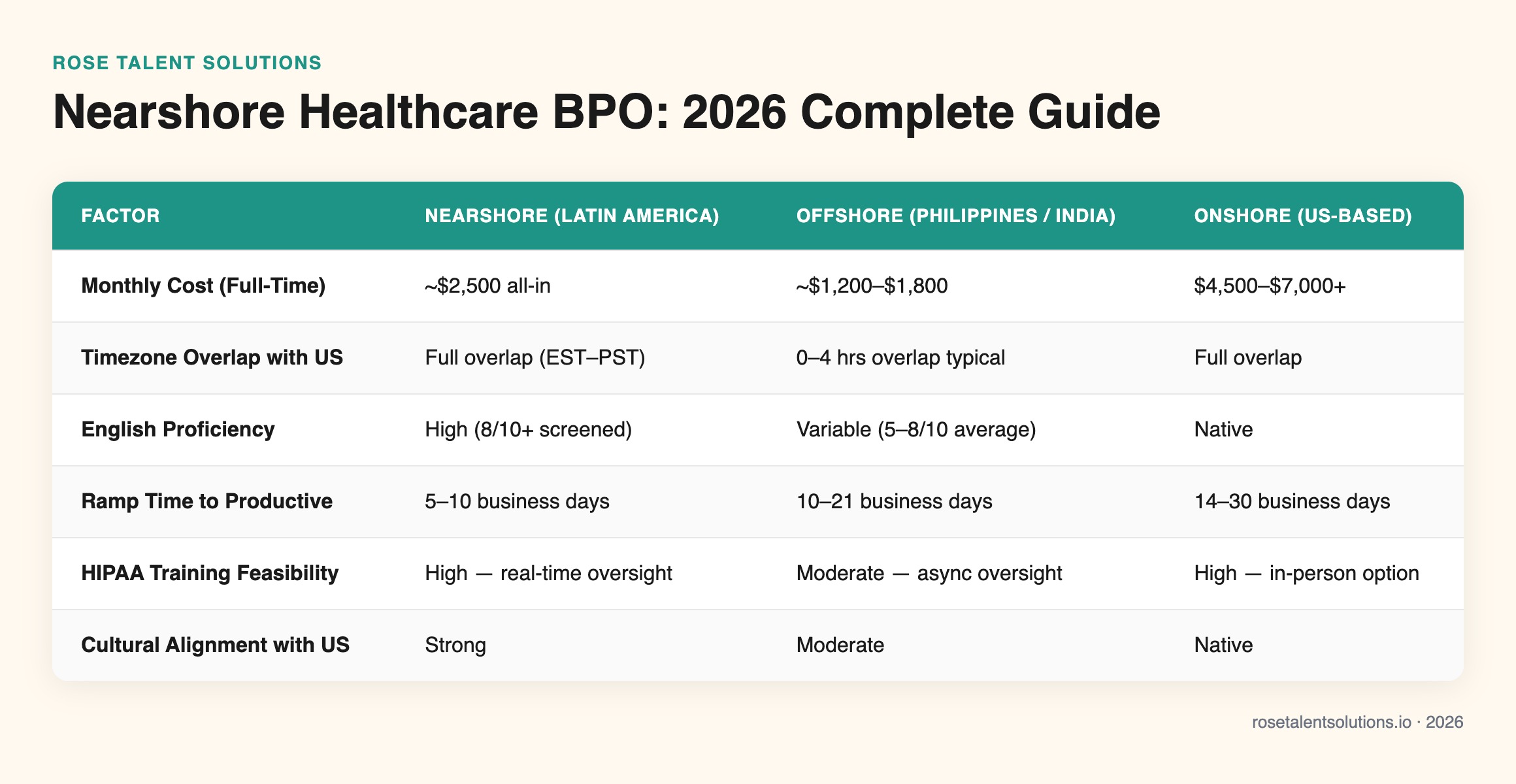
The table above makes one thing clear: nearshore isn't just a cheaper version of onshore. It's a distinct model that trades a modest cost premium over offshore for full timezone overlap, stronger English fluency, and real-time supervisory access — three non-negotiables in a HIPAA-regulated environment. If you want to understand the full cost and quality tradeoffs in plain terms, Rose's onshore vs offshore virtual assistant breakdown goes deeper on the numbers.
What Tasks Does a Nearshore Healthcare BPO Specialist Actually Handle?
One of the most common questions healthcare operators ask is whether a remote, Latin America-based team member can genuinely own complex medical admin tasks — or whether they're limited to data entry. The answer in 2026 is unambiguous: the scope of what nearshore healthcare BPO staff can handle has expanded dramatically, especially when they're equipped with role-specific AI tools trained on the platforms your practice actually uses.
Here's what a well-placed nearshore healthcare BPO specialist typically owns from day one:
- Patient scheduling and appointment management — inbound calls, online booking platforms, reschedule queues
- Insurance verification and eligibility checks — real-time portal lookups before appointments
- Prior authorization submission and follow-up — the 13-hour-per-week problem that's bleeding your physicians dry
- Medical billing support — claim submission, denial tracking, ERA/EOB reconciliation
- Patient intake and registration — demographic entry, consent form management, EMR updates
- Referral coordination — outbound fax, portal submissions, status tracking
- Phone triage and message routing — HIPAA-compliant call handling with escalation protocols
Every Rose team member arrives with a role-specific AI copilot trained on the software your practice runs — whether that's Athenahealth, eClinicalWorks, Epic, or a specialty-specific platform. This isn't a generic chatbot. It's a system that knows your workflows, your payer mix, and your documentation standards before the team member logs in on day one. Learn more about how this works on Rose's AI advantage page.
The hidden cost of offshore healthcare BPO isn't the hourly rate — it's the 6–8 hour timezone gap that means a prior auth denial received at 3pm your time doesn't get actioned until the next morning. In healthcare, that delay compounds: the patient misses their procedure window, you lose the revenue, and your front desk absorbs the fallout call.
How Rose Talent Solutions Delivers Nearshore Healthcare BPO in 2026
Rose's model is built specifically for US, Canadian, and UK operators who need skilled administrative staff without the overhead of traditional hiring. The entire process — recruiting, vetting, HIPAA-awareness training, payroll, HR, and ongoing performance management — is handled inside the flat $2,500/month fee. There are no hidden per-task charges, no seat licenses, and no long-term contract. If the team member placed isn't the right fit for your practice, Rose replaces them at no additional cost.
Here's how the placement process works from first contact to a productive team member in your EMR:
Discovery Call
Rose maps your specific administrative bottlenecks — scheduling volume, payer complexity, billing software — to build an exact role profile. This takes 30 minutes.
Candidate Matching
Rose screens from its vetted Latin America talent pool for candidates with verified medical admin experience, 8/10+ English scores, and proficiency in your specific platforms.
AI Copilot Configuration
Before placement begins, the role-specific AI copilot is configured for your EMR, payer portals, and workflow documentation — so the team member hits the ground running.
Onboarding & Integration
Your new team member joins your communication channels, attends your team standup, and begins handling real tasks within the first week — with Rose's ongoing management layer providing quality oversight.
Ongoing Performance Management
Rose handles HR, payroll, and regular performance check-ins. You get a dedicated administrative resource without the management overhead of a direct hire.

Is Nearshore Healthcare BPO HIPAA-Compliant? 2026 Standards Explained
HIPAA compliance is the first objection every healthcare operator raises when the conversation turns to remote staffing — and it's a legitimate one. The short answer: HIPAA applies to business associates regardless of geography. A properly structured Business Associate Agreement (BAA) with your staffing partner and the team member is the legal foundation. Rose executes BAAs as a standard part of every healthcare placement.
Beyond the BAA, HIPAA-readiness for nearshore healthcare BPO staff rests on three operational pillars. First, access controls: team members access your systems through your own credentialed logins, with role-based permissions you control. Second, encrypted communication: all patient data transmission happens inside your existing HIPAA-compliant infrastructure (your EMR, your messaging system), not through personal email or consumer chat tools. Third, real-time oversight: because nearshore staff work your hours, your compliance officer or practice manager can monitor, correct, and audit in real time — something that's structurally impossible with an offshore team operating 8 time zones away.
It's also worth noting that the Latin America talent market has matured significantly. Many candidates entering the healthcare BPO space have prior experience with US practices and have completed HIPAA awareness training before they ever speak to a US employer. For context on what the broader Latin America VA market looks like today, Rose's post on virtual assistant companies in Latin America gives useful market context on who's available and what they cost.
"The assumption that offshore vendors can't meet US healthcare compliance standards is increasingly outdated — but it's not geography that matters, it's the operational controls. Timezone proximity makes those controls dramatically easier to enforce." — Aneesh Chopra, former US Chief Technology Officer and co-founder of CareJourney (2023)
The Real Cost Comparison: Nearshore Healthcare BPO vs. Domestic Hire in 2026
Let's put concrete numbers on a decision most practice administrators make on gut instinct. A full-time domestic medical administrative specialist in 2024 costs roughly $47,000 in base salary, per the Bureau of Labor Statistics. Add employer payroll taxes (7.65%), health insurance (~$7,000/year for single coverage per KFF's 2023 Employer Health Benefits Survey), PTO (10 days minimum), and a conservative recruiting fee (15–20% of salary for agency placements), and the true first-year cost of a domestic medical admin hire lands between $62,000 and $70,000.
A nearshore healthcare BPO specialist through Rose costs $2,500/month — $30,000 annually — all-in. Recruiting, vetting, payroll, HR, ongoing management, and the AI copilot are included. That's a 55–57% cost reduction without sacrificing timezone overlap, English fluency, or compliance feasibility. And because the engagement is month-to-month with no long-term contract, you're not locked in if your volume changes seasonally or if you're scaling a new service line.
For healthcare operators curious about what comparable Latin America-based administrative talent typically earns, Rose's post on average salaries for Latin America virtual assistants provides a transparent look at market rates — useful context for understanding why the nearshore model is sustainably cost-effective, not artificially cheap.
Nearshore Healthcare BPO — Pros
- Full US timezone overlap — real-time patient communication
- 55%+ cost savings vs. equivalent domestic hire
- Fluent English at 8/10+ screened proficiency
- Month-to-month terms — no long-term contract
- AI copilot configured for your EMR on day one
- BAA-backed, HIPAA-aware placement process
- Free replacement if the team member isn't a fit
Potential Limitations to Anticipate
- Requires your practice to have documented workflows for fastest ramp
- Not a substitute for licensed clinical staff (RNs, MAs, coders)
- Physical presence tasks (mail sorting, in-office filing) need local coverage
How to Get Started with Nearshore Healthcare BPO Through Rose
The fastest path to reducing your practice's administrative overhead is a focused 30-minute intake call where Rose maps your current bottlenecks to specific role profiles. There's no obligation at that stage — just clarity on whether nearshore healthcare BPO is the right lever for your specific situation. If it is, placements typically begin within 7 business days of role confirmation.
Rose serves healthcare operators across primary care, specialty practices, behavioral health, dental groups, physical therapy, and wellness businesses. If your practice runs any combination of prior auth, scheduling, billing support, or patient communication — and you're currently handling those tasks with expensive domestic staff or, worse, your clinical team — there's an immediate, quantifiable ROI case to be made.
You can review Rose's full staffing model, including how the AI copilot integrates with your existing tech stack, on the AI advantage page. When you're ready to move, the start page is where placement begins. For practices that also need bookkeeping, billing reconciliation, or financial reporting support alongside clinical admin, Rose's bookkeeping and accounting team works in parallel with your healthcare BPO specialist under the same flat-rate structure.