
Nearshore frontend developers — engineers based in Latin America who work US business hours — have become the default hiring move for growth-stage US companies that need real-time collaboration without the $130K+ salary of a local senior developer. If you're reading this in 2026, you've probably already felt the squeeze: domestic frontend talent is expensive and slow to hire, offshore teams in Asia create a communication lag that kills sprint velocity, and freelance platforms give you availability risk with no HR support. Nearshore solves all three problems simultaneously.
This guide covers everything a hiring manager or founder needs to know before sourcing nearshore frontend talent: what to look for, what it actually costs, how it compares to every alternative, and how to get a developer productive inside a week.
What Are Nearshore Frontend Developers in 2026?
A nearshore frontend developer is a software engineer — specializing in HTML, CSS, JavaScript, and frameworks like React, Vue, or Angular — who is based in a country geographically close to the client's home market and operates in an overlapping timezone. For US companies, "nearshore" means Latin America: Mexico, Colombia, Argentina, Brazil, Costa Rica, and similar countries. This is fundamentally different from offshore outsourcing in India or the Philippines, where a 10-to-12-hour time difference turns every pull request review into a 24-hour loop.
The timezone overlap is the defining feature. A nearshore frontend developer in Bogotá, Colombia is at most 1–2 hours off Eastern Time. They join your daily standup live, push fixes before your US team's lunch, and escalate blockers in real time on Slack — exactly like a local hire, at a dramatically lower total cost. According to the U.S. Bureau of Labor Statistics (2024), the median annual wage for a software developer in the United States is $132,270 — a figure that makes nearshore rates immediately compelling for budget-conscious engineering teams.

How Nearshore Frontend Developers Compare to Every Other Option in 2026
Every hiring model has a real cost profile — not just the hourly or monthly rate, but the hidden costs of timezone friction, recruiting overhead, ramp time, and churn. The table below puts nearshore, offshore, onshore, and freelance frontend developers side by side so you can see the full picture.
| Hiring Model | Typical Monthly Cost (Mid-Level) | Timezone Overlap (US) | English Fluency | Ramp Time | HR / Payroll Included? |
|---|---|---|---|---|---|
| Nearshore (Latin America) | $2,500–$4,500 | Full overlap (0–3 hrs) | High (8/10+ screened) | 5–10 days | Yes (via staffing partner) |
| Offshore (India / Philippines) | $1,200–$2,800 | Minimal (8–12 hrs gap) | Variable (unscreened) | 14–30 days | Rarely |
| Onshore (US Local Hire) | $8,000–$13,000+ | Full overlap | Native | 30–60 days | Yes (internal HR) |
| Freelance Platform (Upwork / Toptal) | $3,000–$9,000+ | Variable | Variable | 7–21 days | No |
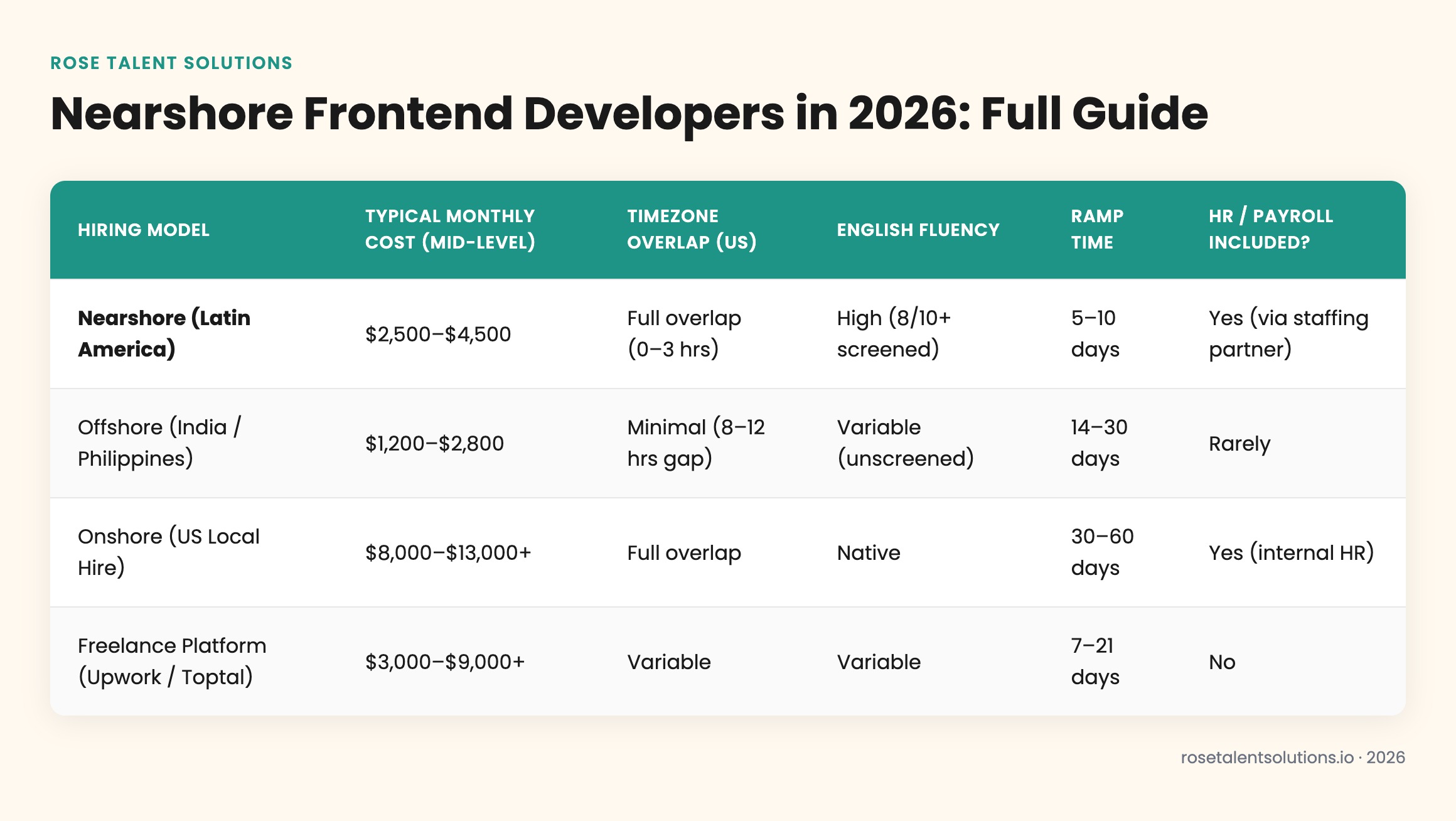
Nearshore hits the sweet spot: onshore-quality collaboration at a fraction of the domestic cost, with none of the management overhead of running offshore contractors across 10+ time zones. If you're weighing platform options, our deep-dive on nearshore developers versus Toptal breaks down exactly where freelance marketplaces fall short for teams that need consistency.
What Skills Do the Best Nearshore Frontend Developers Have in 2026?
The frontend landscape has shifted significantly. In 2026, a strong nearshore frontend developer isn't just someone who can write React components — they're expected to work across a modern web stack and contribute to performance, accessibility, and CI/CD pipelines. Here's what a well-rounded candidate profile looks like:
- Framework depth: React is still dominant, but Vue 3 and Next.js are increasingly required. If your team ships mobile too, check our guide on nearshore mobile developers for iOS and Android — many frontend engineers are cross-trained.
- TypeScript: Expected by default on any production-grade project. Untyped JavaScript is a red flag in 2026.
- State management: Redux Toolkit, Zustand, or React Query. Know which pattern your codebase uses before the interview.
- Testing: Jest, Vitest, Playwright, or Cypress. Ask for examples of component and end-to-end tests they've written.
- Performance optimization: Core Web Vitals awareness, lazy loading, code splitting, and bundle analysis are baseline expectations.
- Design handoff: Figma proficiency. The best nearshore frontend developers can translate a Figma frame to pixel-perfect HTML/CSS without a lengthy back-and-forth.
According to the Stack Overflow Developer Survey (2024), React remains the most widely used web framework at 39.5% of respondents, with Next.js growing fastest among production teams. Nearshore candidates from Latin America's top engineering hubs — Medellín, Buenos Aires, Mexico City — are typically trained on exactly this stack.
Gallup's research on remote work productivity found that fully remote workers who share significant timezone overlap with their managers report 23% higher engagement scores than those working across large time gaps, according to Gallup's State of the Global Workplace report (2023). For frontend developers — where daily standups and rapid PR review cycles define productivity — that engagement gap translates directly into shipping velocity.
"Latin America has quietly built one of the world's strongest engineering talent pools, particularly in web and mobile. The combination of strong CS university programs, US-market exposure, and cultural alignment makes nearshore developers genuinely competitive with any global option." — Ariel Camus, CEO at Microverse (2023)
The hidden cost of offshore frontend developers isn't the day rate — it's the async review cycle. A pull request that takes 20 minutes to review in real time can take 48 hours to close when your team is 10 time zones apart. At two sprints per month, that lag compounds into missed releases and frustrated product owners.
How Rose Talent Solutions Places Nearshore Frontend Developers in 2026
Rose Talent Solutions is a nearshore staffing agency that sources, vets, and manages full-time frontend developers from Latin America for US, Canadian, and UK businesses. The model is straightforward: you pay $2,500/month flat, and you get a dedicated full-time developer (40 hours per week) with recruiting, vetting, payroll, HR compliance, and ongoing management all included. There's no long-term contract — you can cancel with 30 days' written notice.
Every Rose developer ships with a role-specific AI copilot trained on their stack — whether that's a React component library, your internal design system, or a specific CI/CD pipeline. This isn't a generic ChatGPT wrapper; it's a trained assistant that knows your tooling, reducing onboarding time significantly. And if the developer isn't a fit, Rose replaces them at no additional cost — that's the risk reversal.

Intake Call
Rose's team maps your stack, your sprint process, your communication style, and the specific frontend skills you need — React, Vue, TypeScript, performance, whatever it is.
Candidate Matching
Within days, Rose surfaces 1–3 pre-vetted candidates who've passed English proficiency screening (8/10+ bar), technical assessment, and a background check. You interview them directly.
You Choose and We Onboard
You pick your developer. Rose handles payroll, HR compliance, and equipment provisioning. The developer joins your standup within the week.
Ongoing Management
Rose stays in the loop — monitoring performance, handling HR issues, and stepping in immediately if a replacement is ever needed. You manage the work; Rose manages the employment relationship.
Is Nearshore Right for Your Frontend Team in 2026? Honest Pros and Cons
Nearshore frontend staffing isn't the right fit for every team in every situation. A 2-person startup that needs a 10-hour contract engagement is better served by a freelance platform. A regulated enterprise with complex security requirements may need domestic hires. But for the majority of growth-stage US product companies — those running 2-to-10-person engineering teams, shipping product continuously, and feeling the salary pressure of the domestic market — nearshore is the highest-leverage hire you can make right now.
For teams building across web and mobile simultaneously, it's also worth reading how nearshore React and Android developers are being paired together on the same sprint teams in 2026, cutting cross-platform handoff time dramatically. And if your product ambition runs deeper than frontend alone, the case for a nearshore full-stack developer is worth exploring before you lock in a role definition.
According to McKinsey Digital (2023), the global shortage of software developers is expected to reach 85 million unfilled tech jobs by 2030 — making nearshore talent pipelines not just a cost play, but a strategic necessity for companies that can't afford a 6-month domestic recruiting cycle. Meanwhile, SHRM's talent acquisition research (2024) shows the average time-to-fill for a software developer role in the US is 45 days — nearly 6 weeks of lost sprint capacity while your team waits. And according to Statista's Latin America IT outsourcing market report (2024), the region's IT services export revenue has grown more than 40% since 2020, reflecting accelerating demand from North American companies that have discovered the nearshore talent advantage firsthand.
Pros of Nearshore Frontend Developers
- Full US business hours overlap — join standups, ship fixes, review PRs in real time
- Significantly lower total cost than domestic hiring ($2,500/mo vs. $8,000–$13,000/mo)
- English fluency screened before you ever see a candidate
- Faster time-to-productivity than offshore (no async lag in onboarding)
- HR, payroll, and compliance managed by the staffing partner
- No long-term contract — cancel with 30 days' notice
Cons to Consider
- Slightly higher cost than deep-offshore options (India, Eastern Europe) — the premium buys timezone and communication quality
- You're still managing a remote developer — requires good async documentation habits
- Not ideal for sub-20-hour-per-week engagements (model is built around full-time dedicated roles)
The bottom line: if real-time collaboration and English fluency matter to your team's velocity, nearshore frontend developers deliver an ROI that offshore and domestic options simply can't match at the same price point. The question isn't whether nearshore works — it's whether your team is ready to integrate a remote developer effectively.