
Nearshore development talent is reshaping how US, Canadian, and UK businesses build their teams in 2026. Instead of wrestling with 10-hour time zone gaps or six-figure domestic salaries, companies are turning to a nearshore development talent hiring company to place full-time, English-fluent professionals from Latin America — people who show up at 9 AM your time, not midnight theirs. This guide breaks down exactly how these firms work, what to look for, and how to avoid the traps that sink most first-time buyers.
What Is a Nearshore Development Talent Hiring Company?
A nearshore development talent hiring company is a staffing agency that sources, vets, and places full-time remote workers from geographically proximate regions — in the case of US businesses, that means Latin America. "Nearshore" is the operative word: unlike offshore staffing firms based in the Philippines or India, nearshore providers specifically prioritize time zone alignment, cultural compatibility, and English fluency above all else.
The model goes well beyond a simple job board. A quality nearshore firm handles the entire employment lifecycle: sourcing candidates, administering skills and language assessments, running background checks, managing payroll in the worker's home country, and providing ongoing HR support. You get a single flat monthly invoice. The complexity lives on their side of the relationship.
According to SHRM's Talent Acquisition research (2024), the average cost to replace a single employee in the US reaches 50–200% of that role's annual salary — a figure that makes the risk-managed, managed-service model of nearshore hiring particularly attractive for growing businesses.
How Nearshore Hiring Compares to Offshore and Onshore in 2026
The decision between nearshore, offshore, and onshore hiring is rarely about price alone. Time zone overlap, communication quality, and management overhead all compound over months in ways that an hourly-rate comparison misses entirely. If you want the full breakdown, our complete nearshore vs offshore vs onshore virtual assistant comparison walks through every dimension in detail. Here is the summary version:
| Factor | Nearshore (Latin America) | Offshore (Philippines / India) | Onshore (US-Based) |
|---|---|---|---|
| Monthly Cost (Full-Time) | ~$2,500 flat | $1,200–$2,000 | $5,500–$9,000+ |
| Time Zone Overlap with US | Full overlap (EST–PST) | 0–4 hrs (async heavy) | Full overlap |
| English Proficiency | High (8/10+ screened) | Moderate–High (varies widely) | Native |
| Cultural Alignment with US | Strong | Moderate | Native |
| Contract Flexibility | Month-to-month | Often month-to-month | Often 12-month+ |
| Employer of Record / Payroll Handled | Yes (by agency) | Varies by provider | Employer pays directly |
| Ramp Time to Productivity | Fast (real-time collaboration) | Slower (async delays) | Fast |
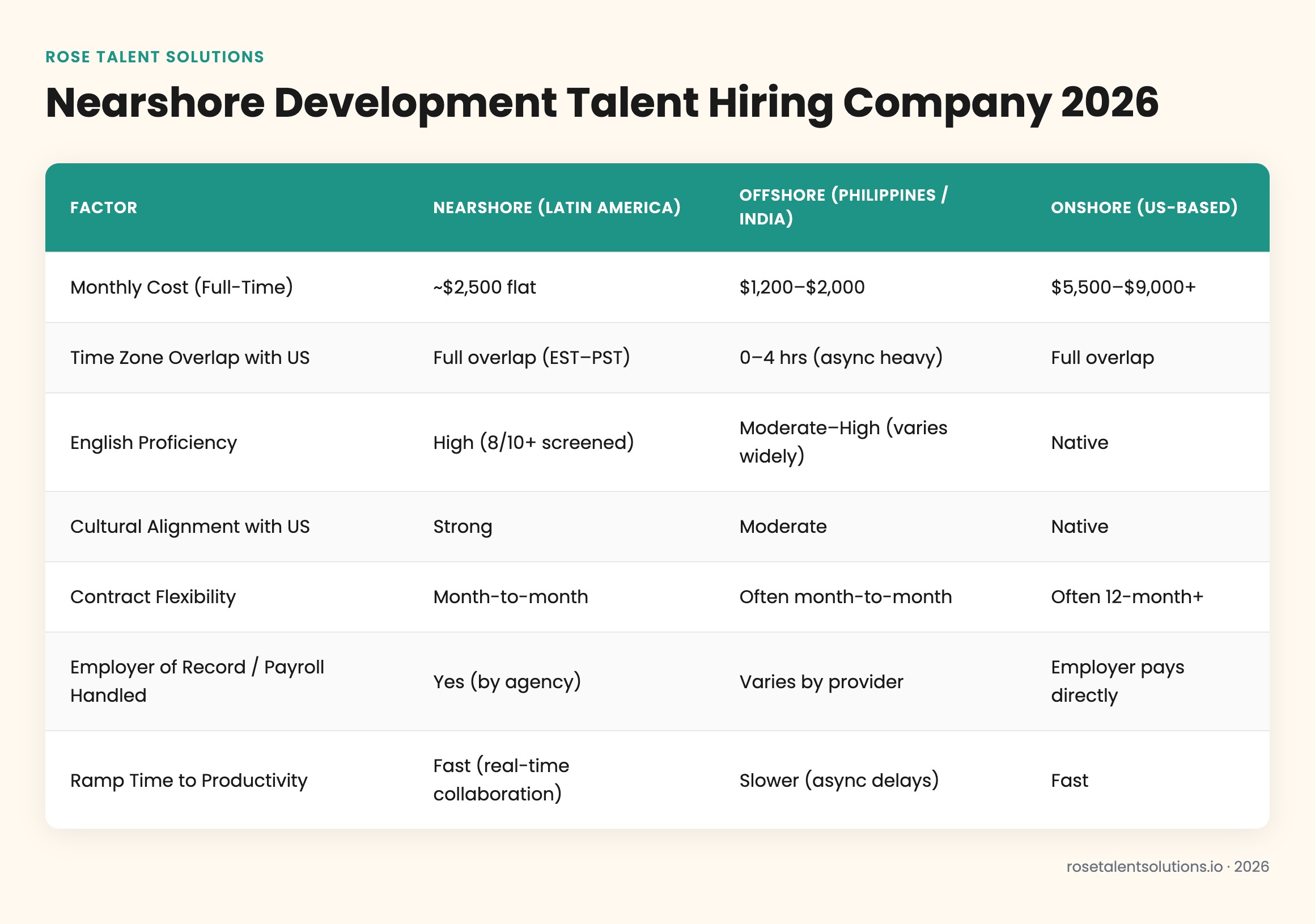

The offshore price advantage erodes fast once you factor in communication delays, revision cycles, and the management overhead of async-only teams. Research from McKinsey's People & Organizational Performance practice (2023) found that distributed teams operating across significant time zone gaps spend up to 30% more calendar time on coordination than co-located or time-zone-aligned teams. That overhead is invisible on a rate card but very visible on your projects.
How a Nearshore Development Talent Hiring Company Vets Candidates in 2026
The vetting process is where most nearshore staffing firms either earn or lose your trust. A rigorous provider runs candidates through at minimum four gates before a name lands on your desk: a structured skills assessment, an English proficiency screen (Rose's published floor is 8 out of 10), a background and identity verification, and a role-specific technical evaluation. Firms that skip any of these gates are selling you a resume lottery, not a vetted placement.
At Rose Talent Solutions, every team member also arrives equipped with a role-specific AI copilot — trained on the software stack relevant to their function, whether that's QuickBooks, AppFolio, Buildium, or a custom CRM. This matters because Gallup's State of the Global Workplace report (2024) consistently shows that employee confidence in their tools is one of the top three drivers of early engagement — and early engagement predicts retention.
"The organizations winning the talent war in 2025 are not the ones paying the most — they are the ones removing friction from the first 90 days." — Josh Bersin, Global Industry Analyst & Founder at The Josh Bersin Company (2024)
Software-trained placement is especially critical for roles like bookkeeping and accounting support where a VA who already knows QuickBooks workflow can be productive in days rather than weeks. The same principle applies to operations and coordination roles — a team member pre-trained on your software stack closes the ramp gap that makes most first-hire experiences painful.
The real hidden cost of a bad nearshore hire isn't the monthly fee — it's the 6–10 weeks of ramp time you lose before discovering the mismatch. Firms that offer a free replacement guarantee absorb that risk so you don't have to start the clock over at full cost.
What Does a Nearshore Development Talent Hiring Company Actually Cost?
Pricing transparency is rare in staffing. Most agencies bury markups inside "management fees," "platform fees," and variable billing that makes it impossible to forecast your monthly spend. The cleanest model — and the one increasingly preferred by operators — is a single flat monthly rate that covers everything: recruiting, vetting, payroll administration, HR, and ongoing account management.
Rose Talent Solutions charges $2,500 per month, flat, for a full-time (40-hour-per-week) team member. That fee includes all recruiting, vetting, payroll processing, and management support. There are no setup fees, no variable billing surprises, and no long-term contract — you operate month-to-month and can cancel with 30 days written notice. If the placement isn't a fit, Rose replaces them at no additional cost.
To understand how Latin American compensation structures make this pricing sustainable without cutting corners on talent quality, the data on average Latin American virtual assistant salaries is worth reviewing — it explains why nearshore providers can deliver strong talent at rates that would be impossible to replicate onshore.
For context: the US Bureau of Labor Statistics Occupational Employment Statistics (2024) puts the median annual wage for a US-based administrative coordinator at approximately $47,000 — or roughly $3,900 per month in direct salary alone, before benefits, payroll taxes, and recruiting costs. The nearshore all-in model at $2,500 represents a meaningful structural cost advantage, not a quality compromise.

How the Rose Talent Solutions Hiring Process Works in 2026
Understanding the end-to-end process helps you set realistic expectations and plan your onboarding. Rose's placement sequence is built to move from intake call to active team member in approximately one week for most roles.
Role Scoping Call
Rose's team meets with you to map the exact skills, software, time zone requirements, and communication style needed for your role — not a generic job description, but a precise talent brief.
Candidate Matching
Rose's recruiting team searches their vetted Latin America candidate pool and screens against your brief, running English proficiency checks (8/10+ floor), skills assessments, and background verification before you see a single name.
You Interview and Select
You meet the shortlisted candidates and make the call. Rose doesn't place anyone without your explicit sign-off — you own the hiring decision.
AI Copilot Onboarding
Your new team member is set up with their role-specific AI copilot — pre-trained on the software stack relevant to your business — so they can contribute from day one rather than spending weeks in passive orientation. Learn more about this on Rose's AI advantage page.
Ongoing Management Support
Rose stays in the relationship. If performance issues surface or the fit isn't right, Rose manages the resolution — including a free replacement — so you're never managing a staffing problem alone.
How to Evaluate Any Nearshore Development Talent Hiring Company
Not every agency calling itself "nearshore" delivers the same product. The label has become marketing shorthand, and some providers slap it on what is functionally an offshore operation with a time zone adjustment. Here is what actually separates a serious nearshore hiring firm from a rebranded offshore marketplace.
First, ask where the candidates physically live and work. Latin America is nearshore for US businesses; Southeast Asia is not, regardless of what a provider's homepage says. Second, ask for the exact English proficiency methodology — not "we screen for English" but the specific test, scoring rubric, and minimum threshold. Third, ask who manages payroll and HR compliance in the worker's home country. If the answer is "the contractor handles their own taxes," you have an unmanaged freelancer arrangement, not a staffed placement. You can find a broader overview of reputable virtual assistant companies operating in Latin America to benchmark what a credible provider looks like.
Fourth — and this is the one most buyers skip — ask about the replacement policy in writing. A firm that stands behind its vetting will offer a structured replacement guarantee with no additional cost. A firm that hedges on this question is implicitly telling you their vetting process is not airtight.
Signs of a Credible Nearshore Firm
- Candidates physically based in Latin America, verifiable
- Published English proficiency floor (e.g., 8/10+)
- Payroll and HR compliance managed by the agency
- Flat-rate pricing with no hidden fees
- Free replacement guarantee in writing
- Month-to-month terms, no long-term contract
- Role-specific skills assessment, not just a resume review
Red Flags to Walk Away From
- Vague geography ("global talent" with no specifics)
- No documented English proficiency standard
- Contractor-only model — no payroll management
- Variable billing with unclear fee structures
- No replacement policy or guarantee buried in fine print
- Requires 6- or 12-month minimum commitment upfront
- No AI or software training for placed candidates
For businesses that also want to understand how the onshore-only hiring model compares before making a final decision, the detailed onshore vs offshore virtual assistant breakdown covers the tradeoffs across cost, compliance, and communication quality in a format that maps directly to how operators actually make this decision.
If you are ready to scope a role and see who Rose can match you with, the fastest next step is the getting started page — the intake form takes under five minutes and triggers the role scoping process immediately. For businesses that need support across property operations, Rose's property management virtual assistant practice is one of the most active placement areas, with team members pre-trained on AppFolio, Buildium, and Yardi.
According to Statista's Future of Work research hub (2024), 62% of companies that adopted remote global staffing in 2022–2023 reported that geographic talent expansion became a permanent strategy rather than a pandemic-era workaround. Nearshore hiring is not a trend — it is a structural shift in how competitive businesses staff their operations.
The bottom line: the best nearshore development talent hiring company is the one that treats placement as an ongoing managed service, not a one-time transaction. Recruiting is the easy part. Vetting, payroll, HR, software onboarding, and performance management over a 12-month arc — that's where the real value is built, and where most budget providers fall apart.