
Nearshore developers — engineers hired from Latin America to work alongside US, Canadian, or UK product teams — have moved from a niche workaround to a mainstream hiring strategy in 2026. If you're running a startup, a SaaS company, or a growing tech team and you're still choosing between an expensive local hire or a low-cost offshore contractor in a wildly different time zone, you're missing the option that's winning right now. This guide covers what a nearshore developer actually is, what they cost, how they compare to offshore and onshore alternatives, and how to decide whether nearshore is right for your team.
What Is a Nearshore Developer in 2026?
A nearshore developer is a software engineer employed or contracted from a country geographically close to your own — for US companies, that means Latin America. Countries like Mexico, Colombia, Argentina, Brazil, and Costa Rica supply the vast majority of nearshore talent for the North American market. The defining traits are three: real-time time zone overlap, fluent English communication, and cost structures well below US market rates.
Nearshore development is distinct from offshore development, where teams are typically based in regions that may be 8–12 hours ahead or behind US business hours. The time zone alignment of Latin America (GMT-3 to GMT-8) means a nearshore developer in Medellín or Mexico City is on the same morning standup as your Austin engineering team. That single variable changes everything about how collaboration actually works day-to-day.
Latin America's developer population has grown rapidly. According to IDC (2023), the region added over 300,000 net-new software engineers in a single year, driven by government STEM investment and a wave of US-backed coding bootcamps and universities. English proficiency scores across the region have climbed alongside tech education — which is why Rose Talent Solutions holds a minimum 8/10 English proficiency bar for every developer we place. Every team member Rose places is based in Latin America — not Southeast Asia, not South Asia — specifically so that real-time collaboration with your North American team is never a workaround, it's the default.
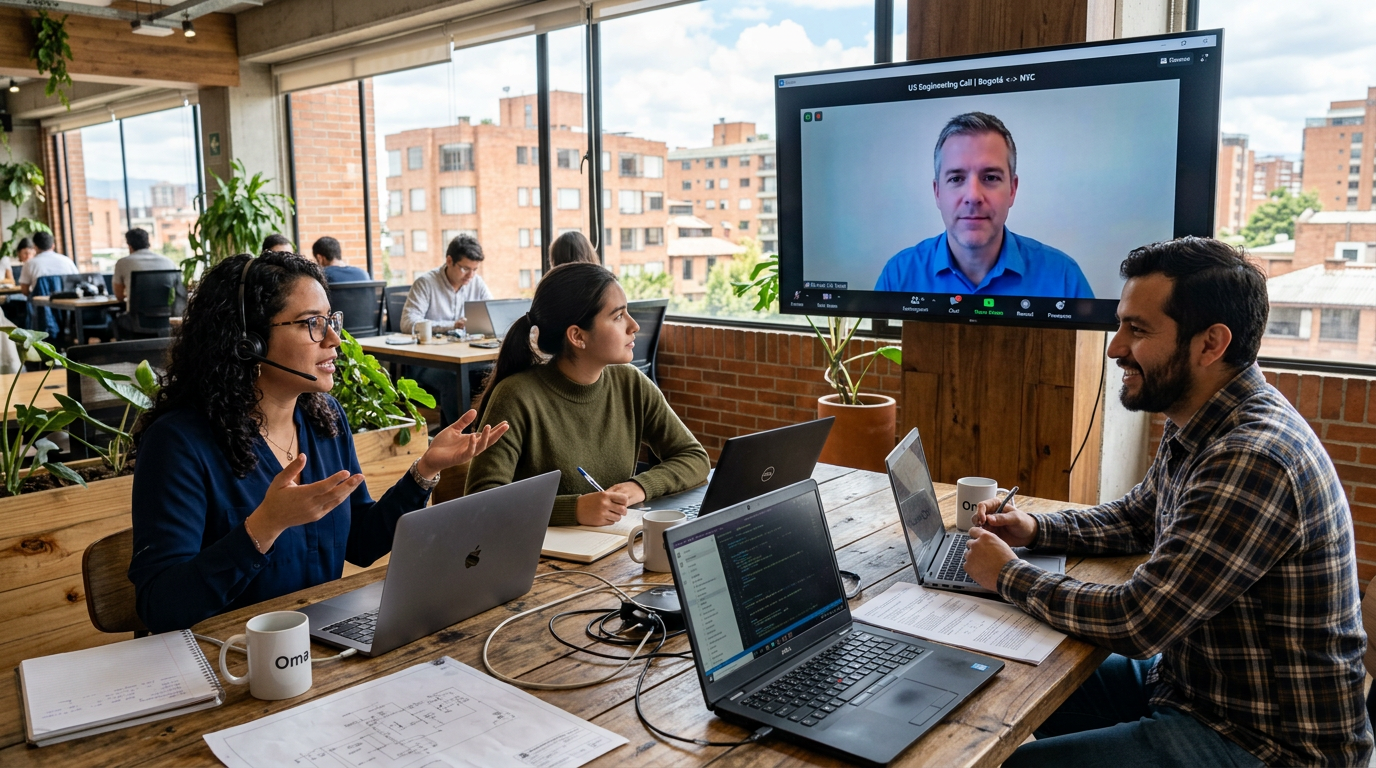
How Nearshore, Offshore, and Onshore Developers Compare in 2026
The staffing model you choose affects more than cost — it shapes sprint velocity, communication overhead, and how fast you can ship. Here's how the three models stack up on the factors that actually matter to a growing product team.
| Factor | Nearshore (Latin America) | Offshore (Far-abroad regions) | Onshore (US / Canada) |
|---|---|---|---|
| Monthly cost (mid-level engineer) | $2,500–$5,000 | $1,200–$3,000 | $9,000–$16,000+ |
| Time zone overlap with US East | 6–8 hours/day | 0–2 hours/day | 8 hours/day |
| English fluency (avg. EF score) | High (EF EPI: 55–65+) | Moderate–High (EF EPI: 50–60) | Native |
| Cultural alignment with US teams | Strong | Moderate | Native |
| Legal / IP risk | Low (USMCA aligned) | Moderate | Lowest |
| Ramp time to productivity | 1–2 weeks | 3–5 weeks | 2–4 weeks |
The offshore cost advantage is real but narrowing. As McKinsey Digital (2024) noted in their outsourcing state-of-play report, wage inflation in key offshore markets has eroded the offshore discount by roughly 18% over three years — while Latin American salaries remain more stable due to regional economic dynamics. At the same time, the productivity cost of an 8-hour async gap is rarely priced into offshore ROI calculations. It should be.
If you're evaluating platform-specific comparisons, our post on how a nearshore developer stacks up against Toptal breaks down the cost and quality differences in detail — including where Toptal's model makes sense and where it doesn't.
What Does a Nearshore Developer Actually Cost in 2026?
At Rose Talent Solutions, a full-time nearshore developer runs $2,500/month flat. That's 40 hours a week, fully managed — recruiting, vetting, payroll, HR, and ongoing performance management are all included. No long-term contract. If the developer isn't a fit, we replace them at no additional cost.
To put that in context: the median US software developer salary in 2024 was $124,200 per year according to the U.S. Bureau of Labor Statistics — roughly $10,350/month before benefits, payroll taxes, and recruiting costs. A nearshore developer through Rose costs about 24 cents on that dollar, with real-time availability during your business hours.
That pricing also compares favorably to freelance platforms. Platforms like Toptal charge client markups that can push effective rates to $150–$250/hour for senior talent. If you're running a team that needs consistent, full-time contribution — not spot consulting — a nearshore developer model outperforms Turing and similar AI-matching platforms on both cost and accountability.
The true cost comparison for a nearshore developer isn't salary vs. salary — it's total cost of employment (salary + benefits + payroll tax + recruiting + management overhead) vs. the flat monthly rate. When you do the full math, nearshore wins by 55–70% in most scenarios.
How AI Copilots Make Nearshore Developers More Productive in 2026
One of the differentiators Rose builds into every placement is a role-specific AI copilot trained on the tools your team already uses. For a nearshore developer, that means an AI layer tuned to your stack — whether that's GitHub workflows, Jira sprint management, specific frameworks, or CI/CD pipelines. This isn't a generic ChatGPT wrapper. It's a productivity layer trained on the actual software the developer ships in every day.
According to GitHub's research on AI-assisted development (2023), developers using AI code completion tools complete tasks up to 55% faster than those working without AI assistance. When that tooling is calibrated to your specific environment from day one, the ramp time for a new nearshore hire compresses significantly. Learn more about how this works on our AI advantage page.
"AI coding assistants don't replace engineers — they amplify the ones you already have. A mid-level developer with the right AI tooling ships like a senior in many contexts." — Gergely Orosz, Author & Engineering Leadership Analyst at The Pragmatic Engineer (2024)
This matters especially for nearshore hiring because it directly addresses the most common objection: "Will a nearshore developer be as fast as someone I hire locally?" With AI copilots integrated from day one, the answer is increasingly yes — and often faster, because the developer isn't burdened by internal politics, unnecessary meetings, or context-switching across unrelated company tasks.

What Roles Can a Nearshore Developer Fill in 2026?
The term "nearshore developer" covers a wide range of specializations. The most common roles US companies fill through nearshore staffing include full-stack engineers, backend API developers, frontend specialists, mobile developers, DevOps engineers, and QA automation engineers. Latin America has deep talent pools in React, Node.js, Python, Java, Ruby on Rails, Swift, Kotlin, and increasingly in AI/ML frameworks.
If your team is building for mobile, our detailed breakdown of nearshore mobile developers for iOS and Android covers platform-specific considerations — including how Swift and Kotlin expertise is distributed across the region and what vetting looks like for mobile-specific roles.
For teams that need a single engineer who can own both front-end and back-end, our guide on hiring a nearshore full-stack developer walks through the skill matrix, what to look for in a technical screen, and how Rose structures the matching process for generalist engineering roles.
Beyond core engineering, nearshore teams increasingly support adjacent functions: technical project management, QA, and even product operations. If your business also needs finance or administrative support running alongside your tech team, Rose's bookkeeping and accounting virtual staff can be staffed through the same flat-rate model — useful for startups that want to consolidate vendor relationships.
How the Rose Nearshore Hiring Process Works in 2026
Most nearshore staffing engagements are slow because the recruiter doesn't understand technical roles. Rose's process is built around role-specific technical vetting — not just English screening and a resume scan. Here's how it works end to end.
Role Discovery Call
We learn your stack, team structure, and the specific problem you're hiring to solve. This shapes the job brief and filters the candidate pool from the start.
Technical + English Vetting
Candidates complete a technical screen relevant to your stack plus an English proficiency evaluation — minimum 8/10 to advance. We reject candidates at this stage so you don't have to.
Client Interview (2–3 candidates)
You interview a shortlist of pre-vetted candidates. Most clients make a hire from the first shortlist within one week of kickoff.
AI Copilot Onboarding
Before day one, we configure the developer's role-specific AI copilot to your stack and workflows — so they're productive from the first standup, not the third week.
Ongoing HR & Management
Payroll, HR, performance check-ins, and replacement logistics are handled by Rose. You manage the work; we manage the employment relationship.
Ready to start the process? You can kick off a role discovery call directly on the Rose Talent Solutions start page — most clients have a shortlist in front of them within five to seven business days.
Nearshore Developer Pros and Cons: An Honest Assessment for 2026
Nearshore isn't perfect for every team. Here's an honest breakdown of where it wins and where you need to go in eyes-open.
Pros
- Real-time collaboration during US business hours — no async lag
- 40–70% cost savings vs. equivalent US hire, all-in
- Strong English fluency and US cultural alignment
- USMCA legal framework reduces IP and contract risk vs. far-offshore alternatives
- AI copilots compress ramp time to days, not weeks
- No long-term contract — cancel with 30 days written notice
Cons
- Smaller raw talent pool than some regions for ultra-niche specializations
- Senior architect or principal-level talent commands rates closer to $5,000–$8,000/month
- Still requires internal engineering leadership to manage day-to-day technical direction
- Not ideal for teams that want to hand off an entire product with zero internal involvement
According to SHRM's Talent Acquisition research (2024), the average cost to hire a US-based software engineer — including recruiter fees, interview time, onboarding, and ramp — exceeds $28,000 per hire. Nearshore staffing through a managed model like Rose eliminates most of that overhead entirely, because vetting, payroll, and HR are bundled into the flat monthly rate. For high-growth teams cycling through engineering headcount quickly, that alone is a compelling financial argument. You can explore the full Rose managed staffing model to understand how we handle the employment infrastructure end-to-end.