
Nearshore contractor recruitment has quietly become the most practical labor strategy for US, Canadian, and UK businesses that need full-time remote staff without full-time US salaries. Instead of posting on LinkedIn and competing with enterprise budgets, or rolling the dice on an offshore freelancer twelve time zones away, nearshore hiring pulls from Latin America — same-day time zones, strong English, and a talent pool that has grown sharply over the last three years. This guide breaks down exactly how the model works in 2026, what you should expect to pay, and how to avoid the most common mistakes operators make when they try to run this process themselves.
The labor market context matters here. According to SHRM's State of the Workplace research (2024), hiring and retention costs have risen sharply for small and mid-size businesses, making alternative staffing models — including nearshore contracting — more attractive than at any prior point in the last decade. If you have been putting off exploring this model because it felt complicated or risky, 2026 is the year the infrastructure finally caught up to the promise.
What Is Nearshore Contractor Recruitment, Exactly?
Nearshore contractor recruitment is the process of identifying, vetting, and placing remote workers from geographically proximate countries — in the US context, that means Latin America — into dedicated roles inside your business. The word "nearshore" is deliberate: it distinguishes this model from offshore staffing (typically Philippines or India, with 10–14 hour time-zone gaps) and from domestic onshore hiring (US-based, full employment-law exposure, and significantly higher cost).
A nearshore contractor works your business hours. If you open at 8 AM Eastern, they are logged in at 8 AM Eastern. They attend your Slack standups, respond to your emails in real time, and join your Zoom calls without anyone scheduling around an overnight overlap window. That real-time presence is the single biggest functional difference between nearshore and offshore — and it is the reason operators who have tried both models rarely go back. For a deeper breakdown of how these three models compare structurally, the nearshore vs. offshore vs. onshore virtual assistant comparison covers every dimension in detail.
Nearshore is not a compromise between offshore cost and onshore quality — it is a distinct model with its own structural advantages, particularly around communication latency, cultural alignment with US business norms, and time-zone synchrony.
How Nearshore Recruitment Differs From Traditional Staffing in 2026
Traditional staffing agencies hand you a candidate and bill you a placement fee — often 15–25% of first-year salary — and then walk away. If the hire doesn't work out in month three, you absorb the recruiting cost and start over. Nearshore staffing, at least the modern managed version, bundles recruiting, vetting, payroll, HR compliance, and ongoing management into a single flat monthly rate. You are not paying a placement fee and then running HR yourself; the agency handles the operational layer so you can focus on the work, not the worker.
At Rose Talent Solutions, that flat rate is $2,500 per month for a full-time team member — 40 hours per week, all-in, with no long-term contract. If a team member turns out not to be the right fit, Rose replaces them at no additional cost. That is the entire risk structure: one flat number, one replacement guarantee, month-to-month terms with 30 days written notice to cancel.
This structure matters because it changes how you think about the decision. You are not committing to a six-figure annual salary with benefits and termination risk. You are committing to a month, seeing what the team member can do in a real operational context, and then deciding whether to continue. The financial downside is capped; the upside — getting 40 hours a week of skilled support — is real from week one.

According to the U.S. Bureau of Labor Statistics Job Openings and Labor Turnover Survey (2024), average time-to-fill for administrative and operations roles in the US now exceeds 45 days. Nearshore managed staffing routinely cuts that to under two weeks for pre-vetted candidates — because the agency maintains an active bench rather than starting a search from zero every time a position opens.
Nearshore vs. Offshore vs. Onshore: 2026 Comparison
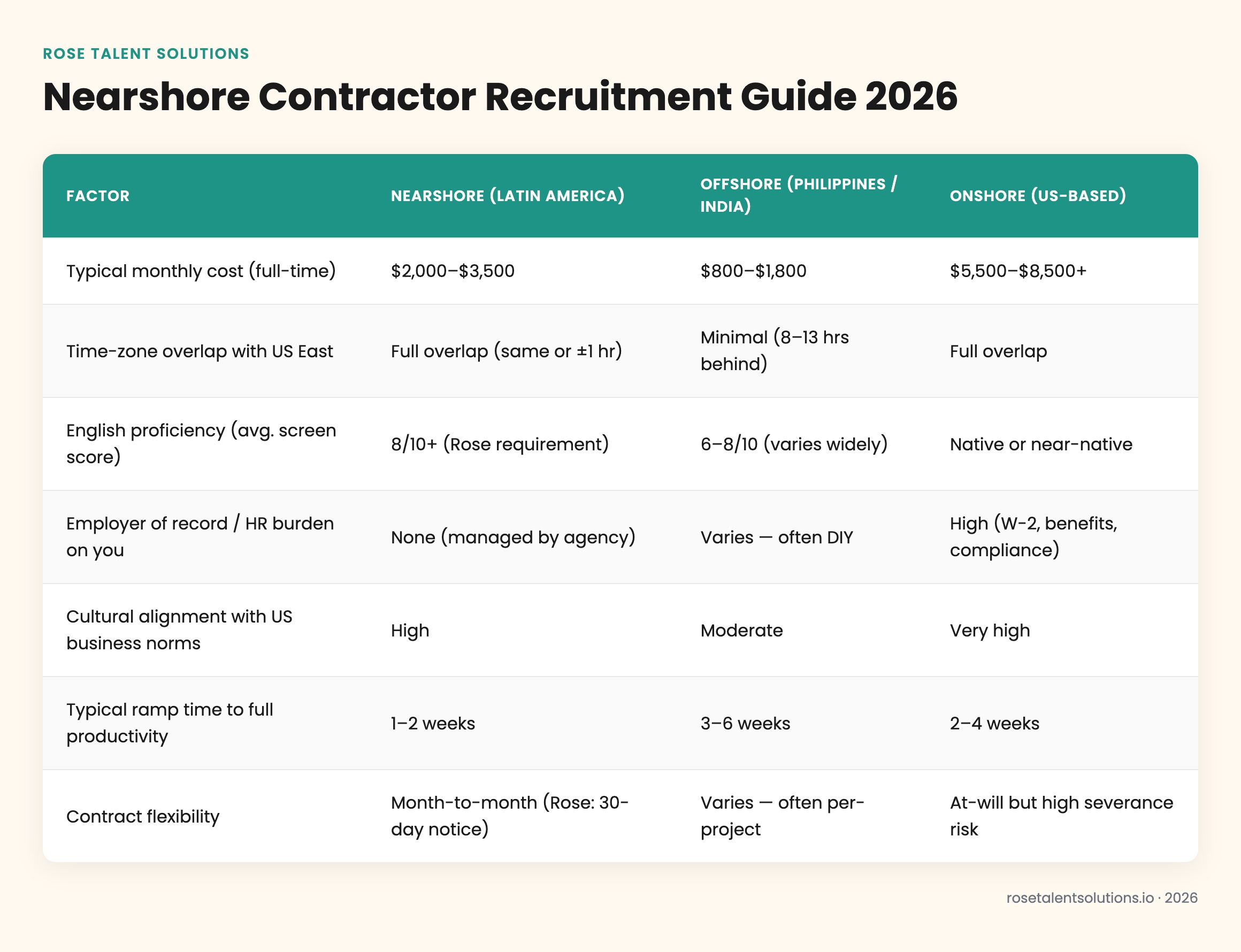
Before you commit to any staffing model, it helps to see the tradeoffs in one place. The table below compares the three dominant models across the dimensions that actually affect day-to-day operations — not just the headline cost.
| Factor | Nearshore (Latin America) | Offshore (Philippines / India) | Onshore (US-based) |
|---|---|---|---|
| Typical monthly cost (full-time) | $2,000–$3,500 | $800–$1,800 | $5,500–$8,500+ |
| Time-zone overlap with US East | Full overlap (same or ±1 hr) | Minimal (8–13 hrs behind) | Full overlap |
| English proficiency (avg. screen score) | 8/10+ (Rose requirement) | 6–8/10 (varies widely) | Native or near-native |
| Employer of record / HR burden on you | None (managed by agency) | Varies — often DIY | High (W-2, benefits, compliance) |
| Cultural alignment with US business norms | High | Moderate | Very high |
| Typical ramp time to full productivity | 1–2 weeks | 3–6 weeks | 2–4 weeks |
| Contract flexibility | Month-to-month (Rose: 30-day notice) | Varies — often per-project | At-will but high severance risk |
"The biggest mistake companies make when evaluating remote staffing is comparing hourly rates in isolation. The real cost is the sum of the hourly rate, the communication overhead, and the management time required to bridge a timezone gap — and on that total-cost basis, nearshore wins for any role requiring real-time collaboration." — Liam Martin, Co-founder at Time Doctor and Remote Work Advocate (TimeDoctor.com, 2024)
For a more detailed look at how the onshore and offshore models stack up against each other independently, the onshore vs. offshore virtual assistant breakdown is worth reading before you finalize your model decision. And if you want to evaluate specific agencies operating in the region, the guide to virtual assistant companies in Latin America covers what to look for in a provider.
How Rose's AI Advantage Changes the 2026 Nearshore Equation
The most significant development in nearshore contractor recruitment over the last 18 months is not pricing or talent supply — it is software integration. Every Rose team member ships with a role-specific AI copilot trained on the tools they will actually use: AppFolio, Buildium, QuickBooks, or whichever platform your business runs on. This is not a generic chatbot overlay. It is a trained assistant that understands your software's workflows, reducing the onboarding curve from weeks to days.
What this means operationally: a nearshore coordinator handling your property management back office is not just doing data entry — they are working alongside an AI layer that flags maintenance request anomalies, surfaces lease renewal dates, and auto-drafts tenant communications for human review. The team member makes the judgment calls; the AI handles the retrieval and formatting. You get the output quality of a more senior hire at the cost of a junior one. You can learn more about how this works in practice on the AI advantage page.
An AI copilot does not replace the nearshore team member — it makes them faster and more consistent. The human still owns the client relationship, the judgment call, and the accountability. The AI handles the retrieval, the formatting, and the routine pattern-matching that used to eat two hours of every workday.
According to Gallup's State of the Global Workplace (2024), employee engagement and output quality are most strongly predicted by whether workers have the tools and clarity to do their job well — not by whether they are in-office or remote. A nearshore team member with purpose-built AI tooling scores on both dimensions from day one.

What Roles Work Best for Nearshore Contractor Recruitment in 2026?
Not every role is a good nearshore fit. The model works best for positions where the work is screen-based, the output is measurable, and real-time communication with US colleagues or clients is required. Here is where nearshore consistently delivers:
- Property management coordination — maintenance dispatch, lease administration, tenant communications, AppFolio or Buildium data management. Rose's dedicated property management virtual assistant service is built specifically for this workflow.
- Bookkeeping and accounting support — accounts payable, reconciliations, QuickBooks management, financial reporting prep. The bookkeeping and accounting virtual assistant track is one of Rose's most in-demand placements.
- Executive and administrative assistance — calendar management, inbox triage, CRM updates, travel coordination, document processing.
- Customer service and leasing coordination — inbound inquiry handling, showing scheduling, follow-up sequences, tenant onboarding.
- Marketing operations — social media scheduling, listing management, email campaign execution, graphic asset coordination.
Roles that require physical presence (on-site maintenance, in-person client meetings) or deep local legal expertise (licensed real estate transactions, US-licensed CPA sign-off) are not appropriate for remote nearshore placement. Everything else is worth evaluating. According to Pew Research Center (2023), over 58% of US adults now work in jobs that could be performed remotely at least part-time — which means the pool of nearshore-eligible roles is far larger than most operators initially assume.
How the Rose Nearshore Recruitment Process Works: Step by Step
Role scoping call
You describe the role, the software stack, the hours, and the outcome you need. Rose's team translates that into a candidate brief — specific, not generic.
Candidate matching
Rose pulls from its active Latin America talent network — candidates are pre-screened on English proficiency (8/10+ floor), software skills, and role-fit. You typically see shortlisted candidates within 5–7 business days.
Interview and selection
You interview your top candidates on video. Rose coordinates scheduling and provides a structured evaluation framework so you are comparing apples to apples.
AI copilot setup and onboarding
Before day one, Rose configures the team member's role-specific AI copilot for your software environment. Most team members are operationally productive within the first week.
Ongoing management and QA
Rose handles payroll, HR, and regular check-ins. If performance issues emerge, Rose intervenes — and if the fit simply isn't right, the replacement guarantee means you are not starting from zero.
This end-to-end structure is what separates managed nearshore staffing from simply posting a job on a freelance marketplace. You are not project-managing a contractor; you are plugging a pre-built operational role into your business. To get started, the start page walks you through the intake process in under five minutes.
Why Latin America Is the Right Nearshore Source in 2026
The question of which nearshore region to recruit from matters as much as the model itself. Latin America has emerged as the dominant source for US-facing nearshore talent for three structural reasons: time-zone alignment, English proficiency at scale, and rapid higher-education expansion in technology and business disciplines.
Why Latin America Works
- UTC-3 to UTC-8 time zones — full overlap with all US business hours
- English proficiency rising steadily; Brazil, Colombia, Mexico, and Argentina all rank in EF's top global improvers
- University enrollment in business, tech, and finance disciplines up 34% in the last decade across the region
- Cultural proximity to US business communication norms — direct, deadline-oriented, email-and-Slack native
- Lower cost of living means competitive salaries for workers translate to affordable rates for US employers
What to Watch For
- English proficiency varies sharply by country and candidate — always require a scored screen, not just a conversation
- Infrastructure quality (internet, power) varies by city and neighborhood — managed agencies vet for this; DIY hiring often doesn't
- Labor law differs by country — payroll compliance is complex to run yourself; managed staffing removes this risk
The guide to Latin America staffing agencies covers how to evaluate providers operating in this space — including what questions to ask about payroll compliance, candidate bench depth, and replacement policies before you sign anything.
According to McKinsey Global Institute's Future of Work research (2021, updated 2023), Latin America is projected to be the fastest-growing source region for English-speaking remote talent serving North American businesses through 2030 — driven by demographic youth, expanding higher education, and accelerating English-language adoption in secondary schools across the region. The talent pipeline is not shrinking; it is growing faster than US employer demand for it.