
Nearshore bilingual call centers have quietly become one of the most effective staffing moves a US or Canadian business can make in 2026. If you've been fielding customer calls in English and Spanish — or watching your hold times climb — and you're wondering whether there's a smarter way to staff your front line, the answer almost always points south: to Latin America, where English-fluent, Spanish-native agents work your exact business hours at a fraction of domestic cost. This guide breaks down exactly how these centers work, what to look for, what they cost, and why timezone alignment is the factor most buyers underestimate before they sign.
What Is a Nearshore Bilingual Call Center?
A nearshore bilingual call center is a customer-facing support operation staffed by agents based in a geographically close country — in the US context, that means Latin America — who communicate fluently in at least two languages, most commonly English and Spanish. "Nearshore" specifically refers to proximity: same or overlapping time zones, short flight distances, and cultural familiarity with North American business norms. This is distinct from offshore outsourcing to the Philippines or India, where 8–12 hour time differences force overnight staffing or next-day callbacks.
The bilingual element matters because the US Hispanic population crossed 63 million in 2022, according to Pew Research Center (2023). Any business serving a broad US consumer base — property management, healthcare scheduling, retail, financial services, legal intake — is almost certain to handle a meaningful volume of Spanish-language calls. A bilingual nearshore agent handles both seamlessly, in real time, without a transfer or an interpreter line.
How Nearshore Compares to Offshore and Onshore in 2026
Before you pick a model, you need to understand what you're actually trading off. Most buyers start by looking at hourly rate and stop there. That's a mistake. The real cost equation includes ramp time, error rates, supervisor overhead, and the compounding cost of a 6–8 hour lag on every customer issue. To understand the full spectrum, it's worth reading Rose's complete nearshore vs. offshore vs. onshore comparison, which breaks down each model across a dozen variables. For a focused look at just the two-way comparison, Rose's onshore vs. offshore virtual assistant breakdown is also worth reviewing before you decide.
The table below distills the key differences for bilingual call center use cases specifically:
| Factor | Nearshore (Latin America) | Offshore (Philippines / India) | Onshore (US-based) |
|---|---|---|---|
| Monthly cost (FT agent) | ~$2,500 | ~$1,200–$1,800 | ~$4,500–$8,000 |
| Timezone overlap with US | Full overlap (ET/CT/MT/PT) | Little to none (8–12 hr gap) | Full overlap |
| Native Spanish fluency | Yes — mother tongue | Rare | Varies by hire |
| English proficiency | High (8/10+ screened) | High (accent differences noted) | Native |
| Cultural alignment (US norms) | Strong | Moderate | Native |
| Ramp time to productivity | Fast (1–2 weeks) | Slower (timezone delays training) | Fast |
| Contract flexibility | Month-to-month | Often 12-month minimums | Varies |

Why English Fluency and Spanish Fluency Are Not the Same Problem
Most businesses shopping for bilingual support focus almost entirely on Spanish coverage — because that's the gap they feel. But English quality is equally important. A caller who starts in Spanish and switches mid-sentence to English (code-switching is extremely common among US Hispanic consumers) needs an agent who can track the conversation without missing a beat. According to SHRM's workforce planning research, communication breakdowns are the single most commonly cited driver of customer escalations in mixed-language service environments.
Rose Talent Solutions screens every candidate to an 8/10 or higher English proficiency floor — not a soft benchmark, a hard screen. If a candidate doesn't clear it, they don't reach the client. That bar matters because bilingual agents aren't just translating: they're de-escalating frustrated callers, capturing precise intake details, updating CRM records in real time, and representing your brand. Both languages have to be working at a professional level simultaneously. For a deeper look at how Latin American VA markets have developed and what salary benchmarks look like, see Rose's breakdown of Latin American virtual assistant salary ranges.
Gallup's research on employee engagement also underscores a related point: agents who feel culturally connected to their customers perform measurably better on satisfaction scores, according to Gallup's workplace engagement research (2023). Latin American agents serving US Hispanic callers share cultural context — holidays, idioms, regional references — that offshore agents simply don't have, and that familiarity shows up in first-contact resolution rates.
"Bilingual proficiency in a customer-facing role isn't additive — it's multiplicative. An agent who's great in one language and mediocre in the other will lose customers in both." — Gustavo Möller-Hergt, CEO at Also Holding AG, cited in multilingual CX research (2023)
How a Nearshore Bilingual Call Center Gets Deployed in 2026
The staffing process for a dedicated nearshore bilingual agent is faster than most operators expect. Rose typically places a matched candidate within a week of intake. Here's how the sequence works:
Intake & Role Scoping
You describe the role — call volume, software used, language split, hours needed. Rose maps this to a specific candidate profile with the right language pair and industry background.
Candidate Matching & Vetting
Rose's recruiting team shortlists pre-screened candidates who clear the 8/10+ English proficiency bar, pass background checks, and have verified experience with your software stack (CRM, property management platforms, booking tools, etc.).
Interview & Selection
You interview your top 1–2 matches. Most clients make a hire after a single round. If nobody clicks, Rose keeps sourcing at no additional cost.
Onboarding with AI Copilot
Your new agent receives a role-specific AI copilot trained on your software — whether that's Salesforce, AppFolio, Buildium, or a proprietary CRM. This cuts ramp time significantly compared to a cold-start hire. Learn more about how Rose's AI advantage works.
Live & Managed
Rose handles payroll, HR, and ongoing performance management. You get a dedicated team member who's fully integrated into your operation — without the overhead of being their employer of record.
What Industries Benefit Most From Nearshore Bilingual Call Centers in 2026?
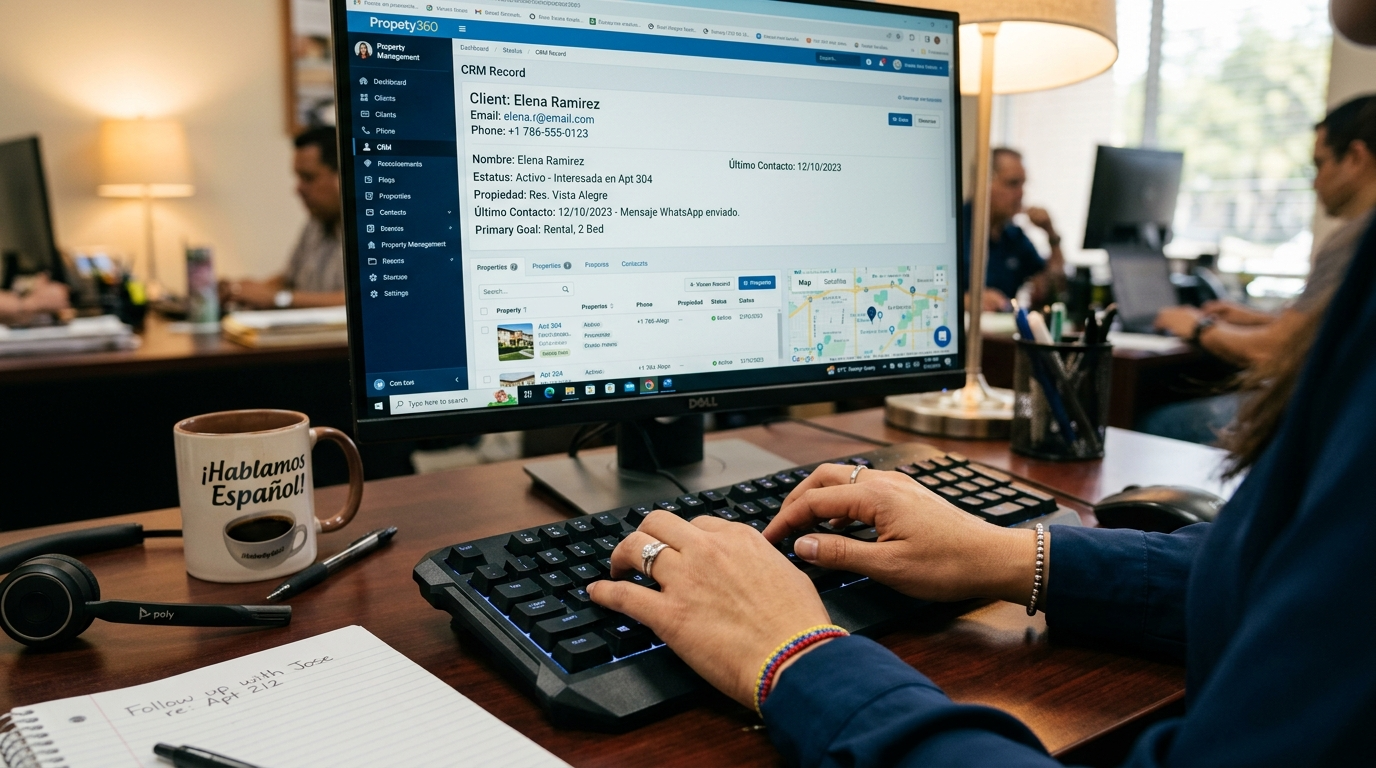
Any business with a bilingual customer base and real-time support requirements is a strong fit. Property management is the clearest example: leasing inquiries, maintenance coordination, and tenant communication don't wait until the next business day, and Spanish-speaking residents are a significant demographic in virtually every major US market. Rose's property management virtual staffing service specifically addresses this use case — bilingual coordinators who work in AppFolio, Buildium, or Yardi and answer calls in both languages without missing a beat.
Beyond property management, high-demand verticals include legal intake (where a missed call from a Spanish-speaking potential client is a lost case), healthcare scheduling, real estate transaction coordination, e-commerce customer service, and financial services. According to the US Bureau of Labor Statistics, customer service representative roles are among the highest-volume positions in the US economy — and the bilingual premium for those roles is real, often adding 10–15% to market wages domestically. Nearshore staffing eliminates that premium entirely while adding the Spanish fluency as a baseline expectation.
The National Multifamily Housing Council reports that Hispanic households represent one of the fastest-growing renter segments in the country, according to NMHC's diversity in multifamily housing research. That growth makes bilingual support not a nice-to-have but an operational requirement for any property management company operating in major US metros.
The hidden cost of offshore bilingual staffing isn't the hourly rate — it's the 6–12 hour timezone gap that turns every Spanish-language customer complaint into an overnight ticket and every English escalation into a next-day callback. Nearshore eliminates both problems at once.
How Much Does a Nearshore Bilingual Call Center Agent Cost in 2026?
At Rose Talent Solutions, pricing is $2,500 per month, flat. That's a full-time, 40-hour-per-week dedicated agent. Included in that number: recruiting, vetting, payroll processing, HR management, and ongoing performance oversight. There are no add-on fees for the AI copilot, no setup charges, and no long-term contract. You pay month-to-month, and if the team member isn't a fit, Rose replaces them at no additional cost — that's the risk reversal built into the model.
Compare that to the US market. According to BLS Occupational Employment Statistics, the median annual wage for a customer service representative in the US is approximately $37,780 — roughly $3,148/month in salary alone, before benefits, payroll taxes, recruiting costs, and training. A bilingual candidate commands more. The nearshore model at $2,500/month all-in represents a genuine economic advantage, not a quality tradeoff. For context on how the broader landscape of virtual assistant companies operating across Latin America has evolved, Rose's market overview covers the major players and what differentiates them.
Bookkeeping-adjacent tasks — invoicing, payment processing notes, account reconciliation — often get bundled into bilingual call center roles when call volume has natural quiet periods. If that's your situation, Rose's bookkeeping and accounting virtual staffing covers how those hybrid roles are structured.
Nearshore Bilingual — Pros
- Full US timezone alignment — real-time support, no overnight queues
- Native Spanish + high-fluency English in one hire
- Strong cultural familiarity with US business norms and consumer expectations
- Month-to-month terms — no long-term contract lock-in
- AI copilot included — faster ramp on your specific software stack
- Free replacement if the agent isn't a fit
Nearshore Bilingual — Considerations
- Higher cost than deep-offshore (Philippines, India) — though all-in cost gap is smaller than it appears
- Smaller talent pool than pure English-only nearshore hiring
- Requires clear onboarding documentation to maximize ramp speed
How to Evaluate a Nearshore Bilingual Call Center Provider in 2026
Not all nearshore providers are built the same. When you're evaluating options, ask these specific questions before you sign anything: What is the English proficiency screening process, and what score is required to pass? Can agents demonstrate live bilingual conversation, not just a written test? Is the pricing truly all-in, or are recruiting fees, replacement fees, and benefits charged separately? What's the actual time zone of the agents — some providers market as "nearshore" but staff from Eastern Europe or Southeast Asia?
According to McKinsey's research on the future of customer care, the single biggest driver of customer satisfaction in phone-based support is first-contact resolution — solving the issue on the first call, without a transfer or callback. That outcome depends almost entirely on agent competence and information access. An agent who speaks both languages fluently, works your exact hours, and has your CRM open in front of them resolves calls on the first contact. An offshore agent working the night shift with a 10-hour information lag does not.
If you're ready to move forward, the fastest path is starting the matching process at Rose — intake takes under 10 minutes, and most clients have a shortlist of matched candidates within a week.