
Nearshore virtual assistants who specialize in n8n are one of the fastest-growing hires in the small-business automation space — and for good reason. n8n has crossed 80,000 self-hosted instances worldwide, according to n8n's official blog (2024), and most of those instances are being managed by someone other than the founder. The problem is that "someone" is usually a $120/hour freelance developer, a contractor who disappears mid-project, or — honestly — no one at all, with broken workflows silently failing in the background. This guide shows you exactly how to hire a dedicated n8n workflow virtual assistant, what they should be able to do on day one, and what a fair, transparent price looks like in 2026.
What Is an n8n Workflow Virtual Assistant?
An n8n workflow virtual assistant is a remote professional whose primary job is to design, build, deploy, and maintain automation workflows inside the n8n platform. Unlike a generalist VA who handles email and calendar, an n8n VA is a technical operator — someone who understands nodes, webhook triggers, conditional logic, API authentication, and error-handling branches. They typically work inside your existing stack: connecting your CRM, your inbox, your project management tool, and your billing software into a single automated pipeline.
n8n itself is an open-source, self-hostable workflow automation tool that competes with Zapier and Make.com. It offers far more flexibility than either — including the ability to write custom JavaScript inside nodes — which is why it attracts operations teams that have outgrown simpler tools. If you want a deeper look at how VAs handle the broader automation ecosystem, the Rose post on Make.com automation virtual assistants covers the adjacent skillset well.
How n8n VAs Differ From Zapier or Make.com Specialists in 2026
The short answer: n8n VAs need more technical depth. Zapier is largely point-and-click. Make.com adds visual logic that requires some systems thinking. n8n adds a full JavaScript execution environment, self-hosting responsibilities, and raw API calls that don't require a pre-built connector. That means an n8n specialist is closer to a junior developer than a typical automation VA — but they still operate as a support function, not an engineering hire.
According to the U.S. Bureau of Labor Statistics (2024), the median annual wage for a software developer in the US is $132,270. An n8n workflow virtual assistant delivers a meaningful slice of that capability at a fraction of the cost, because their work lives at the operations layer — not the product engineering layer. They are not writing application code; they are wiring your existing software together.

If your team is also using no-code tools alongside n8n, it's worth reading about hiring a no-code virtual assistant to understand the full spectrum of technical VA roles available — from Airtable builders to API integrators.
How Nearshore n8n VAs Compare to Every Other Hiring Option in 2026
Before you post a job on Upwork or sign a retainer with a dev shop, run the real comparison. The table below covers the four realistic options a US or Canadian business has when they need dedicated n8n workflow support. Note that all cost estimates for US-based hires reflect fully-loaded compensation including benefits and payroll taxes.
| Hiring Option | Monthly Cost (est.) | Time Zone Overlap | English Proficiency | n8n Technical Depth | Continuity / Reliability |
|---|---|---|---|---|---|
| Nearshore VA — Latin America (Rose) | $2,500 flat | Full US hours | 8/10+ screened | Mid–High (operations layer) | Dedicated; managed + replaced if not a fit |
| Generic Remote Freelancer (Upwork/Fiverr) | $3,200–$6,400 | Variable / unpredictable | Unscreened | Low–Mid; no vetting | Project-based; high churn; no replacement |
| US Freelance Dev (Upwork) | $4,800–$9,600+ | Full overlap | Native | High (product layer) | Project-based; high churn |
| US Full-Time Employee | $8,000–$12,000+ | Full overlap | Native | High | Stable but expensive + benefits overhead |
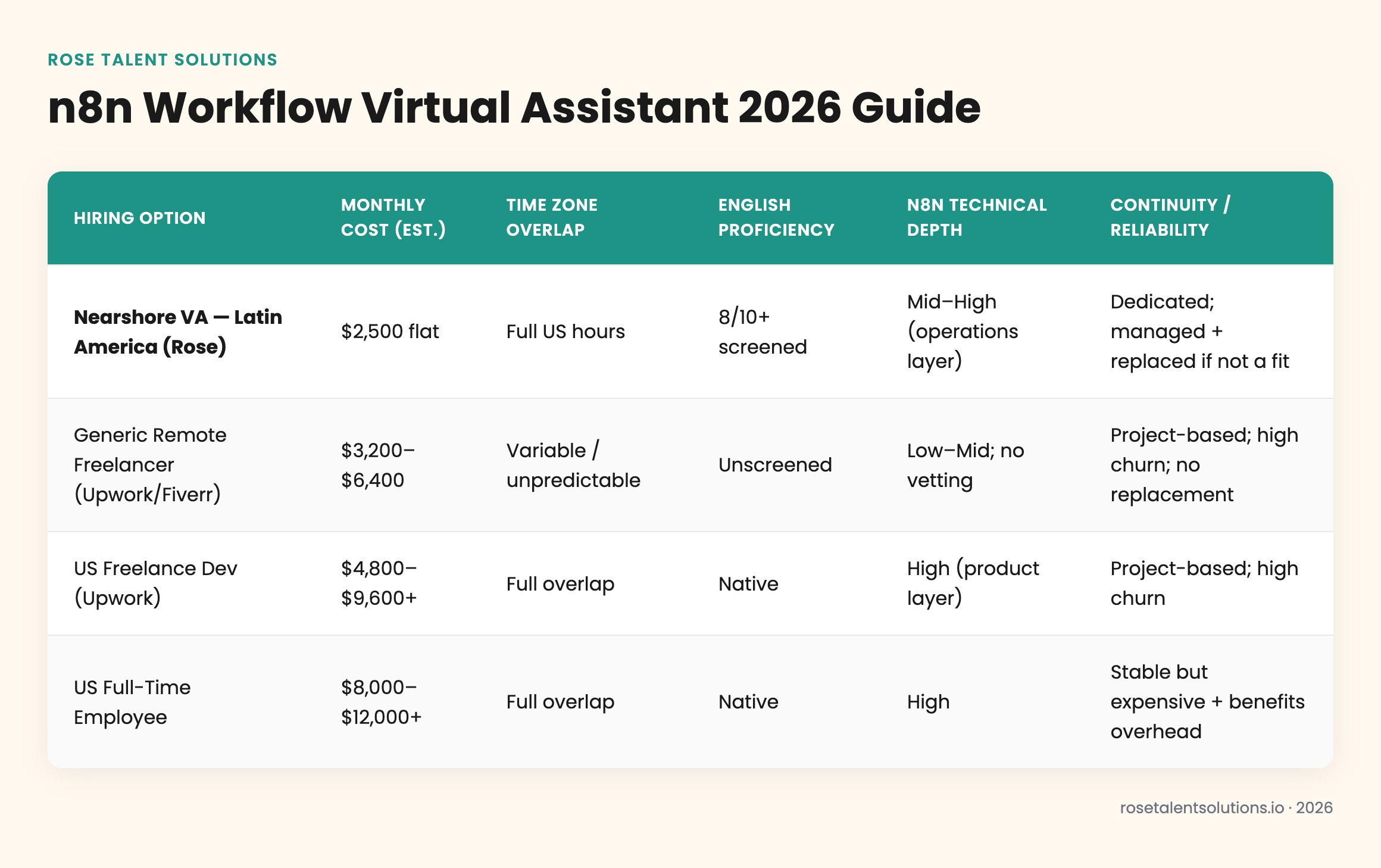
The generic remote freelancer comparison deserves a specific note: the cost difference looks attractive until you factor in the lack of timezone accountability and screening. When a workflow breaks at 10am EST and your unmanaged freelancer is unreachable, that's a half-day of broken data pipelines before anyone touches the problem. Nearshore VAs based in Colombia, Mexico, or Argentina work your business hours — they see the Slack alert when you do, and Rose's managed model means someone is accountable for the relationship even if a swap is needed.
What Tasks Should an n8n Workflow VA Handle Every Day in 2026?
A well-scoped n8n VA role is not just "build automations." The most productive setups treat the VA as an ongoing automation operations manager. Here is a realistic daily and weekly task list:
- Monitor active workflows for errors and failed executions in the n8n dashboard
- Build new workflows from SOPs you provide (e.g., "when a new lead fills out this form, create a CRM contact and send a Slack notification")
- Maintain API credentials and refresh tokens before they expire
- Document every workflow in a shared Notion or Google Doc so nothing lives only in one person's head
- Test and QA workflow changes before they touch production data
- Optimize slow or redundant workflows — n8n's execution logs make this straightforward
- Coordinate with your other tools: if you use Airtable as a data layer, for example, a VA who also understands Airtable virtual assistant services can manage the full data pipeline end-to-end
"The businesses getting the most from workflow automation in 2025 and 2026 are not the ones who built the cleverest automations — they're the ones who hired someone to maintain them consistently." — Alex Hormozi, Business Operator and Author of $100M Leads, interview on the My First Million podcast (2024)
According to McKinsey & Company's Digital Insights research (2023), up to 30% of work activities in most business functions can be automated with existing technology — yet adoption stalls because no one owns the automation layer full-time. A dedicated n8n VA fills exactly that gap.

The real cost of not having a dedicated n8n VA isn't the broken workflow — it's the compounding data errors downstream. A missed webhook means a lead that never got followed up. A failed API call means an invoice that never got created. These failures are silent and expensive.
How Rose's AI Copilot Makes n8n VAs Faster From Day One
Every Rose team member ships with a role-specific AI copilot trained on the tools they use. For an n8n VA, that means the copilot is pre-loaded with n8n node documentation, common workflow patterns, error codes, and troubleshooting guides. Rather than a new hire spending two weeks learning your stack from scratch, they walk in with a structured knowledge base already tuned to the job.
This is the same principle behind how Rose's bookkeeping VAs are pre-trained on QuickBooks and Xero workflows before their first day — the AI layer removes the generic ramp-up time and gets the specialist to productive output faster. For technical roles like n8n support, that acceleration is even more pronounced, because the documentation surface area is large and constantly updated.
For businesses that also need VAs handling API connections between n8n and external platforms, Rose's specialists who focus on API integration virtual assistant work can complement your n8n operator directly — handling the authentication, credential management, and endpoint testing that sits adjacent to n8n workflow logic.
According to Gallup's State of the Global Workplace report (2023), only 23% of employees globally are engaged at work — a number that drops further for remote workers managing repetitive technical tasks without structured support. Rose's AI copilot model is specifically designed to keep nearshore technical VAs engaged, equipped, and accurate by giving them real-time decision support rather than leaving them to navigate errors without guidance.
How to Onboard an n8n Workflow VA in 2026: The Step-by-Step Process
Audit Your Existing Workflows
Before your VA starts, document every active n8n workflow — even the broken ones. A simple spreadsheet with workflow name, trigger, purpose, and last successful run date is enough. Your VA will build from this baseline.
Grant Scoped Access
Add your VA to your n8n instance with an operator-level account. Separately, share API credentials for connected platforms (CRM, inbox, billing) via a password manager like 1Password — never in plain text over Slack.
Define a Weekly Automation Roadmap
Give your VA a prioritized list of three to five workflows to build or fix in the first two weeks. This creates immediate wins and establishes a working rhythm before you expand scope.
Set Up Daily Check-Ins
A 15-minute async Loom update or a live standup works equally well. Your VA should surface failed executions, blockers, and completed tasks every morning so you have full visibility without micromanaging.
Review and Expand Monthly
At the end of each month, review which manual processes still exist in your business and assign the top one to your VA. Automation is a compounding asset — each month your workflows handle more and cost less per task.
Nearshore Latin America vs. Unmanaged Remote Freelancers: The Honest Pros and Cons in 2026
Choosing between a nearshore VA in Latin America and an unmanaged remote freelancer comes down to one question more than any other: how fast do your workflows need a human response? n8n workflows can fail at any time. The difference in response time between a managed nearshore VA and a self-sourced freelancer with no accountability layer is often the difference between a 15-minute fix and a next-day fix — if the freelancer responds at all.
Nearshore Managed VA (Latin America) — Pros
- Works your exact business hours (EST/CST/PST overlap)
- English proficiency screened to 8/10+ before placement
- Same-day response to broken workflows and urgent changes
- Cultural alignment with US business communication norms
- No long-term contract; cancel with 30 days written notice
- Free replacement guarantee if the match isn't right
Unmanaged Remote Freelancer — Cons
- No timezone accountability — availability is unpredictable
- English proficiency unscreened; communication quality varies widely
- High freelancer churn increases your retraining burden
- No managed replacement if the relationship breaks down
- Lower sticker price often masked by lost productivity and error costs
According to SHRM's research on employee turnover costs (2024), replacing a worker costs an average of 50–200% of their annual salary in lost productivity, recruiting, and retraining. Unmanaged freelancer platforms with high churn transfer that cost directly to you. Rose's model includes a free replacement if your team member isn't a fit — eliminating the single biggest hidden cost of the "cheap freelancer" calculation.
If your business is ready to hire, the fastest path is through Rose's onboarding process — you can describe your n8n workflow needs directly and get matched with a pre-vetted specialist, typically within a week.