
Nearshore Latin America recruiters have become the go-to solution for US, Canadian, and UK businesses that need full-time, English-fluent remote staff without the timezone headaches of traditional offshore hiring. Unlike recruiters who source from Southeast Asia or South Asia, LATAM-focused firms place professionals who live in UTC-5 to UTC-3 time zones — meaning they're online when your team is online, every single day. That alignment changes everything about how remote work actually functions.
This guide breaks down exactly how Latin America recruiters work, what separates the great ones from the average ones, and how to evaluate whether nearshore staffing is the right move for your business in 2026.
What Do Latin America Recruiters Actually Do in 2026?
A Latin America recruiter does far more than post a job and forward resumes. The best firms handle the full hiring lifecycle: sourcing candidates from their established LATAM talent networks, running English proficiency screens, conducting skills assessments, checking references, managing payroll in-country, and providing ongoing HR oversight once the hire is placed. That end-to-end model is why businesses pay a flat monthly fee rather than a one-time placement fee — the relationship doesn't end at the offer letter.
The term "nearshore recruiter" specifically refers to a staffing firm that sources talent from countries geographically close to the client — in this context, Latin America for North American businesses. Nearshore differs from offshore (Asia, Eastern Europe) in two critical ways: shared or overlapping time zones, and stronger cultural alignment with US business norms. For a deeper look at how these models compare, the nearshore vs offshore vs onshore virtual assistant complete comparison breaks down the tradeoffs in detail.
Top LATAM markets for English-fluent remote professionals include Colombia, Mexico, Argentina, Costa Rica, and Brazil. Each country has its own talent density, cost profile, and labor law considerations — which is exactly why working with a recruiter who specializes in the region (rather than a generalist global staffing firm) matters so much. According to the World Bank's Latin America & Caribbean overview (2024), the region has seen sustained growth in tertiary education enrollment, expanding the qualified, degree-holding workforce available to international employers.

How Nearshore Recruiters Outperform Offshore Staffing in 2026
The difference between nearshore and offshore isn't just geography — it's operational rhythm. When your VA is 10–12 hours ahead or behind you, every back-and-forth becomes an overnight delay. A tenant maintenance request submitted at 3pm doesn't get routed until the next morning. A bookkeeping question asked on a Tuesday sits until Wednesday. Those delays compound.
Nearshore Latin America recruiters solve that problem structurally. LATAM professionals work US Eastern, Central, Mountain, or Pacific hours — same day, same meeting, same Slack thread. Real-time collaboration isn't a feature you have to negotiate; it's the default. According to Gallup's State of the American Workplace Report (2023), employees who can collaborate in real time report 21% higher engagement — a dynamic that applies equally to remote staff.
The hidden cost of offshore staffing isn't the hourly rate — it's the 6–12 hour timezone gap that turns every simple question into a 24-hour delay, quietly eroding the productivity gains you expected from outsourcing in the first place.
Language is the second dimension. Rose Talent Solutions screens every LATAM candidate to an 8/10 or higher English proficiency standard before they ever meet a client. That threshold matters for client-facing roles — leasing calls, vendor negotiations, customer service — where a heavy accent or limited vocabulary creates friction. For a head-to-head breakdown, see this analysis on onshore vs offshore virtual assistant tradeoffs that walks through real cost and performance comparisons.
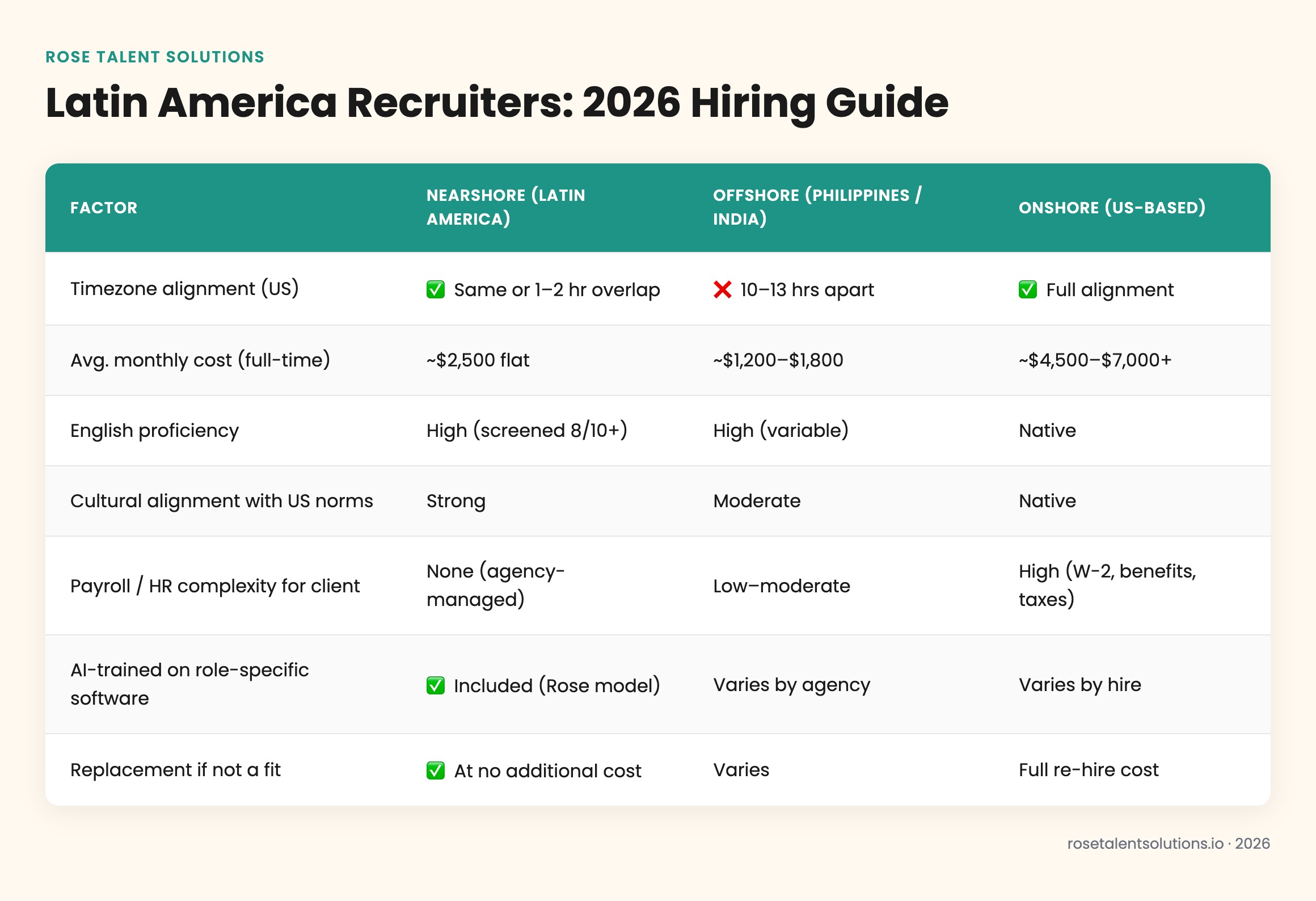
| Factor | Nearshore (Latin America) | Offshore (Philippines / India) | Onshore (US-based) |
|---|---|---|---|
| Timezone alignment (US) | ✅ Same or 1–2 hr overlap | ❌ 10–13 hrs apart | ✅ Full alignment |
| Avg. monthly cost (full-time) | ~$2,500 flat | ~$1,200–$1,800 | ~$4,500–$7,000+ |
| English proficiency | High (screened 8/10+) | High (variable) | Native |
| Cultural alignment with US norms | Strong | Moderate | Native |
| Payroll / HR complexity for client | None (agency-managed) | Low–moderate | High (W-2, benefits, taxes) |
| AI-trained on role-specific software | ✅ Included (Rose model) | Varies by agency | Varies by hire |
| Replacement if not a fit | ✅ At no additional cost | Varies | Full re-hire cost |
How to Evaluate a Latin America Recruiter Before You Sign
Not all Latin America recruiters are built the same. Some are broad-market generalists who happen to source from LATAM. Others specialize in specific verticals — property management, accounting, e-commerce operations — and have pre-vetted talent pools ready to deploy. The difference in placement quality and ramp time between these two types is significant.
Here are the five questions that separate serious LATAM recruiters from the rest:
- What is your English proficiency screening standard? Any recruiter worth working with should be able to tell you the exact test, threshold, and what happens if a placed candidate falls below that standard. Rose's bar is 8/10+ — ask every recruiter you evaluate to name their number.
- Do you handle payroll, benefits, and in-country HR compliance? LATAM labor law varies significantly by country. A recruiter who handles in-country compliance protects you from legal exposure you didn't know you had.
- What is your replacement policy? Rose replaces any team member who isn't a fit at no additional cost. Confirm whether a recruiter's replacement guarantee has time limits, fees, or hidden conditions.
- What software verticals do your candidates have experience in? If you need someone trained in AppFolio, Buildium, or QuickBooks, ask for placement examples. Generic admin experience is not the same as role-specific software fluency.
- What are the contract terms? Avoid firms that lock you into 12-month minimums. Rose operates month-to-month with 30 days written notice — no long-term contract required.
Understanding the full cost picture before you engage is equally important. The Latin America virtual assistant cost breakdown covers what to expect across different LATAM countries, role types, and agency models — so you're not surprised by what you get quoted.

"Latin America has quietly built one of the strongest remote-work talent pools in the world. The combination of US timezone alignment, bilingual fluency, and university-educated professionals makes it the most underutilized hiring market for North American companies." — Guillermo Bravo, Founder at Remoti Talent (2024)
According to the US Bureau of Labor Statistics (2024), the median annual wage for a US-based HR specialist is $67,650 — illustrating exactly why businesses are turning to nearshore alternatives for administrative and operational roles that don't require physical US presence.
How Rose Talent Solutions Matches and Places LATAM Staff in 2026
Rose Talent Solutions is a nearshore staffing agency purpose-built for US businesses. Every placement is full-time (40 hours per week), priced at a flat $2,500/month, and includes recruiting, vetting, payroll, HR, and ongoing management — all in. There's no long-term contract, and if the team member isn't a fit, Rose replaces them at no additional cost.
What sets Rose apart from generic Latin America recruiters is the AI copilot layer. Every Rose team member ships with a role-specific AI assistant trained on the software they'll actually use — AppFolio, Buildium, QuickBooks, Yardi, and others. That means your new hire isn't spending their first three weeks Googling how to run a report. They're productive from day one. Learn more about how this works on the AI advantage page.
Intake Call
Rose's team learns your role, software stack, working style, and must-have skills. This call shapes every filter applied during sourcing — no generic job descriptions.
Sourcing & Screening
Rose pulls from its established LATAM talent network, running English proficiency screens, skills assessments, and reference checks before any candidate reaches you.
Client Interview
You meet 1–3 finalists. You choose. No pressure, no upsell — just the right person for your team.
Placement & Onboarding
Rose handles payroll setup, in-country HR compliance, and AI copilot configuration. Your team member starts within days, not weeks.
Ongoing Management
Rose stays in the loop — managing HR issues, handling replacements if needed, and ensuring your team member is performing at the level you expect month over month.
Rose places staff across a range of business functions. The most common verticals include property management virtual assistants (AppFolio, Buildium, Yardi operators), and bookkeeping and accounting VAs (QuickBooks, Xero, AP/AR specialists). Both categories benefit enormously from the LATAM timezone advantage — tenants and vendors get real-time responses, and your books don't sit unreconciled overnight.
According to SHRM's Benchmarking Reports (2024), the average cost-per-hire for a US-based administrative role exceeds $4,700 — before salary, benefits, or turnover costs are factored in. At $2,500/month flat with Rose, businesses that need to understand the full cost comparison should also review what a Latin America staffing agency model delivers versus a traditional US recruiter.
What Makes a Strong LATAM Candidate in 2026?
The best Latin America recruiters don't just find bilingual candidates — they find professionals with specific, demonstrated skills in the tools and workflows US businesses actually use. A strong LATAM candidate in 2026 combines English fluency at a conversational or professional level, hands-on experience with US-facing software, and a stable home office setup with reliable high-speed internet.
University education rates in Colombia, Argentina, and Mexico have risen sharply over the past decade. LATAM professionals increasingly hold degrees in business administration, accounting, communications, and information technology — fields that map directly to the administrative and operational roles US companies need filled. According to Pew Research Center (2021), Latin America has seen consistent growth in higher education attainment across its major economies, expanding the qualified talent pool available to international employers.
Remote work infrastructure across Latin America has also matured significantly. The International Telecommunication Union's 2023 Connectivity Report found that household internet access in urban Latin America now exceeds 80% in key markets including Chile, Brazil, and Colombia — meaning the connectivity gaps that once plagued remote hiring from the region have largely closed in the cities where top LATAM talent is concentrated.
Why LATAM Recruiters Work
- US timezone alignment means real-time collaboration, every day
- University-educated, bilingual talent at nearshore cost points
- Strong cultural familiarity with US business communication norms
- Agency handles payroll, HR, and compliance — zero admin burden on you
- Month-to-month terms with no long-term contract lock-in
Where to Watch Out
- Not all recruiters specialize — generalists may lack role-specific vetting depth
- Quality varies significantly by country and city — ask where candidates are based
- Replacement policies differ — confirm terms in writing before you start
- Some agencies charge per-placement fees on top of monthly rates — always clarify the full fee structure
If you're ready to stop sorting through generalist recruiter pitches and want to see how a specialized nearshore agency approaches your specific role, the fastest next step is to get started with Rose — the intake call takes under 30 minutes and comes with zero obligation.