
Nearshore staffing from Latin America has moved from a niche experiment to a mainstream hiring strategy for US businesses — and 2026 is the year the market fully matures. The top LATAM staffing companies today don't just hand you a résumé and disappear. They recruit, vet, place, and manage full-time virtual team members who work your hours, speak fluent English, and hit the ground running inside your existing software stack. If you're evaluating your options, this guide breaks down exactly how these providers work, what separates the strong ones from the weak ones, and what you should expect to pay.
The demand signal is real. Remote work adoption among US small businesses jumped to 58% of knowledge-work roles by mid-2024, according to Pew Research Center (2023). As hiring costs for in-house staff keep climbing, nearshore talent has become the lever that growth-stage operators are pulling hardest. For a broader look at the full provider landscape, our overview of virtual assistant companies in Latin America is a useful starting point alongside this guide.
What Is a LATAM Staffing Company — and How Does the Model Work in 2026?
A LATAM staffing company recruits, screens, and places full-time or part-time workers based in Latin America with businesses in the United States, Canada, or the United Kingdom. Unlike a freelance marketplace where you manage payment, taxes, and turnover yourself, a managed staffing provider handles the entire employment infrastructure — recruiting pipelines, skills assessments, payroll processing, HR compliance, and ongoing performance management — under one flat monthly fee.
The core value proposition is timezone alignment. Latin American countries like Colombia, Mexico, Argentina, and Costa Rica sit in time zones that overlap fully with US business hours. That structural advantage is what separates nearshore LATAM staffing from staffing models that rely on talent working a 10-to-14-hour gap away, where your VA is clocking in while you sleep and responses batch overnight. If you want a full side-by-side analysis of how these models compare, our nearshore vs. offshore vs. onshore virtual assistant comparison walks through every major dimension.

How Do the Top LATAM Staffing Companies Compare in 2026?
Not all LATAM staffing companies operate the same way. Some are pure marketplaces — they match you with a contractor and step back. Others are fully managed: they own the relationship, handle payroll, replace poor fits, and even train team members on your software. The distinction matters enormously when something goes wrong at month two.
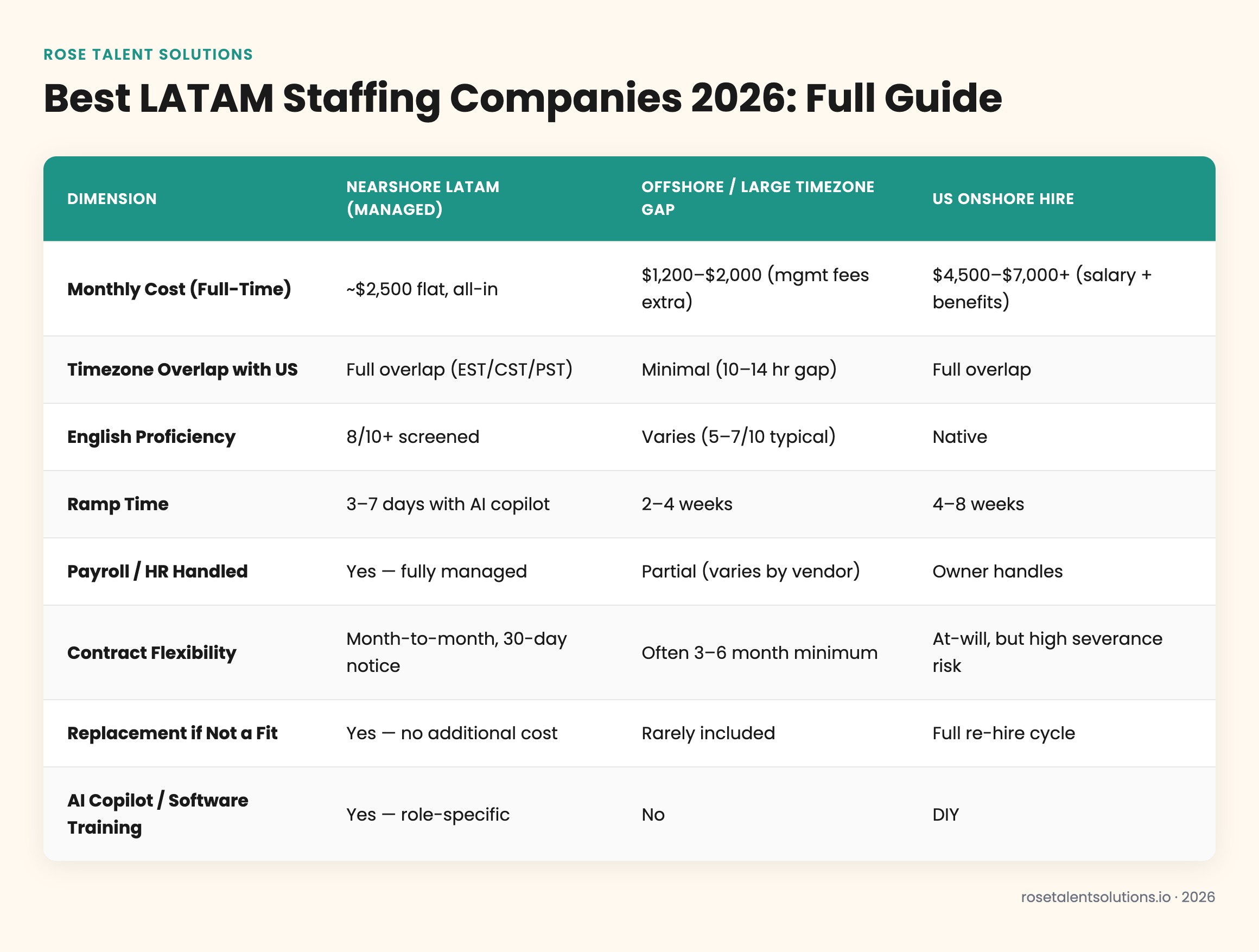
The table below compares the three primary staffing models you'll encounter when searching for LATAM talent: a fully managed nearshore provider like Rose Talent Solutions, a staffing model built around talent working a large timezone gap from the US, and direct domestic hiring. These aren't hypothetical — they represent the real decision most US operators face.
| Dimension | Nearshore LATAM (Managed) | Offshore / Large Timezone Gap | US Onshore Hire |
|---|---|---|---|
| Monthly Cost (Full-Time) | ~$2,500 flat, all-in | $1,200–$2,000 (mgmt fees extra) | $4,500–$7,000+ (salary + benefits) |
| Timezone Overlap with US | Full overlap (EST/CST/PST) | Minimal (10–14 hr gap) | Full overlap |
| English Proficiency | 8/10+ screened | Varies (5–7/10 typical) | Native |
| Ramp Time | 3–7 days with AI copilot | 2–4 weeks | 4–8 weeks |
| Payroll / HR Handled | Yes — fully managed | Partial (varies by vendor) | Owner handles |
| Contract Flexibility | Month-to-month, 30-day notice | Often 3–6 month minimum | At-will, but high severance risk |
| Replacement if Not a Fit | Yes — no additional cost | Rarely included | Full re-hire cycle |
| AI Copilot / Software Training | Yes — role-specific | No | DIY |
How LATAM Staffing Companies Handle Vetting — and Why It Matters for 2026 Hiring
The single most common complaint about staffing arrangements with large timezone gaps is inconsistent candidate quality. You post a role, receive 40 résumés, interview eight candidates, hire one, and discover three weeks in that their English breaks down under pressure and their claimed software experience was largely exaggerated. With a managed nearshore provider, that entire burden shifts to the agency.
At Rose Talent Solutions, every candidate clears a multi-stage screen before you ever see their profile: English proficiency must hit 8/10 or higher on a standardized assessment, software-specific skills are tested against real platform environments (AppFolio, Buildium, QuickBooks, and others), and cultural fit is evaluated for US business norms. This matters because, according to SHRM (2023), the average cost of a bad hire equals 50–200% of that employee's annual salary. For a $55,000/year role, one failed hire can cost you $27,000–$110,000 in lost productivity, re-recruiting, and onboarding time.
Beyond vetting, the best LATAM staffing companies also equip placed staff with role-specific AI copilots trained on the exact software your team uses. A team member placed through Rose's AI Advantage program isn't just placed — they arrive with AI-powered support that surfaces the right workflow steps inside your platform in real time. That cuts ramp time from weeks to days. If you want to explore the full scope of what a managed LATAM agency provides, our post on the Latin America staffing agency model covers the operational structure in detail.
The hidden cost of a bad nearshore hire isn't the monthly fee — it's the 3–6 weeks of lost productivity before you admit the fit is wrong. The free replacement guarantee exists precisely to remove that hesitation: if a team member isn't performing, your provider replaces them at no additional cost so you don't sit on a bad match out of sunk-cost bias.

What Roles Do LATAM Staffing Companies Fill Best in 2026?
The common misconception is that LATAM virtual staff are only suitable for basic admin work. That picture is outdated. The Latin American professional talent pool includes university-educated specialists in accounting, property management operations, marketing, customer success, and financial analysis. The constraint isn't capability — it's finding the right staffing partner who recruits at that level.
The roles where nearshore LATAM staffing consistently delivers the fastest ROI include:
- Property management coordinators — tenant communication, work order dispatch, lease renewals, AppFolio or Buildium data entry. See our property management VA role page for the full scope of tasks.
- Bookkeeping and accounts payable specialists — bank reconciliation, invoice processing, vendor payments, QuickBooks or Xero management. Our bookkeeping and accounting VA page details what a placed specialist handles from day one.
- Executive assistants — calendar management, inbox triage, travel coordination, document preparation.
- Customer support representatives — inbound call handling, live chat, ticket resolution across US business hours.
- Marketing operations coordinators — social scheduling, content uploads, reporting, CRM list management.
The labor economics are compelling across all of these. The US Bureau of Labor Statistics (2024) puts the median annual wage for an administrative assistant at $46,760 — that's roughly $3,900/month before payroll taxes, benefits, PTO, and workspace overhead. A fully managed nearshore equivalent at $2,500/month all-in represents a 36% reduction in direct labor cost, with no employer taxes, no benefits liability, and no long-term contract.
Why LATAM Staffing Works
- Full US timezone overlap — real-time collaboration
- English fluency screened to 8/10+ minimum
- Flat monthly fee covers recruiting, HR, payroll
- Month-to-month terms — 30-day cancellation notice
- AI copilot accelerates ramp to days, not weeks
- Free replacement if the team member isn't a fit
What to Watch For
- Not every LATAM agency vets to a consistent standard — ask for the screening rubric
- Some providers are marketplaces, not managed — confirm who handles payroll and HR
- Roles requiring in-person presence or physical tasks are not a fit
- Specialized technical roles (software engineering, legal) need deeper skills assessments
How to Evaluate and Start With a LATAM Staffing Company in 2026
The evaluation process for a LATAM staffing partner doesn't need to be complicated, but it does need to be deliberate. Providers vary widely on candidate quality, management depth, and contractual flexibility. Here's the sequence that experienced operators use:
Define the Role Scope Before You Call Anyone
Write a one-page role brief: what software your VA will use daily, what metrics define success in 90 days, and what your current team hands off. Providers who ask you to do this first are the ones worth working with — it signals they care about fit, not just fill speed.
Ask Three Vetting Questions
Request the English proficiency cutoff score, the software-specific assessment used for your role, and what happens if the placement doesn't work out. If a provider can't answer all three clearly, move on.
Review the Contract Terms
Confirm month-to-month terms with a 30-day written cancellation notice — no long-term contract commitments. Confirm the all-in pricing covers payroll, HR, and ongoing management with no hidden per-hire fees.
Request Candidate Profiles Within 7 Days
Top LATAM staffing companies maintain active talent pipelines and can present pre-vetted profiles within a week. If a provider needs 3–4 weeks to find candidates, they don't have a real pipeline — they're sourcing from scratch every time.
Start and Measure a 60-Day Ramp Period
Set clear KPIs for the first 60 days. If the placement isn't meeting them, invoke the replacement guarantee early rather than waiting. The best providers expect this conversation and handle it without friction. Ready to begin? Start the placement process here.
The global staffing industry is projected to reach $671 billion by 2027, according to Statista (2024), with nearshore and remote-first models capturing a growing share of that growth. Meanwhile, McKinsey Global Institute (2023) found that 20–25% of workforces in advanced economies could work remotely three to five days a week without productivity loss — a stat that directly validates the nearshore staffing model at scale. For a detailed look at how staffing models stack up against each other from a pure operational standpoint, our guide on onshore vs. offshore virtual assistants offers a practical breakdown.
"Latin America is producing an extraordinary generation of bilingual, tech-literate professionals who are operationally ready for US business environments right now — not in five years." — Guillermo Bracciaforte, Co-founder at Workana (Latin America's largest freelance platform) (2023)
The bottom line: 2026 is not the year to keep evaluating LATAM staffing from a distance. The model is proven, the talent pool is deep, and the best providers have de-risked the entry point to 30-day terms and a free replacement guarantee. The only real question is whether the role you're drowning in today is one a skilled nearshore professional could own by next week.