
Nearshore Amazon virtual assistants have become one of the fastest-growing hiring decisions for US-based ecommerce sellers — and understanding how much an Amazon virtual assistant costs is the first step to making a smart one. Before you post a job on Upwork or sign up with an overseas staffing agency, you need a clear picture of what Amazon VA talent actually costs in 2026, what drives those costs up or down, and which model gives you the most leverage per dollar spent. This guide breaks all of it down, without the fluff.
What Is an Amazon Virtual Assistant?
An Amazon virtual assistant is a remote team member dedicated to managing the operational and growth tasks inside your Amazon seller account. That covers a wide range: listing creation and optimization, PPC campaign management, inventory forecasting, supplier communication, customer service, and return processing. A single experienced Amazon VA can own one of these verticals deeply or cover several at a lighter level, depending on your business size and how you structure the role.
The term "virtual assistant" is broad, and Amazon-specific VAs are a distinct skill set. Someone trained in Amazon Seller Central operations understands the nuances of suppressed listings, A+ Content, Buy Box dynamics, and FBA reimbursement claims — tasks that a general VA simply isn't equipped to handle without months of on-the-job learning.
That bottleneck is exactly what a well-placed Amazon VA is designed to break. The question is: how much does an Amazon virtual assistant cost, and what does each pricing model actually include?
How Much Does an Amazon Virtual Assistant Cost in 2026? Pricing Models Compared
There are three main ways to hire an Amazon VA in 2026, and they are not equivalent. Each has a different cost structure, risk profile, and management burden. Understanding the real all-in cost — not just the headline rate — is what separates sellers who scale cleanly from those who churn through hires.

| Hiring Model | Typical Monthly Cost | Hours Included | Timezone Overlap (US) | English Proficiency | Management Overhead | Replacement if Not a Fit |
|---|---|---|---|---|---|---|
| Offshore Freelancer (outside US/Canada) | $800–$2,400 | Variable (you track) | Low (6–12 hr gap) | Inconsistent | High (you recruit, vet, manage) | No — re-hire from scratch |
| Nearshore Freelancer (Latin America, self-hired) | $2,880–$4,480 | Variable (you track) | High (same time zone) | Strong | High (you recruit, vet, manage) | No — re-hire from scratch |
| Rose Managed Nearshore VA | $2,500 flat | 40 hrs/week dedicated | High (US business hours) | 8/10+ screened | Low (Rose handles HR, payroll, management) | Yes — free replacement if not a fit |
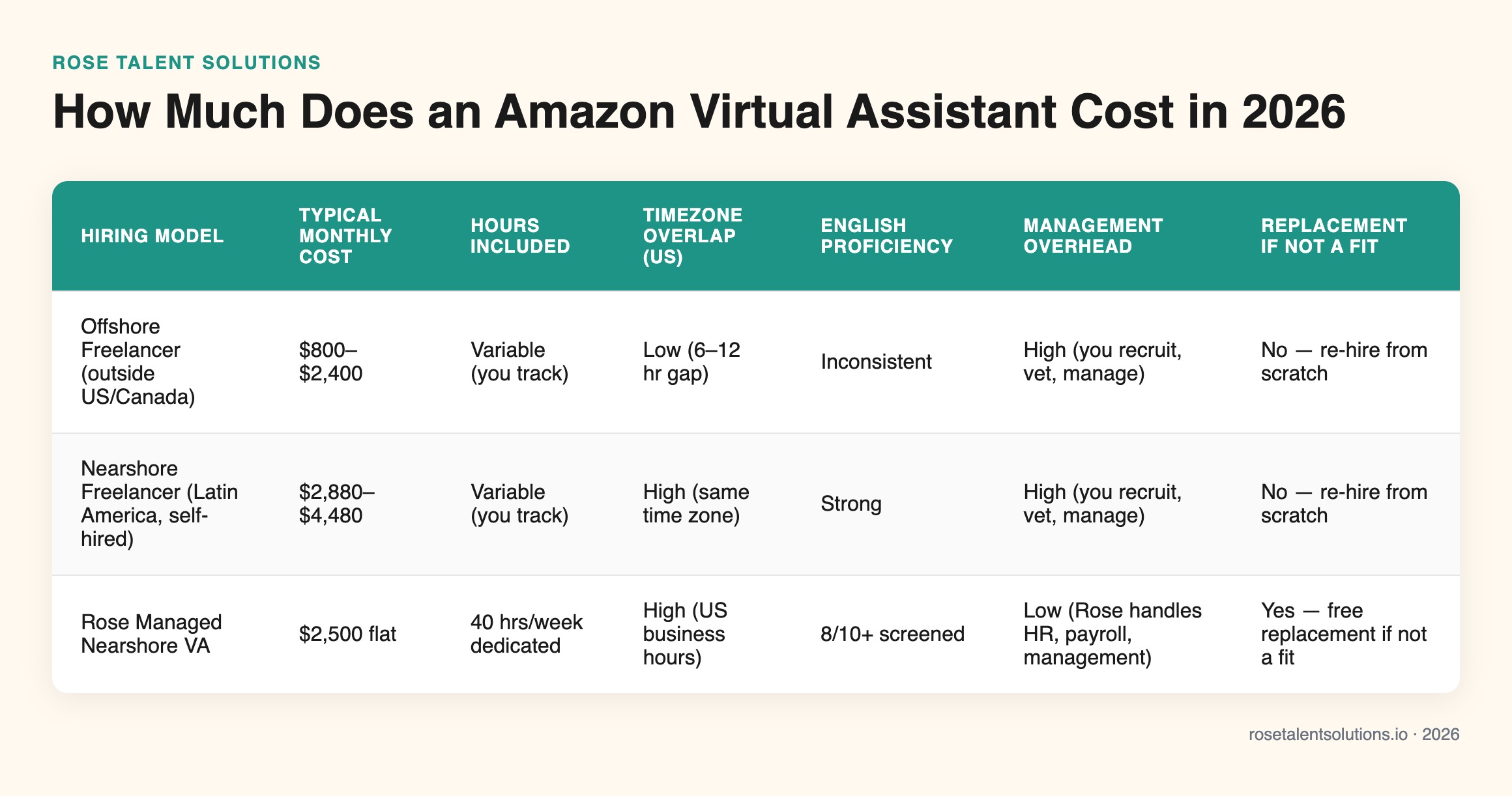
The offshore freelancer looks cheapest on paper. At $5–$10/hr for 40 hours a week, you're spending roughly $800–$1,600/month in wages. But that number excludes the 10–20 hours you'll spend recruiting, the platform fees (Upwork charges up to 20% on top), the time lost to timezone delays, and the cost of re-hiring when that person disappears or underperforms — which, according to SHRM's turnover cost research, can run 50–200% of the role's annual compensation once you factor in lost productivity.
What Drives Amazon Virtual Assistant Costs Up in 2026 (and What Sellers Miss)
Most sellers focus on the wage cost and ignore four cost multipliers that consistently blow up their VA budgets. Understanding these is critical before you choose a model.
Timezone gap. A VA operating 8–12 hours out of sync with US Eastern time creates an overnight queue on every task you send after noon. For time-sensitive issues — a suppressed listing, a hijacked Buy Box, a customer escalation — that delay has a direct revenue cost. Nearshore VAs in Latin America work your actual business hours, which means real-time collaboration, same-day task completion, and no batched overnight queue.
Specialization premium. A VA who can run PPC campaigns in Amazon Ads and interpret ACoS trends costs more than one who can only do data entry. For deep-dive tasks like Amazon product research — competitive analysis, keyword gap work, supplier vetting — you need someone with genuine platform fluency, not just task-following ability. That skill level commands a higher rate whether you're hiring freelance or through an agency.
Recruiting and vetting time. Screening 20 applicants to find one qualified Amazon VA takes 8–15 hours of your time conservatively. At $100/hr of your own effective hourly rate, that's $800–$1,500 in opportunity cost before you've made a single hire. Managed staffing agencies absorb this cost into their flat fee.
Turnover. Freelance platforms see significant annual churn. According to the U.S. Bureau of Labor Statistics JOLTS data, voluntary quit rates in service-adjacent roles have remained elevated post-2022. When a freelance Amazon VA leaves mid-quarter, you restart the entire recruiting cycle while your account sits partially unmanaged.
The hidden cost of a cheap Amazon virtual assistant isn't the $8/hr rate — it's the 6–12 hour timezone gap that turns every urgent account issue into a next-day problem, plus the recruiting and turnover cycle that burns 10–20 hours of your time every time someone leaves.
How Rose's 2026 Flat Rate Compares to Hourly Amazon VA Pricing
At $2,500/month for a full-time (40 hr/week) dedicated Amazon VA, Rose Talent Solutions prices out to roughly $15.63/hr all-in. That rate includes recruiting, vetting (with English proficiency screening at 8/10+ minimum), payroll, HR compliance, and ongoing performance management. Compare that to the true all-in cost of a self-managed freelancer — wages, platform fees, your recruiting time, and turnover risk — and the flat-rate model typically wins by the third month.
The terms are month-to-month with 30 days written notice — no long-term contract. And if the team member isn't the right fit for your Amazon operation, Rose replaces them at no additional cost. That's the entire risk reversal: one flat rate, one replacement guarantee, no re-recruiting cycle on your end.
Every Rose VA also ships with a role-specific AI copilot trained on the tools your Amazon business actually uses — whether that's Helium 10, Jungle Scout, Amazon Ads, or multi-channel platforms. This means your VA isn't learning your software from scratch on day one. You can read more about how this works on the AI advantage page.
If you're running other ecommerce channels alongside Amazon, it's worth knowing that Shopify virtual assistant pricing follows a similar flat-rate model — and the same all-in cost logic applies. Multi-channel sellers often place one VA per platform to keep responsibilities clean and accountability clear.

How to Evaluate Whether an Amazon VA Is Worth the Cost
The ROI question isn't "can I afford an Amazon virtual assistant?" — it's "what is an hour of my time worth, and how many of those hours am I currently spending on tasks a trained VA could own?" For most Amazon sellers doing $500K–$5M in annual revenue, the answer is 15–30 hours per week of directly delegatable tasks: listing management, customer service tickets, PPC reporting, FBA shipment creation, and review monitoring.
"Sellers who delegate operational tasks to trained VAs consistently report reclaiming 15+ hours per week within the first month — time that goes directly into sourcing and scaling." — Jon Tilley, Founder & CEO at ZonGuru (2023)
The Amazon customer service VA role alone often pays for itself: faster response times protect your seller metrics (Order Defect Rate, Late Response Rate), which directly affect Buy Box eligibility and, by extension, revenue. According to Statista's Amazon marketplace data, third-party sellers now account for over 60% of Amazon's gross merchandise sales — meaning competition for Buy Box position is fiercer than ever, and seller metrics are the deciding factor.
According to McKinsey's Future of Work research, roles requiring real-time collaboration and judgment — as opposed to pure task execution — are the fastest-growing segment of remote work demand. Amazon account management, with its constant platform changes and reactive decision-making, sits squarely in that category. That's why timezone alignment isn't a nice-to-have; it's a core productivity variable.
If you're ready to price out your first or next hire, the Rose intake process takes about 10 minutes and gives you a clear picture of which role would move the needle fastest for your Amazon operation.
How Nearshore Amazon VAs Outperform Offshore in 2026
The nearshore vs. offshore debate for Amazon VAs comes down to one practical question: how much does timezone misalignment cost your business? For sellers managing time-sensitive account health issues, running live PPC campaigns, or handling customer escalations, an overnight lag is a genuine revenue risk — not just a minor inconvenience.
Nearshore Amazon VAs (Latin America)
- Work US business hours — real-time collaboration
- Strong English proficiency (Rose screens 8/10+ minimum)
- Cultural alignment with US business communication norms
- Same-day task completion on urgent account issues
- Lower timezone-driven error rate on PPC and inventory decisions
Offshore Amazon VAs (outside Americas)
- 6–12 hour timezone gap creates overnight queues
- English proficiency varies widely without formal screening
- High platform churn — replacement cycle restarts from zero
- Lower nominal hourly rate, but higher true all-in cost
- Cultural misalignment can affect customer service tone and buyer messaging
For Amazon sellers specifically, the customer service component is where nearshore talent shows the clearest advantage. Amazon customer service VAs need to communicate in natural, idiomatic English — both in buyer messages and in Seller Support cases. A VA who answers tickets 10 hours after they arrive, in slightly stilted English, is a measurable drag on your seller metrics and your buyer satisfaction scores. Nearshore removes both friction points simultaneously.
Define the Role
Identify which 15–20 hours of weekly Amazon tasks you want off your plate first — listing management, PPC, customer service, or inventory ops. Specificity here determines VA fit and ramp speed.
Rose Matches and Vets
Rose sources candidates from its Latin America network, screens for English proficiency (8/10+ minimum), Amazon platform knowledge, and role-specific tool fluency before presenting finalists.
You Approve the Hire
You interview and approve your preferred candidate. Rose handles the offer, onboarding paperwork, payroll setup, and HR compliance — you get a start date, not a stack of admin work.
VA Starts with AI Copilot Active
Your new Amazon VA arrives with a role-specific AI copilot trained on your tools, so day-one productivity is measurably higher than a raw hire learning software from scratch.
Ongoing Management by Rose
Rose handles performance check-ins, HR issues, and — if the match isn't right — a free replacement at no additional cost. Month-to-month terms, 30 days written notice to exit, no long-term contract.
For sellers evaluating broader ecommerce staffing needs across platforms, the Rose intake process can scope a single VA role or a multi-person team build — depending on where your operational gaps are largest.