
Nearshore virtual assistants — based in Latin America, working US business hours — are quietly replacing both distant offshore contractors and expensive in-house hires for Amazon seller support. When a buyer opens an A-to-Z claim or leaves a one-star review, you have hours, not days, to respond before Amazon's algorithm registers the silence. A Latin America-based VA working your business hours answers that message in real time. A VA based twelve time zones away does it tomorrow morning, when the damage is already done.
This guide breaks down exactly what an Amazon customer service virtual assistant does, how to evaluate your options in 2026, and what the real all-in cost looks like when you stop adding up hourly rates and start thinking in outcomes.
What Does an Amazon Customer Service Virtual Assistant Actually Do in 2026?
An Amazon customer service virtual assistant is a remote team member — typically full-time and dedicated to your seller account — who manages every buyer-facing communication and post-purchase workflow inside Amazon Seller Central. This is not a chatbot or a shared-queue agent. It is a person who learns your catalog, your return policy, and your brand voice, then represents you directly to buyers.
Day-to-day tasks typically include:
- Responding to buyer messages within Amazon's 24-hour response window (most VA-managed accounts target under 4 hours)
- Filing and defending A-to-Z Guarantee claims with evidence packages
- Processing return requests, issuing replacements, and coordinating with 3PLs on restocking
- Submitting feedback removal requests for reviews that violate Amazon's guidelines
- Monitoring account health dashboards and flagging Order Defect Rate (ODR) spikes to you immediately
- Handling SAFE-T claim reimbursements for Seller Fulfilled Prime orders
- Writing case escalations to Amazon Seller Support when automated systems fail
According to Statista (2024), third-party sellers now account for more than 60% of all Amazon unit sales. The sheer volume of buyer interactions that creates — across returns, questions, and complaints — is why dedicated customer service VAs have become standard infrastructure for serious sellers, not a luxury.

How Nearshore Compares to Offshore and Onshore for Amazon Support in 2026
The VA market breaks into three tiers: onshore (US/Canada/UK based), offshore (distant time zones such as Southeast Asia or South Asia), and nearshore (Latin America). Each has a different cost-to-value profile for Amazon sellers specifically. The comparison below maps the variables that matter most for Seller Central work — not generic VA tasks, but specifically the latency-sensitive, English-fluent, timezone-aligned work that Amazon support demands.
| Factor | Nearshore (Latin America) | Offshore (Distant Time Zones) | Onshore (US / Canada) |
|---|---|---|---|
| Time Zone Alignment | Full overlap with US Eastern / Central / Pacific hours | 6–13 hour gap; async by default | Perfect overlap |
| Typical Monthly Cost (Full-Time) | ~$2,500 flat (all-in with management) | $800–$1,400 (agency rate, no HR/mgmt) | $4,500–$7,000+ |
| English Proficiency | 8/10+ fluency floor (screened) | Varies; 6–8/10 typical | Native |
| Amazon Seller Central Experience | High — growing Latin American talent pool with SC background | Available but async delivery limits effectiveness | Limited supply; high churn |
| Response Latency for Buyer Messages | Real-time during US hours | Batched overnight; next-day AM | Real-time |
| HR, Payroll, Compliance Included? | Yes (with Rose Talent Solutions) | Rarely; usually DIY | No (you handle employer taxes) |
| Replacement if Not a Fit? | Yes — free replacement | Varies by platform; usually fees apply | Full rehire cost |
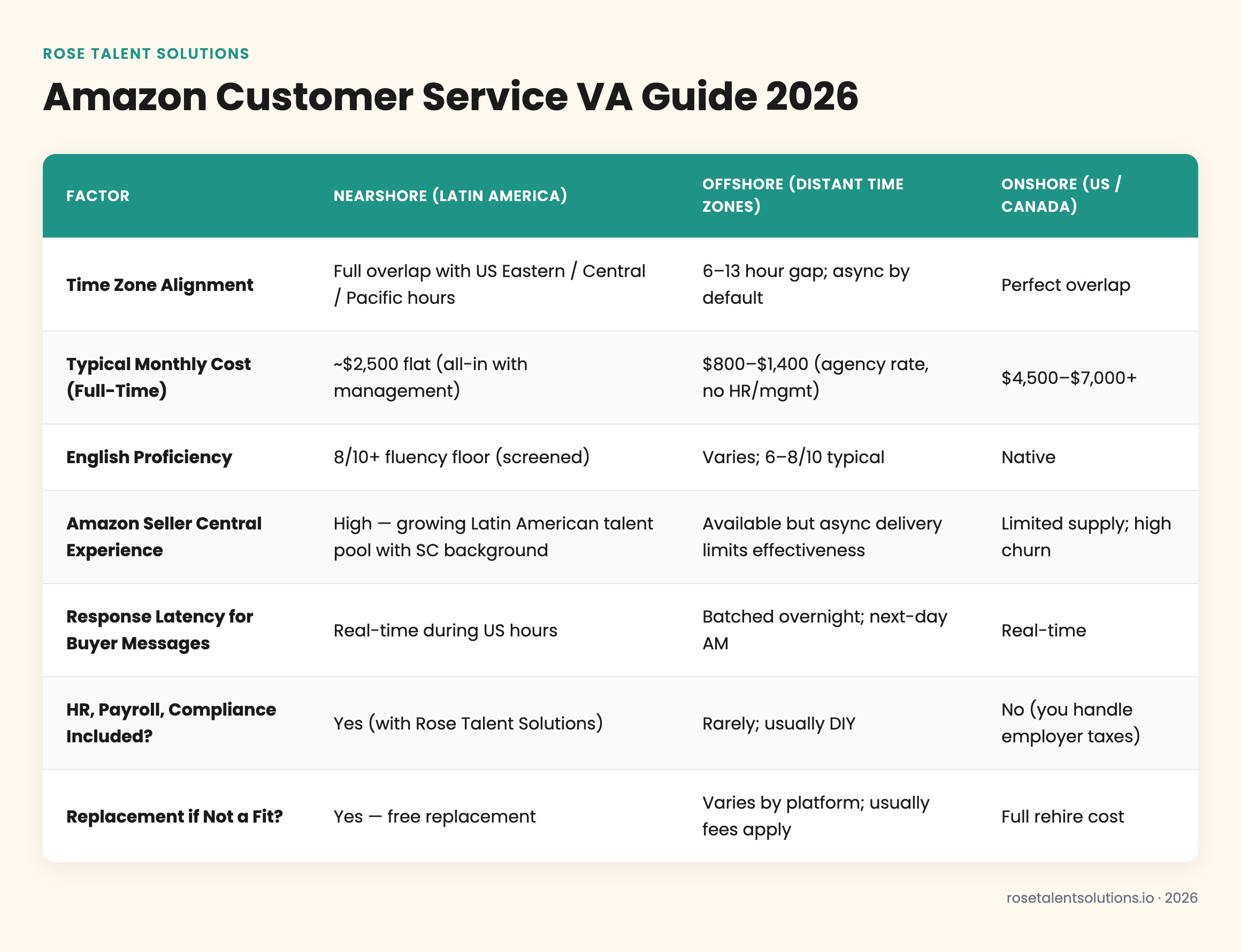
The offshore cost advantage looks attractive on a spreadsheet until you price in the hidden costs: an ODR above 1% triggers suspension review, and a single suspension can cost a mid-size seller tens of thousands in frozen inventory and lost revenue. Real-time response is not a perk — it is risk management.
How Amazon's A-to-Z Guarantee and ODR Rules Make 2026 Seller Support Non-Negotiable
Amazon's Order Defect Rate is calculated across three components: negative feedback rate, A-to-Z Guarantee claim rate, and credit card chargeback rate. Amazon publishes a threshold of 1% — sellers above it face account suspension. According to Amazon Seller Central's own documentation, a single unaddressed A-to-Z claim that resolves in the buyer's favor counts against your ODR for 60 days.
A trained customer service VA does three things that directly protect your ODR. First, they respond to buyer messages fast enough that frustrated buyers cancel the A-to-Z claim before it is filed. Second, when claims are filed, they submit a documented evidence package — tracking proof, communication screenshots, policy citations — that dramatically improves your win rate. Third, they proactively identify orders with delivery exceptions and reach out to buyers before the buyer contacts Amazon at all.
"Proactive outreach is the single highest-leverage customer service tactic for Amazon sellers. If you contact a buyer before they contact you about a problem, they almost never escalate to a claim." — Cynthia Stine, Founder at eGrowth Partners, Amazon Reinstatement Specialist (2022)
According to the U.S. Bureau of Labor Statistics (2024), the median annual wage for customer service representatives in the United States is $37,780 — roughly $3,150/month before benefits, payroll taxes, and recruiting costs. A nearshore VA through Rose Talent Solutions delivers comparable or superior Seller Central expertise at $2,500/month flat, with recruiting, HR, and ongoing management already included.
Amazon's ODR clock does not stop for time zone gaps. When a buyer opens a claim at 9am Eastern and your offshore VA is asleep on the other side of the world, you have already lost 12+ hours of the response window Amazon uses to evaluate your account health. Nearshore VAs in Latin America close that gap entirely — they are online when your buyers are online.
What Sets a Rose Talent Solutions Amazon VA Apart: AI Copilots Built for Seller Central
Every team member placed by Rose Talent Solutions ships with a role-specific AI copilot trained on the tools they use daily. For an Amazon customer service VA, that means the AI is pre-loaded with Seller Central workflows: how to draft A-to-Z response packages, how to escalate cases to Amazon Seller Support using the correct contact paths, how to write feedback removal requests that meet Amazon's content policy criteria, and how to read account health dashboards for early suspension signals.
This is not a generic ChatGPT wrapper. The AI copilot reduces the ramp time for a new VA from weeks to days, and it means your VA is producing compliant, on-brand buyer responses from day one — not month three.

According to McKinsey & Company's report on Generative AI (2023), generative AI tools can automate or augment up to 70% of customer service tasks — but only when the AI is domain-specific. Generic AI produces generic outputs. Domain-trained AI produces outputs your buyers and Amazon's review systems actually accept.
How the Rose Talent Solutions Hiring Process Works for Amazon VAs in 2026
Getting an Amazon customer service VA placed through Rose is a structured five-step process, not an open marketplace browse. You are not sifting through 400 profiles — you tell Rose what you need and they deliver a matched, vetted candidate, sourced exclusively from Latin America to ensure US-hours alignment from day one.
Discovery Call
Rose's team maps your Amazon operations — catalog size, monthly order volume, Seller Central access level, and the specific metrics you need to protect. This call determines exactly what skills the VA needs before any recruiting begins.
Recruiting & Vetting
Rose screens candidates from its Latin American talent network against your role profile, tests English proficiency to the 8/10+ floor, and verifies Seller Central experience with practical assessments — not just résumé review.
Candidate Presentation
You receive a shortlist of matched candidates with profiles and interview recordings. You interview, you choose — Rose does not place anyone without your approval.
Onboarding & AI Copilot Setup
Your VA's role-specific AI copilot is configured for your catalog and workflows before their first day. Rose handles payroll, HR compliance, and the employment relationship in-country across Latin America.
Ongoing Management & Replacement Guarantee
Rose stays in the loop throughout the engagement. If the VA is not the right fit at any point, Rose replaces them at no additional cost — no rehire fees, no delays.
The entire engagement runs month-to-month. There is no long-term contract. You can cancel with 30 days written notice. The flat rate is $2,500/month and covers recruiting, vetting, payroll, HR, and ongoing management — everything except your Seller Central login credentials.
If you are ready to get a VA into your account, the fastest path is the intake form at Rose's start page — most sellers have a candidate presented within a week of the discovery call.
Nearshore vs. Offshore Amazon VAs: The Real Tradeoffs in 2026
The offshore VA pitch is simple: lower sticker price. The nearshore pitch is more nuanced: better outcomes for time-zone-sensitive work, at a cost difference that shrinks once you add management overhead, compliance risk, and the cost of account health incidents caused by delayed responses.
Nearshore VA (Latin America) — Strengths
- Works your US business hours in real time — no overnight batching of buyer messages
- English fluency screened to 8/10+ floor, reducing buyer friction and Amazon's communication quality flags
- HR, payroll, and compliance handled for you — no employer-of-record setup required
- Free replacement if the VA is not a fit — zero additional recruiting cost
- AI copilot pre-trained on Seller Central workflows included at no extra charge
Offshore VA (Distant Time Zones) — Tradeoffs
- 6–13 hour time zone gap means buyer messages batch to next morning by default
- Lower sticker rate but no included HR, payroll, or management — you absorb that overhead
- English proficiency varies significantly; no standardized fluency floor on most platforms
- Replacement fees or re-sourcing delays common when fit is wrong
- Generic AI tools (if any) — not pre-trained on your specific Seller Central workflows
According to SHRM's remote workforce management research, the average cost of replacing a remote employee — including recruiting, onboarding, and productivity loss — ranges from 50% to 200% of their annual compensation. A VA that does not work out is not a cheap problem to fix. The free replacement guarantee that comes with a Rose placement is real financial protection, not a marketing line.
For sellers managing bookkeeping and accounting alongside their operations, Rose also places nearshore accounting VAs familiar with Amazon payout reconciliation, COGS tracking, and sales tax compliance — the same AI-advantage model applied to your financial workflows. And if your business extends beyond ecommerce into property or service operations, Rose's property management VA practice follows the identical nearshore, Latin America-sourced staffing model.