
Nearshore Shopify virtual assistants have become one of the fastest-growing hiring decisions in ecommerce — and for good reason. If you've been asking yourself how much does a Shopify virtual assistant cost, the answer depends almost entirely on where you hire from and what's actually included in that rate. US-based Shopify store owners are drowning in operational work: order management, customer service tickets, product listing updates, inventory syncs, and returns processing. Hiring someone locally costs $50,000–$65,000 a year in salary alone. So the real question isn't whether to hire a VA — it's how much you should actually be paying, and what you get for that money depending on your hiring model.
This guide breaks down every major pricing model for Shopify VAs in 2026, what's typically included (and what's quietly not), and how to calculate whether the Shopify virtual assistant cost makes sense for your store's current revenue and operational load.
How Shopify Virtual Assistant Pricing Actually Breaks Down in 2026
There are four distinct hiring models for Shopify virtual assistants, and each one has a very different real cost once you factor in hidden fees, ramp time, and management overhead. Understanding how much a Shopify virtual assistant costs across each model is the only way to make a genuinely informed decision — the hourly rate you see advertised on a freelance platform almost never reflects what you actually spend.
Freelance marketplace VAs (Upwork, Fiverr, OnlineJobs.ph) typically run $8–$18/hour for offshore talent and $20–$35/hour for more experienced workers. At 40 hours/week, that's $1,280–$2,880/month before you account for platform fees (Upwork charges clients up to 5% on top), payroll compliance, time-tracking overhead, and the hours you'll spend sourcing and interviewing candidates. According to SHRM (2023), the average cost to replace a failed hire is 50–200% of that role's annual salary — a risk that's very real with unvetted freelancers.
Offshore agency models (based outside the Americas) typically price between $1,200 and $2,200/month for a full-time Shopify VA. The headline rate looks attractive, but timezone gaps of 10–14 hours mean your VA is largely asleep during your peak customer service window. For a Shopify store doing meaningful volume, delayed ticket responses directly hurt your review scores and repeat purchase rate.
Nearshore agency models (Latin America-based, US business hours) run $2,200–$3,500/month through most providers. The premium over offshore exists because the talent works your hours, speaks fluent English, and requires far less asynchronous back-and-forth to get things done.
In-house US hire at a comparable skill level runs $40,000–$55,000/year in base salary, plus benefits, payroll taxes, and recruiting costs — call it $55,000–$70,000 all-in, or roughly $4,600–$5,800/month.

2026 Shopify Virtual Assistant Cost Comparison: Which Hiring Model Wins?
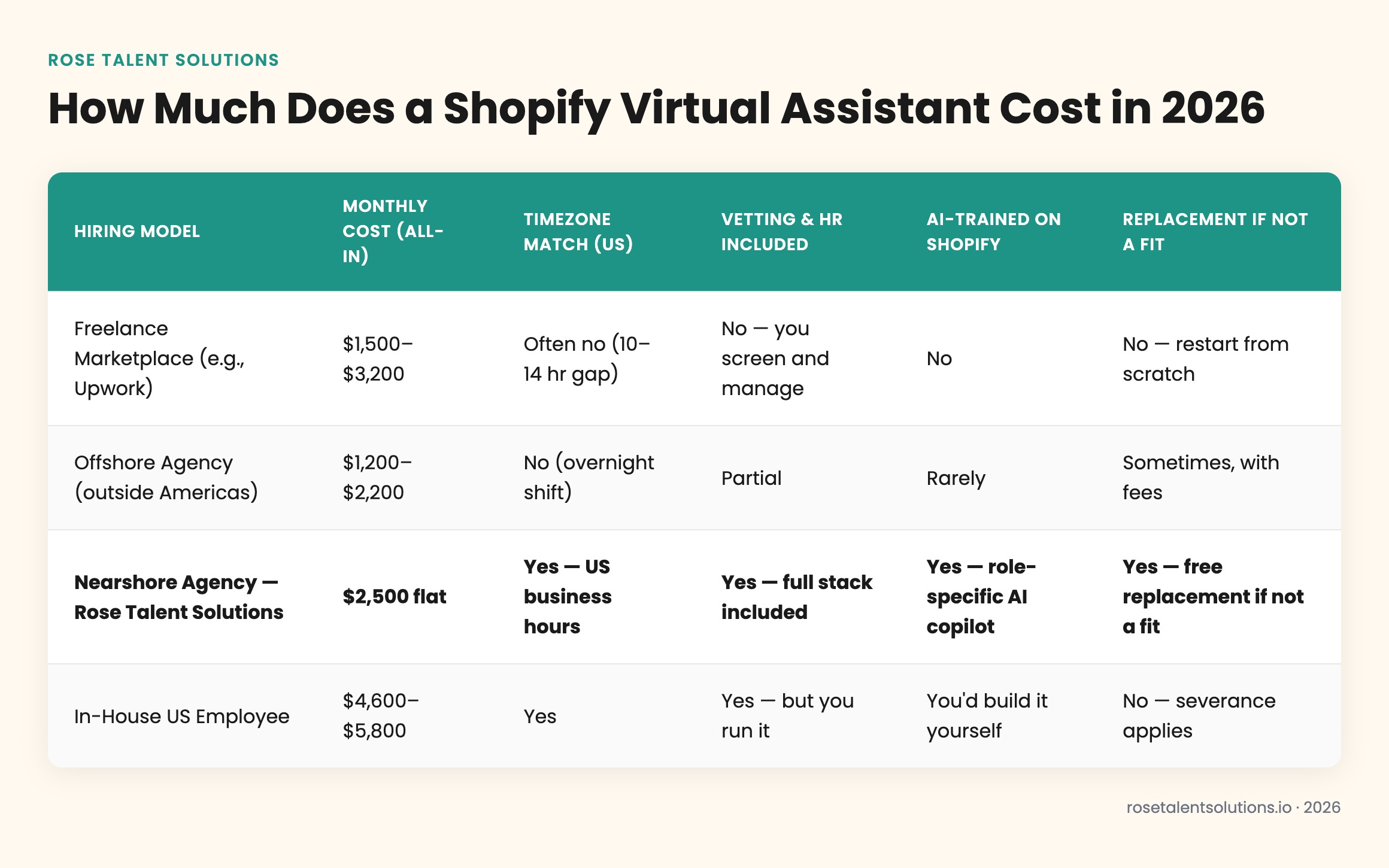
The table below compares four real hiring scenarios side by side. The numbers use conservative assumptions: 40 hours/week, a mid-tier Shopify store ($500K–$2M annual GMV), and standard US Eastern timezone operating hours. Use this to answer the core question — how much does a Shopify virtual assistant cost relative to what you actually receive — across every model at once.
| Hiring Model | Monthly Cost (All-In) | Timezone Match (US) | Vetting & HR Included | AI-Trained on Shopify | Replacement if Not a Fit |
|---|---|---|---|---|---|
| Freelance Marketplace (e.g., Upwork) | $1,500–$3,200 | Often no (10–14 hr gap) | No — you screen and manage | No | No — restart from scratch |
| Offshore Agency (outside Americas) | $1,200–$2,200 | No (overnight shift) | Partial | Rarely | Sometimes, with fees |
| Nearshore Agency — Rose Talent Solutions | $2,500 flat | Yes — US business hours | Yes — full stack included | Yes — role-specific AI copilot | Yes — free replacement if not a fit |
| In-House US Employee | $4,600–$5,800 | Yes | Yes — but you run it | You'd build it yourself | No — severance applies |
What Does a Shopify VA Actually Do — and Does the Task Mix Affect Cost?
The scope of work matters a lot when evaluating Shopify virtual assistant cost, because not all Shopify VA services are priced equally. A VA handling only order fulfillment and customer service tickets is a different hire than one managing your entire product catalog, running email flows in Klaviyo, and coordinating with your 3PL. Understanding the task mix helps you evaluate whether a given rate is reasonable.
Common Shopify VA responsibilities include: processing and tracking orders, responding to customer service tickets (email, chat, social DMs), updating product listings and descriptions, managing inventory levels and flagging low-stock SKUs, processing returns and refunds, uploading and scheduling promotional content, and coordinating with suppliers or fulfillment centers. More experienced VAs also handle basic Shopify app management, Google Merchant Center feed updates, and reporting in tools like Triple Whale or Northbeam.
According to Statista (2024), global ecommerce now accounts for over 20% of all retail sales — which means the operational complexity of running a Shopify store at scale has grown substantially. More SKUs, more channels, more return volume. A VA who can handle that complexity without constant supervision is worth paying for.
For operators who also sell on Amazon alongside their Shopify store, the skill set overlaps significantly. If you're evaluating VAs for multi-channel work, it's worth reading about what a dedicated Amazon Seller Central virtual assistant handles — the task split between platforms often surprises store owners who assumed one VA could cover both channels at the same depth.
The hidden cost of a cheap Shopify VA isn't their hourly rate — it's the 4–6 hours per week you spend re-doing their work, answering their clarifying questions asynchronously, and managing customer complaints they should have caught. A well-vetted, software-trained VA at $2,500/month often costs less in total time than a $10/hour freelancer you're babysitting.
How Rose Talent's $2,500 Flat Rate Compares to Building Your Own VA Roster
Rose Talent Solutions charges $2,500/month flat for a full-time, dedicated nearshore Shopify VA. That rate includes everything: sourcing, skills vetting (including Shopify platform proficiency), English proficiency screening at 8/10 or higher, payroll administration, HR compliance, and ongoing management support. There is no long-term contract — terms are month-to-month with 30 days written notice to cancel. If the team member isn't the right fit, Rose replaces them at no additional cost.
Every Rose Shopify VA also ships with a role-specific AI copilot trained on the tools they'll use — Shopify admin, Gorgias or Zendesk for customer service, Klaviyo for email, and whatever 3PL portal your operation runs. This matters because, according to McKinsey (2023), AI-augmented workers complete repetitive operational tasks up to 40% faster than non-augmented counterparts. You're not just paying for a person — you're paying for a person plus the tooling that makes them run faster from day one.
Explore how Rose structures ecommerce VA placements on the get started page, or see the full AI advantage breakdown at Rose's AI Advantage overview.
"Businesses that delegate operational work to trained, English-fluent assistants in compatible time zones report measurable gains in owner productive hours within the first 30 days — the timezone variable is consistently underweighted in VA hiring decisions." — Matthew Mottola, Future of Work Author & Workforce Strategist, The Human Cloud (2022)
How to Know When Your Shopify Store Is Ready for a VA in 2026
There's a practical revenue and volume threshold where the Shopify virtual assistant cost stops being an expense and starts being a multiplier. Most ecommerce operators hit that threshold earlier than they expect — usually around $20,000–$30,000/month in GMV, when order volume, customer service tickets, and listing management collectively consume 15+ hours of the founder's week.
At $2,500/month, a full-time Shopify VA costs roughly $30,000/year. If your store is generating $400,000+ annually and you're personally handling operational tasks, the math almost always favors delegation. The founder hours you recover can go toward paid acquisition, new product development, or wholesale channel expansion — activities with 5–10× the ROI of processing refund requests.
Ecommerce operators who also run product research workflows should look closely at how a product research virtual assistant can extend that same delegation model to catalog expansion — particularly if you're testing new SKUs across both Shopify and Amazon simultaneously. Similarly, if your Shopify store handles high ticket volumes with Amazon integration, understanding the role of an Amazon customer service VA can help you decide whether to hire one cross-trained VA or two specialized ones.
According to the U.S. Bureau of Labor Statistics (2024), administrative support and operations roles in ecommerce continue to grow faster than the broader labor market — which means the cost of hiring domestically for these roles will only increase. Locking in a nearshore VA at a flat monthly rate now hedges against that inflation.
Submit Your Role Brief
Tell Rose what your Shopify store needs — order volume, platforms used, hours required, and any specific software (Klaviyo, Gorgias, ReCharge, etc.). Takes about 10 minutes.
Receive Matched Candidates
Rose's recruiting team surfaces 2–3 vetted candidates with Shopify experience, English proficiency scores, and AI copilot readiness. Most clients see candidates within 5–7 business days.
Interview and Select
You interview your shortlist and choose the right fit. Rose handles offer, onboarding paperwork, and payroll setup — you don't touch any of it.
Your VA Goes Live
Your dedicated Shopify VA starts on your schedule, with their AI copilot already configured for your tech stack. Rose stays in the loop on performance and handles any HR issues that arise.
Nearshore vs. Offshore Shopify VA Cost in 2026: The Real Trade-Offs
The offshore-vs-nearshore decision comes down to three variables: timezone, English fluency, and cultural alignment with your customer base. For a Shopify store primarily selling to US or Canadian consumers, all three variables favor nearshore Latin America — even at a slightly higher monthly Shopify virtual assistant cost. The key question isn't which option is cheaper on paper; it's which one actually costs less once you account for management overhead and missed customer service windows.
A VA in Bogotá, Mexico City, or Buenos Aires works EST, CST, or MST natively. They're online when your customers are shopping, when your suppliers are calling, and when your team is in Slack. According to Gallup (2023), team members who operate in aligned time zones report significantly higher engagement and collaboration scores than those working asynchronously across large time gaps — and that engagement directly translates into responsiveness quality.
For stores that also run Amazon listing optimization alongside Shopify, the ability to brief your VA in real time — rather than leaving a Loom at midnight and hoping they catch it by your afternoon — compresses the feedback loop dramatically. That speed compounds over weeks and months into meaningfully better execution.
Nearshore VA (Latin America)
- Works US business hours natively — no overnight shift
- English fluency at 8/10+ (Rose's verified floor)
- Cultural familiarity with US consumer expectations
- Real-time Slack/Zoom availability during your workday
- Lower management overhead — fewer clarifying question cycles
Offshore VA (outside Americas)
- 10–14 hour timezone gap with US East Coast
- Variable English fluency — depends heavily on individual vetting
- Asynchronous communication adds 24-hour lag to most feedback loops
- Cheaper headline rate — but hidden management cost closes the gap
- Cultural context gaps can affect customer-facing communication tone
Rose Talent's placement process is built specifically for the nearshore model — every candidate is sourced from Latin America, screened for US-hours availability, and tested on the exact software stack your Shopify store uses before they ever reach your interview round.