
Nearshore virtual executive assistants have quietly become one of the smartest hires a US or Canadian business owner can make in 2026 — but understanding how much a virtual executive assistant costs requires comparing four very different hiring models. Price tags range from $8/hour to $85/hour depending on geography, management structure, and what's actually included. This guide breaks down every model so you know exactly what you're paying for, what drives the differences, and which option delivers the most value per dollar for founders, operators, and executives who need real leverage.
A quick note on scope: a virtual executive assistant means a dedicated remote professional handling calendars, travel, inbox management, board prep, vendor coordination, research, and executive-level communication — not a part-time task-rabbit. The difference matters when you're evaluating cost because a true VEA saves you 10–15 hours per week of high-cognitive work. Remote work flexibility and delegation are increasingly central to how high-performing executives structure their weeks, according to Pew Research Center (2023) survey data on workplace productivity and flexibility preferences.
How Virtual Executive Assistant Pricing Is Structured in 2026
There are four primary ways to hire a virtual executive assistant, and each has a radically different cost structure. Understanding the model before you compare price tags is essential — otherwise you're comparing apples to aircraft carriers.
Hourly freelancers are the most common starting point for founders asking how much does a virtual executive assistant cost. Platforms like Upwork quote $15–$75/hour depending on geography and skill level, but the real cost includes your time sourcing, vetting, onboarding, and re-hiring when someone disappears. According to SHRM (2024), the average cost of replacing an employee or contractor is 50–60% of their annual salary — a number that compounds fast if you're churning through freelancers.
US-based staffing agencies place W-2 or 1099 executive assistants at $45–$85/hour, sometimes with a placement fee of 15–25% of first-year salary layered on top. For a full-time hire at $55/hour, that's roughly $114,000/year before benefits. The fully-loaded cost of a US-based EA — including payroll taxes, benefits, office overhead, and recruiting — routinely exceeds $130,000 annually, according to the U.S. Bureau of Labor Statistics (2024) occupational outlook data for executive secretaries and administrative assistants.
Offshore VAs from Southeast Asia or South Asia are often advertised at $8–$14/hour, but the timezone gap (typically 10–14 hours behind US Eastern), communication friction, and high turnover rates erode that apparent savings quickly. For a detailed breakdown of why all-in cost often exceeds the headline rate, the full virtual executive assistant cost analysis on Rose's blog is worth the five-minute read.
Nearshore agencies — staffing VEAs from Latin America who work US business hours — typically price between $1,800 and $3,500/month all-in for a full-time placement. Rose Talent Solutions sits at $2,500/month, flat, with no long-term contract.

How the 2026 Cost Comparison Stacks Up: Nearshore vs Offshore vs Onshore vs Freelance
Side-by-side comparisons are the fastest way to cut through pricing noise. The table below uses real market data to show you what you actually get — and pay — across the four models. Note that "all-in cost" includes recruiting, payroll, HR, benefits equivalents, and management overhead where applicable.
| Hiring Model | Monthly All-In Cost | Hours/Week | Timezone Overlap (US ET) | English Proficiency | Management Overhead |
|---|---|---|---|---|---|
| Nearshore Agency (Rose) | $2,500 flat | 40 | Full overlap (same or +1 hr) | 8/10+ screened | Minimal — managed for you |
| US-Based Staffing Agency | $9,500–$11,000+ | 40 | Full overlap | Native | High — you manage directly |
| Offshore VA (Southeast/South Asia) | $1,400–$2,200 | 40 | None–2 hrs overlap | 4–7/10 (varies widely) | High — you source, vet, manage |
| Freelancer (Upwork / Fiverr) | $2,600–$6,000 | Variable (no guarantee) | Variable | Variable | Very high — fully self-managed |
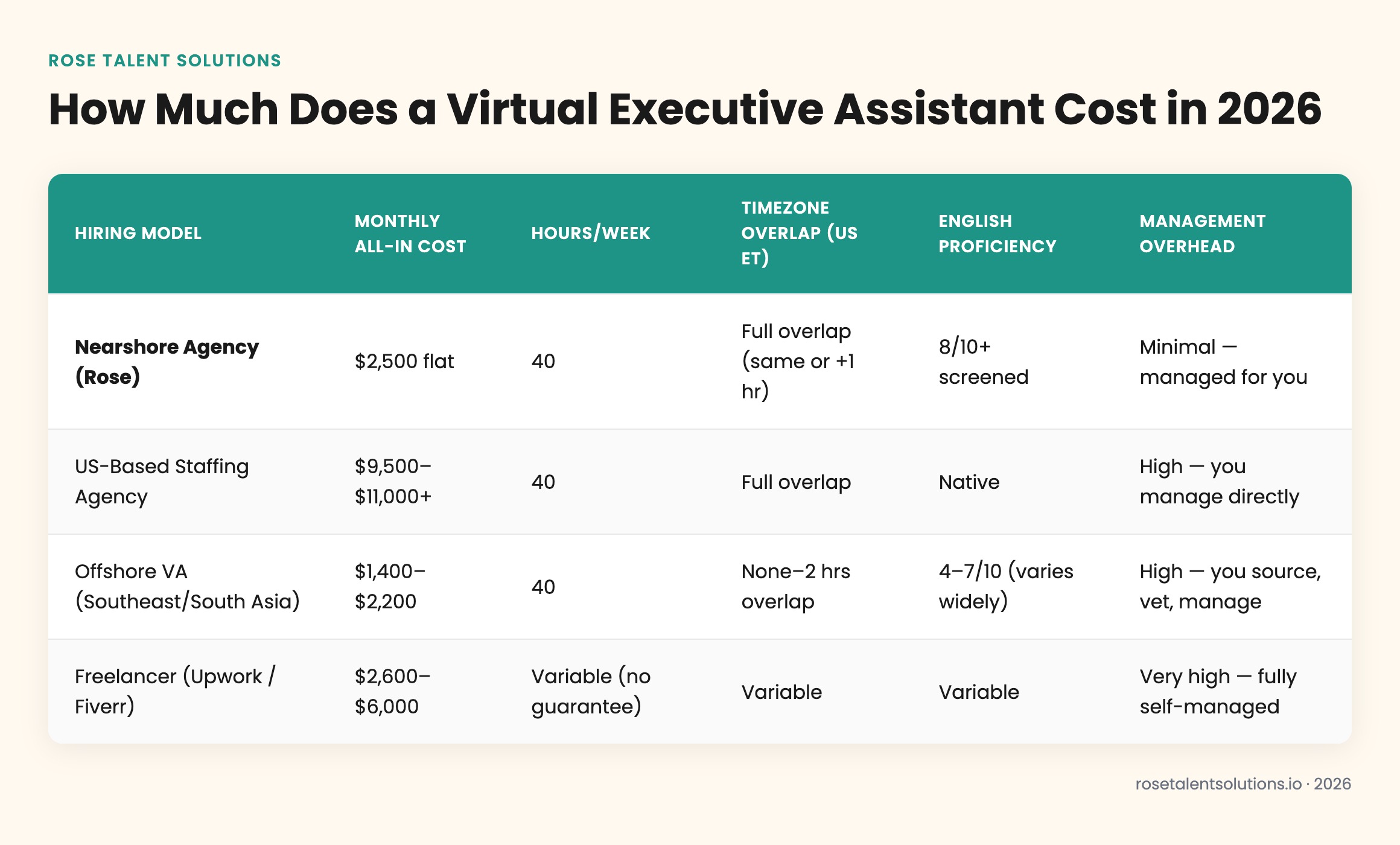
The offshore price looks tempting until you factor in the timezone reality. A 12-hour gap means your VEA is processing your 3pm calendar change at 3am their time — or worse, batching it until the next day. For an executive assistant role where real-time responsiveness is the core value-add, that gap is structural, not fixable by good intentions.
What Does a Virtual Executive Assistant Actually Do — and How Does That Affect Cost?
A virtual executive assistant is a remote professional who manages the operational and administrative layer directly around an executive or business owner. Typical responsibilities include inbox zero management, calendar scheduling and conflict resolution, travel booking, board and meeting preparation, CRM updates, vendor and contractor coordination, and internal communications. The more specialized the role — say, a VEA who also manages a full email marketing workflow or oversees a content calendar — the higher the value delivered and, potentially, the pricing tier.
Scope creep is one of the hidden cost drivers in this category. Many founders hire a "VA" expecting EA-level output, then discover the person they hired specializes in data entry. Rose's placement process matches on skill level, not just category — a VEA placement includes screening for communication standards, executive-level judgment, and software fluency before you ever get on a call.
"Executives who delegate effectively to trained assistants recover an average of 8 hours per week — equivalent to one full working day returned to strategic work." — Julie Morgenstern, Organizational Consultant and Author, Never Check Email in the Morning (2023)
Role specialization also affects cost at the margin. A generalist VEA handling scheduling and inbox is on the lower end of the market. A VEA with demonstrated fluency in tools like HubSpot, Notion, Asana, or QuickBooks commands a modest premium — but still far less than a US-based hire with equivalent skills. According to SHRM's 2024 compensation benchmarking data, a mid-level executive assistant in a major US metro earns $62,000–$85,000 base salary before benefits or overhead. When you factor in employer payroll taxes, benefits, and PTO, the true annual cost of a US-based EA regularly exceeds $110,000, per BLS Employee Benefits Survey (2024) data showing benefits add roughly 30–38% on top of wages for office roles.
The real cost of a virtual executive assistant isn't the monthly invoice — it's what that assistant does to your own hourly output. If your effective hourly rate as a founder is $200/hour and a $2,500/month VEA recovers 8 hours per week, the ROI math is $6,400/week recovered against $625/week spent. That's not an expense; it's infrastructure.

How Rose's AI Copilot Advantage Changes the Virtual Executive Assistant Cost Equation in 2026
Every Rose team member ships with a role-specific AI copilot trained on the software stack they'll actually use. For a virtual executive assistant, that means AI workflows built around inbox triage, meeting summarization, travel research, and CRM data entry — turning a 40-hour-per-week assistant into a higher-output operator without increasing your monthly cost. You can read more about how this works on the Rose AI advantage page.
This matters because the historical knock on VAs — especially offshore ones — was that they required constant supervision and re-training as tools evolved. AI-augmented assistants at Rose arrive pre-trained on the most common executive software stacks, so ramp time compresses and output quality holds from week one.
For executives who also need support beyond the core EA role — think a VEA who can assist with managing paid ad campaigns or coordinating a broader digital marketing function — Rose also places specialists in those adjacent roles. Many clients start with one VEA and expand to a two- or three-person nearshore team as trust builds.
The McKinsey Global Institute (2023) estimates that AI augmentation of knowledge workers can increase individual productivity by 20–40% on task-dense roles — exactly the profile of an executive assistant. That productivity gain doesn't require you to pay more; it's baked into how Rose trains and equips each placement. A separate Gallup State of the Global Workplace (2024) report found that engaged remote workers outperform disengaged in-office counterparts by 23% on core productivity metrics — reinforcing why a motivated, well-equipped nearshore VEA often outpaces a disengaged domestic hire at four times the price.
How the Rose Hiring Process Works — From Brief to Day One
Discovery Call
You walk Rose through your executive workflows, software stack, communication style, and non-negotiables. This brief drives the match — not a generic job post.
Candidate Matching
Rose screens from a pre-vetted talent pool, filtering on English proficiency (8/10+ floor), relevant software experience, and executive-level communication judgment. You typically see 1–3 matched candidates, not a stack of 50 resumes.
Your Interview
You interview shortlisted candidates on a video call. You pick the person you want — Rose doesn't decide for you.
Onboarding & AI Setup
Rose handles payroll, contracts, and HR setup. Your VEA receives their role-specific AI copilot training before day one.
Ongoing Management
Rose stays in the loop. If performance dips or the fit isn't right, you get a free replacement — no additional cost, no awkward firing conversation.
The entire process from kickoff call to your VEA's first day typically runs under two weeks. Compare that to the average 42-day time-to-fill for administrative roles cited by SHRM (2024) for direct hires, plus the additional 30–90 days before a new hire reaches full productivity. According to Deloitte's Global Workforce Trends (2024) research, organizations that use managed staffing services reduce total time-to-productivity by an average of 35% compared to direct-hire processes — a compounding advantage when you need executive support now, not next quarter.
Nearshore vs Offshore Virtual Executive Assistants in 2026: The Real Tradeoffs
If you're seriously weighing nearshore against offshore when calculating how much a virtual executive assistant will cost your business, the honest tradeoff looks like this. Offshore is cheaper on paper — often $300–$600/month less. Nearshore delivers real-time responsiveness, full timezone overlap, higher average English proficiency, and lower churn rates. For a role where you're trusting someone with your calendar, your inbox, and your executive communications, the proficiency bar matters enormously.
Nearshore VEA (Latin America)
- Full US business hours overlap — real-time responses
- 8/10+ English proficiency — no communication friction
- Lower churn — Latin American VAs average 18+ month tenure at Rose
- AI copilot included — faster ramp, higher output
- Managed service — HR, payroll, and ongoing oversight handled
Offshore VEA (Southeast/South Asia)
- 10–14 hour timezone gap — overnight batching of urgent tasks
- English proficiency varies widely — vetting is your responsibility
- High turnover on self-sourced hires — average 6–9 month tenure
- Self-managed — recruiting, onboarding, HR are all on you
- Lower base rate, but hidden management costs accumulate fast
For executives and founders who also need support on social content or brand presence, Rose places specialized social media VA roles that complement a core VEA hire — giving you an executive assistant for operations and a separate specialist for digital presence, both on the same nearshore model.
Ready to see what a nearshore VEA looks like for your specific workflow? The fastest path is to start your matching process at Rose — it takes about 15 minutes and you'll have a shortlist within days, not months.