
Nearshore virtual marketing assistants are running Google Ads accounts for US businesses right now — not just pulling reports, but owning full campaign cycles from keyword research to conversion tracking. If you've been skeptical that a remote hire could handle paid search, this post will change your mind. It will also show you exactly where the limits are, how to structure the working relationship, and why the timezone factor matters more than almost anything else when it comes to paid ads.
The short answer is yes. The longer answer is: it depends entirely on how the VA is vetted, what tools they're trained on, and whether they're working your hours or a 12-hour lag behind you. Let's break all of that down.
What Does "Running Google Ads" Actually Mean in 2026?
A lot of business owners picture Google Ads management as one monolithic task. It isn't. It's a stack of about a dozen repeatable responsibilities — and a well-trained virtual marketing assistant can own most of them independently.
Here's what that stack looks like in practice:
- Keyword research and negative keyword management — building and pruning the keyword list weekly
- Campaign and ad group structure — organizing campaigns by intent, match type, and audience segment
- Ad copy writing and A/B testing — writing responsive search ads, rotating variants, logging winners
- Bid strategy management — switching between manual CPC, target CPA, and maximize conversions based on data
- Conversion tracking setup — configuring goals in Google Ads and Google Analytics 4
- Search term report analysis — weekly review of what queries are triggering ads
- Landing page coordination — flagging copy mismatches between ad and landing page to the web team
- Budget pacing — monitoring daily spend against monthly budget caps
- Performance reporting — weekly and monthly decks with cost per click, conversion rate, ROAS, and recommendations
A skilled virtual marketing assistant handles every item on that list. The one thing most VAs won't own without senior oversight is the initial strategy layer — deciding whether Google Ads is even the right channel for a new product, or how paid search fits into a broader funnel. That's a strategist call. Execution is the VA's domain.
That bandwidth gap is exactly what a dedicated virtual marketing assistant fills. According to WordStream's advertising benchmarks research (2023), the average small business wastes roughly 25% of its Google Ads budget on poorly matched keywords — a problem that weekly search term audits by a trained VA eliminate almost entirely.
How Nearshore VAs Handle Google Ads Differently Than Offshore Hires in 2026
The timezone question isn't a soft preference — it's a hard operational variable for paid search. Google Ads campaigns react to real-time signals: a spike in CPCs, a sudden drop in Quality Score, a landing page that goes down at 10am on a Tuesday. If your VA is 11 hours ahead of EST, they won't see that problem until your budget has already burned through the day.
Nearshore virtual marketing assistants based in Latin America work fully synchronized US business hours — Eastern, Central, or Pacific, depending on your setup. They're in Slack when you are. They can pause a campaign in minutes, not the next morning.
The hidden cost of offshore Google Ads management isn't the hourly rate — it's the 10–12 hour timezone gap that turns a $200 budget overage into a $2,000 one before anyone catches it. Real-time campaign oversight requires real-time availability.
Rose Talent Solutions places nearshore virtual marketing assistants who work your hours, communicate in fluent English (screened at 8/10 or higher on our proficiency rubric), and arrive with a role-specific AI copilot already trained on the tools your campaigns run on — including Google Ads, GA4, SEMrush, and HubSpot. You can explore the full breakdown of how that works on our AI advantage page.
According to the U.S. Bureau of Labor Statistics (2024), the median annual wage for a marketing specialist in the US is $74,680 — roughly $6,200/month fully loaded with taxes and benefits. A nearshore virtual marketing assistant from Rose runs $2,500/month flat, all-in, with recruiting, HR, payroll, and ongoing management included.
Nearshore vs. Offshore vs. In-House: A 2026 Google Ads Staffing Comparison
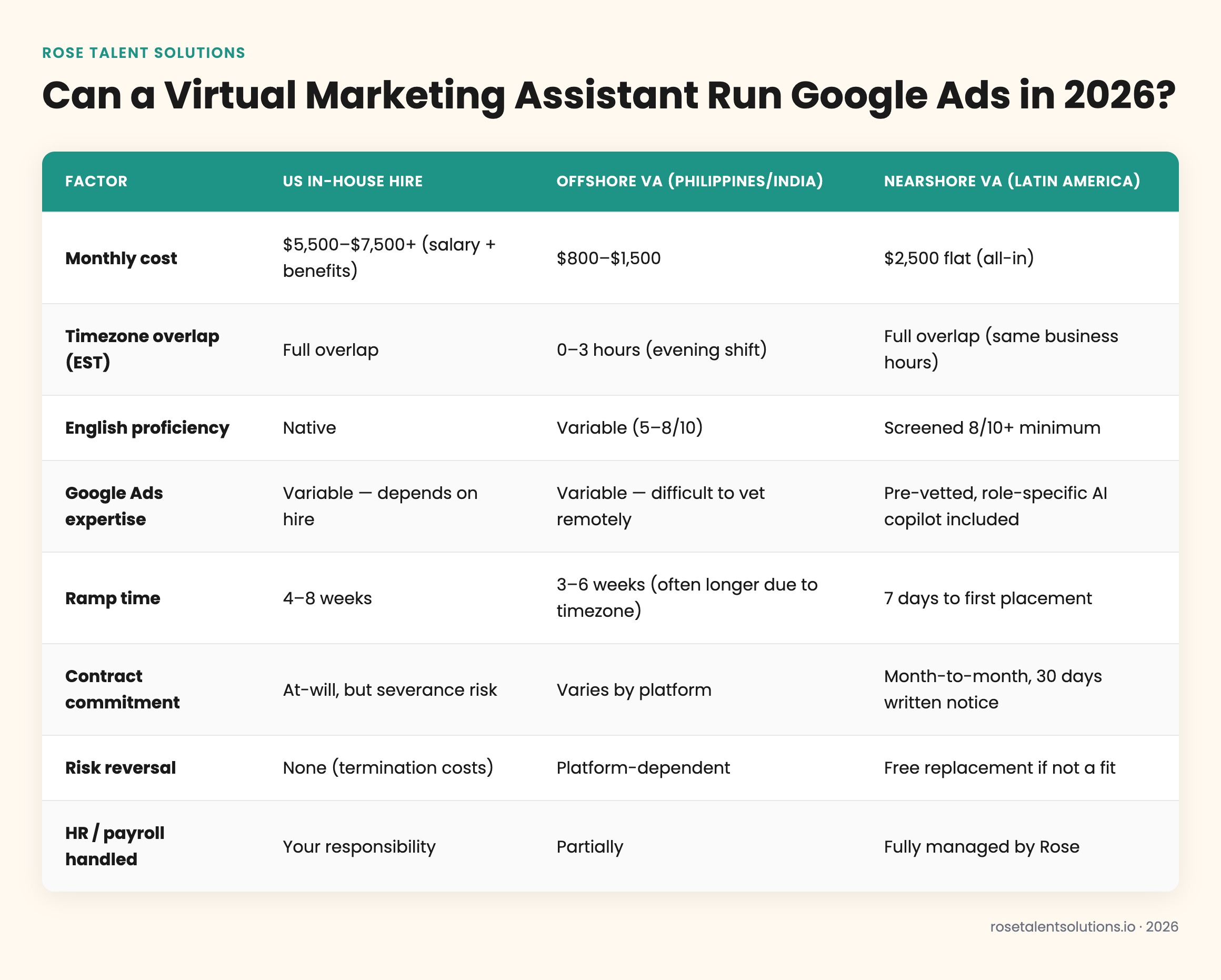
If you're deciding between building in-house, hiring an offshore VA, or bringing on a nearshore virtual marketing assistant, the table below makes the tradeoffs explicit. This is where most businesses make the wrong call because they optimize only on hourly rate.
| Factor | US In-House Hire | Offshore VA (Philippines/India) | Nearshore VA (Latin America) |
|---|---|---|---|
| Monthly cost | $5,500–$7,500+ (salary + benefits) | $800–$1,500 | $2,500 flat (all-in) |
| Timezone overlap (EST) | Full overlap | 0–3 hours (evening shift) | Full overlap (same business hours) |
| English proficiency | Native | Variable (5–8/10) | Screened 8/10+ minimum |
| Google Ads expertise | Variable — depends on hire | Variable — difficult to vet remotely | Pre-vetted, role-specific AI copilot included |
| Ramp time | 4–8 weeks | 3–6 weeks (often longer due to timezone) | 7 days to first placement |
| Contract commitment | At-will, but severance risk | Varies by platform | Month-to-month, 30 days written notice |
| Risk reversal | None (termination costs) | Platform-dependent | Free replacement if not a fit |
| HR / payroll handled | Your responsibility | Partially | Fully managed by Rose |
That level of weekly hands-on presence is exactly what you get from a dedicated nearshore VA — and it's not possible when your Google Ads manager is asleep during your business day. For more on what a full-service virtual marketing assistant role looks like, the Rose guide to the best virtual marketing assistant services in 2026 covers the full scope of tasks these roles can own.
What Tasks Should You Actually Delegate to a Virtual Marketing Assistant for Google Ads?
Not every Google Ads task is the same level of complexity. A smart delegation framework separates strategic decisions (your job or a CMO's) from execution tasks (the VA's domain). Here's how to split it:
Delegate immediately: keyword list builds, negative keyword additions, ad copy variants, bid adjustments within a set range, search term report pulls, weekly performance summaries, campaign budget pacing, Quality Score tracking, audience exclusion updates, and conversion goal verification.
Keep at senior level (review together): net-new campaign strategy, landing page architecture decisions, major budget reallocation between campaigns, and channel mix decisions (Google vs. Meta vs. LinkedIn).
This split means a single virtual marketing assistant can run your day-to-day Google Ads operation while you spend 30 minutes a week in a review call rather than 10 hours a week inside the platform.
"The best PPC managers I've seen at the SMB level aren't the ones who know the most esoteric Google features — they're the ones who execute the fundamentals obsessively. Weekly search term audits, tight ad group themes, and consistent A/B testing beat exotic automation every time." — Purna Virji, Principal Consultant at LinkedIn Marketing Solutions and former Microsoft Advertising Senior Manager (LinkedIn, 2023)
If you also want your VA covering email campaigns and content alongside paid search, our post on the best email marketing virtual assistant services explains how to structure that kind of hybrid marketing role without diluting Google Ads performance.

How the Rose Onboarding Process Gets a Google Ads VA Live in 7 Days
One of the most common objections we hear is: "Even if this works, it'll take weeks to get someone ramped on our accounts." Here's the actual process:
Intake & role scoping
You complete a 15-minute intake form describing your Google Ads setup, current monthly spend, ad platforms, and the specific tasks you need owned. Rose uses this to pre-filter candidates — you don't interview 20 people.
Matched placement
Rose presents 1–2 pre-vetted candidates with verified Google Ads experience within 5–7 business days. Each candidate has already cleared the English proficiency screen (8/10+) and a platform-specific skills assessment.
AI copilot activation
Your VA's role-specific AI copilot is configured for your toolstack — Google Ads, GA4, your CRM, and any reporting dashboards you use. This is what cuts ramp time from weeks to days.
Day-one access & kickoff
Your VA gets read-only Google Ads access first, reviews your account structure, and delivers an audit document by end of week one. Full execution access follows once you've confirmed their audit is accurate.
Ongoing management by Rose
Rose handles payroll, HR, and performance check-ins so you never manage the employment relationship. If the fit isn't right, Rose replaces the team member at no additional cost — no disruption to your campaigns.
The full engagement runs month-to-month with no long-term contract. You can start the intake process here — most clients have a candidate shortlist within a week of submitting their role brief.
Pros and Cons of Hiring a Virtual Marketing Assistant for Google Ads in 2026
Like any staffing decision, this one has tradeoffs. Here's the honest version:
Pros
- Full-time dedicated focus on your accounts — not split across 15 other clients like an agency
- Real-time timezone overlap (nearshore) means same-day campaign adjustments
- $2,500/month vs. $5,500–$7,500 for a US in-house hire
- Month-to-month, no long-term contract — cancel with 30 days written notice
- Free replacement if the hire isn't the right fit
- AI copilot reduces ramp time and improves output quality from day one
- HR, payroll, and management fully handled by Rose
Cons
- Not a strategic CMO — won't build your go-to-market plan from scratch
- Requires you to grant platform access and set initial campaign goals
- Best results come when you do a 30-min weekly review call — some owners want fully zero-touch
- Won't manage creative video production (ad copy and static creative briefs, yes — video shoots, no)
According to SHRM's benchmark research (2022), the average cost-per-hire in the US exceeds $4,700 before the employee earns a single dollar. For a marketing role, that number climbs further. The nearshore model sidesteps recruiting costs entirely — Rose absorbs them in the flat monthly fee.
If you want your virtual marketing assistant to also manage your organic social presence alongside Google Ads, the Rose overview of the best social media manager virtual assistant services details how to structure a hybrid paid-plus-organic marketing VA role.
And if you're scaling beyond marketing and need executive-level calendar and communications support alongside your marketing function, our guide to the best virtual executive assistant services in 2026 covers how to pair those roles without doubling your cost.
For businesses ready to get someone into their Google Ads account without the overhead of a full US hire, the math is straightforward. Learn more about the full virtual marketing assistant service at the Rose start page, or explore the broader Rose property management VA services if your Google Ads campaigns are tied to a real estate or property management business. The combination of real-time timezone overlap, verified platform expertise, and a flat all-in rate is what makes the nearshore model genuinely competitive with anything else in the market right now — not just on cost, but on execution quality.
According to Gallup's employee engagement research (2023), workers who feel ownership over their role's outcomes are 17% more productive than those operating under heavy supervision. Nearshore VAs placed by Rose work dedicated, accountable, single-client roles — which is structurally different from the fractional attention you get from a marketing agency account manager handling 40 accounts at once.
Finally: the single biggest mistake businesses make with Google Ads VAs is hiring someone without verifying their actual platform experience. Rose's vetting process includes a live Google Ads skills screen — not a certification check, but a hands-on assessment of account structure decisions. That's the difference between a VA who knows the theory and one who can log in on Monday and improve your campaign by Friday.