
What Does a Virtual Executive Assistant Actually Cost in 2026?
Nearshore virtual executive assistants have fundamentally changed the math on executive support. Two years ago, your options were basically a $60/hour US-based freelancer, a hard-to-manage offshore hire in a wildly different timezone, or a $70,000/year in-house EA. In 2026, a fourth option — full-time, Latin America-based, English-fluent, and flat-rate priced — has made the "how much should I pay a VA?" question a lot more interesting to answer.
This guide breaks down every pricing model in plain language: per-hour freelance rates, retainer packages, agency flat rates, and the hidden costs nobody else is talking about. By the end, you'll know exactly what you should expect to pay, what you get for that money, and where the real value gaps are.
According to the U.S. Bureau of Labor Statistics (2024), the median annual wage for executive administrative assistants in the United States sits at $67,980 — roughly $32.68/hour before you add benefits, payroll taxes, and overhead.
That number is the benchmark everything else should be measured against. A virtual executive assistant — nearshore, offshore, or freelance — only makes sense if it delivers comparable output at meaningfully lower total cost. Let's look at what the real numbers are.
Virtual Executive Assistant Cost Per Hour: 2026 Rate Breakdown
Hourly rates for virtual executive assistants vary enormously depending on location, experience, and how you're hiring. Here's what the market looks like right now across the four main sourcing models.
The "effective hourly rate" column is where flat-rate monthly plans win. At $2,500/month for a full 40-hour week, you're paying roughly $15–$16/hour in pure labor cost — but the all-in price (recruiting, vetting, payroll, HR, management) translates to an effective rate of $15.62/hour. Compare that to $60+ for a US freelancer who also requires you to manage their onboarding, track their hours yourself, and handle a 1099 at year end.
According to Statista's outsourcing market overview (2024), the global BPO market is expected to exceed $525 billion by 2030, with Latin America growing as the fastest-expanding nearshore delivery region for North American clients.

How Do Hiring Models Compare for Virtual Executive Assistant Cost?
Not all virtual executive assistants are priced the same way, and the pricing model you choose locks in a different risk profile. Here's a direct comparison of the four main options available to US and Canadian business owners in 2026.
| Hiring Model | Typical Cost Per Month | Hours Included | Who Manages HR/Payroll | Cancellation Risk | Timezone Alignment (US) |
|---|---|---|---|---|---|
| US-Based Freelancer | $4,400–$8,000+ | Variable (hourly) | You (1099) | Low — but you absorb rehire cost | Full overlap |
| Offshore Agency (Philippines/India) | $1,200–$2,800 | 40 hrs/wk typical | Agency handles | Often 3–6 month contracts | 6–12 hour gap |
| Onshore US Agency | $5,000–$10,000+ | 40 hrs/wk or part-time | Agency handles | Often annual contract | Full overlap |
| Nearshore Agency (Latin America) | $2,500 flat | 40 hrs/wk dedicated | Agency handles | No long-term contract (30-day notice) | Full US hours overlap |
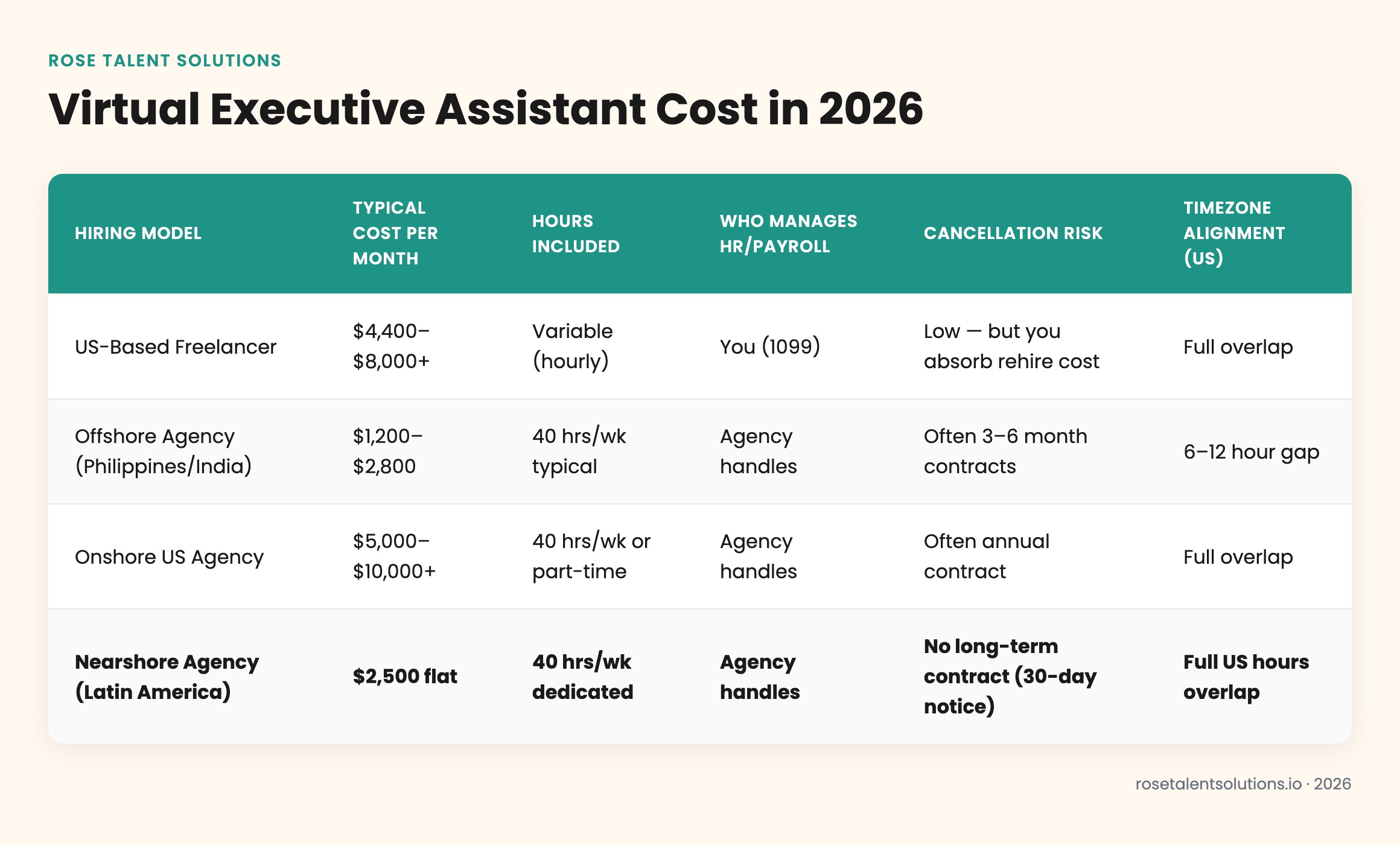
The nearshore model occupies a unique sweet spot: lower cost than onshore, zero timezone gap unlike offshore, and managed HR so you don't carry the administrative burden. Rose Talent Solutions' AI-advantage approach adds one more differentiator — every team member ships with a role-specific AI copilot trained on the tools they'll actually use, from QuickBooks to Google Workspace.
What Are the Hidden Costs of Hiring a Virtual Executive Assistant in 2026?
The sticker price is rarely the real price. Here's what competitors never tell you about the total cost of ownership when you hire a virtual executive assistant — whether freelance, offshore, or through an agency.
Onboarding and ramp-up time. A new VA — even an experienced one — needs 2–4 weeks to learn your systems, communication style, and priorities. During that window, you're paying full rate for partial output. Freelance hires amplify this because you're doing the onboarding yourself. According to SHRM's talent acquisition research (2022), the average cost to onboard a new hire exceeds $4,100, and that figure doesn't account for the manager's time investment.
Software seat costs. Executive assistants need access to your calendar platform, project management tool, communication stack, and CRM. At $15–$50 per seat per month across four to six tools, you can add $60–$300/month in SaaS costs that never appear in the VA's advertised rate.
Communication overhead. Offshore VAs working in a 6–12 hour timezone gap create asynchronous bottlenecks. Every same-day task becomes a next-day task. Every back-and-forth thread stretches across two calendar days. That overhead costs you decision-making speed — which, for an executive assistant role, is the entire point.
The hidden cost of offshore virtual executive assistants isn't the hourly rate — it's the 6–12 hour timezone gap that converts every real-time executive task into an overnight queue. For calendar management, travel booking, and inbox triage, that delay erodes the entire value proposition of having an EA.
Rehire cost when a placement doesn't work out. On freelance platforms, if a hire underperforms, you restart the search from scratch: job post, screening, test tasks, interviews, and another ramp-up period. That cycle costs 2–6 weeks of lost productivity plus recruiter time. A managed staffing model with a built-in replacement guarantee eliminates this exposure — if your team member isn't a fit, Rose replaces them at no additional cost.

How to Evaluate VA Quality Before You Hire (And Red Flags to Watch For)
Price is only half the equation. A $15/hour VA who delivers 50% output is more expensive than a $25/hour VA who delivers 100%. Here's how to vet candidates before committing.
English proficiency screening. For an executive assistant role, English fluency isn't optional. Rose's published standard is an 8/10 or higher score on English proficiency screens — a bar that filters out candidates who can handle data entry but struggle with executive-level communication. Always ask agencies to share their specific proficiency threshold, not just "fluent English."
Test tasks with real deliverables. Before a first day, give shortlisted candidates a 30-minute task that mirrors actual work: draft a response to a vendor email, build a travel itinerary from a brief, or organize a messy inbox folder structure. Execution quality and turnaround time tell you more than any resume.
Accountability and time-tracking tools. Ask any agency or freelancer what time-tracking system they use and how you'll verify output. Reputable managed staffing providers include reporting structures. Roles like bookkeeping VAs often use tool-specific audit trails (QuickBooks logs, reconciliation reports), but for executive assistants, daily task wrap-up notes and calendar visibility are the minimum standard.
Signs of a High-Quality VA Placement
- Demonstrated English at 8/10+ (with a verifiable screening score)
- Role-specific software experience (Google Workspace, HubSpot, Asana, etc.)
- Proactive communication — flags issues before they escalate
- Agency-managed payroll and HR (no 1099 admin burden on your end)
- Replacement guarantee if the fit isn't right
Red Flags That Will Cost You Later
- Vague English proficiency claims with no measurable bar
- No ramp-up support or onboarding framework from the agency
- Offshore timezone (6–12 hr gap) for a real-time executive support role
- Long-term lock-in contracts with no performance exit clause
- Hourly billing with no output verification mechanism
When NOT to Hire a Virtual Executive Assistant in 2026
A virtual EA is the wrong solution in specific situations, and most VA content never admits this. Knowing when to pass is as valuable as knowing when to hire.
Roles requiring physical presence. If your "executive support" need is greeting clients at a reception desk, running physical errands, or managing an on-site office, a virtual hire doesn't fit. No remote placement solves a presence problem.
Deep institutional knowledge from day one. If you need someone who already understands your industry's regulatory framework, existing client relationships, and internal politics — and you need that on day one — a VA is a 60–90 day ramp investment, not an instant solution. Factor that runway into your decision.
Sub-10-hour-per-week needs. A full-time 40-hour flat-rate model doesn't make economic sense if you only have eight hours per week of genuine executive support work. In that case, a part-time freelancer or a shared VA arrangement is the right fit. Be honest about your task volume before committing to a full-time placement.
According to McKinsey's organizational performance research (2023), companies that match role scope to hiring model see 34% higher productivity outcomes from support hires than companies that default to the same model regardless of fit.
How Rose Talent Solutions' Nearshore Model Works in 2026
For US and Canadian business owners who need a full-time virtual executive assistant without the overhead of traditional employment, here's exactly how the Rose model works.
Intake and Role Scoping
Rose's team maps your specific tasks, software stack, and communication preferences to build a candidate profile — not a generic EA job description, but a role built around your actual workflow.
Candidate Vetting and Matching
Candidates are screened for English proficiency (8/10+ floor), role-specific software experience, and culture fit. You review a shortlist — typically within 7 days of intake — and choose your match.
AI Copilot Onboarding
Your team member's role-specific AI copilot is configured to their software environment — Google Workspace, HubSpot, Asana, or whatever your stack uses — so day-one productivity is meaningfully higher than a cold start.
Ongoing Management at $2,500/Month Flat
Payroll, HR, performance management, and compliance are handled entirely by Rose. You direct the work; Rose manages the employment relationship. No long-term contract — cancel with 30 days written notice.
Free Replacement If It's Not a Fit
If your placed team member isn't working out for any reason, Rose replaces them at no additional cost. That's the risk reversal — no financial exposure on a mismatch.
The flat $2,500/month rate includes everything: recruiting, vetting, payroll processing, benefits administration, and ongoing HR management. According to SHRM's employee benefits benchmarking data (2023), US employer costs for benefits and payroll taxes average 31% on top of base salary — expenses that disappear entirely when you hire through a managed nearshore staffing firm.
For business owners ready to stop losing hours to inbox management, travel logistics, vendor coordination, and calendar chaos, a full-time nearshore executive assistant at a flat monthly rate is the most cost-effective lever available in 2026. The math works. The timezone works. And the risk is covered by a replacement guarantee — not a vague promise.