
Nearshore developers — software engineers based in Latin America working US business hours — have become the default hiring move for growth-stage US companies that need engineering talent without the $150K+ salary burden of a domestic hire. The model has matured fast. In 2026, it is no longer a scrappy workaround; it is a deliberate staffing strategy used by bootstrapped SaaS founders, mid-market product teams, and enterprise IT departments alike. If you are evaluating it for the first time, or reconsidering a previous offshore experiment that didn't stick, this guide covers everything you need to make a confident decision.
That statistic captures why nearshore has pulled ahead. When your standup is at 9 AM Eastern, a team in Medellín or Mexico City is already at their desk. A team in Manila or Bangalore is at midnight. The overlap difference is not trivial — it determines whether your sprint velocity is real or manufactured.
What Is a Nearshore Developer, and How Does the Model Work in 2026?
A nearshore developer is a software engineer employed or contracted in a country geographically and culturally close to the client — in the US context, that means Latin America. The key characteristics that separate nearshore from generic offshore are same-timezone availability, English fluency, and cultural alignment with US agile practices. These are not soft advantages; they directly reduce cycle time on tickets, pull requests, and stakeholder reviews.
The nearshore model in 2026 typically works one of two ways: you hire directly through a local employer-of-record, or you partner with a staffing firm that handles recruiting, vetting, payroll, and HR on your behalf. The second path is faster — placements happen in days, not months — and eliminates the legal complexity of employing someone across an international border. At Rose Talent Solutions, for example, the flat rate is $2,500 per month for a full-time, 40-hour-per-week developer, with recruiting, vetting, payroll, and ongoing HR all included. You can start the matching process here with no long-term contract commitment required.
If you are exploring specific stacks, the talent pool in Latin America is deep across the board. Whether you need iOS and Android mobile engineers or full-stack generalists who can own both front- and back-end work, the region produces credentialed engineers at scale — and the pipeline keeps growing as top-ranked engineering programs in Brazil, Colombia, Argentina, and Mexico expand their output.

How Nearshore Developers Compare to Offshore and Onshore in 2026
The honest comparison chart most vendors avoid publishing is the one that shows trade-offs, not just wins. Nearshore is not perfect for every situation — but for most US product teams that rely on daily standups, Slack responsiveness, and sprint ceremonies, it outperforms both alternatives on the dimensions that actually slow teams down.
| Factor | Nearshore (Latin America) | Offshore (India / Philippines) | Onshore (US / Canada) |
|---|---|---|---|
| Time zone overlap with US East | 0–2 hours difference | 9–13 hours difference | 0 hours difference |
| Typical all-in monthly cost (full-time) | $2,000–$4,000 | $1,200–$2,500 | $10,000–$18,000 |
| English proficiency (average screen score) | 8/10+ (Rose standard) | 6–8/10 (varies widely) | Native |
| Cultural alignment with US agile teams | High | Moderate | Native |
| Average time to first placement | 7–14 days (via staffing firm) | 14–30 days | 45–90 days (W2 hire) |
| Employer-of-record complexity | Low (handled by partner) | Moderate to High | None (direct hire) |
| Risk reversal available | Yes — free replacement if not a fit | Rarely | No (severance applies) |
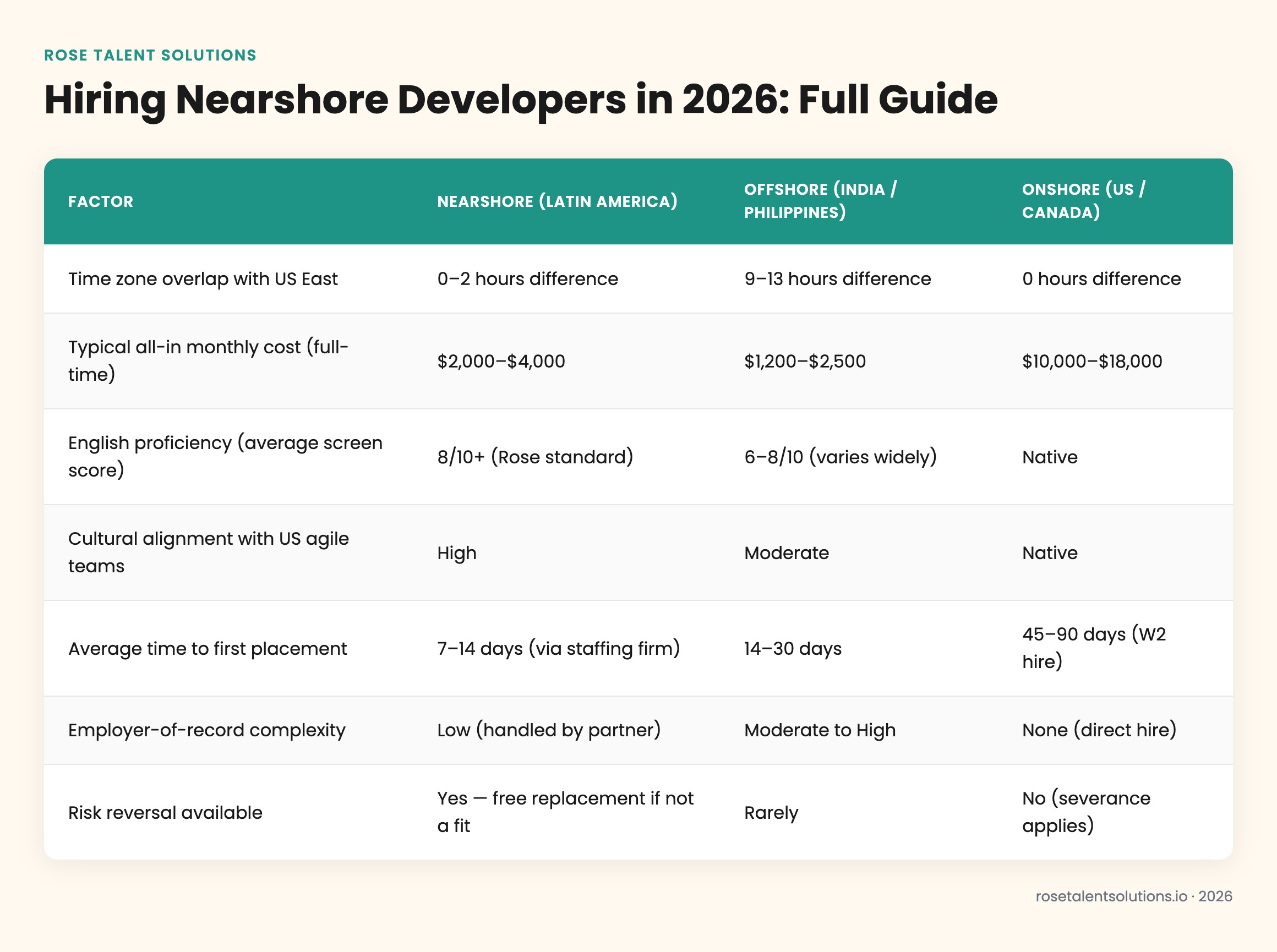
The cost gap versus offshore looks smaller than most people expect, but the productivity gap runs in the opposite direction. According to McKinsey Digital (2023), asynchronous communication delays are responsible for up to 25% of lost developer productivity on distributed teams — a drag that nearshore teams largely eliminate by sharing working hours with their US counterparts.
How to Vet Nearshore Developers: What the Best Firms Do in 2026
Vetting quality is the variable that separates a successful nearshore engagement from a failed one. Any staffing partner worth working with should be able to answer the following questions before you place a single developer: What is the minimum English proficiency score you screen for, and what test do you use? What technical assessments do candidates complete, and are those stack-specific? Do you conduct behavioral interviews, and do you share those notes with the client? What is your replacement policy if the hire does not work out?
At Rose, the published English proficiency floor is 8/10 on its screening rubric — not a marketing claim but a hard disqualifier at intake. Technical assessments are role-specific: a React developer sits a component-architecture exercise, not a generic coding quiz. And the replacement guarantee is real: if the team member is not a fit, Rose replaces them at no additional cost. That is the sole risk reversal — there is no first-week arrangement of any kind, so the replacement guarantee is what gives you the confidence to move fast.
"The number-one mistake companies make when hiring offshore is treating language fluency as a checkbox instead of a spectrum. A developer who scores 6/10 in English will add hours of friction to every code review, every Slack thread, every stakeholder call." — Guillermo Rauch, CEO at Vercel, speaking at VelocityConf (2022)
Beyond language, the vetting bar should cover time-zone discipline (do they actually work US hours, or do they shift back to their local schedule after onboarding?), familiarity with US sprint methodologies, and tool fluency. If you are running a React front end, your developer should know the ecosystem cold — not just the syntax but the opinionated patterns your team uses. That is why AI copilot training matters: every Rose team member is paired with a role-specific AI copilot trained on the tools they will use on day one, cutting ramp time significantly. Learn more about how that works on the AI advantage page.
The vetting process your staffing partner runs before you ever meet a candidate is the single biggest predictor of placement success. Ask for the scorecard, not just a resume. If a vendor can't show you their rubric, that's your answer.
What Does Hiring Nearshore Developers Actually Cost in 2026?
Cost transparency is rare in this industry, so here is a plain-English breakdown. A fully loaded US software engineer — salary, benefits, payroll taxes, recruiting fees, equipment — runs $120,000 to $200,000 per year for mid-level talent, according to the Bureau of Labor Statistics (2024). A nearshore developer through a managed staffing model costs a fraction of that.
Rose's flat rate of $2,500 per month — $30,000 per year — includes recruiting, vetting, payroll, HR administration, and ongoing management. That is the all-in number. No surprise invoices for benefits, no recruiting markup on top of a day rate, no employer-of-record fee billed separately. For companies that want to compare nearshore staffing to platforms like Toptal, the cost difference is substantial — Toptal engagements typically run $6,000 to $15,000 per month for a single developer, with no HR infrastructure included.
The month-to-month terms matter as much as the monthly rate. With no long-term contract, you can scale a team up for a product launch and right-size it after. That flexibility is worth real money when you are running lean. According to SHRM's hiring benchmarks (2023), the average cost to replace a full-time employee is 50–200% of their annual salary — a risk nearshore staffing's replacement guarantee directly offsets.
How to Onboard a Nearshore Developer in 2026: The 5-Step Process
Even the best hire fails if the first two weeks are disorganized. A structured onboarding sequence is especially important for remote nearshore engineers who need to establish trust, understand your codebase, and plug into your team's communication rhythm all at once. Here is the sequence that works.
Define the role with stack-level specificity
Before the staffing partner starts sourcing, write a role spec that names the frameworks, repos, and team workflows the developer will touch. "Full-stack developer" is not enough — "React 18 / Node / PostgreSQL, working in a monorepo with Turborepo, daily standups at 10 AM ET" is actionable.
Shortlist and interview within your business hours
Your staffing partner should deliver pre-vetted candidates within 7–14 days. Run technical and cultural fit interviews synchronously — the same as you would for any direct hire — and treat the first call as a real interview, not a formality.
Set up access and tooling on day one, not day three
Repo access, Slack invite, project management seats, and a dev environment that actually works should be ready before the developer's first standup. Admin delays in week one destroy momentum faster than any skills gap.
Assign a first real ticket, not a "get-familiar" task
Give your new nearshore engineer a real, scoped ticket in the first 48 hours. It signals trust, creates a natural touchpoint for feedback, and surfaces any workflow misalignments early when they are cheap to fix.
Run a 30-day structured check-in
At day 30, hold a formal review with the developer and your staffing partner. Cover technical output, communication quality, and team integration. If anything is off, the replacement guarantee exists precisely for this moment — use it rather than tolerating a slow drag on team velocity.
Nearshore vs Offshore Development in 2026: Pros and Cons
The nearshore-vs-offshore debate comes down to a single question: how much does real-time communication matter to the work you are building? For teams running product discovery, complex debugging, or rapid-iteration sprints, the answer is "enormously." For teams with well-scoped, low-dependency tasks, offshore can work. Here is the honest grid.
Nearshore Pros
- 0–2 hour time zone difference enables live standups, code reviews, and stakeholder calls
- High English fluency (8/10+ floor at reputable firms) reduces PR review friction
- Cultural alignment with US agile norms — sprints, retros, and estimation meetings feel familiar
- Faster placement timelines — 7–14 days vs 30+ for offshore sourcing
- Legal simplicity — staffing partner handles employer-of-record, payroll, and HR
Nearshore Cons
- Slightly higher cost than deep offshore (India / Southeast Asia), though the productivity gap often closes this
- Smaller raw talent pool for hyper-niche stacks compared to India's volume
- Requires a structured onboarding process — remote-first discipline is non-negotiable
For teams building mobile applications specifically, the nearshore talent pool in Latin America is particularly strong. If you are staffing for a cross-platform build, the guide on hiring nearshore React and Android developers covers the vetting nuances for those roles in depth.
One frequently overlooked cost is what Gallup's employee engagement research (2023) calls "collaboration tax" — the cumulative time lost to follow-up messages, delayed approvals, and re-explained requirements when teams are out of sync. For offshore teams with a 9–13 hour difference, this tax compounds daily. Nearshore teams operating in the same business window eliminate it structurally, not through extra effort.
If your company also needs financial operations support alongside its development team, Rose's bookkeeping and accounting staffing runs on the same model — flat rate, Latin America-based, US hours — so you can build an integrated remote team without managing multiple vendors.