
Nearshore virtual staffing is quietly becoming the default hiring move for Edinburgh businesses that need skilled, full-time support without the overhead of a local hire. While offshore outsourcing has dominated the conversation for a decade, a sharper model has emerged: Latin America-based virtual staff who work your hours, speak fluent English, and cost a fraction of a local salary. This post breaks down exactly how that model works, what it costs, and how to decide if it's right for your business in 2026.
Why Edinburgh Businesses Are Looking Beyond Local Hiring in 2026
Edinburgh's labour market is competitive. Office support, admin, bookkeeping, and property coordination roles are expensive to fill locally — and even harder to retain. According to the Office for National Statistics (2024), median weekly earnings for full-time administrative roles in Scotland now sit above £580 — which annualises past £30,000 before employer NI, pension contributions, or equipment. When you add those on-costs, a single in-house admin hire routinely lands between £38,000 and £42,000 all-in per year.
That cost pressure is pushing Edinburgh operators — property managers, accountants, consultancies, e-commerce brands — to explore remote staffing seriously. And the search data backs it: queries around how to hire virtual staff in Edinburgh have grown steadily as businesses look for a model that delivers full-time commitment without full-time local overhead.
The question isn't whether to consider remote staff — it's which remote staffing model actually works. That's where nearshore versus offshore becomes the critical decision.
What Is a Nearshore Virtual Assistant? (2026 Definition)
A nearshore virtual assistant is a remote professional based in a geographically and culturally proximate region relative to the hiring business. For UK businesses, the Latin American talent pool is highly accessible: timezone overlap with Edinburgh (GMT/BST) spans 4–6 hours of same-day business time across most of Central and South America, making real-time collaboration practical without graveyard shifts for either party.
Nearshore is distinct from offshore in three practical ways: timezone compatibility, cultural alignment with Western business norms, and English proficiency. Rose Talent's published screening bar requires an 8/10 or higher English proficiency score on every candidate before they are presented to a client. That standard matters when your VA is representing your business on calls, emails, or client-facing platforms. All Rose team members are based in Latin America — not South or Southeast Asia.
If you want to go deeper on how nearshore compares to every other staffing model, Rose's complete nearshore vs offshore vs onshore virtual assistant comparison covers the full breakdown with real cost examples.

How Nearshore VAs Compare to Offshore and Local Hires for Edinburgh Businesses
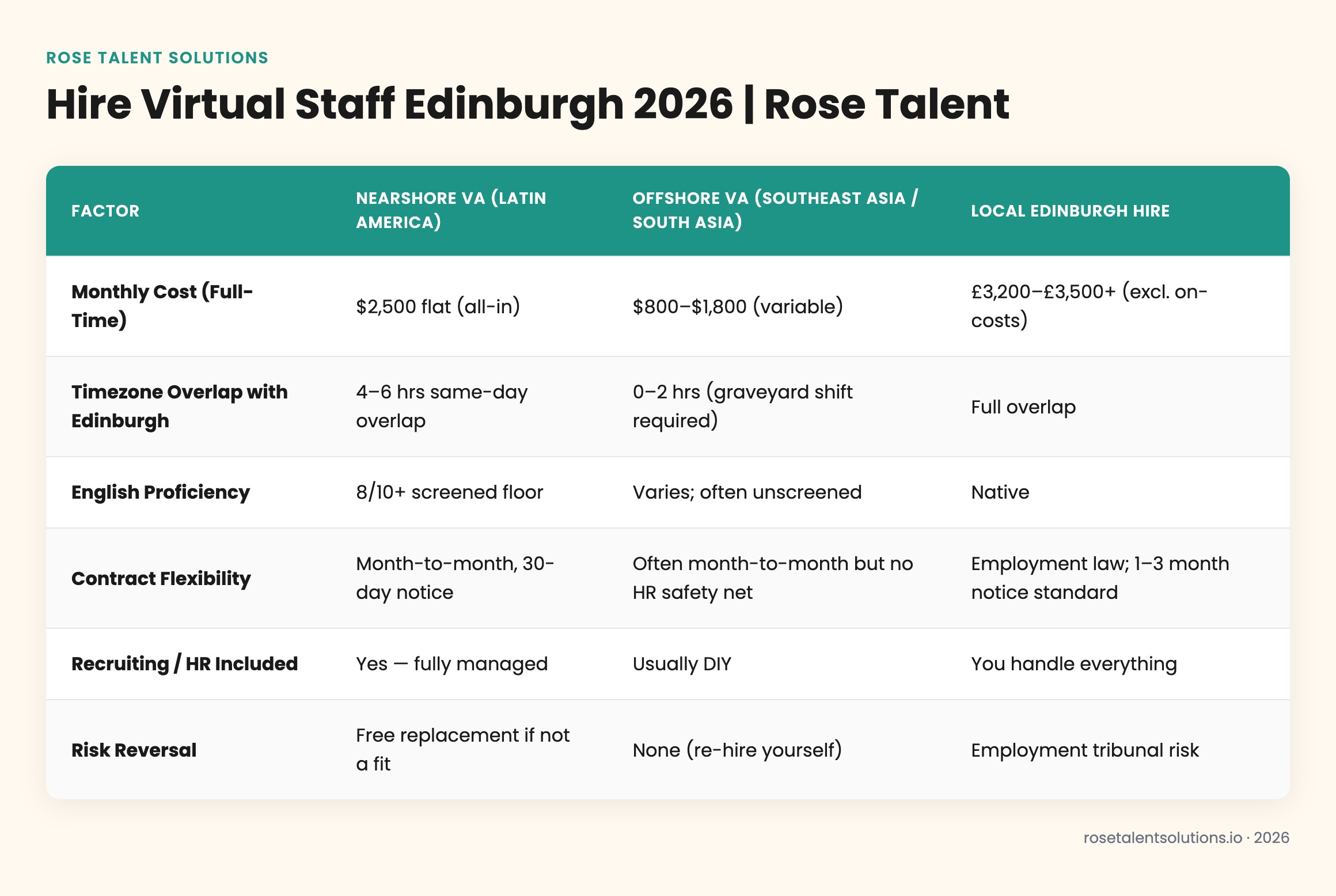
The table below cuts through the noise. These are the four dimensions that actually determine whether a remote hire works: cost, timezone fit, English fluency, and contract flexibility.
| Factor | Nearshore VA (Latin America) | Offshore VA (Southeast Asia / South Asia) | Local Edinburgh Hire |
|---|---|---|---|
| Monthly Cost (Full-Time) | $2,500 flat (all-in) | $800–$1,800 (variable) | £3,200–£3,500+ (excl. on-costs) |
| Timezone Overlap with Edinburgh | 4–6 hrs same-day overlap | 0–2 hrs (graveyard shift required) | Full overlap |
| English Proficiency | 8/10+ screened floor | Varies; often unscreened | Native |
| Contract Flexibility | Month-to-month, 30-day notice | Often month-to-month but no HR safety net | Employment law; 1–3 month notice standard |
| Recruiting / HR Included | Yes — fully managed | Usually DIY | You handle everything |
| Risk Reversal | Free replacement if not a fit | None (re-hire yourself) | Employment tribunal risk |
What Does It Actually Cost to Hire Virtual Staff in Edinburgh via Rose in 2026?
Rose Talent Solutions charges one flat rate: $2,500 per month. That covers a full-time team member (40 hours per week), all recruiting and vetting, payroll processing, HR management, and ongoing account management. There are no per-hour charges, no setup fees layered on top, and no long-term contract locking you in. You continue month-to-month and cancel with 30 days written notice.
To put that in context: according to SHRM (Society for Human Resource Management, 2024), the average cost-per-hire for professional roles runs approximately $4,700 — and that's before the first paycheck. Rose's model eliminates that upfront cost entirely and replaces variable hiring risk with a predictable monthly rate.
The free replacement guarantee is the key risk reversal. If the team member placed with you isn't the right fit — for any reason — Rose replaces them at no additional cost. You don't restart the recruiting process yourself; the agency handles it. For Edinburgh businesses used to the friction of employment law and notice periods, that flexibility is significant.
For a broader look at how Latin American staffing agencies price and structure engagements, see Rose's guide to what to expect from a Latin America staffing agency.
How Rose's AI Copilot System Makes Virtual Staff Faster from Day One
One of the practical objections Edinburgh business owners raise about virtual staff is ramp time — how long before they're actually useful? It's a fair concern. A local hire walks in and absorbs context passively. A remote hire needs structured onboarding.
Rose addresses this with a built-in AI advantage: every team member is equipped with a role-specific AI copilot trained on the software they'll actually use — whether that's QuickBooks, AppFolio, Buildium, HubSpot, or another platform. That means they arrive already oriented to the toolchain, not learning it from scratch on your time.
"AI-augmented workers are not just faster — they make fewer errors on routine tasks and escalate edge cases more accurately because the copilot flags what it doesn't know." — Erik Brynjolfsson, Professor at Stanford Institute for Human-Centered AI (2024)
According to McKinsey Global Institute (2023), generative AI can automate up to 70% of time spent on data collection and processing tasks — the exact work that fills most administrative and coordinator roles. When your VA arrives already proficient in AI-assisted workflows, that productivity is available from week one rather than month three.
Separately, Gallup's State of the Global Workplace report (2023) found that remote workers score higher on engagement when their roles have clear output metrics and structured tooling — precisely the conditions Rose's AI copilot onboarding creates from day one.

The hidden cost of offshore VAs isn't the monthly rate — it's the compounding timezone tax. Every approval, query, and revision that should take minutes instead takes overnight. Edinburgh businesses running on GMT/BST are structurally better served by nearshore Latin American staff who share a real-time working window, not an async one.
Which Roles Can Edinburgh Businesses Hire as Virtual Staff in 2026?
The most common roles Rose places for UK and US clients fall into four broad categories. All are available at the same $2,500/month flat rate.
- Property management coordinators — maintenance scheduling, tenant communication, leasing follow-up, AppFolio or Buildium administration. See Rose's dedicated virtual property management staffing page for role specifics.
- Bookkeeping and accounts support — QuickBooks or Xero data entry, invoice processing, bank reconciliation, month-end prep. Rose's bookkeeping and accounting VA service covers the full scope.
- Executive and operations assistants — calendar management, CRM updates, research, inbox management, project coordination.
- Customer service and client success reps — inbound/outbound calls, live chat, email support, ticketing systems.
Edinburgh businesses in financial services, letting agencies, professional services, and e-commerce tend to find the strongest ROI because those sectors already run on well-defined digital workflows that remote staff can plug into cleanly. According to the U.S. Bureau of Labor Statistics American Time Use Survey (2023), workers in administrative support roles spend roughly 35% of their day on tasks that are highly automatable — meaning a well-equipped VA can absorb that load and free your in-house team for higher-value work.
If you want to understand how the onshore-versus-offshore debate applies specifically to your business type before committing, the Rose post on onshore vs offshore virtual assistants is a useful reference point.
How the Rose Hiring Process Works: From Brief to First Day in 2026
Submit Your Role Brief
You tell Rose what the role involves, which software you use, your preferred hours, and any must-have skills. This takes about 20 minutes via the get started form.
Rose Recruits and Vets Candidates
Rose's team screens applicants for English proficiency (8/10+ floor), technical skills, and culture fit — typically presenting 1-2 matched candidates within days, not weeks.
You Interview and Select
You meet the shortlisted candidates and choose your hire. There's no pressure to accept someone you're not confident in — that's what the replacement guarantee is for.
AI Copilot Onboarding Begins
Your new team member is set up with their role-specific AI copilot and begins orientation on your specific tools and workflows — so they're contributing quickly.
Ongoing HR and Management Handled by Rose
Payroll, compliance, performance check-ins, and HR issues are all managed by Rose. You manage the work; Rose manages the employment relationship.
Nearshore vs Offshore: The Honest Pros and Cons for Edinburgh in 2026
Offshore isn't without merit — the price point is lower on paper. But for Edinburgh businesses operating on GMT/BST, the structural timezone mismatch with Southeast Asia creates friction that compounds daily. Here's the honest comparison:
Nearshore (Latin America) — Pros
- 4–6 hour real-time overlap with Edinburgh GMT/BST
- English proficiency screened to 8/10+ minimum
- Western business culture and communication norms
- All-in managed service — no DIY HR or payroll
- Free replacement if not a fit
Offshore (Remote-only, non-nearshore) — Considerations
- 6–8 hour timezone gap typically forces async-only workflows
- English proficiency varies widely without standardised screening
- Usually self-managed — you handle disputes and replacements
- Lower sticker price but hidden coordination costs accumulate
- No structured AI copilot onboarding in most agency models
For Edinburgh businesses that need real-time collaboration — calls with clients, same-day approvals, live platform work — nearshore is the structurally sounder choice even though the monthly rate is higher than the cheapest offshore options. The comparison also changes when you factor in that offshore placements are typically DIY: you recruit, manage, and replace on your own, while Rose's managed model includes all of that in the $2,500 rate.
According to Deloitte's Global Outsourcing Survey (2022), 70% of companies that outsource cite cost reduction as a primary driver — but 40% also flag quality and control issues as the top challenge with offshore models. Nearshore addresses exactly that gap: the cost savings are real, and the quality controls are built in rather than bolted on.
Rose's deeper guide on how to hire virtual assistants from Latin America walks through the specific vetting criteria, salary benchmarks, and platform choices for anyone still in research mode.