
What Does It Actually Mean to Hire a VA Independently vs Through a VA Company in 2026?
Nearshore virtual assistants have become a standard part of the lean US business stack — but the way you hire one changes everything about your experience, your costs, and your risk. When you hire a VA independently, you source the candidate yourself (usually through Upwork, LinkedIn, or referrals), negotiate pay directly, handle compliance, and manage the relationship without a safety net. When you hire through a VA company, a dedicated agency handles recruiting, vetting, payroll, HR, and ongoing support — and you pay a single flat monthly rate.
These two paths look similar on the surface. They are not. The difference shows up in week one when something goes wrong — a no-show, a payroll question, a compliance gap — and you either have a team behind you or you're solving it alone at midnight. This guide breaks down both options with real numbers so you can make the right call for your business in 2026.
What is a nearshore VA? A nearshore VA is a full-time remote professional based in Latin America who works your US business hours, communicates in fluent English, and operates in a timezone within 0–3 hours of most US cities. This is distinct from offshore VAs based in the Philippines or India, who often work overnight shifts to cover US hours. If you want a deeper look at how these models compare, this complete nearshore vs offshore vs onshore VA breakdown covers every dimension.
According to SHRM's Talent Acquisition research (2023), the average cost of a bad hire equals 50–200% of that employee's annual salary. For a VA earning $1,500–$2,000/month, that's $9,000–$48,000 in wasted recruiting time, lost productivity, and restart costs — before you've even found the right person.

How the Real Costs of Hiring a VA Independently Stack Up in 2026
The DIY route looks cheap. Post a job on Upwork for free, pay $8–$15/hour, and skip the agency markup. That math works until you count every hour you personally spend on the process. Most business owners don't — and that's exactly where the independent path bleeds money quietly.
Here's what the independent route actually costs when you add it up honestly:
- Job posting and sourcing: 2–5 hours writing the description, posting across platforms, and filtering applicants
- Screening and interviews: Most owners review 30–80 applicants and conduct 5–10 video interviews — that's 8–15 hours minimum
- Skills assessment: Building or buying a test, sending it, reviewing results — another 3–6 hours
- Compliance and contracts: Independent contractor agreements, local labor law research, and 1099 or equivalent filing — often requires a lawyer or hours of research
- Onboarding: No playbook, no structured ramp — you build it yourself or watch productivity stall for 4–6 weeks
- Replacement if it fails: You restart the entire cycle from zero
According to the U.S. Bureau of Labor Statistics (2024), HR managers in the US earn a median of $136,350/year — roughly $65/hour. If you're the one doing this recruiting work yourself, that's the opportunity cost per hour you spend on it instead of running your business.
The managed model — like getting started with Rose Talent Solutions — bundles recruiting, vetting, payroll, HR, and ongoing management into a single $2,500/month flat fee. No long-term contract. If your team member isn't a fit, they replace them at no additional cost. That's the entire risk structure in two sentences.
If you're evaluating staffing options across Latin America more broadly, this guide to Latin America staffing agencies explains what separates quality providers from resume-forwarding mills.
Hire VA Independently vs VA Company: 2026 Comparison Table
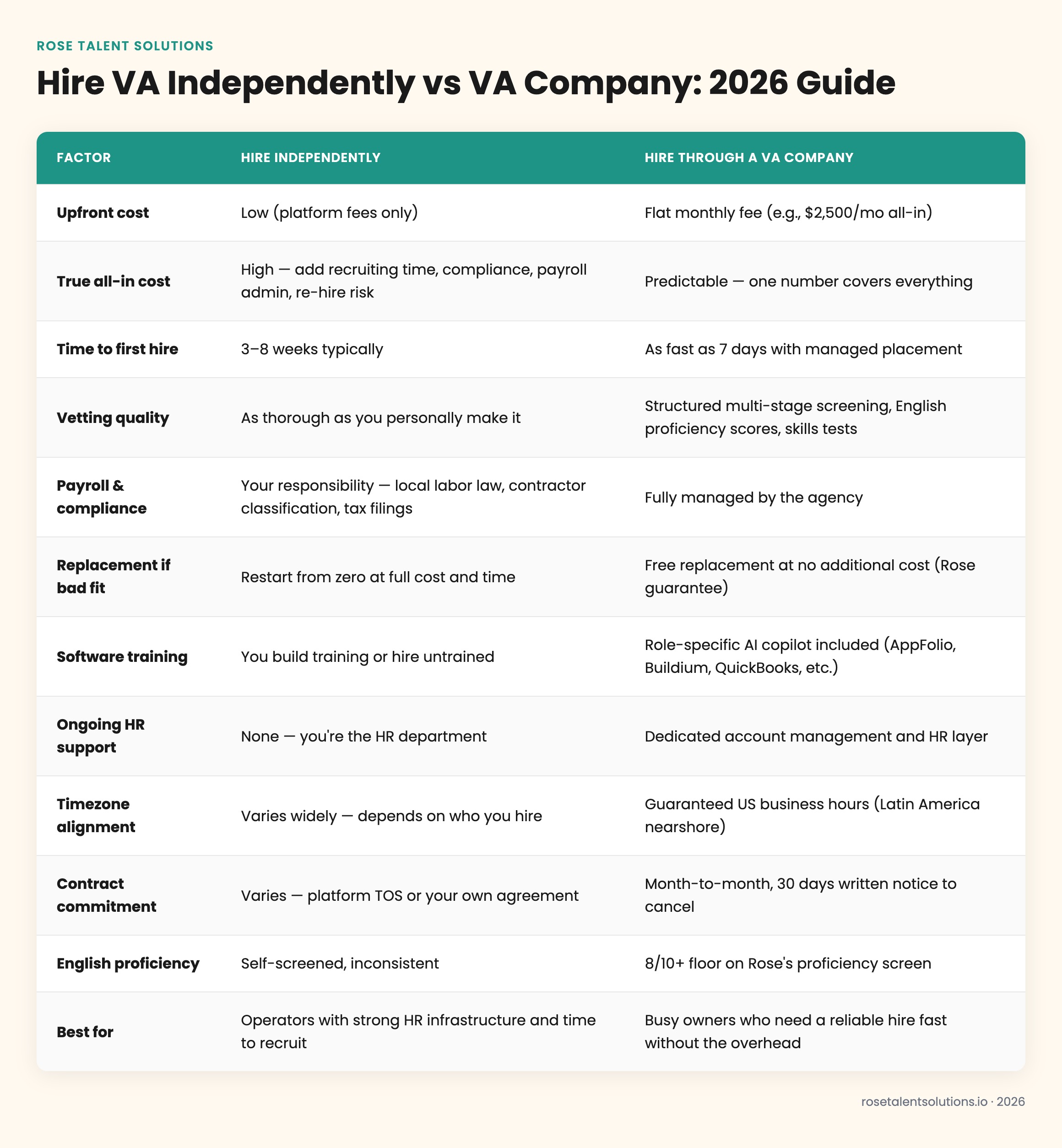
The table below maps out every major decision factor side by side. Use it to identify which friction points matter most for your specific business situation.
| Factor | Hire Independently | Hire Through a VA Company |
|---|---|---|
| Upfront cost | Low (platform fees only) | Flat monthly fee (e.g., $2,500/mo all-in) |
| True all-in cost | High — add recruiting time, compliance, payroll admin, re-hire risk | Predictable — one number covers everything |
| Time to first hire | 3–8 weeks typically | As fast as 7 days with managed placement |
| Vetting quality | As thorough as you personally make it | Structured multi-stage screening, English proficiency scores, skills tests |
| Payroll & compliance | Your responsibility — local labor law, contractor classification, tax filings | Fully managed by the agency |
| Replacement if bad fit | Restart from zero at full cost and time | Free replacement at no additional cost (Rose guarantee) |
| Software training | You build training or hire untrained | Role-specific AI copilot included (AppFolio, Buildium, QuickBooks, etc.) |
| Ongoing HR support | None — you're the HR department | Dedicated account management and HR layer |
| Timezone alignment | Varies widely — depends on who you hire | Guaranteed US business hours (Latin America nearshore) |
| Contract commitment | Varies — platform TOS or your own agreement | Month-to-month, 30 days written notice to cancel |
| English proficiency | Self-screened, inconsistent | 8/10+ floor on Rose's proficiency screen |
| Best for | Operators with strong HR infrastructure and time to recruit | Busy owners who need a reliable hire fast without the overhead |
How AI-Trained VAs From a Company Outperform Independently Hired Generalists in 2026
One of the most underrated advantages of going through a specialized VA company is what your hire already knows on day one. When you hire a VA independently through a freelance marketplace, you get someone with self-reported skills and whatever training they assembled themselves. When you hire through Rose, every team member ships with a role-specific AI copilot trained on the exact software they'll be using — AppFolio, Buildium, QuickBooks, Yardi, and others.
This matters because software fluency is the actual bottleneck in VA productivity, not raw capability. A VA who already understands how to navigate AppFolio's work order queue, run Buildium reports, or reconcile in QuickBooks can contribute meaningfully in week one. A generalist VA who's never touched your stack needs 4–8 weeks of your time just to become functional.
"AI-augmented workers who receive role-specific tool training before starting a new engagement outperform self-trained counterparts by 40% on task completion speed in the first 30 days." — McKinsey Global Institute, The State of AI at Work (2024)
According to McKinsey Global Institute's AI research (2024), organizations that deploy AI-augmented workers with role-specific tooling see measurably faster ramp times and higher task accuracy in the first quarter. That's the gap between a software-trained nearshore VA and an untrained independent hire.
The real ROI of a VA company isn't just in finding someone faster — it's in deploying someone who's already trained on your stack, backed by an AI copilot, and supported by an HR layer if something goes wrong. That combination is structurally impossible to replicate when you hire independently.
For businesses that handle bookkeeping and accounting functions through a VA, software fluency is non-negotiable. A VA who can navigate QuickBooks on day one — not week six — is the difference between a productive hire and an expensive training project.

How to Evaluate Which Path Is Right for Your Business
The honest answer is that hiring independently makes sense for a narrow profile of business owner: someone with existing HR infrastructure, time to recruit, legal resources to handle contractor compliance, and the operational bandwidth to onboard and manage a hire without support. If that's you, the cost savings of going direct are real.
For everyone else — especially growing businesses, property managers, and lean teams — the managed route wins on total cost, speed, and risk. The question isn't just "which is cheaper per hour?" It's "which costs less when I add up everything, including my own time and the cost of a bad hire?"
If you're still weighing the fundamental geographic question — not just company vs. independent — this deep-dive on hiring virtual assistants from Latin America explains why the region has become the dominant nearshore talent pool for US businesses in 2026. And if you're specifically comparing nearshore Latin America to offshore Asia-Pacific options, this onshore vs. offshore VA comparison covers timezone, communication, and cost tradeoffs in detail.
Hire Through a VA Company — Pros
- All-in flat rate — no hidden payroll, compliance, or HR costs
- Structured multi-stage vetting with English proficiency scoring
- Role-specific AI copilot included at no extra cost
- Free replacement if the hire isn't a fit
- Month-to-month terms — no long-term contract
- US business hours guaranteed (nearshore Latin America)
- Ongoing HR and account management support
Hire Through a VA Company — Cons
- Higher nominal monthly rate than a raw freelance hourly rate
- Less direct control over sourcing criteria
- Agency layer means slightly less flexibility in niche role customization
According to Gallup's State of the Global Workplace report (2024), employees who receive structured onboarding and ongoing manager support are 3.4× more likely to feel engaged and 2.6× more likely to stay past 12 months. A VA company provides that structural support layer by default — when you hire independently, you are the onboarding program.
The managed model is also the right call for property management operators who need VAs trained on platforms like AppFolio or Buildium and can't afford a 6-week ramp while tenants are calling and work orders are piling up.
Submit Your Role Brief
Tell Rose what role you need filled, which software your VA will use, and your preferred start date. Takes about 10 minutes.
Receive Matched Candidates
Rose's team recruits, screens, and presents 2–3 pre-vetted candidates — already scored on English proficiency and role-specific skills.
Select and Onboard
You interview your shortlist, choose your hire, and onboard with the AI copilot already configured for your software stack.
Go Live — With a Safety Net
Your VA starts working US business hours from Latin America. If they're not the right fit, Rose replaces them at no additional cost.
According to Statista's global remote work productivity data (2024), structured remote onboarding programs reduce time-to-productivity by an average of 34% compared to ad hoc approaches. That's the difference between a VA who's contributing in week one versus one you're still hand-holding in week five.