
What Does It Mean to Hire Nearshore Talent in 2026?
Nearshore talent refers to skilled professionals hired from countries geographically and culturally close to your own — for US and Canadian businesses, that means Latin America. Unlike offshore hires based in the Philippines or India (who often work 10–14 hours behind US time zones), nearshore team members in Colombia, Mexico, or Argentina operate on EST, CST, or PST. They're on your Slack when you are. They answer calls when your customers call. That real-time alignment is the core value proposition, and it's why demand for virtual assistants from Latin America has surged heading into 2026.
A nearshore virtual assistant (VA) is a full-time remote professional based in Latin America who handles specific business functions — administrative support, bookkeeping, property management coordination, customer service, or operations — for a US, Canadian, or UK employer. Rose Talent Solutions' published English proficiency floor is 8/10 or higher on standardized screening, meaning every placement can communicate clearly and confidently with your clients from day one.
If you're still weighing the full spectrum of options, the complete nearshore vs. offshore vs. onshore virtual assistant comparison breaks down every dimension — cost, risk, language, and time zone — in one place.
Why 2026 Is the Right Year to Hire Nearshore Talent
Several macro forces have collided to make 2026 the clearest window yet to build a nearshore team. US labor costs keep climbing — the Bureau of Labor Statistics reports that total employer compensation costs for private-sector workers rose 4.2% year-over-year as of early 2025, according to the U.S. Bureau of Labor Statistics (2025). Meanwhile, Latin American talent pipelines have deepened — university enrollment in business, technology, and finance disciplines across Colombia, Mexico, and Argentina has grown steadily, producing a large, English-fluent graduate class entering the workforce every year.
At the same time, AI tooling has become table stakes. The most effective nearshore providers now pair each team member with a role-specific AI copilot trained on the software they'll actually use — AppFolio, Buildium, QuickBooks, and others. That means your new hire isn't just competent on day one; they're genuinely faster than a local hire who's learning the same tools from scratch. You can read more about how this works on Rose's AI advantage page.
According to Deloitte's Global Outsourcing Survey (2022), 70% of companies cite cost reduction as a primary driver of outsourcing decisions — but the fastest-growing secondary driver is access to skills and capabilities not available locally. Latin America now delivers on both simultaneously, which is what makes the nearshore model so compelling in 2026.

How Nearshore Compares to Offshore and Onshore in 2026
The three-way comparison is worth spelling out clearly, because the word "virtual assistant" gets applied to wildly different things. An offshore VA from Southeast Asia might cost $8–12/hour but arrives with a 12-hour time gap and variable English fluency. A US-based onshore VA solves those problems but typically runs $25–45/hour — sometimes more in high-cost markets. Nearshore sits in the middle on price and at the top on timezone fit and cultural alignment for North American businesses.
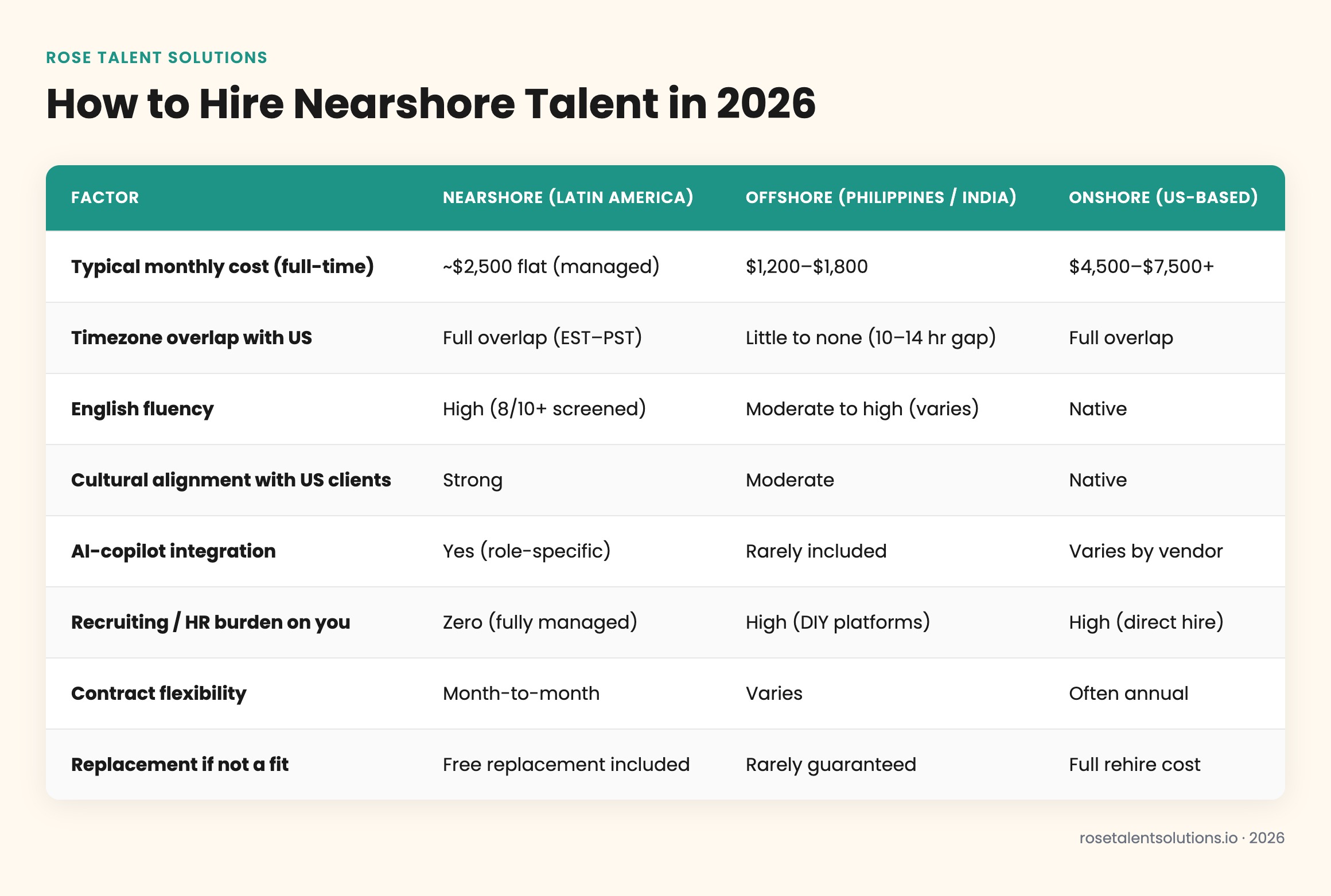
The table below maps the key decision variables side by side. For a deeper narrative analysis of these trade-offs, see Rose's post on onshore vs. offshore virtual assistants, which covers scenarios where each model makes the most sense.
| Factor | Nearshore (Latin America) | Offshore (Philippines / India) | Onshore (US-Based) |
|---|---|---|---|
| Typical monthly cost (full-time) | ~$2,500 flat (managed) | $1,200–$1,800 | $4,500–$7,500+ |
| Timezone overlap with US | Full overlap (EST–PST) | Little to none (10–14 hr gap) | Full overlap |
| English fluency | High (8/10+ screened) | Moderate to high (varies) | Native |
| Cultural alignment with US clients | Strong | Moderate | Native |
| AI-copilot integration | Yes (role-specific) | Rarely included | Varies by vendor |
| Recruiting / HR burden on you | Zero (fully managed) | High (DIY platforms) | High (direct hire) |
| Contract flexibility | Month-to-month | Varies | Often annual |
| Replacement if not a fit | Free replacement included | Rarely guaranteed | Full rehire cost |
What Roles Can You Fill When You Hire Nearshore Talent?
The range is broader than most business owners expect. The highest-volume use cases in 2026 fall into three buckets: property management support, bookkeeping and accounting, and executive or administrative assistance. But nearshore placements also cover marketing coordination, customer success, inside sales support, data entry, and operations management.
For property managers specifically, a nearshore coordinator can handle work order intake, lease renewals, tenant communications, and AppFolio or Buildium data entry — tasks that eat 2–3 hours of a property manager's day but rarely require a licensed professional to execute. Rose's property management VA service is built exactly around this workflow, with team members pre-trained on the most common PM software stacks.
On the finance side, a nearshore bookkeeping specialist can own your QuickBooks reconciliation, accounts payable, monthly close, and owner distributions — the kind of work that costs $55–75/hour from a local bookkeeper but can be handled just as accurately by a credentialed Latin American accountant at a fraction of that rate. Rose's bookkeeping and accounting VA service places professionals with actual accounting degrees, not just data entry experience.
"Remote work has permanently expanded the talent market. The question is no longer whether distributed teams work — it's which geography gives you the best combination of cost, communication, and reliability." — Johnny C. Taylor Jr., President & CEO at SHRM (2024)
According to Gallup's State of the Global Workplace report (2024), employees who work in roles well-matched to their skills show 23% higher productivity — a finding that underscores why role-specific vetting (not just generic VA placement) produces meaningfully better outcomes for the businesses hiring them.
The property management industry alone illustrates the scale of the opportunity. The National Multifamily Housing Council (NMHC) (2024) reports that the US apartment industry employs roughly 17.5 million people across on-site and administrative roles — and operators at every scale are under pressure to reduce overhead without sacrificing service quality. Nearshore staffing is one of the clearest levers available.
The hidden cost of offshore VAs isn't the hourly rate — it's the 6–14 hour timezone gap that turns every quick question into a 24-hour delay. When a tenant calls about a maintenance emergency at 2pm EST, a nearshore coordinator picks up. An offshore team member reads the message the next morning.

How the Hiring Process Works in 2026: Step by Step
One of the biggest friction points for business owners considering their first nearshore hire is uncertainty about the process. How long does it take? Who does the vetting? What happens if the person isn't a good fit? With a fully managed model like Rose, the answers are straightforward. For more context on what distinguishes managed nearshore staffing from DIY platforms, the Rose post on Latin America staffing agencies explains the structural difference clearly.
Intake & Role Definition
You spend 20–30 minutes with a Rose placement specialist mapping the exact tasks, software, and hours you need covered. This brief drives the entire search.
Sourcing & Vetting
Rose recruits from its Latin America talent network, running English proficiency screens (8/10+ floor), skills assessments, and background checks. You never post a job ad or review a résumé pile.
Candidate Presentation
You receive a shortlist — typically 2–3 pre-vetted candidates — with a written profile for each. You interview the ones you want and choose.
AI Copilot Onboarding
Your new team member arrives with a role-specific AI copilot already configured for your software stack — AppFolio, Buildium, QuickBooks, or whichever tools your business runs on.
Ongoing Management
Payroll, HR, compliance, and performance oversight stay with Rose. If the placement isn't the right fit at any point, Rose replaces them at no additional cost — no rehiring fees, no downtime billing.
McKinsey research on workforce transformation found that companies that invested in structured onboarding and clear role definition saw new-hire productivity reach full output 34% faster than those without defined processes, according to McKinsey & Company (2022). That's exactly what a managed nearshore model operationalizes — the structure is built in.
What Does It Cost to Hire Nearshore Talent in 2026?
Rose Talent Solutions prices at a flat $2,500/month for a full-time, 40-hour-per-week team member. That rate is all-in: recruiting, vetting, payroll processing, HR, and ongoing management are included. There are no add-on fees for the AI copilot, no placement charges, and no long-term contract required — the engagement is month-to-month with 30 days written notice to cancel.
Compare that to the fully loaded cost of a US-based employee. The Society for Human Resource Management estimates that the average cost per hire in the US is $4,683, according to SHRM (2024) — and that's before salary, benefits, payroll taxes, and equipment. A full-time US admin or coordinator at $22/hour costs roughly $3,800/month in wages alone, before you add the 25–35% burden of benefits and employer taxes.
Pew Research Center data on workforce composition shows that remote-capable workers increasingly expect location flexibility as a baseline condition of employment, according to Pew Research Center (2022) — which means US employers competing for local administrative talent face both higher wages and higher attrition risk. Nearshore staffing sidesteps both pressures simultaneously.
The risk reversal is a free replacement: if the team member isn't the right fit for your business, Rose places a new one at no additional cost. That eliminates the single biggest financial risk of any hire — the sunk cost of a bad match.
Why Nearshore Works
- Full US timezone overlap — real-time collaboration, no overnight delays
- High English fluency screened before you ever meet a candidate
- Flat monthly rate with all HR, payroll, and management included
- Role-specific AI copilot accelerates ramp time significantly
- Month-to-month terms — no long-term contract locks you in
- Free replacement if the placement isn't the right fit
What to Plan For
- Requires a 30–60 minute intake call to define the role clearly
- Best results come when you have documented SOPs to hand off
- Not ideal if the role requires a physical US presence
- Savings vs. offshore are smaller — the value is speed and alignment, not rock-bottom cost
If you're ready to move forward, the fastest next step is Rose's intake process — you can start your placement here with a short call to map your role requirements.
The all-in flat rate and free replacement guarantee are what make nearshore staffing through a managed agency categorically different from posting on a freelance marketplace and hoping for the best. With a DIY platform, every bad hire is entirely your problem. With a managed model, the agency has skin in the game on quality.