
Nearshore Swift developers — based in Latin America, working US business hours — have become the go-to hire for US startups and product teams that need iOS and Apple-platform talent without paying San Francisco salaries or absorbing a 12-hour time zone gap. If you've been burning time interviewing offshore candidates who disappear mid-sprint or onshore freelancers who invoice $150/hour, this guide is for you. We'll break down exactly how nearshore Swift hiring works in 2026, what it costs, and how to avoid the mistakes that slow most teams down.
What Is a Nearshore Swift Developer — and Why Does It Matter in 2026?
A nearshore Swift developer is a full-stack or iOS-focused engineer based in Latin America (think Colombia, Mexico, Argentina, Brazil, or Costa Rica) who works synchronously with a US or Canadian team during normal business hours. Unlike offshore developers in Southeast Asia or South Asia, nearshore engineers overlap with US Eastern and Pacific time zones by four to eight hours, which means real-time code reviews, same-day pull request merges, and no overnight communication lag.
Swift is Apple's primary programming language for iOS, macOS, watchOS, and visionOS development. Demand for Swift engineers has surged alongside App Store growth: Statista (2024) tracks over 1.8 million apps currently live on the iOS App Store, each representing an engineering team that needs ongoing Swift talent. As Apple's ecosystem expands into enterprise and health tech, the gap between Swift developer supply and demand in the US keeps widening — and nearshore hiring is the most practical bridge.
If you're new to nearshore staffing or want a full framework before diving into Swift-specific hiring, the nearshore vs. offshore vs. onshore comparison guide on Rose's blog is the clearest breakdown available — it covers cost, overlap hours, and communication quality across all three models.
How 2026 Swift Developer Demand Is Reshaping Nearshore Hiring
The US Bureau of Labor Statistics projects software developer employment to grow 25% from 2022 to 2032 — far faster than average — and Apple-platform specialization (Swift, SwiftUI, Combine) commands a premium within that pool. The result: US-based senior Swift engineers are quoting $160,000–$220,000 in annual base salary, plus equity and benefits, according to Levels.fyi (2024). For a Series A startup or a mid-market product company, that's an enormous fixed cost for a single IC.
Latin America's tech workforce has grown dramatically in response to exactly this gap. Argentina alone produces over 100,000 engineering graduates annually, according to the Inter-American Development Bank (2023), and Colombia's tech export sector has expanded 30%+ year-over-year. Swift adoption across LATAM developer communities mirrors global trends — Apple's developer certification programs have made Swift training accessible and standardized across the region.

The practical implication: a US company paying $2,500/month for a full-time nearshore Swift developer through Rose Talent Solutions is accessing a vetted, English-fluent engineer at a fraction of the domestic market rate — without the management overhead of running a foreign subsidiary or juggling offshore contractor invoices. If you want context on how the broader Latin America staffing market works before engaging a specific agency, this overview of the Latin America staffing agency landscape is worth ten minutes of your time.
Nearshore vs. Offshore vs. Onshore Swift Developers: 2026 Comparison
Not all "remote developer" arrangements are equal. The table below maps the four dimensions that matter most to a US product team: cost, time zone overlap, English communication quality, and typical ramp-up time to productive code contribution.
| Factor | Nearshore (Latin America) | Offshore (India / Philippines) | Onshore (US/Canada) |
|---|---|---|---|
| Monthly Cost (Full-Time) | ~$2,500–$4,500 all-in | ~$1,200–$2,800 all-in | ~$12,000–$20,000+ all-in |
| US Time Zone Overlap | 4–8 hours daily (high) | 0–2 hours daily (very low) | Full overlap |
| English Proficiency | Fluent (Rose screens 8/10+) | Variable (often 5–7/10) | Native |
| Ramp-Up Time | 1–2 weeks | 3–6 weeks (async lag) | 1–3 weeks |
| Cultural Alignment | High (similar business norms) | Moderate | High |
| Contract Flexibility | Month-to-month | Varies (often 6–12 mo minimums) | W2 or long-term contract |
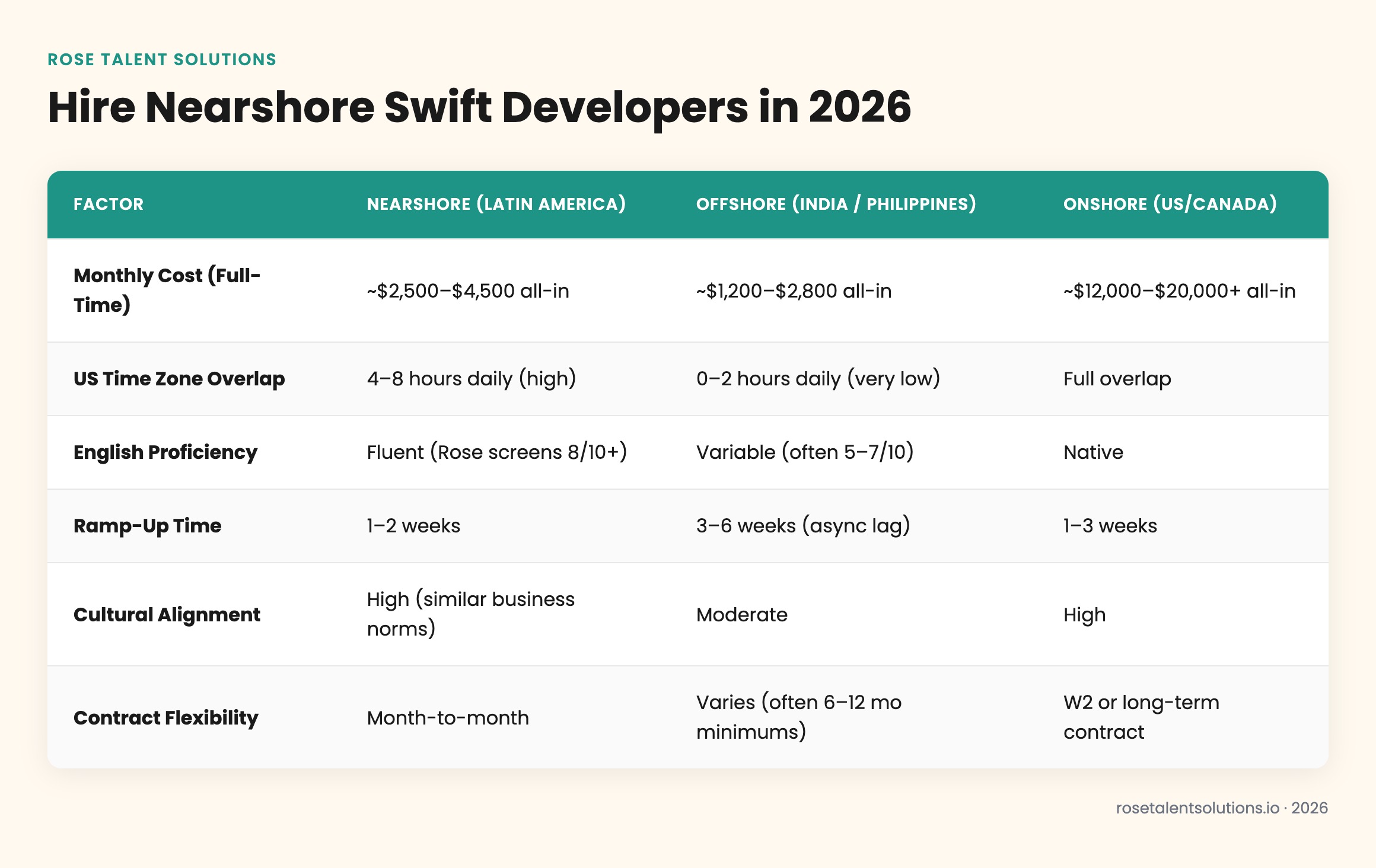
The table makes the trade-off clear: offshore wins on sticker price, onshore wins on cultural shorthand, but nearshore wins on the combination of real-time collaboration and cost efficiency that most growth-stage product teams actually need. The async communication penalty of offshore hiring — where a question asked at 2pm EST doesn't get answered until the following morning — compounds across a sprint cycle into days of lost velocity.
For a deeper look at the onshore vs. offshore decision framework before you add nearshore to the mix, Rose's post on onshore vs. offshore virtual staffing covers the core trade-offs in plain language.
How to Vet and Hire Nearshore Swift Developers the Right Way in 2026
Hiring a Swift developer — nearshore or otherwise — without a structured vetting process is how teams end up with someone who can build a "Hello World" SwiftUI view but falls apart on async/await architecture or App Store submission compliance. Here's the process Rose uses, and what you should replicate if you're vetting independently.
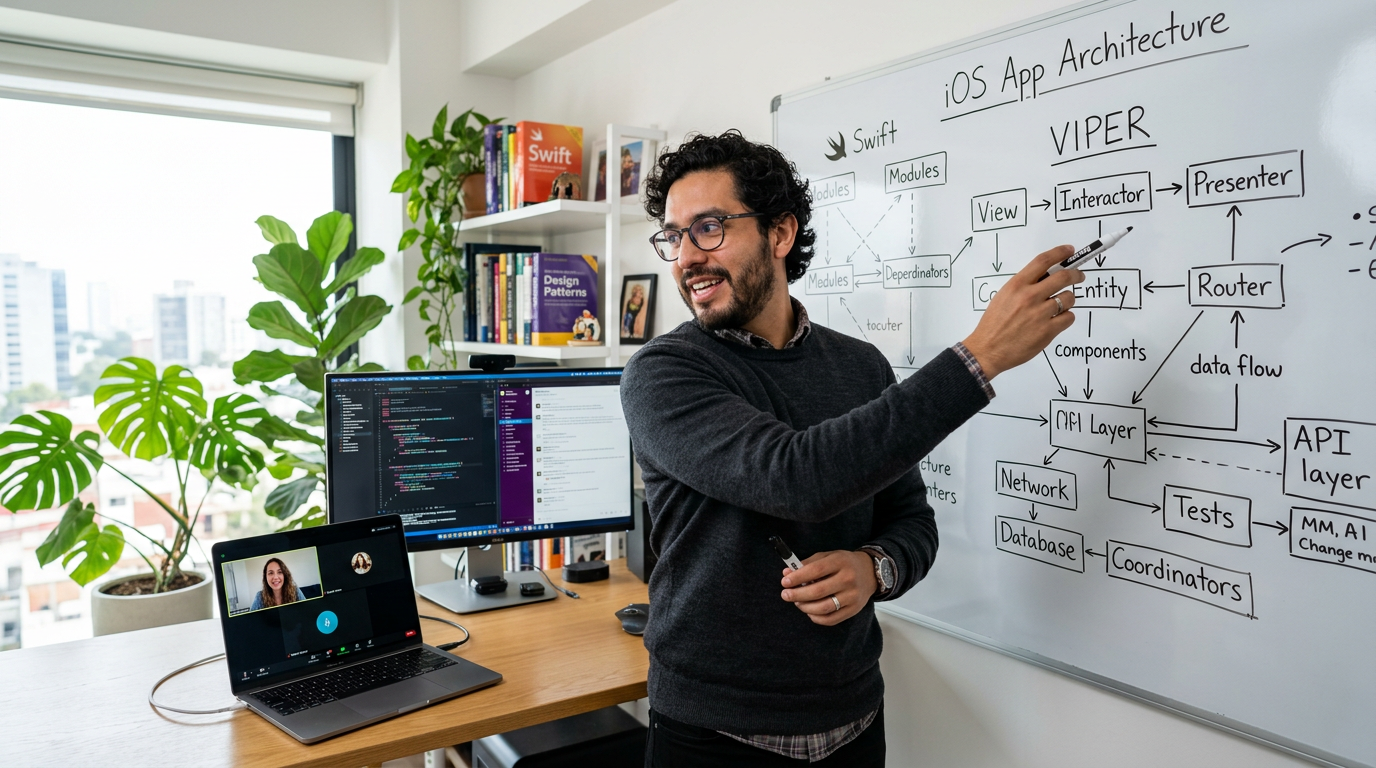
The most common mistake US teams make when hiring nearshore Swift developers is testing for syntax knowledge instead of system design instincts. A developer who can architect a clean MVVM or TCA pattern, manage Combine pipelines under load, and ship a compliant App Store build is worth three times a developer who can pass a LeetCode screen but has never shipped a real app.
Rose's vetting process for technical nearshore hires covers five layers: English proficiency screening (scored 8/10 minimum), portfolio review of live App Store submissions, a timed Swift coding assessment (SwiftUI, Combine, async/await), a system design interview focused on iOS architecture patterns, and a cultural alignment call with the specific US team they'll join. According to SHRM's talent acquisition research (2024), structured multi-stage interviews improve quality-of-hire by up to 50% compared to unstructured screening — a gap that matters acutely when you're hiring across borders without the ability to do an in-person whiteboard session.
Once a developer passes vetting, Rose's AI advantage layer kicks in: every placed team member ships with a role-specific AI copilot trained on their actual stack. For Swift developers, that means an AI assistant pre-loaded with iOS documentation patterns, Xcode workflow shortcuts, and App Store Review Guideline references — cutting the ramp-up period from weeks to days. You can read more about how this works on the AI advantage page.
What Does It Actually Cost to Hire Nearshore Swift Developers in 2026?
Rose Talent Solutions prices nearshore talent at $2,500/month flat — full-time (40 hours/week), all-in. That rate covers recruiting, technical vetting, payroll processing, HR compliance, and ongoing performance management. There's no long-term contract: the arrangement runs month-to-month with 30 days written notice to cancel. If the developer isn't the right fit for your team, Rose replaces them at no additional cost.
Compare that to the fully-loaded cost of a US-based mid-level Swift developer: $160,000+ base salary, plus 25–30% in employer taxes and benefits, plus recruiting fees (typically 15–25% of first-year salary if you use a traditional technical recruiter). According to McKinsey's research on hiring costs (2023), a failed mid-level technical hire can cost 1.5–2× annual salary in total replacement expense. The nearshore model with a built-in replacement guarantee structurally eliminates that tail risk.
Pros of Nearshore Swift Hiring
- Real-time US hours overlap — no overnight async lag
- $2,500/month flat vs. $15,000–$18,000/month fully-loaded US equivalent
- Month-to-month terms — no long-term contract lock-in
- Free replacement if the developer isn't a fit
- Latin America engineering talent pool growing 30%+ YoY
- 8/10+ English proficiency screened at intake
Considerations to Plan For
- Requires a clear onboarding doc and codebase access from day one
- Some niche Swift specializations (e.g., visionOS, CarPlay) have a smaller LATAM talent pool
- Time zone overlap, while strong, is not 100% — West Coast 5pm meetings may fall after LATAM hours
For teams exploring the full range of Latin America hiring options — not just Swift developers — Rose's guide on how to hire virtual assistants from Latin America explains the regional talent landscape and what to look for in a placement partner.
How to Onboard a Nearshore Swift Developer in 2026: The Rose Process
Speed to productivity is the metric that matters after hire. Rose's standard onboarding sequence gets a nearshore Swift developer from signed agreement to committed code in under two weeks.
Role Definition Call
Rose's team meets with your engineering lead or CTO to map the specific Swift stack (UIKit vs. SwiftUI, backend integration type, testing requirements, App Store cadence). This call takes 30 minutes and drives the matching criteria.
Candidate Matching (Days 1–5)
Rose surfaces 1–3 pre-vetted candidates from the active nearshore pool who match your stack and seniority requirements. You review recorded technical interviews and live App Store portfolio links — no cold screening required from your side.
Interview and Select (Days 5–7)
You run a single final-round technical conversation — typically a 45-minute architecture discussion or pair programming session. Rose coordinates scheduling across time zones.
Access and Tooling Setup (Day 7–8)
Your new developer receives repo access, Jira/Linear onboarding, Slack workspace invite, and the AI copilot configuration tailored to your specific Xcode and CI/CD environment.
First Sprint (Week 2)
The developer joins your first standup, picks up assigned tickets, and ships their first PR. Rose's account manager checks in at day 7 and day 30 to validate fit and address any calibration needed.
If you're ready to start the process, the fastest path is the intake form at Rose's start page — the role definition call is typically scheduled within 24 hours of submission.
For teams that also need operational or financial support alongside engineering — bookkeepers, project coordinators, or admin staff — Rose's bookkeeping and accounting team and property management staffing practices operate on the same $2,500/month model, making it straightforward to build a blended nearshore team across functions.
"The developers coming out of Latin America — particularly Argentina and Colombia — are not junior resources filling a cost arbitrage role. They are senior engineers who happen to live in a lower cost-of-living geography. The mistake US companies make is treating them like the former." — Ariel Camus, CEO at Microverse (2023)
The 2026 nearshore Swift developer market rewards companies that treat placement as the beginning of an engineering relationship, not a staffing transaction. With the right vetting, the right onboarding structure, and the right agency partner, a Latin America-based Swift engineer can be your most productive team member within 30 days — at a cost that makes the math impossible to argue with.