
Nearshore software development has quietly become one of the most efficient hiring strategies for US, Canadian, and UK tech teams in 2026. Rather than managing a 10-hour timezone gap with vendors in Asia, or paying $120,000+ per year for a domestic senior developer, nearshore staffing gives you full-time, English-fluent talent — sourced exclusively from Latin America — working your business hours at a fraction of the cost. If you're comparing the best nearshore software development companies right now, this guide breaks down what actually separates good providers from great ones, and what the pricing, models, and red flags look like on the ground.
What Is Nearshore Software Development — and Why Does It Matter in 2026?
Nearshore software development means hiring technical talent from geographically close countries that share or overlap with your timezone. For US-based businesses, that means Latin America — countries like Colombia, Mexico, Argentina, and Costa Rica. Latin American nearshore is a fundamentally different model from traditional outsourcing to Asia or Eastern Europe, where timezone gaps alone add 24–48 hours of latency to every code review, pull request, or bug escalation.
The distinction matters because software development is a real-time collaboration sport. Stand-ups, sprint reviews, stakeholder demos — they all assume your developer is awake and reachable when you are. Timezone alignment is not a soft perk; it's a hard multiplier on team velocity. A nearshore developer in Medellín working CST hours attends your 10am stand-up the same way a Chicago hire does.
According to Deloitte's Global Outsourcing Survey (2024), 72% of software teams cite timezone misalignment as their top productivity challenge with non-nearshore vendors. That single data point explains why nearshore Latin American staffing has grown faster than traditional outsourcing over the last three years — and why the best nearshore software development companies are booked out months in advance.
How Nearshore Compares to Offshore and Onshore Staffing in 2026
Before you evaluate any specific provider, it helps to understand what you're actually comparing. The table below maps the three main staffing models across the dimensions that move the needle for engineering teams: timezone overlap, English fluency, cost, ramp time, and contract flexibility.
| Factor | Nearshore (Latin America) | Non-Nearshore Offshore | Onshore (US / Canada) |
|---|---|---|---|
| Timezone Overlap with US | Full overlap (same or ±2 hrs) | Minimal (8–12 hr gap) | Full overlap |
| English Fluency | High (8/10+ screened) | Variable (5–8/10 typical) | Native |
| Avg. Monthly Cost (Full-Time) | $2,000–$3,500 all-in | $800–$2,000 all-in | $7,000–$14,000+ all-in |
| Typical Ramp Time | 3–7 days | 14–30 days | 14–45 days |
| Long-Term Contract Required? | Often month-to-month | Often 3–12 month lock-in | At-will or agency contract |
| Cultural Alignment (US business) | High | Moderate | High |
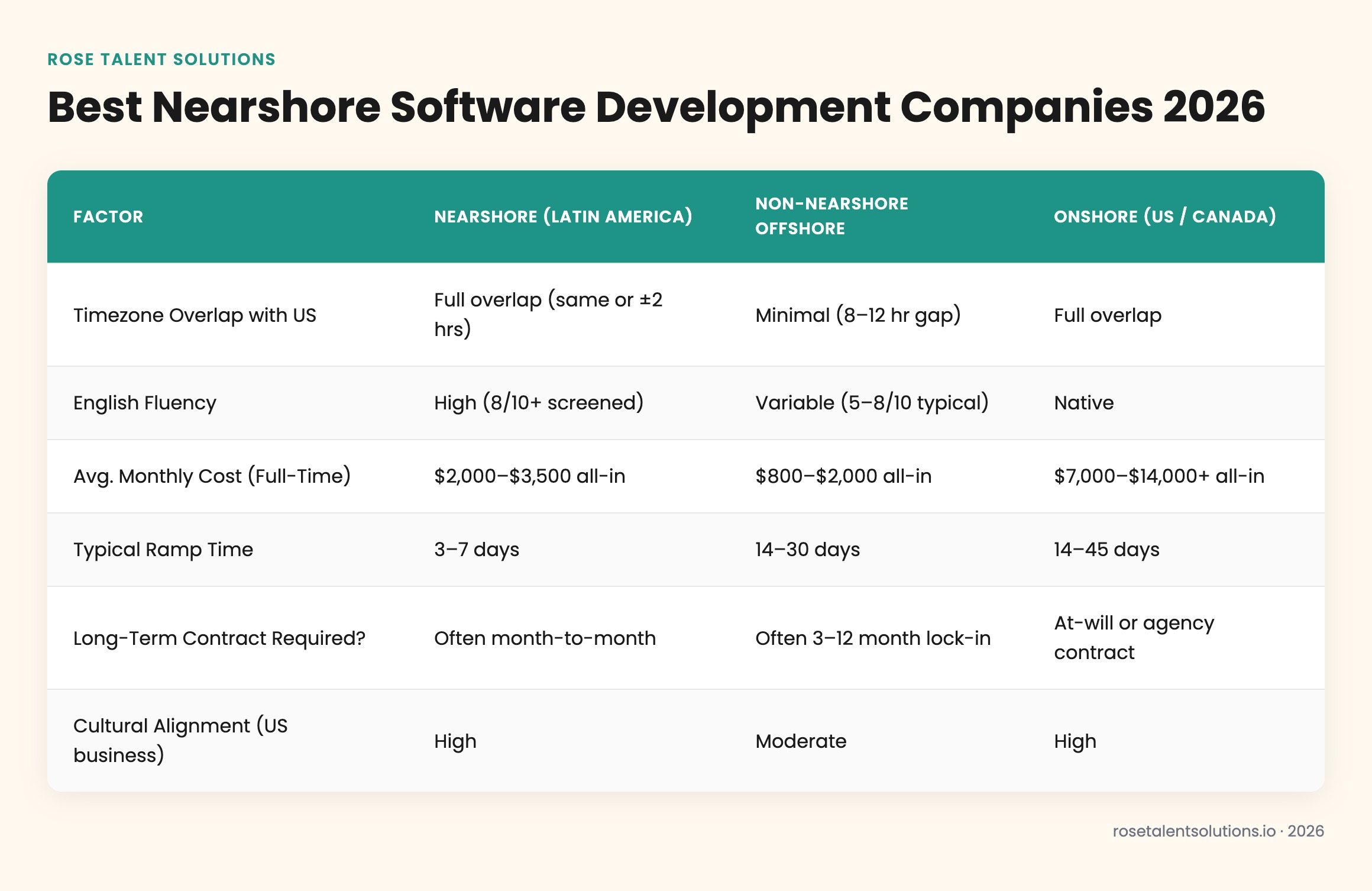
The cost comparison above reflects fully-loaded rates — not just the developer's hourly wage. Onshore hiring at $100k/year sounds straightforward until you add employer payroll taxes, benefits, recruiting fees, and equipment. Vendors operating across large timezone gaps look cheap until you add project management overhead to bridge the communication gap. Nearshore Latin American staffing — done through a managed staffing partner — lands in the sweet spot: real collaboration hours at a predictable monthly flat rate.

How to Evaluate the Best Nearshore Software Development Companies in 2026
Not all nearshore providers are built the same. Some are traditional staffing agencies that happen to source from Latin America. Others are full-stack managed services. A growing category — where Rose Talent Solutions sits — operates as a managed nearshore staffing partner: they handle recruiting, vetting, payroll, HR compliance, and ongoing management so you get a full-time team member without the employer-of-record headaches.
Here are the five criteria that actually separate good nearshore providers from great ones in 2026:
- Timezone discipline — Does the provider guarantee your staff member works your business hours, or just "overlapping" hours that could mean 6am–2pm your time?
- English proficiency screening — What's the minimum bar, and how is it measured? Rose's published floor is 8/10 on structured English proficiency screens.
- AI tool enablement — Does the provider train staff on the software stack your team actually uses? An AI copilot trained on your tools cuts ramp time dramatically.
- Pricing transparency — Flat rate with no hidden markups, or hourly billing that balloons unpredictably? Rose charges $2,500/month flat — recruiting, payroll, HR, and management included.
- Risk reversal — If the person isn't a fit, what happens? The right answer is a free replacement at no additional cost, not a refund negotiation.
The hidden cost of staffing through vendors in distant timezones isn't the hourly rate — it's the management overhead. US engineering leads spend an average of 8–12 hours per week bridging communication gaps with teams operating across large timezone differences, according to McKinsey Digital (2024). That's half a sprint gone before a line of code ships.
What Does a Nearshore Software Staffing Model Look Like in 2026?
If you've only worked with traditional software agencies or non-nearshore dev shops, the managed nearshore staffing model may feel unfamiliar. Here's how a modern provider like Rose Talent Solutions structures the engagement from your first call to your developer's first commit:
Intake & Role Scoping
You define the role — stack, hours, tools, team culture. Rose maps that against its Latin American talent pool and surfaces 2–3 matched candidates within days, not weeks.
Vetting & English Screening
Every candidate clears a structured English proficiency screen (minimum 8/10) plus technical vetting relevant to your stack. You interview finalists — Rose does the filtering work beforehand.
AI Copilot Deployment
Before Day 1, your new team member is paired with a role-specific AI copilot trained on your software environment — whether that's Jira, GitHub, Figma, Notion, or your internal toolchain.
Flat-Rate Billing Starts
You pay $2,500/month, flat. No hourly overages, no recruiting fees on top. Month-to-month — cancel with 30 days written notice, no long-term contract required.
Ongoing HR & Management
Rose handles payroll, HR compliance, and performance management in the background. If the fit isn't right, you get a free replacement — no renegotiation, no extra cost.
This model works because the economics align. Rose is incentivized to send you the right person the first time — a bad placement means they absorb the cost of a re-search and replacement. That's a fundamentally different incentive structure than a project-based vendor who bills by the hour regardless of output quality.
How the Latin American Tech Talent Market Shifts the 2026 Landscape
The supply side of nearshore software development has changed dramatically. Latin America now graduates over 500,000 STEM professionals annually, according to the World Economic Forum (2023), with Colombia, Mexico, and Argentina producing a disproportionate share of software engineers. Developer bootcamp ecosystems in Bogotá, Mexico City, Buenos Aires, and São Paulo have matured to the point where mid-level engineers with 3–5 years of experience in modern stacks are abundant — not scarce.
"Latin America has become a serious contender in the global software talent market — not because it's cheap, but because the combination of technical depth, cultural alignment with the US, and timezone compatibility is genuinely hard to match elsewhere." — Ariel Camus, CEO at Microverse (2024)
English fluency has also improved markedly across the region. According to the EF English Proficiency Index (2024), Argentina ranks in the global top 25 for English proficiency — ahead of several countries historically associated with software outsourcing. Colombia and Costa Rica have both climbed significantly in the same index over the past five years. This matters for software roles specifically because code review comments, PR discussions, architecture docs, and client demos all live in English.

The labor cost arbitrage is real but not the primary story. The primary story is talent density. You can now hire a React developer with 4 years of experience, fluent English, and AWS certification from Bogotá for what you'd pay a junior hire in Austin — and they're in your Slack by 9am. That's the 2026 nearshore advantage in one sentence.
For businesses that also need operational support beyond pure development — think bookkeeping and accounting roles, administrative coordination, or property management support — the same Latin American talent pool and managed staffing model applies. Rose's staffing model covers technical and operational roles under the same flat-rate, month-to-month structure.
Nearshore vs. Non-Nearshore for Software Teams: Pros and Cons in 2026
If you're still weighing nearshore against lower-cost alternatives — particularly if budget is the driving concern — this comparison is worth sitting with before you decide. Non-nearshore options are cheaper on paper. But cheap on paper and cheap in practice are two different things. According to SHRM's workforce research (2024), the total cost of a bad hire or a high-friction vendor relationship averages 50–200% of annual salary when you factor in lost productivity and rehiring costs.
Nearshore Latin America
- Full US timezone alignment — real-time stand-ups, no async bottlenecks
- High English fluency, culturally aligned with US work norms
- Flat-rate, month-to-month pricing with free replacement guarantee
- AI copilot onboarding cuts ramp time to days, not weeks
- Managed HR, payroll, and compliance — zero employer-of-record overhead
Non-Nearshore Alternatives
- 8–12 hour timezone gap creates async-only collaboration by default
- Variable English fluency — technical writing and verbal demos suffer
- Often requires 3–12 month contracts with limited exit flexibility
- Higher management overhead on the US side to bridge communication gaps
- Cultural misalignment on urgency, direct feedback, and decision-making speed
The right choice depends on your team structure. If you run a pure async engineering team on a constrained budget and have strong internal PM coverage, a non-nearshore model can work. But if your developers need to attend sprint ceremonies, talk directly to stakeholders, or pair-program synchronously — Latin American nearshore is the only model that doesn't require you to restructure your entire engineering process around the vendor's timezone.