
Why Nearshore Logistics Coordinators Are the 2026 Hiring Move
Nearshore logistics coordinators—full-time, Latin America-based staff working your US business hours—are quietly replacing both expensive domestic hires and frustrating offshore arrangements for supply chain teams across North America. The math is simple: domestic logistics coordinators cost $55,000–$70,000 per year in salary alone, before benefits, before taxes, before turnover. Offshore coordinators are cheaper, but the 8–12 hour timezone gap turns every freight exception into an overnight delay. Nearshore closes both gaps simultaneously.
The logistics sector is under mounting pressure. Freight volumes, last-mile complexity, and carrier communication demands have all increased, but headcount budgets haven't kept pace. According to the U.S. Bureau of Labor Statistics (2024), employment of logisticians is projected to grow 18% through 2032—well above the national average—meaning domestic talent will become harder and more expensive to attract. Companies that solve the talent gap now build a durable operational advantage.
If you've been comparing nearshore to offshore options and aren't sure where the real differences lie, our complete nearshore vs. offshore vs. onshore virtual assistant comparison breaks down every dimension—cost, timezone, quality, and control—in plain language. The short version: for logistics roles, timezone alignment is the single highest-leverage variable.
What Is a Nearshore Logistics Coordinator? (2-Minute Definition)
A nearshore logistics coordinator is a full-time remote professional based in Latin America—countries like Mexico, Colombia, Costa Rica, or Argentina—who handles supply chain coordination tasks on behalf of a US, Canadian, or UK business. They work standard US business hours (EST, CST, or PST depending on your preference), communicate fluently in English, and operate inside the platforms your team already uses: TMS software, freight broker portals, ERP systems, Slack, and email.
Unlike a freelancer or a part-time virtual assistant, a nearshore logistics coordinator is a dedicated full-time team member. They own a specific function—carrier communication, shipment tracking, customs documentation, vendor follow-up—and they show up every day, just like an in-office hire would. The only difference is you're not paying US salary, US payroll taxes, or US benefits overhead.
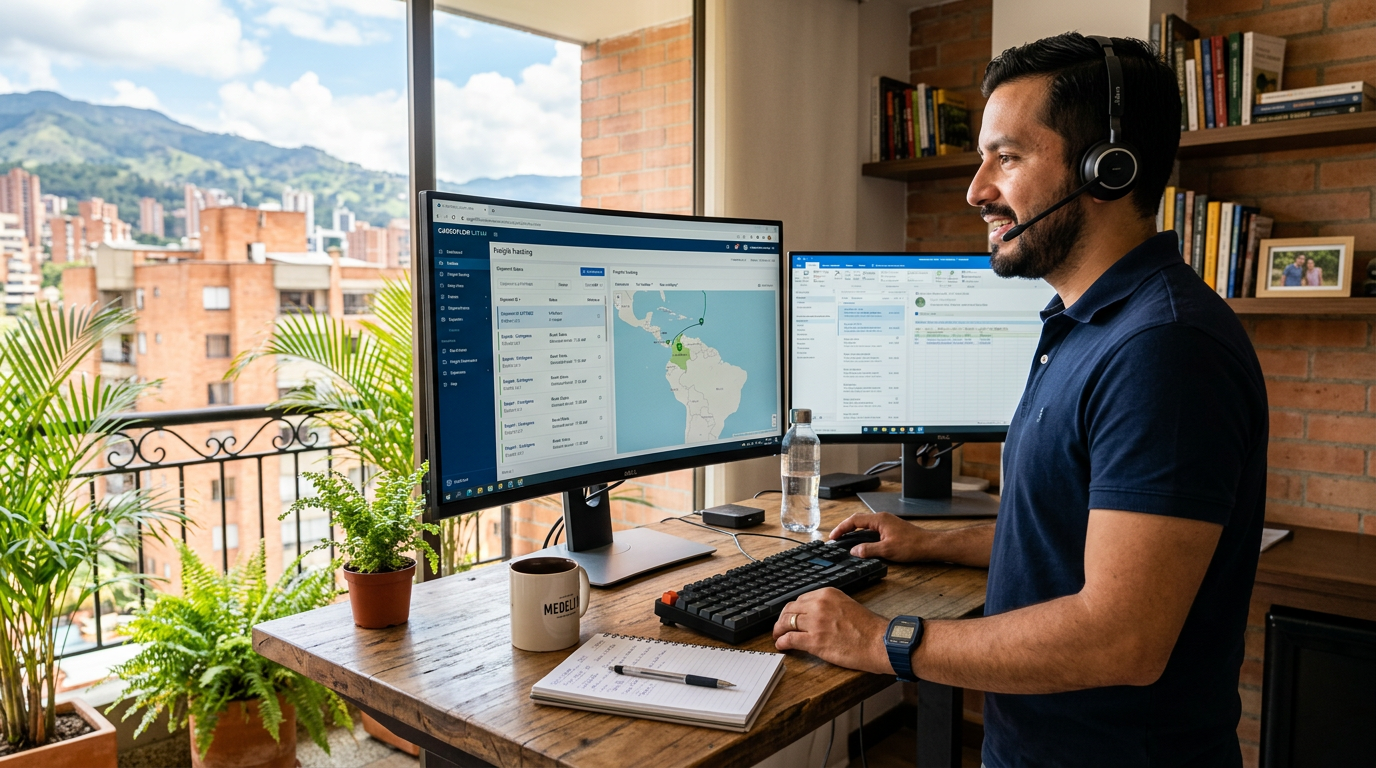
What separates a nearshore coordinator from an offshore one is geography and time. Latin America sits in overlapping or adjacent US time zones. A coordinator in Bogotá, Colombia is only one hour ahead of EST. A coordinator in Mexico City is on CST. That means real-time Slack responses, live phone calls with carriers, and same-day resolution on freight exceptions—none of which are reliably possible when your team is 10 hours ahead in Manila or 12 hours ahead in Mumbai.
How Nearshore Coordinators Outperform Offshore for Logistics Operations
The logistics industry runs on time-sensitive communication. A delayed check call, a missed customs deadline, or an unanswered carrier email doesn't just create paperwork—it creates chargebacks, late fees, and customer churn. This is exactly why the nearshore model outperforms offshore for logistics roles in ways that don't show up in a simple hourly rate comparison.
According to McKinsey & Company (2023), supply chain disruptions cost businesses an average of 45% of one year's profits over a 10-year span—and a significant portion of those disruptions trace back to communication failures and slow response cycles. When your coordinator is 12 time zones away, every question becomes an asynchronous email thread. When they're one hour away, it's a Slack message that gets answered in 4 minutes.
The hidden cost of offshore logistics coordinators isn't the hourly rate—it's the 8–12 hour timezone gap that turns every freight exception, carrier dispute, or customs question into an overnight delay. For logistics operations, that lag compounds daily.
English fluency is the second critical variable. Rose Talent Solutions screens every candidate to an 8/10 or higher English proficiency standard before placement. That means your coordinator can write professional carrier emails, take live calls with dispatchers, and draft customs documentation without a review cycle. Offshore hires at similar price points often require heavy editing and back-and-forth that eats hours your team doesn't have.
For a deeper look at how Latin America compares to other staffing regions across every dimension, the Rose blog post on hiring virtual assistants from Latin America covers the candidate quality data, salary benchmarks, and platform proficiency rates in detail.
"Latin American professionals bring a cultural proximity to US business norms that you simply don't get from Southeast Asia or South Asia—the communication style, the business etiquette, and the overlap in working hours make collaboration feel native, not outsourced." — Flores Salgado, VP of Operations at a North American 3PL provider, as cited in SHRM Global Talent Trends Report (2023)
Nearshore vs. Offshore vs. Onshore: 2026 Coordinator Comparison
Before you commit to a hiring model, you need a clean side-by-side view of what each option actually delivers. The table below compares the three main staffing approaches for logistics coordinator roles across the variables that matter most to operations teams.
| Factor | Nearshore (Latin America) | Offshore (Philippines / India) | Onshore (US-based) |
|---|---|---|---|
| Monthly cost (full-time) | ~$2,500 flat (all-in) | $800–$1,500 (coord only, no HR/mgmt) | $4,500–$6,500+ (salary + benefits) |
| Timezone alignment (US) | ✅ Same or 1–2 hr difference | ❌ 8–13 hr gap | ✅ Exact match |
| English fluency | ✅ 8/10+ screened | ⚠️ Variable; accent friction common | ✅ Native |
| Real-time carrier calls | ✅ Yes, live during your day | ❌ Typically async/overnight | ✅ Yes |
| AI tool training included | ✅ Role-specific AI copilot | ❌ Rarely included | ❌ Rarely included |
| Recruiting/HR managed | ✅ Fully managed | ⚠️ Platform-dependent | ❌ You handle everything |
| Replacement if not a fit | ✅ Free replacement | ⚠️ Varies by platform | ❌ Full re-hire cost |
| Contract commitment | Month-to-month, 30-day notice | Varies widely | At-will but high exit cost |
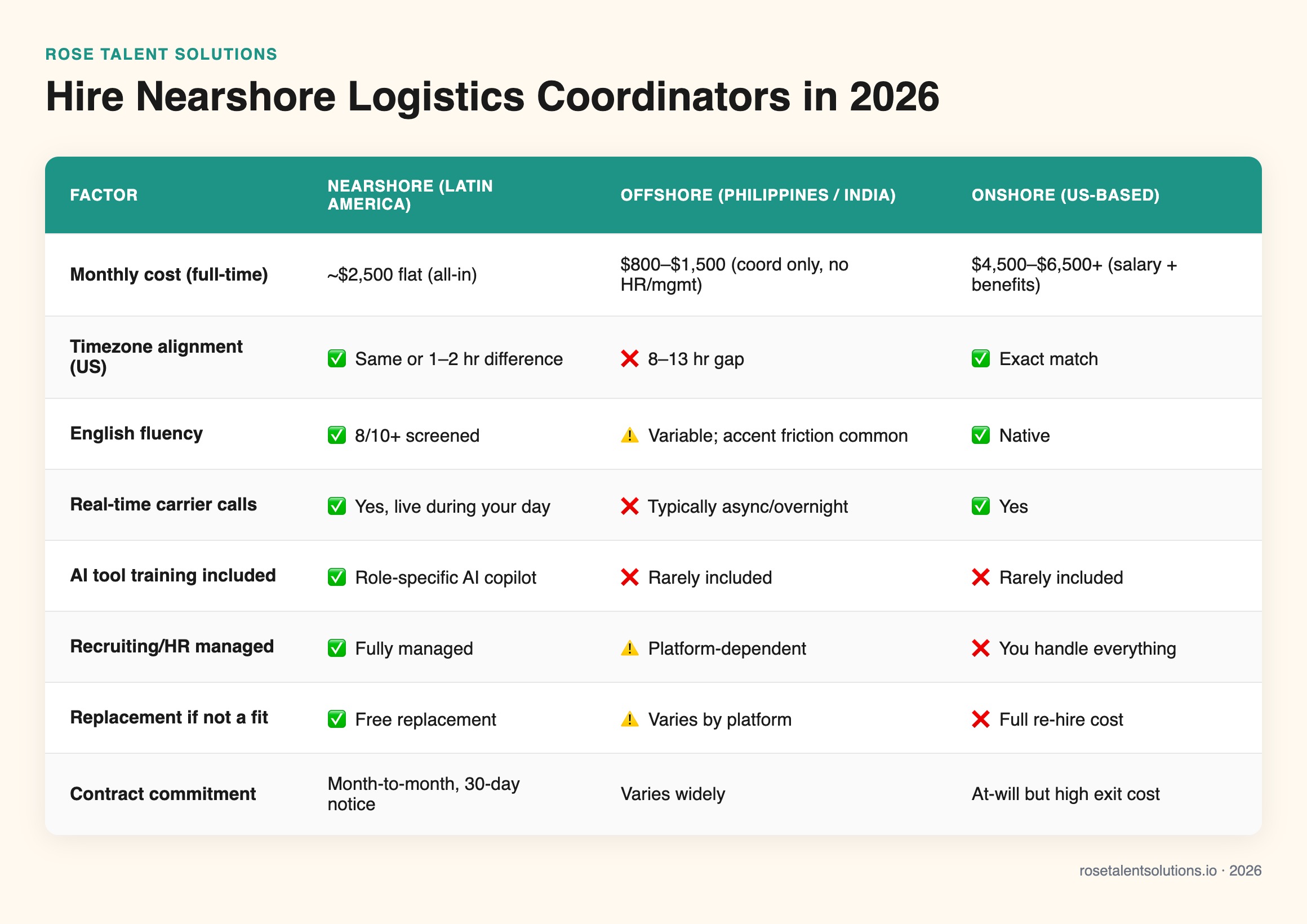
The offshore cost advantage evaporates quickly once you account for the management overhead, timezone-driven delays, and the re-hire cost when a placement doesn't work out. With a nearshore model and a free replacement guarantee, the risk is structurally lower even at a higher nominal rate. You can also read our full breakdown of onshore vs. offshore virtual assistant tradeoffs for a deeper analysis of how these models compare in real operational settings.
What Tasks Can a Nearshore Logistics Coordinator Handle in 2026?
One of the most common questions from operations managers is scope: what can a nearshore coordinator actually own end-to-end? The answer is more than most people expect. A well-placed, well-trained nearshore logistics coordinator can take over the following functions completely, with minimal oversight from your internal team once ramped.
- Shipment tracking and exception management — monitoring TMS dashboards, flagging delays, proactively updating customers
- Carrier communication — check calls, POD retrieval, appointment scheduling, claims initiation
- Freight invoice auditing — matching BOLs to invoices, flagging discrepancies, submitting disputes
- Customs and compliance documentation — compiling and reviewing import/export paperwork for broker submission
- Vendor and supplier follow-up — PO status tracking, delivery confirmations, lead time updates
- Customer order updates — proactive outreach on delays, ETA communication, escalation routing
- Data entry and reporting — maintaining logistics KPIs in spreadsheets or BI tools, updating ERP records
- Rate shopping support — pulling quotes from broker portals, comparing lanes, organizing load boards
Every Rose team member also ships with a role-specific AI copilot trained on the software your coordinator uses daily. If your team runs on a TMS like Flexport, a freight ERP, or even just a complex Google Sheets workflow, the AI copilot is configured to accelerate exactly those tasks—cutting ramp time and reducing the small errors that slow new hires down. According to McKinsey Digital (2023), generative AI tools can automate 60–70% of time spent on data movement and documentation tasks in operations roles—which is precisely where logistics coordinators spend their first two hours every morning.

How Rose Talent Solutions Places Nearshore Coordinators: The 2026 Process
Understanding the placement process removes the biggest hesitation most operators have: "How long does this actually take, and how much work does it create for me?" The answer is that Rose handles the entire workflow. You describe the role; Rose delivers a vetted coordinator. Here's what that looks like in practice.
Role Scoping Call
Rose's team walks through your logistics workflows, software stack, and team structure to define the exact coordinator profile needed—tasks, hours, platform skills, and communication style.
Candidate Sourcing & Vetting
Rose recruits from its Latin America talent network, screens for English proficiency (8/10+ floor), logistics domain knowledge, and software familiarity. You receive a shortlist of matched candidates—not a pile of resumes.
Interview & Selection
You interview your top choice. Rose facilitates scheduling, provides a structured interview guide, and offers its own assessment data so you make a confident hire, not a hopeful guess.
Onboarding & AI Copilot Setup
Rose handles payroll, HR paperwork, and compliance. The coordinator's role-specific AI copilot is configured before day one—so your new team member arrives trained on your tools, not learning from scratch.
Ongoing Management Support
Rose stays in the loop on performance, conducts check-ins, and manages any HR issues. If the coordinator isn't the right fit for any reason, Rose replaces them at no additional cost.
The entire process from intake to first placement typically runs 1–7 business days. That's faster than writing a job description, posting on Indeed, and waiting for a résumé pile to accumulate. And unlike a direct hire, you're not taking on payroll infrastructure, benefits management, or legal employment risk in a foreign jurisdiction—Rose manages all of it.
Pricing is $2,500 per month, flat. That's full-time (40 hours per week), all-in. Recruiting, vetting, payroll, HR, ongoing management, and the AI copilot are included. There's no long-term contract—just month-to-month with 30 days written notice if you ever need to cancel. And if your coordinator isn't the right fit, Rose replaces them at no additional cost. That's the only risk reversal we offer, and we think it's the right one: you're not taking a blind leap, you're making a structured hire with a built-in correction mechanism.
If you're evaluating Latin America staffing agencies and want to understand how Rose compares to other providers in the region, our post on what to look for in a Latin America staffing agency walks through the vetting questions you should ask any agency before you commit.
The Real Cost of Waiting to Hire a Nearshore Logistics Coordinator
Every week you operate without a dedicated logistics coordinator is a week your highest-paid team members are doing coordinator work. According to Gallup (2023), employee disengagement costs US businesses $1.9 trillion annually in lost productivity—and a significant driver is skilled employees doing work below their capability level. When your operations manager is chasing PODs instead of optimizing your carrier network, you're paying $40/hour for $15/hour work.
Why operators hire nearshore coordinators
- Immediate timezone-aligned coverage without a domestic salary
- Full-time dedicated focus—no split attention across multiple clients
- AI-trained from day one, reducing ramp time significantly
- Month-to-month terms mean no long-term staffing commitment
- Free replacement if the fit isn't right—structural risk removal
What operators get wrong at first
- Underestimating how much they can delegate (coordinators can own more than expected)
- Not documenting SOPs before the coordinator starts (slows onboarding)
- Treating the coordinator like a temp instead of a team member (kills retention)
- Comparing the flat rate to offshore hourly without accounting for management overhead
The operators who get the most out of nearshore logistics coordinators treat them exactly like in-office hires: Slack them in the morning, include them in team standups, and give them ownership of specific outcomes—not just task lists. That shift from task-giver to outcome-owner is what separates operators who say "it was fine" from ones who say "we can't imagine going back."
For companies that also need financial oversight alongside logistics coordination—tracking freight costs, reconciling carrier invoices, or managing AP workflows—Rose also places dedicated nearshore bookkeeping and accounting staff using the same model. Many clients run a logistics coordinator and a bookkeeper together for under $5,000/month combined, fully managed.
According to Statista (2024), the global logistics market is projected to exceed $14.08 trillion by 2028—driven primarily by e-commerce growth and supply chain restructuring. As volumes grow, the coordinators who manage the daily operational layer of that system become more valuable, not less. Hiring a nearshore coordinator in 2026 is not a cost-cutting move. It's a capacity-building move at a cost-efficient price point.
To explore the full range of roles Rose can place for your operations team, visit the Rose property management and operations staffing page or go directly to start your placement to describe your role and get matched.