
Why Nearshore Engineering Talent from Argentina Is Surging in 2026
Nearshore hiring from Argentina has moved from a cost-cutting tactic to a genuine talent strategy for US and Canadian businesses. Argentina's universities produce a technically rigorous graduate pipeline — the country ranks among the top three in Latin America for software engineering output, with over 100,000 STEM graduates entering the workforce each year, according to The World Bank (2024). That's not a one-year spike. It's a structural reality that has compounded for a decade.
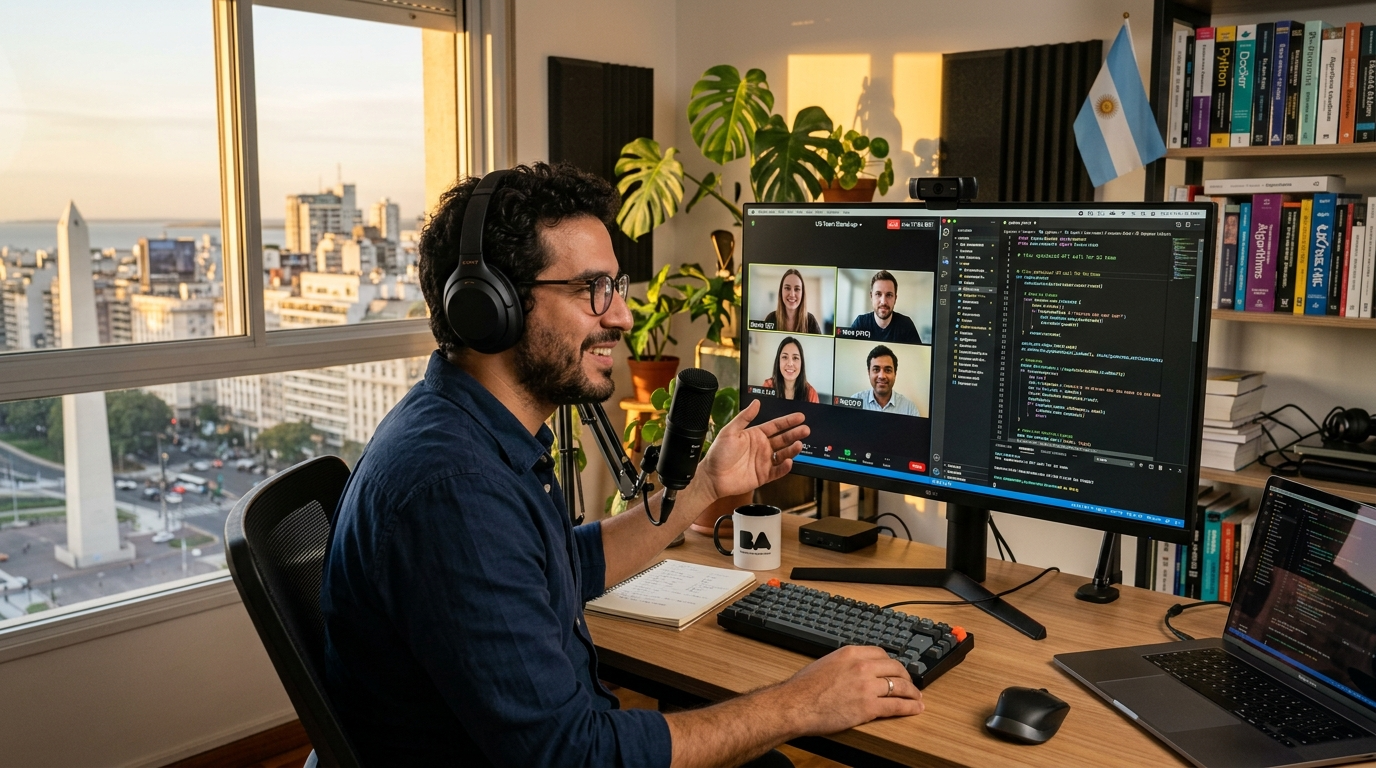
The time zone argument alone settles most debates. Buenos Aires runs UTC-3 year-round, which means a 9 a.m. standup in New York City starts at 10 a.m. in Argentina. Your engineers are online, responsive, and able to pair-program with your US team in real time — something you simply cannot replicate with an offshore team operating on a 10-to-12-hour lag. If you've ever read a detailed breakdown of how nearshore, offshore, and onshore staffing truly compare, the time zone factor is consistently the deciding variable for technical roles.
English proficiency tracks the same direction. Argentina scores higher on the EF English Proficiency Index than any other major Latin American economy, consistently landing in the "High Proficiency" band, according to Education First's EF EPI (2024). For engineering roles where documentation, PR reviews, and client-facing communication matter, that score is not a soft metric — it's a hard workflow multiplier.
What Does It Actually Cost to Hire Engineers from Argentina in 2026?
Cost is the first question every hiring manager asks, and the numbers are genuinely compelling. A mid-level software engineer in Argentina earns the equivalent of $18,000–$32,000 USD annually when engaged through a reputable nearshore staffing firm — compared to $90,000–$130,000 for a comparable US-based hire, according to compensation data published by the U.S. Bureau of Labor Statistics (2024). The savings are real, but the more important insight is what you get per dollar: a full-time, dedicated professional with a degree, strong English, and same-timezone availability.
When you work with a managed nearshore staffing provider like Rose Talent Solutions, the all-in rate is $2,500/month — flat. That covers recruiting, vetting, payroll, HR compliance, and ongoing management. There are no surprise invoices for employer taxes, benefits administration, or replacement searches. If the engineer isn't a fit, Rose replaces them at no additional cost. That's the entire risk structure: one flat number, no long-term contract, and a free replacement guarantee.
The flat-fee model matters more than most operators realize. Hourly billing from freelance marketplaces like Upwork creates scope creep — you end up micromanaging hours instead of managing outcomes. A dedicated full-time engineer who is accountable to your sprint board, your Slack, and your codebase is categorically different from a per-task contractor. If you're evaluating the cost models side by side, this comparison of onshore vs. offshore staffing costs breaks down the real total-cost-of-ownership difference.
How Argentina's Engineering Talent Compares to Offshore Alternatives in 2026
The comparison most US companies need to make is Argentina (nearshore) versus India or Eastern Europe (offshore). Each model has merit, but the tradeoffs are stark enough that the "right" answer is usually dictated by your workflow — specifically, how much synchronous collaboration your engineering work requires.
| Factor | Argentina (Nearshore) | India (Offshore) | US Domestic |
|---|---|---|---|
| Time Zone Overlap with US East | 6–8 hrs shared workday | 0–2 hrs shared workday | Full workday |
| English Proficiency (EF EPI) | High (scored top in LATAM) | Moderate–High (varies by region) | Native |
| Mid-Level Engineer Annual Cost (USD) | ~$18,000–$32,000 | ~$12,000–$22,000 | ~$90,000–$130,000 |
| Cultural Alignment with US Teams | High (Western cultural norms) | Moderate | Native |
| Typical Ramp Time | 1–2 weeks | 3–5 weeks (async lag) | 2–4 weeks |
| Contract Flexibility | Month-to-month available | Often 6–12 month minimums | At-will employment (US law) |
"Latin America has developed one of the most underutilized reservoirs of technical talent in the world. The combination of time zone alignment, improving English fluency, and strong university systems makes the region uniquely suited for integrated US team models." — Ariel Camus, CEO at Microverse (2023)
What Engineering Roles Can You Actually Fill from Argentina in 2026?
Argentina's technical depth covers a wide spectrum. The roles most commonly filled through nearshore arrangements with US companies include full-stack web developers (React, Node.js, Python), backend engineers (Go, Java, Ruby on Rails), QA automation engineers, DevOps and cloud infrastructure engineers (AWS, GCP, Azure-certified), data engineers, and mobile developers (iOS/Swift, Android/Kotlin). Argentina has a particularly strong pipeline in fintech and SaaS engineering, given that the country's own startup ecosystem — centered in Buenos Aires — has produced globally recognized companies.
Rose Talent Solutions pairs every engineer with a role-specific AI copilot trained on the tools your team already uses. If your stack includes Jira, GitHub, Confluence, or industry-specific platforms, the engineer arrives oriented — not starting from zero. You can learn more about how that works on the AI advantage page.
Argentina's engineering talent is not limited to cost-sensitive "body shop" work. The country produces export-quality engineers who contribute to product architecture, own entire microservices, and lead cross-functional squads — not just execute tickets.
The World Economic Forum ranked Argentina among the top countries in Latin America for digital skills readiness, noting a rapidly expanding cohort of engineers with cloud and AI competencies, according to the World Economic Forum Global Competitiveness Report (2024). That ranking isn't marketing language — it reflects national investment in technical education that has been compounding since the 1990s.
If you're thinking broader than just engineers — operations staff, customer support, or back-office roles — Rose's guide to hiring virtual assistants from Latin America covers the full picture of what's available across the region.

How the Hiring Process Works When You Use a Nearshore Staffing Firm in 2026
Understanding what "managed nearshore staffing" actually means in practice helps set realistic expectations. The process is faster than most US companies assume, and the ongoing management burden on your side is substantially lower than direct freelance hiring.
Role Scoping Call
Rose's team conducts a 30-minute intake to understand your stack, team structure, and the specific outcomes you need the engineer to own — not just a job description.
Candidate Matching
Rose screens from its vetted Latin American talent pool, filtering for English proficiency (8/10+ floor), technical skill alignment, and cultural fit with your team's working style.
Your Interview
You interview the shortlisted candidates — typically 1-3 people — and make the final selection. Rose handles all scheduling and pre-screening so you only see qualified matches.
Onboarding & AI Copilot Setup
Rose onboards the engineer to your tools, sets up their role-specific AI copilot, and handles all HR, payroll, and compliance administration on the Latin America side.
Ongoing Management Support
Rose stays active post-placement — if anything isn't working, they resolve it or initiate a free replacement. You manage the work; Rose manages the employment relationship.
The entire sequence from scoping call to first day typically takes under two weeks. For comparison, the average time-to-fill for a software engineering role in the US is 45 days, according to SHRM's Talent Acquisition Benchmarking Report (2024). Nearshore managed staffing compresses that timeline significantly because the candidate pool is pre-vetted and the legal/compliance infrastructure is already built.
How to Evaluate Nearshore Staffing Providers Before You Hire Engineers from Argentina
Not all nearshore staffing firms operate the same way. The two variables that separate quality providers from commodity ones are: (1) how they vet English proficiency, and (2) whether they provide ongoing HR and management support or just make the placement and disappear.
Rose Talent Solutions publishes its English proficiency floor as 8/10+ on its screening rubric — that's a specific, verifiable standard. Many providers state "fluent English" without a measurable threshold, which means your mileage varies wildly by placement. When you're evaluating providers, ask them directly: what is your English proficiency screening score, and what assessment do you use?
The second question to ask is about the replacement policy. A free replacement guarantee — not a "satisfaction guarantee" — means the provider commits to finding you another qualified candidate at no additional charge if the initial placement doesn't work out. That's Rose's model. It's the only risk reversal that actually matters in practice.
Why Managed Nearshore Staffing Works
- All-in flat fee eliminates billing surprises
- Provider handles Latin American payroll, HR, and compliance
- Pre-vetted pool cuts time-to-hire from 45 days to under 2 weeks
- Free replacement guarantee removes placement risk
- No long-term contract — cancel with 30 days written notice
Where Direct Hiring Falls Short
- You own the full recruiting and vetting burden
- Latin American employment law and payroll compliance is your problem
- No replacement safety net if the hire doesn't work out
- Freelance platforms bill hourly — scope creep is built in
- No ongoing HR management once the contract is signed
For a broader look at how Latin American staffing companies differ in structure and service model, the overview of virtual assistant companies in Latin America is a useful reference point for understanding what questions to ask before committing to a provider.
If you're ready to scope a role, the fastest path is the Rose Talent Solutions start page — the intake form takes about five minutes and routes your request directly to a matching specialist. For roles outside engineering — finance, operations, bookkeeping — Rose also covers bookkeeping and accounting staffing through the same managed, flat-fee model.
The bottom line: Argentina's engineering talent market in 2026 is deep, affordable, and structurally aligned with US business hours in a way that offshore alternatives simply are not. The only real question is whether you build the hiring infrastructure yourself or work with a provider who's already done it. For most US companies, the math on managed nearshore staffing is straightforward — and the free replacement guarantee removes the last meaningful reason to hesitate.