
Nearshore talent from Colombia has moved from a niche experiment to a mainstream hiring strategy for US, Canadian, and UK tech teams. The country's software engineering workforce has grown faster than almost any in Latin America, its developers work your business hours without alarms at 3 a.m., and the monthly cost sits well below what a mid-level US developer commands. If you're evaluating whether to hire Colombian developers in 2026, this guide answers every practical question: where the talent is, what it costs, how to vet candidates, and how a Latin America-focused staffing approach compresses your time-to-hire to days rather than months.
Why Colombia's Developer Market Stands Out in 2026
Colombia has invested heavily in STEM education over the past decade. The government's Ministry of Information and Communication Technologies (MinTIC) launched programs that trained more than 100,000 coders between 2020 and 2024 alone. Bogotá and Medellín now rank among the top five tech hubs in Latin America by developer headcount, with Cali and Barranquilla growing fast behind them.
The English proficiency picture has improved sharply. According to the EF English Proficiency Index (2023), Colombia sits in the "moderate proficiency" band and has climbed 11 positions in five years — a meaningful shift for teams that need developers who can join a standup, read a Jira ticket, and push a PR comment in English without friction.
The timezone advantage is real. Colombia runs on UTC−5 year-round — no daylight saving adjustment, no seasonal drift. For a New York team (ET) or a Chicago team (CT), that means you share nearly every working hour. For a West Coast team, Colombia is only three hours ahead — close enough for morning scrums and real-time code review. Compare that to a 10–13 hour gap with developers based in regions where async becomes the default and collaboration suffers.

How Colombian Developer Costs Compare in 2026
One of the most common questions we get is: "How much cheaper is this, actually?" The honest answer is that it depends on seniority and stack — but the savings versus US hiring are consistent. According to the U.S. Bureau of Labor Statistics (2023), the median US software developer earns roughly $127,260 per year — or about $10,600 per month in fully loaded salary alone, before benefits, payroll taxes, and recruiting overhead.
A mid-level Colombian full-stack developer working through a nearshore staffing arrangement typically costs $2,000–$4,500 per month all-in. That's a 55–80% reduction in labor cost for comparable output — and when you factor in that nearshore staffing consistently outperforms offshore models on collaboration speed and quality, the ROI calculation becomes straightforward.
| Hiring Model | Monthly Cost (Mid-Level) | Timezone Overlap (US ET) | English Proficiency | Ramp Time |
|---|---|---|---|---|
| US Onshore Developer | $8,500–$14,000+ | Full overlap | Native | 30–90 days |
| Colombian Nearshore (Rose) | $2,500 flat | Full overlap (UTC−5) | 8/10+ screened | 7–14 days |
| Offshore (large timezone gap) | $1,200–$2,500 | 2–4 hrs overlap max | Variable (unscreened) | 21–60 days |
| Freelance Marketplace | $1,800–$4,000 (project-rate) | Variable | Variable | Highly variable |
What Skills Can You Find When You Hire Colombian Developers?
The Colombian developer ecosystem is not just WordPress freelancers. The technical depth available spans the full modern stack. React, Node.js, Python, and Java are the most common, but you'll also find solid pipelines in DevOps (AWS, GCP, Terraform), mobile (Flutter, React Native), and data engineering (Spark, dbt, Snowflake). Medellín in particular has become a hub for fintech and SaaS product engineers, driven by accelerator ecosystems like Ruta N, the city's publicly backed innovation district.
"Latin America is producing some of the most motivated engineering talent in the world right now. The combination of improving CS curricula, bootcamp ecosystems, and remote-first culture has created a deep bench that most US companies are still underutilizing." — Sebastián Mejía, President & Co-founder at Rappi (2023)
According to McKinsey's State of AI Report (2023), companies that integrate AI-augmented developers into their workflows see productivity increases of 20–40% on routine engineering tasks. Rose's model builds on this directly — every team member ships with a role-specific AI copilot trained on the tools they'll actually use, whether that's a GitHub Actions workflow, a ticketing integration, or a client-facing dashboard. That's not a generic ChatGPT login; it's a purpose-built assistant that compresses ramp time from weeks to days. Learn more about how this works on Rose's AI advantage page.
If you want to understand how different virtual staffing models stack up before committing, this breakdown of onshore vs. offshore virtual assistant models gives you an honest side-by-side that applies directly to developer hiring decisions.
The hidden cost of large-timezone-gap developer hiring isn't the hourly rate — it's the 6–10 hour timezone gap that turns a 15-minute Slack clarification into a 24-hour delay. On a two-week sprint, that adds up to multiple lost days of productive output per developer.
How the Rose Hiring Process Works in 2026
Most companies that try to hire Colombian developers directly spend 6–12 weeks on job posts, technical screens, reference checks, and compliance paperwork. Rose compresses that into a predictable process that typically delivers your first candidate within a week of your intake call. Here's how it runs:
Intake Call
You describe the role, stack, communication style, and working hours. Rose maps this to the pre-vetted talent pool immediately — no weeks-long sourcing lag.
Candidate Matching
Rose surfaces 2–3 pre-screened profiles within 48–72 hours. Every candidate has already cleared English proficiency (8/10+ floor), technical assessment, and background verification.
Your Interview
You interview the shortlist. You make the call. Rose doesn't make placement decisions for you — you own the final yes.
Onboarding & AI Copilot Setup
Once selected, Rose handles payroll, HR compliance, and the role-specific AI copilot configuration. Your developer arrives ready to contribute, not learn your toolchain from scratch.
Ongoing Management
Rose manages HR, performance check-ins, and retention — you manage the work. If the placement isn't a fit, Rose replaces them at no additional cost.
The flat $2,500/month rate covers everything in that process: recruiting, vetting, payroll, HR, and ongoing management. There's no long-term contract — month-to-month terms with 30 days written notice if you need to exit. And if the team member isn't working out, the free replacement guarantee means you're not stuck with a bad hire or forced to start a new search from zero.
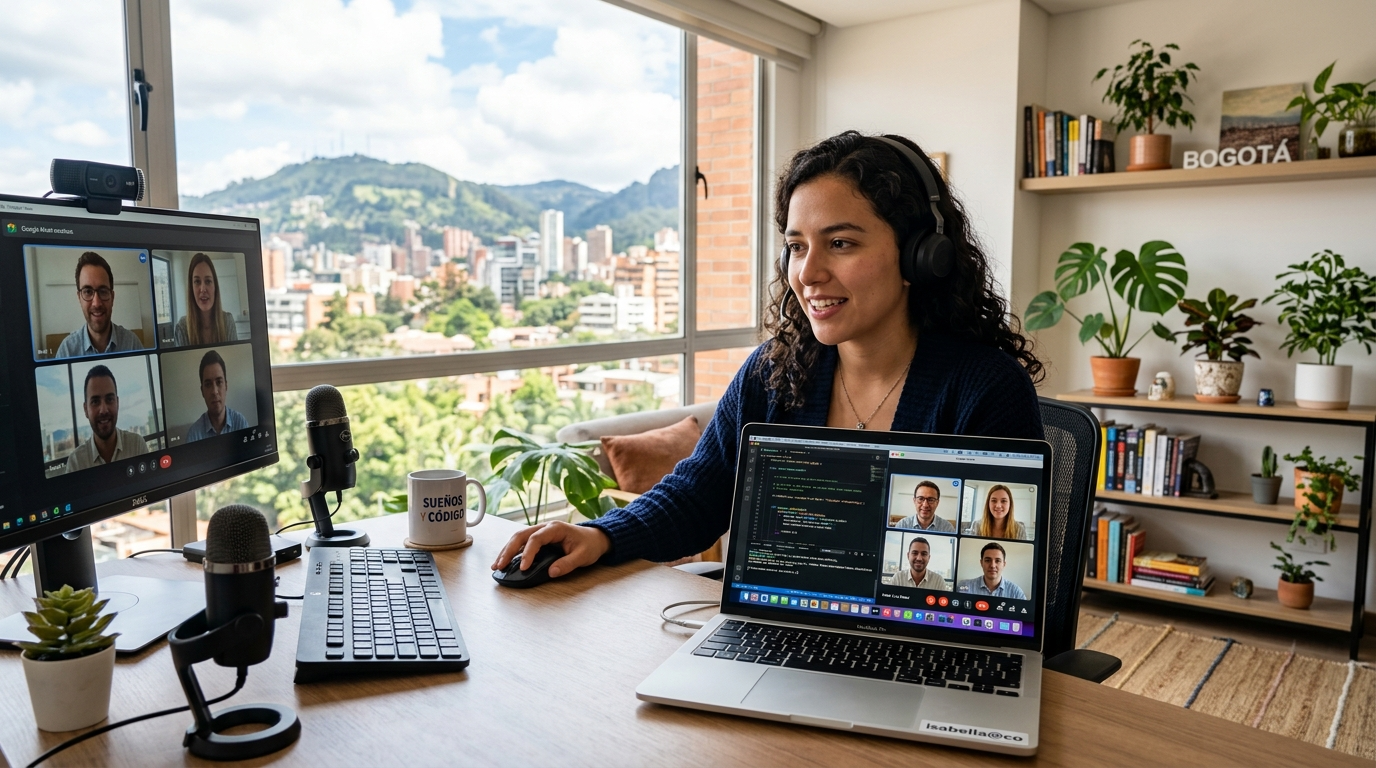
Nearshore vs. Offshore Developers in 2026: How the Trade-offs Break Down
The word "offshore" gets used as a catch-all, but it papers over a massive operational difference. When you hire a developer through a large-timezone-gap offshore model, you're buying a lower sticker price at the cost of real-time collaboration. Standups become recorded videos. PR reviews happen 18 hours after they're posted. A blocker that a nearby teammate would fix in ten minutes becomes an overnight ticket.
Nearshore development — specifically from Latin America — eliminates that tax. Your Colombian developer is online when you are, attends your morning standup live, and can hop on a Zoom call when the production bug hits at 2 p.m. ET. For a deeper look at how these models differ in practice, this overview of virtual staffing companies in Latin America covers the structural differences that matter most for US businesses.
Nearshore (Colombia) — Pros
- Full US business hour overlap, year-round
- Real-time standup and code review participation
- Cultural alignment with US product expectations
- Strong and improving English proficiency pipeline
- No DST confusion — UTC−5 is fixed
Large-Timezone Offshore — Cons
- 6–13 hour timezone gap forces async-only workflows
- Standups and reviews become recorded, delayed events
- Production incidents resolved next business day, not same day
- Variable English proficiency without formal screening
- Cultural gap on US product/UX expectations
According to SHRM's Employee Engagement Research (2023), teams that collaborate synchronously report 34% higher project satisfaction scores than those working primarily asynchronously across large timezone gaps. That's not just a morale metric — it translates directly into lower turnover and faster delivery cycles for the businesses those developers work for.
How to Evaluate a Colombian Developer Before You Hire in 2026
Technical screening for Colombian developers should follow the same rigor you'd apply to any senior hire. The difference is that a good nearshore partner has already done the first two layers for you. At Rose, every candidate clears a technical assessment for their declared stack, a structured English proficiency screen (8/10+ required — not self-reported), and a background and reference check before you ever see their profile.
When you run your own interview, prioritize three things: live coding or architecture discussion (not a take-home), a real communication scenario (ask them to explain a past production incident as if briefing a non-technical stakeholder), and a work-style conversation (async tools, documentation habits, how they handle blockers). These three lenses surface the candidates who will actually integrate into your team — not just the ones who memorize LeetCode solutions.
If you're building a broader remote operations team beyond engineering — bookkeeping, admin, customer success — Rose's bookkeeping and accounting VA service and property management staffing operate on the same vetted-nearshore model. Many clients start with one developer and expand into a fully integrated nearshore operations layer within 90 days.
The short version: if you want to hire Colombian developers in 2026 without a six-week sourcing cycle, without timezone drag, and without the compliance headache of direct cross-border employment, starting a conversation with Rose is the fastest path to your first placed engineer.